18 Ethiopian Recipes: Injera, Doro Wat & Berbere-Spiced Home Dinners
Sweat the onions dry for 30 minutes before any butter goes in — that single step is the difference between a real wat and red chicken soup.
Ethiopian recipes you can actually cook at home come down to four things: a jar of berbere, a pot of slowly sweated onions, a stack of injera (bought or improvised), and the patience to let a stew go for 90 minutes without stirring it into submission. Master those and you can put a full communal platter on the table for six people for under $25 in ingredients.
Get a free week of easy dinners
Seven weeknight dinners with the shopping list already totalled, sent Sunday. No account needed, unsubscribe in one click.
No spam, unsubscribe in one click. Recipes, shopping lists and Instacart carts all work without an account either way.
Introduction: Ethiopian food is a communal, plant-heavy revelation
Most American home cooks meet Ethiopian food in a restaurant, where a server sets down a meter-wide platter lined with injera and dotted with six or eight stews — red, gold, green, cream — and no cutlery. That format is the whole point. Ethiopian cooking is built around shared surface area rather than individual plates, and the recipes are engineered to sit next to each other rather than compete.
That structure makes it unusually easy to cook at home. There is no last-minute plating, no protein resting while a sauce breaks, no timing puzzle. Every wat (stew) on the platter improves by sitting. You can cook three of them on a Saturday, refrigerate them, and reheat on Wednesday with better flavor than day one.
It is also, by default, one of the most plant-forward cuisines in the world. The Ethiopian Orthodox calendar sets roughly 180 fasting days a year — Wednesdays, Fridays, and the long Lenten stretch — during which observant cooks eat no meat, dairy, or eggs. The result is a deep, non-apologetic vegan repertoire that was never designed as a substitute for anything. Lentils, split peas, chickpea flour, collards, and cabbage carry the plate on their own merits.
As of 2026, berbere and teff flour are both stocked at Whole Foods, most Middle Eastern groceries, and every Ethiopian market in a metro area. The barrier to entry is lower than it has ever been. What follows is the pantry, the technique that actually matters, and 18 recipes to work through.
The Ethiopian pantry: berbere, mitmita, niter kibbeh, teff flour
Four ingredients do 90% of the work. Buy all four once and every recipe below opens up.
Berbere is the red one — dried chilies, garlic, ginger, korarima (Ethiopian black cardamom), fenugreek, coriander, nigella, and warm baking spices, toasted and milled together. It is not simply "hot." Fenugreek gives it a maple-bitter back note and korarima gives it a resinous top note that no chili powder substitutes for. Budget $8–14 for 4 oz of a good blend. Start with a homemade-style smoky berbere blend if you want to see what your store blend is missing.
Mitmita is the orange one — hotter, simpler, built on bird's eye chili, korarima, cloves, and salt. It is a finishing spice, not a braising spice. It goes on kitfo, on tibs, on a wedge of injera at the table. Do not swap it for berbere; mitmita in a long braise turns acrid.
Niter kibbeh is spiced clarified butter, and it is the single ingredient that makes home cooking taste like restaurant cooking. Melt a pound of butter with sliced onion, garlic, ginger, fenugreek, cardamom, cinnamon, and a bay leaf, hold it at a bare simmer for 45 minutes until the milk solids brown and the foam subsides, then strain. It keeps three months refrigerated and takes 10 minutes of hands-on time. Every recipe below that says "butter" means this.
Teff flour is the grain — a tiny, iron-rich, naturally gluten-free grass seed with a mineral-sour flavor. It costs $6–10 per pound, which is why almost nobody makes 100% teff injera on a Tuesday.
| Ingredient | Typical cost | Shelf life | Where it goes |
|---|---|---|---|
| Berbere (4 oz) | $8–14 | 6–9 months | Every red wat, tibs, roasted vegetables |
| Mitmita (2 oz) | $6–10 | 6–9 months | Kitfo, table condiment, finishing |
| Niter kibbeh (1 lb, homemade) | ~$5 in butter | 3 months chilled | Sautéing base for everything |
| Teff flour (1 lb) | $6–10 | 6 months | Injera, blended flatbreads |
| Red lentils (1 lb) | $2 | 1 year+ | Misir wat, azifa |
| Yellow split peas (1 lb) | $2 | 1 year+ | Kik alicha |
| Chickpea flour (1 lb) | $4 | 6 months | Shiro wat |
The full pantry runs about $40 and covers a dozen dinners. That is the cheapest entry into a new cuisine you will find.
How injera works and easier substitutes for a first try
Injera is a fermented sourdough pancake roughly the diameter of a pizza, cooked on one side only, so the top stays spongy and pocked with eyes while the bottom sets smooth. The batter ferments 2–3 days at room temperature, which develops the characteristic sourness and the carbon dioxide that makes the eyes.
Three honest options, in ascending order of effort:
1. Buy it. Any Ethiopian restaurant will sell you a stack — typically five rounds for $6–9. Call ahead. This is what most Ethiopian-American households do on a weeknight, and there is no purity argument against it.
2. Blend the flour. A 50/50 teff and all-purpose batter, fermented 24 hours with a spoonful of sourdough discard, gets you 80% of the texture at 40% of the cost and a third of the wait. Our injera-style teff flatbread with spiced lentil filling uses this approach and is the right first attempt.
3. Skip it. Basmati rice is a completely reasonable base for wats. So is warm pita, lavash, or naan — injera's job is scooping, and any pliable flatbread does that job. You lose the sour counterpoint, so add a squeeze of lemon to the greens to compensate.
The one thing that does not work: a fresh, unfermented pancake batter marketed as "quick injera." Without the ferment there is no sourness and no gas, so you get a dense crepe that fights the stew instead of absorbing it.
Doro wat: the anchor dish and why it takes patience with onions
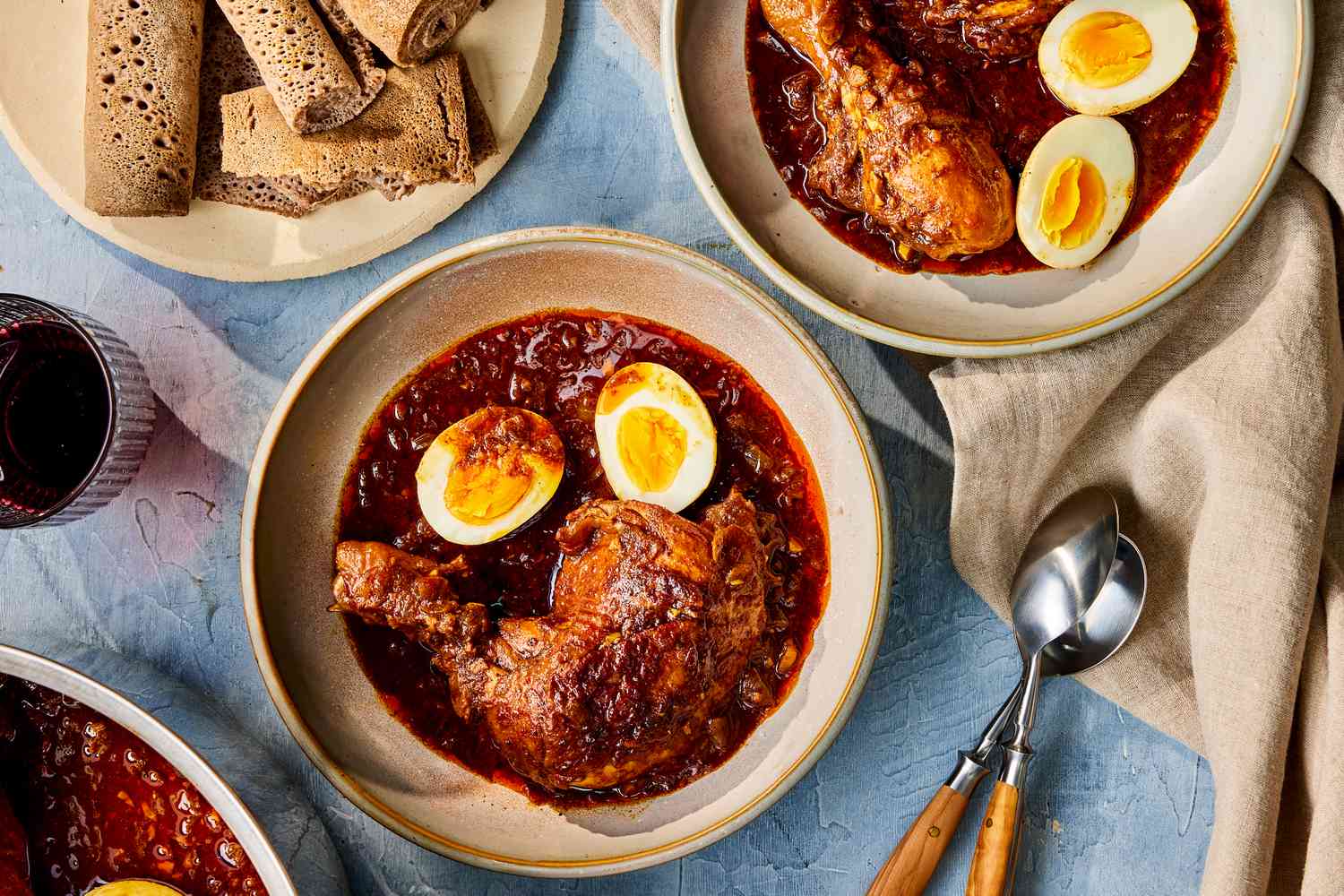
Doro wat is Ethiopia's national dish — chicken and hard-boiled eggs braised in a berbere-red onion sauce, traditionally served at holidays and to guests. It is also the dish that teaches the technique the entire cuisine runs on.
Here is the part people skip: you start with three to four pounds of finely diced red onion and no fat at all. Dry-sweat them in a heavy pot over medium-low heat for 25–35 minutes, stirring occasionally, until they collapse, release their water, cook that water off, and begin to stick and brown. Only then do you add the niter kibbeh. Adding fat at the start makes the onions fry rather than break down, and the finished sauce stays thin and separated instead of turning into the thick, glossy, almost-jammy body that defines a proper wat.
Total time is 2 to 2.5 hours, of which maybe 25 minutes is active. Our berbere-spiced Ethiopian chicken stew (doro wat) walks the full onion-first sequence, and the doro wat-style braised chicken with spiced niter kibbeh butter is a shorter weeknight adaptation that uses thighs only and finishes in about 75 minutes.
Three details that separate good from great:
- Skinless, bone-in dark meat. Skin never crisps in a wat; it just goes flabby and sheds fat into an already rich sauce. Pull it.
- Score the hard-boiled eggs. Three shallow slashes per egg before they go in for the last 15 minutes lets sauce penetrate instead of sliding off.
- Bloom the berbere in fat, not liquid. Stir it into the buttered onions for 60–90 seconds before any broth goes in. Berbere added to liquid tastes raw and dusty.
A second doro wat variation worth knowing: this slow-simmered version leans on a longer, gentler braise and produces a milder result that kids will eat.
Vegetarian wats: misir, kik alicha, gomen, and shiro
This is where the cuisine earns its reputation, and where a weeknight cook should actually start. Every dish in this section is vegan as written, costs under $5 to make, and reheats better than it serves fresh.
Misir wat — red lentils cooked down in berbere and onion until they lose all definition and turn into a dark red purée. It is the single best introduction to Ethiopian cooking: 45 minutes, one pot, pantry ingredients. Start with slow-simmered Ethiopian misir wat with berbere lentils.
Kik alicha — yellow split peas with turmeric, ginger, and garlic, and no chili at all. "Alicha" means mild; this is the gold stripe on the platter that gives every heat-averse eater somewhere to go. Simmered split pea kik alicha with turmeric and ginger takes about 50 minutes, mostly unattended.
Shiro wat — roasted chickpea (or broad bean) flour whisked into a spiced onion base until it thickens like a savory polenta. Fifteen minutes start to finish, which makes it the fastest real Ethiopian dish there is. Slow-cooked shiro wat with berbere and chickpea flour is the version to learn. Whisk constantly for the first two minutes after the flour goes in or you get lumps you will never break up.
Gomen — collard greens braised with garlic, ginger, and green chili until fully tender, no vinegar, no pork, no sweetness. American collard technique fights this dish; there is no braising liquid to speak of and no acid. Sautéed Ethiopian gomen wat collard greens gets the texture right.
Atakilt wat — cabbage, carrots, and potatoes stewed in turmeric until the cabbage goes silky. It is the mildest thing on the platter and the dish leftovers run out of first. Ethiopian atakilt wat stewed cabbage, carrots, and potatoes is a 40-minute one-pot.
If you want a single vegan pot instead of four, one-pot Ethiopian vegetable berbere stew with chickpeas folds the whole idea into one vessel.
Sides and beyond stew: tibs, kitfo (safe home version), and salads
Not everything on an Ethiopian table is a long braise.
Tibs are sautéed cubes of meat, cooked fast and hot with onion, jalapeño, and rosemary, served sizzling. They are the closest thing in the repertoire to a 20-minute weeknight dinner. Berbere-spiced Ethiopian beef tibs with sautéed vegetables uses sirloin cut into ¾-inch cubes; Ethiopian-inspired spiced chicken tibs with berbere swaps in thighs and cooks in about 18 minutes. Get the pan properly hot — 400°F surface temperature — and work in two batches, or the meat steams.
Kitfo is traditionally raw minced beef dressed with mitmita and niter kibbeh, closer to steak tartare than to anything else. The safe home version is lebleb — warmed just until the outside grays, about 90 seconds in a hot pan, which is how it is commonly ordered even in Addis Ababa. Kitfo-style spiced beef tartare with mitmita and Ethiopian butter covers both. If you serve it raw, buy whole muscle and grind it yourself the same day; do not use pre-ground supermarket beef.
Lamb and fish both belong on the platter. Slow-cooked Ethiopian lamb stew with berbere and niter kibbeh is a shoulder braise that runs about three hours. Ethiopian-inspired coffee-spiced lamb skewers with mitmita leans on Ethiopia's other famous export and takes 25 minutes on a grill pan. For a fasting-day protein, Ethiopian spiced tilapia with mitmita and lemon cooks in 12 minutes.
Cold dishes reset the palate between bites of stew. Ethiopian azifa lentil salad with mustard dressing is a sharp brown-lentil salad; ayib Ethiopian-style fresh cheese with herbs is a mild, dry, ricotta-like curd whose entire job is to cool down berbere.
18 Ethiopian recipes to cook this month
Sorted by how hard they are, not by how good they are — every one of these belongs on a platter.
Start here (under 60 minutes, pantry-only)
1. Slow-cooked shiro wat with berbere and chickpea flour — the 15-minute one.
2. Slow-simmered Ethiopian misir wat with berbere lentils — the gateway dish.
3. Simmered split pea kik alicha with turmeric and ginger — mild, gold, kid-safe.
4. Ethiopian atakilt wat stewed cabbage, carrots, and potatoes — cheapest dish here.
5. Sautéed Ethiopian gomen wat collard greens — the green stripe.
6. Ethiopian azifa lentil salad with mustard dressing — serve cold.
7. Ethiopian spiced tilapia with mitmita and lemon — 12 minutes, one pan.
8. Ayib Ethiopian-style fresh cheese with herbs — 20 minutes, mostly draining.
Weeknight mains (under 90 minutes)
9. Ethiopian-inspired spiced chicken tibs with berbere
10. Berbere-spiced Ethiopian beef tibs with sautéed vegetables
11. Ethiopian-inspired coffee-spiced lamb skewers with mitmita
12. One-pot Ethiopian vegetable berbere stew with chickpeas
13. Doro wat-style braised chicken with spiced niter kibbeh butter
Weekend projects
14. Berbere-spiced Ethiopian chicken stew (doro wat) — the full 2.5-hour version.
15. Doro wat Ethiopian spiced chicken stew — the milder long braise.
16. Slow-cooked Ethiopian lamb stew with berbere and niter kibbeh
17. Kitfo-style spiced beef tartare with mitmita and Ethiopian butter
18. Injera-style teff flatbread with spiced lentil filling — plan two days ahead.
And if you want to finish the meal the way it is finished in Ethiopia, brew a pot of coffee-ceremony Ethiopian spiced coffee.
Building an Ethiopian meal spread for 4-6 people
The template that works for six people, with about four hours of total elapsed time and 90 minutes of hands-on work:
| Slot | Dish | Make-ahead | Active time |
|---|---|---|---|
| Anchor stew | Doro wat | Up to 3 days | 30 min |
| Red vegan wat | Misir wat | Up to 4 days | 15 min |
| Mild vegan wat | Kik alicha | Up to 4 days | 15 min |
| Green | Gomen | Up to 2 days | 15 min |
| Cabbage | Atakilt wat | Up to 3 days | 10 min |
| Fast protein | Beef or chicken tibs | Cook to order | 20 min |
| Cold/cooling | Ayib or azifa salad | Up to 2 days | 10 min |
| Base | Injera (bought) or basmati | Day of | 5 min |
The schedule. Saturday: make niter kibbeh, then the four vegan wats back to back in the same pot, wiping between. Sunday morning: doro wat. Sunday evening: tibs to order, plate everything, eat.
Portioning. Figure ¾ cup of each stew per person across five stews — that is roughly 4 cups total per eater, which sounds like a lot until you remember the injera absorbs half of it. Two rounds of injera per person.
Plating. Line a large round tray or platter with overlapping injera. Ladle each stew into its own quadrant or wedge, keeping them separate rather than mixing. Roll extra injera into cigars and stack them along one edge. No serving spoons at the table — the injera is the utensil.
Drinks. Tej (honey wine) if you can find it, an off-dry Riesling if you cannot. High-alcohol IPAs fight berbere badly; a lager or a Belgian wheat works much better.
Kitchen equipment: a wide skillet, a large pot, and a spice grinder
You need surprisingly little, but the three things you need, you really need.
A 12-inch heavy skillet. Tibs demand real heat retention and enough surface area to sear a pound of cubed beef in two batches without crowding. Cast iron or a heavy carbon-steel pan beats nonstick here — you want fond. Browse cookware for a skillet in the 12-inch range; anything smaller forces three batches and the meat stews.
A 5–7 quart heavy pot with a lid. Doro wat starts with three to four pounds of raw diced onion, which is a genuinely enormous volume before it collapses. A 4-quart pot overflows. An enameled Dutch oven is ideal because the long dry-sweat needs even, gentle heat that thin stainless will not give you.
A dedicated spice grinder. Berbere and mitmita are dramatically better freshly milled, and korarima pods have to be cracked and ground. Buy a second blade grinder and use it only for spices — coffee oils contaminate everything. See small appliances for inexpensive options; a $20 blade grinder is entirely adequate.
Nice to have, not required: a fine-mesh strainer and cheesecloth for straining niter kibbeh and draining ayib (check utensils), and a wide nonstick or well-seasoned crepe pan if you commit to making your own injera. A traditional mitad — the clay griddle — is beautiful and completely optional.
Storage matters more than usual. You are making five stews at once, so you need five containers. Wats hold 4–5 days refrigerated and freeze for three months with no texture loss; the lentil and split-pea ones actually improve. Glass containers from storage are worth it here because berbere stains plastic permanently orange.
Common pitfalls
- Rushing the onions. This is the number-one failure. If your wat tastes thin and sharp instead of deep and round, you sweated the onions for 12 minutes instead of 30.
- Using chili powder as berbere. Chili powder is cumin-and-oregano forward. Berbere is fenugreek-and-cardamom forward. The substitution produces something that tastes like unseasoned Tex-Mex.
- Adding berbere to liquid. Always bloom it in fat first. Sixty seconds. Otherwise it stays gritty and tastes dusty through the whole braise.
- Salting the lentils too early. Red lentils salted at the start take 25% longer to break down. Salt at the end.
- Serving everything sizzling hot. Ethiopian stews are meant to be warm, not scalding — the flavors read better at about 140°F, and you can eat with your hands.
FAQ
What is berbere and where do I buy it?
Berbere is Ethiopia's signature spice blend — dried chilies, garlic, ginger, korarima (Ethiopian cardamom), fenugreek, coriander, and warm baking spices. Buy it from an Ethiopian grocery, Penzeys, Burlap & Barrel, or Whole Foods; Amazon sells credible blends too. If you can't find it, mix 3 tbsp smoked paprika, 1 tbsp cayenne, 2 tsp coriander, 1 tsp cardamom, 1 tsp fenugreek, 1 tsp ginger, and 1 tsp allspice for a workable stand-in.
Do I have to make injera from teff?
The traditional version is 100% teff flour, naturally gluten-free but expensive and slow (2–3 day ferment). A common shortcut uses half teff, half all-purpose or brown rice flour with a sourdough starter or club soda to imitate the tang and bubble. For a first Ethiopian dinner, buy injera from a local Ethiopian restaurant (~$8 for 5) and focus your effort on the wats — nobody at the table will notice.
Is Ethiopian food good for vegetarians and vegans?
Exceptionally so. Wednesday and Friday are traditional fasting days in the Ethiopian Orthodox calendar, meaning half the classical recipe repertoire is naturally vegan — no meat, dairy, or eggs. Misir wat, kik alicha, shiro, gomen, and atkilt served together on injera make one of the most satisfying vegan meals in world cuisine. Bring a mixed platter to a plant-based dinner party and expect converts.
How spicy is berbere and can I dial it down?
Berbere ranges from medium to serious depending on how much cayenne the blend uses. For family cooking, start with half the recipe amount, taste after 20 minutes of simmering, and add more. Doubling the caramelized onions in doro wat also mellows the heat naturally. Kids and heat-averse eaters do great with the alicha (mild, turmeric-forward) versions — kik alicha and doro alicha use no chili at all.
What do I eat this with if I can't get injera?
Basmati or jasmine rice works fine as a stand-in — the wats are richly saucy and want a neutral starch. Warm pita, naan, or lavash also work for scooping, since injera's function is to scoop. Long-term, learning a half-teff injera is worth it: the sour-sponge texture is genuinely different and defines the meal. AislePrompt's shopping list flags teff flour if it's not stocked at your local store.
Sources
- Serious Eats — Doro Wat on the onion-first braising sequence and berbere blooming.
- Saveur — Injera on teff fermentation timing and blended-flour shortcuts.
- Bon Appétit — Misir Wat on red-lentil texture and salting order.
Related reading: 22 South Indian recipes, 18 Egyptian recipes, and 20 Persian recipes.
Frequently asked questions
What is berbere and where do I buy it?
Do I have to make injera from teff?
Is Ethiopian food good for vegetarians and vegans?
How spicy is berbere and can I dial it down?
What do I eat this with if I can't get injera?
Sources
Plan a week of meals in two minutes.
Tell our AI what you have and what you like — it builds your plan, shopping list, and Instacart cart. No account needed.
Try free →