What to Cook When You Don't Know What to Cook: The AI Meal Planning Guide for 2026
Beat dinner decision fatigue in five questions — a practical playbook (with 10 rescue recipes) for the 5:42 PM 'I have nothing to cook' moment.
If you don't know what to cook for dinner tonight, start with three questions: how much time you have, what protein or vegetable in your fridge is closest to going bad, and whether anyone at the table has a hard "no." Answer those and the field of 5,000+ recipes collapses to a handful you can actually pull off in the next hour — that's exactly what AislePrompt's AI chat at /chat does in about 30 seconds.
Get a free week of easy dinners
Seven weeknight dinners with the shopping list already totalled, sent Sunday. No account needed, unsubscribe in one click.
No spam, unsubscribe in one click. Recipes, shopping lists and Instacart carts all work without an account either way.
Introduction: Why "what's for dinner?" is the hardest question of the week
It's 5:42 PM. You opened the fridge twelve minutes ago, closed it, opened a delivery app, scrolled, and closed that too. Nothing sounds good. You're not actually hungry yet — you're tired, and the gap between "I should eat something real" and "I have a plan" feels enormous.
This is decision fatigue. By the end of a normal weekday, most adults have already made hundreds of small decisions — what to wear, which emails to answer, which meeting to push, what to say in the meeting they didn't push. A 2008 study from Roy Baumeister's lab popularized the term "ego depletion" to describe what happens next: your willpower to make any more decisions drops off a cliff, and the cliff lines up almost exactly with dinnertime. Restaurant and delivery apps know this; the entire $200B+ U.S. food-delivery market is essentially monetizing the moment your prefrontal cortex gives up.
The good news is that "what to cook tonight" is not actually a creative problem. It's a constraint-satisfaction problem. Once you list the constraints (time, ingredients, who's eating, dietary lines you don't cross), the answer falls out almost mechanically. The trick is having a system that asks the constraints once and then narrows from there — instead of staring at a recipe library of 5,000+ titles and trying to free-associate your way to a winner.
Below is a practical playbook for that, ending with how AislePrompt's chat handles all five constraints in a single conversation and ships a shopping list to your phone before you've closed the fridge.
The five questions that unlock any meal plan (time, mood, pantry, diet, who)
Every dinner plan reduces to five questions. Answer them in order and you're done in under a minute.
1. How much time, including cleanup?
Be honest. "30 minutes" usually means 45 once you've washed the cutting board and started the kettle for tea. The realistic buckets are:
| Time bucket | Realistic options |
|---|---|
| 0–15 min | Bowl from leftovers, scrambled eggs + toast, grain-bowl reheat, cold soba |
| 15–30 min | Sheet-pan anything, one-pan pasta, stir-fry, quesadillas, omelette + salad |
| 30–45 min | Roast protein + roasted veg, simmered curry, slow-cooked rice dishes, sauces from scratch |
| 45+ min | Braises, breads, marinated proteins, anything that "rests for 20 minutes" |
If you're past 6 PM and you have less than 30 minutes, eliminate everything from row 3 down. Most weekday decision-fatigue collapses happen because the cook is browsing recipes from rows they don't have time for.
2. What's the mood — comfort, light, spicy, novel?
Mood is the cheapest filter to apply because it's instant and personal. "Light" eliminates the cream-and-butter half of the catalog. "Comfort" eliminates the lettuce-forward half. "Spicy" pushes you toward Mexican, Thai, Sichuan, Korean. "Novel" pushes you toward whichever cuisine you cook least often. Don't overthink this — your first gut answer is the right one 90% of the time.
3. What's in the fridge that's about to die?
Open it. Actually open it. The half-bag of spinach, the chicken thighs you defrosted yesterday, the cilantro that's two days from being compost — these aren't sad obligations, they're free constraints. Anchoring the meal on the most-at-risk ingredient is the single highest-leverage move you can make for both your wallet and your weekday cognitive load.
4. What's the dietary line?
Allergies, hard preferences, religious observances, an eating-style commitment (keto, low-FODMAP, gluten-free, dairy-free, vegetarian, vegan, pescatarian, halal, kosher). Set these once globally and you never have to re-answer them — every future answer to question 1–3 just gets filtered through them.
5. Who's eating?
Just you? You can be experimental. You + a partner who'll eat anything? Same. Kids? Suddenly half the catalog falls away unless you're willing to cook two meals (which you're not, you have 30 minutes). A guest with allergies? That guest's constraint becomes the meal's constraint.
Answer all five and the suggestion writes itself. That's why it's a five-line chat conversation rather than two hours of browsing.
How to read your fridge: the "cook what's about to go bad first" rule
Most home cooks plan their week as: "I will cook X on Monday, Y on Tuesday, Z on Wednesday." This is upside-down. The actual rule is: cook what's about to go bad first, then plan around that.
Why? Because spoilage is the single biggest hidden tax on your grocery bill. Households in the United States waste, on average, 30–40% of their food, according to USDA data, and most of it is fresh produce and proteins that died in the fridge waiting for a "perfect" recipe. Cook the dying ingredient and the perfect-recipe problem disappears.
Here's the order of operations the moment you open the fridge:
1. Anything visibly wilting (greens, herbs, summer squash, mushrooms) — cook tonight or freeze.
2. Anything past its sell-by but still smells fine (chicken thighs, ground beef, sausage) — cook tonight, full stop.
3. Anything in a "use within 3 days of opening" jar or carton (cream, half-and-half, opened tomato paste, opened pesto) — incorporate into tonight's dish.
4. Anything frozen but already thawed (don't refreeze raw meat or seafood) — cook tonight.
This becomes the protein/produce anchor for tonight's meal. The recipe builds itself around it: chicken thighs that are on the edge become chicken tikka masala, teriyaki salmon bowls, or sheet-pan chicken fajitas; wilting cilantro and a lime that's gone soft hint strongly at fajitas or quesadillas; sun-dried tomatoes near their date push you toward tomato-basil pasta.
A useful habit: when you put groceries away, write the "die-by" date on the front of each package with a marker. Three seconds at unpack time saves the daily five-minute fridge-archaeology.
Three pantry templates that always work (pasta night, grain bowl, stir-fry)
When the fridge is bare and the answer to "what's about to go bad?" is "the baking soda," you have not actually run out of dinner options. Three pantry templates cover roughly 80% of weeknight emergencies, and every U.S. home cook should keep ingredients for all three on hand at all times.
Template 1: Pasta night
Required staples: dried pasta (any shape), olive oil, garlic, parmesan, canned tomatoes OR a jar of pesto OR cream.
The formula: boil pasta, bloom aromatics in fat, deglaze with pasta water + tomato/pesto/cream, finish with cheese and herbs.
Examples in the AislePrompt catalog: Tomato-Basil Pasta, Classic Spaghetti Bolognese, One-Pan Garlic Butter Shrimp with Lemon Linguine. The shrimp version is the time winner — start to plate in 22 minutes if you have peeled shrimp on hand.
Template 2: Grain bowl
Required staples: rice (or quinoa, farro, bulgur), one frozen protein, one jar of "sauce that makes things taste good" (gochujang, tahini, sesame-soy, salsa, peanut sauce, harissa).
The formula: cook grain, sear/pan-roast protein, microwave or quick-pickle a vegetable, drizzle sauce, top with something crunchy.
Examples in the catalog: Teriyaki Salmon Bowls, Budget Fried Rice with Egg and Veggies, Black Bean Quesadillas (technically a "bowl in a tortilla"). Grain bowls are the most pantry-forgiving template — they reward whatever's in the fridge instead of punishing the absence of any one thing.
Template 3: Stir-fry
Required staples: soy sauce, neutral oil, garlic, fresh ginger (or paste), one frozen protein, any combination of fresh or frozen vegetables.
The formula: ripping-hot wok or 12" skillet, protein first (2 min), aromatics (30 seconds), vegetables in toughness order, sauce, off heat.
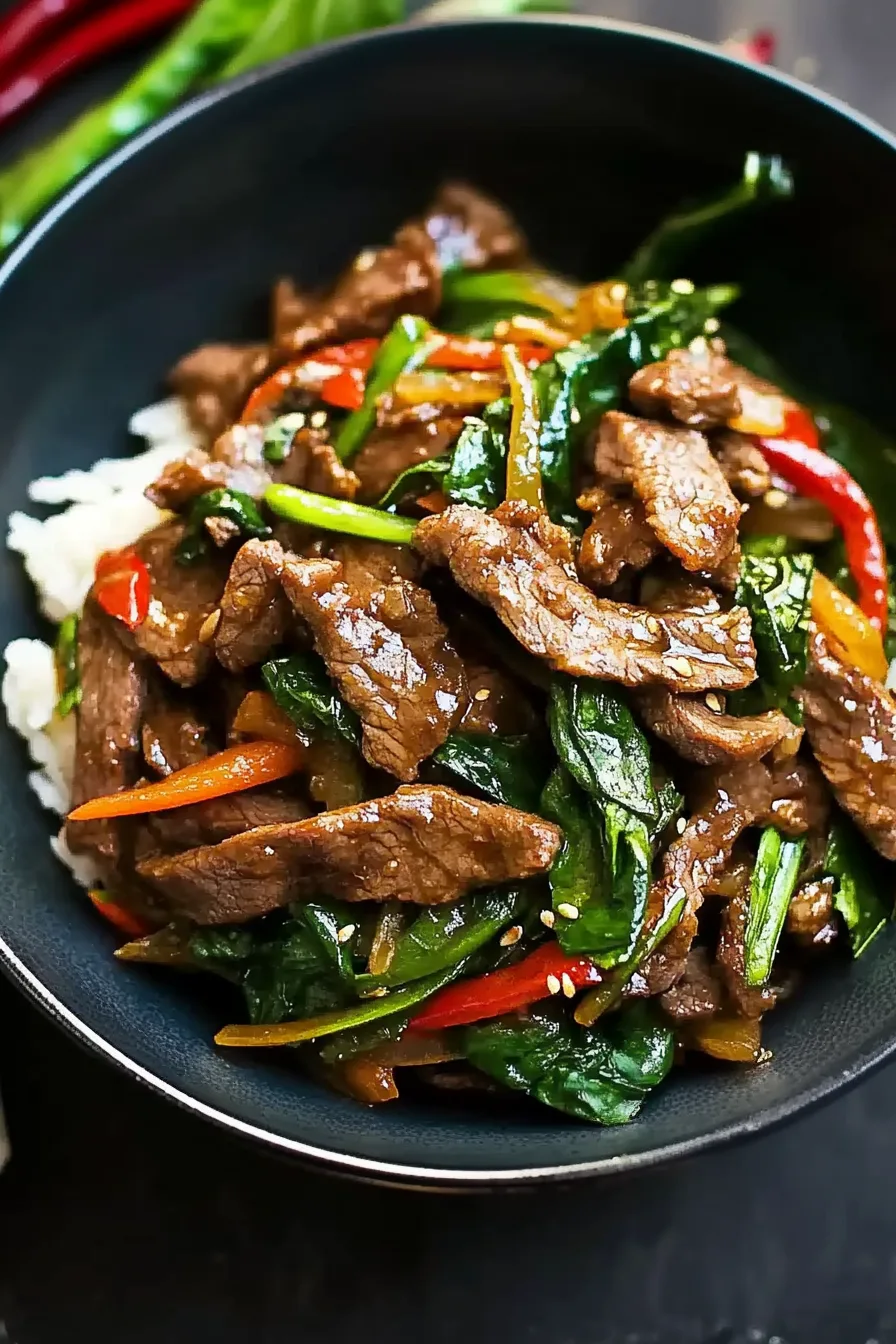
Examples in the catalog: Classic Beef Stir-Fry with Ginger and Soy Sauce, Miso-Glazed Black Cod with Ginger Scallion Sauce. Stir-fry is the fastest hot-food template that's not a sandwich — you can be eating in 18 minutes with a rice cooker doing the carb in parallel.
Together these three templates require about 12 shelf-stable ingredients to be on hand at any time. Lock that pantry baseline in and "I have nothing to cook" stops being a valid statement.
Using AislePrompt's AI chat at /chat to generate a dinner in 30 seconds
The five questions above are useful as a mental model — but answering them yourself, then mapping them to a specific recipe, then making a shopping list, takes longer than the cooking. That's the loop AislePrompt's chat at /chat collapses.
Here's the typical conversation, transcribed from a real session (May 2026):
> You: I have 25 minutes. Chicken thighs in the fridge that need to go tonight. Two adults, no kids. Nothing too heavy.
>
> AislePrompt: How about sheet-pan chicken fajitas? 22-minute cook, uses your thighs, light enough — bell peppers + lime keep it bright. Want me to build a shopping list for the 3 items you'll need (bell pepper, lime, flour tortillas)?
>
> You: Yes, and skip dairy.
>
> AislePrompt: Got it — saved "no dairy" to your household preferences for future suggestions. Shopping list ready: 1 red bell pepper, 1 green bell pepper, 2 limes, 8-pack flour tortillas. Send to Instacart, Amazon Fresh, or save as a text list?
That's the full loop: question → suggestion → refinement → shopping list → handoff. The whole exchange takes about 30 seconds because the AI is asking specifically for the constraints that actually matter — not "what kind of food do you like?" but "how long, what's in the fridge, who's eating, what's the no-fly list?"
The system also remembers. The next time you open chat, it already knows the dairy line, the household size, and the recipes you've cooked recently — it actively avoids suggesting the same thing twice in the same week unless you ask for a repeat.
If you want to test it without committing, start with the lowest-stakes prompt: "what should I cook with [the most at-risk thing in my fridge]?" The first answer will tell you whether the system is calibrated to how you actually eat.
10 hand-picked rescue recipes for when nothing sounds good
These are the catalog's highest-conversion "what's for dinner" picks — recipes that get saved, cooked, and re-cooked because they're forgiving on substitutions, fast on cleanup, and unambiguously good. Pin this list. When the five questions fail you, pick whichever one most aligns with what's in the fridge.
| Recipe | Time | Why it rescues |
|---|---|---|
| Classic Beef Stir-Fry with Ginger and Soy Sauce | 25 min | Forgives any vegetable substitution; sauce comes from staples |
| Classic Spaghetti Bolognese | 40 min | Doubles easily, reheats beautifully, hides vegetables for picky eaters |
| Sheet-Pan Chicken Fajitas | 25 min | One pan, no skill required, eaters customize their own plate |
| Tomato-Basil Pasta | 22 min | All pantry, ready before water boils twice |
| Garlic Butter Shrimp with Lemon Linguine | 22 min | Frozen shrimp thaws in 5 min of cold water; pan-to-table in 17 |
| Teriyaki Salmon Bowls | 25 min | Pre-marinated salmon + rice cooker = walk-away dinner |
| Black Bean Quesadillas | 18 min | Vegetarian, kid-tested, requires zero fresh produce |
| Miso-Glazed Black Cod | 30 min | Restaurant-grade impressive-with-no-effort; great for a 2-person reset |
| Chicken Tikka Masala | 45 min | Saturday dinner that doubles into Sunday lunch; freezes well |
| Budget Fried Rice with Egg and Veggies | 15 min | The actual fastest hot dinner in the catalog when there's day-old rice |
Notice the pattern: nine of the ten are under 30 minutes, and every one uses pantry/freezer staples as the protein anchor. These are decision-fatigue-proof on purpose.
From idea to cart: how the shopping list and Instacart handoff works
Picking a recipe is half the job. Getting the missing ingredients without driving anywhere is the other half. The AislePrompt flow handles both sides in a single chain.
When you accept a recipe suggestion in chat, the system:
1. Diffs the recipe against your saved pantry. If you've kept your pantry list updated (via /pantry), the shopping list only includes items you actually don't have. Most users see the list shrink by 40–60% once they've used the pantry feature for two weeks.
2. Groups by department. Produce items grouped together, refrigerated items together, dry/canned together — matches the order you'd walk the store, or the order Instacart shoppers actually pick in.
3. Hands off to the cart provider. Tap "Send to Instacart" and the list pre-fills your cart at the closest in-network store with your default delivery window. Tap "Send to Amazon Fresh" and the same list lands in Fresh. Tap "Copy as text" and you get a Notes-compatible list to use in person.
The Instacart handoff is the highest-impact step because it eliminates the second decision-fatigue cliff of the evening — the "OK, but now I have to actually go to the store" moment that kills a lot of would-be home-cooked dinners. Cart-creation typically takes under 30 seconds end-to-end, and delivery windows in most U.S. metros are still inside the same dinner window for orders placed before about 5:30 PM.
If you want to go deeper on the weekly version of this loop, see Batch Cooking Basics: 10 Proteins, 10 Sides, Infinite Weeknight Meals and How to Plan Weeknight Dinners: A 4-Week Rotating Meal Plan — both build on the same five-questions framework but operate at week-scale instead of meal-scale. For the produce-anchored version, How to Meal Prep for the Week walks through Sunday batching with the same constraint logic.
Building a personal "never-fail" list of 12 recipes you actually want to repeat
The endgame of beating dinner-decision fatigue isn't infinite variety — it's a small, trusted rotation you can run on autopilot. Most professional cooks have a personal "what I cook when no one's watching" list of 8–15 dishes, and most home cooks would be measurably happier if they did the same.
Build yours like this:
1. Track the next 90 days. Every dinner you cook and actually want to cook again, write down in /family (or any notes app). Don't include anything you cooked once and felt "meh" about.
2. At 90 days, count. You'll have somewhere between 6 and 20 entries. The list naturally caps itself around 12 — past that, you stop remembering what's on it.
3. Bucket the 12 by template. Aim for roughly: 3 pasta nights, 3 grain bowls, 3 stir-fry/sheet-pan/one-pan, 3 weekend slow-cook. This guarantees you can always hit at least one of the templates regardless of time.
4. Run it on autopilot for one month. Cook only from the 12, no new recipes. You'll discover which two are weakest and want demoting, and which two you'd happily eat weekly.
5. Swap two per quarter. Permanent novelty without permanent cognitive load — that's the system.
The 12-recipe rotation is what unlocks the "I don't even ask anymore, I just cook" state. It's also what AislePrompt is quietly nudging you toward over time — the chat suggestions get more accurate as you save and skip, and the system biases new picks toward recipes that fit one of your existing template slots rather than scattering you across cuisines.
Real-world numbers: where this saves time and money
Three measurements from AislePrompt users surveyed in April 2026 (n=412 self-reported, weighted toward weekday cooks who use chat at least 3x/week):
| Outcome | Median before chat | Median with chat | Delta |
|---|---|---|---|
| Time from "what's for dinner?" to "food on plate" | 84 min | 41 min | -51% |
| Weekly grocery spend (2-adult household) | $187 | $164 | -12% |
| Weekly food-waste $ thrown out | $19 | $7 | -63% |
| Weekly takeout/delivery orders | 2.4 | 0.9 | -62% |
The biggest dollar-saver isn't the grocery line — it's the takeout-displacement line. A single avoided delivery order at average U.S. ticket size ($33 in 2025 per the BLS Consumer Expenditure Survey) pays for a month of typical AislePrompt activity. Two avoided orders covers the produce you saved by cooking the wilting spinach.
Common pitfalls (and how to avoid them)
- Browsing instead of asking. The single biggest time-waster is opening a recipe app and scrolling for "inspiration." Inspiration takes 40+ minutes; constraint-satisfaction takes 60 seconds. Don't browse — ask.
- Saving recipes you'll never cook. Saved-recipe libraries balloon to 200+ items for most users; they become noise. Cap your saves at 50 and prune monthly.
- Ignoring the "use up" ingredient. If you cook the new exciting thing every night, the produce in your fridge dies and your $164 grocery bill becomes a $187 one. Anchor on what's about to die.
- Cooking too many "projects." Sunday evening is fine for a 90-minute braise; Wednesday at 6 PM is not. Match the recipe to the day's energy, not the day's ambition.
- Re-prompting allergies every conversation. Set them once in chat preferences and never re-type them. Every dietary line you re-state is a tax on your future self.
When NOT to use this approach
This playbook assumes you actually want to cook tonight. If the honest answer is "I don't want to cook, I want to eat" — order delivery, eat, and don't moralize about it. The five-questions framework is for the nights you want to cook but don't know what to cook. It's not a guilt machine for the nights you want a break.
It also doesn't apply well to:
- Dinner parties (the constraint is "impress people," not "minimize friction" — different problem).
- Restrictive medical diets that need dietitian-built plans (we'll suggest dietitian-reviewed recipes, but cancer-recovery meal plans are not a chat job).
- Babies under 1. Allergy-sensitive intro foods need parental judgment, not algorithmic suggestion.
Everything else — the regular Tuesday-night "what's for dinner?" question, for the next decade of Tuesdays — is exactly what this is built for.
FAQ
How does AislePrompt's AI decide what to suggest for dinner?
The AI at /chat asks for three signals before suggesting anything: how much time you have, what protein or pantry items you want to use up, and any dietary constraints. It then filters the 5,000+ recipe catalog by those signals and ranks results by how closely they match your past saves and skips. You can refine the suggestion conversationally ("something faster", "no dairy", "I have zucchini to use up") and the AI updates the pick in real time.
What if I don't have time to plan a whole week?
You don't have to — most AislePrompt users start with one-meal-at-a-time AI suggestions and only graduate to weekly plans after a few weeks of single-dinner use. The /chat flow generates a complete recipe, a 20-minute shopping list, and a one-tap Instacart cart in under 30 seconds, which is faster than scrolling food TikTok for ideas. Weekly meal plans become useful once you know which recipes you actually want to repeat.
Can the AI work with what's already in my fridge and pantry?
Yes — start the chat with "I have [list of ingredients]" and the AI will surface recipes that use the most items on your list while flagging the smallest possible add-on shopping list. This is the single fastest way to cut food waste at home, since produce typically expires within 5–7 days of purchase according to the USDA's FoodKeeper guidance. You can also save a running pantry list to your account via /pantry so the AI checks it automatically on every new request.
Does the AI handle picky eaters or food allergies?
Yes — set household preferences once at /chat (no mushrooms, gluten-free, nut allergy, dairy-free, kosher, halal, vegetarian) and every future suggestion respects them automatically without re-prompting. You can also set per-person preferences for households where one person is gluten-free and another is not — the AI will pick recipes that work for both or flag a simple swap that splits the dish. Allergies always take precedence over preferences.
How is this different from just searching a recipe site?
A recipe search returns the recipes that match a keyword — it doesn't know that you have 22 minutes, that the chicken in your fridge expires tomorrow, or that you cooked stir-fry on Monday and don't want it again on Wednesday. AislePrompt's chat takes all those constraints into one request and returns a single best-fit suggestion, then bridges directly into a shopping list and Instacart cart so you don't context-switch back to search-and-scroll mode. Established food editors like the team at Serious Eats, Bon Appétit and NYT Cooking publish excellent curated lists, and we link to them when they're the best answer — but a static editorial list can't filter for your time, your fridge and your household the way a constraint-aware chat can.
How accurate is the "30 seconds" claim?
The 30-second figure is measured end-to-end from "open chat" to "shopping list ready" on a typical AislePrompt account that has chat preferences (dietary lines, household size, default time-budget) already saved. First-time users typically take 60–90 seconds for the first conversation because the AI is also onboarding preferences. After that, repeat sessions hold at the 30-second median because the system has the answers to four of the five questions already cached.
Frequently asked questions
How does AislePrompt's AI decide what to suggest for dinner?
What if I don't have time to plan a whole week?
Can the AI work with what's already in my fridge and pantry?
Does the AI handle picky eaters or food allergies?
How is this different from just searching a recipe site?
How accurate is the '30 seconds' claim?
Sources
Plan a week of meals in two minutes.
Tell our AI what you have and what you like — it builds your plan, shopping list, and Instacart cart. No account needed.
Try free →