20 Moroccan Recipes: Tagines, Couscous & Harissa-Spiced Weeknight Bowls
Tagines, harira and harissa-spiced bowls you can cook on a Tuesday — and why a Dutch oven does the same job as the clay pot.
Affiliate disclosure: AislePrompt may earn a commission on qualifying purchases made through Amazon and Instacart links in this article, at no additional cost to you. See our affiliate policy →
Easy Moroccan dinners come down to one spice blend and one pot. Ras el hanout, cumin and a spoonful of harissa turn chicken thighs, chickpeas or ground lamb into a tagine-style braise in 30 to 45 minutes, and a Dutch oven does everything a clay tagine does. Below are 20 tested Moroccan recipes grouped by protein, with times, a 3-day plan and one shopping list.
Introduction: the Moroccan spice box (ras el hanout, cumin, paprika, cinnamon, preserved lemon, harissa)
Moroccan cooking is built on warm spices, not heat. The flavor comes from layering sweet spice (cinnamon, ginger, allspice) against savory spice (cumin, coriander, paprika), then finishing with something sharp — preserved lemon, olives, or a squeeze of fresh citrus. Get those three moves right and almost every recipe on this page works.
Six pantry items cover roughly 90% of the seasoning in this roundup. As of 2026, all six are stocked in mainstream US supermarkets; only preserved lemon still occasionally requires a specialty aisle.
| Pantry item | What it does | Typical US price | Shelf life after opening |
|---|---|---|---|
| Ras el hanout | The all-in-one warm-spice backbone (10–30 spices) | $7–11 / 2 oz jar | 12 months, dark cupboard |
| Ground cumin | Earthy savory base in every tagine and couscous | $3–5 / 2 oz | 12 months |
| Sweet paprika | Color and gentle sweetness, not heat | $3–6 / 2.5 oz | 12 months |
| Harissa paste | Chili, garlic, caraway — the only real heat source | $5–9 / 6 oz tube or jar | 6 weeks refrigerated |
| Preserved lemons | Salty-floral acid that survives a 2-hour braise | $8–12 / 12 oz jar | 6 months refrigerated |
| Cinnamon (stick + ground) | Sweet edge against lamb, apricots and prunes | $4–7 | 24 months whole |
Add whole cumin seed, saffron threads if your budget allows (about $8–15 per gram), and a bag of dried apricots or prunes. Total first-time pantry spend runs $45–60; restocking is closer to $12 a month.
Three technique notes that matter more than any single ingredient:
Bloom your spices in fat, never in liquid. Ground spices are fat-soluble. Thirty to sixty seconds of ras el hanout and cumin in hot olive oil, before any liquid hits the pot, roughly doubles the perceived spice intensity for the same quantity. Dumping the spice into simmering broth is the single most common reason a homemade tagine tastes flat.
Preserved lemon is a rind ingredient. Scrape out and discard the salty pulp; slice the rind thin. The pulp is mostly brine and will oversalt a braise that has already reduced for 90 minutes.
Harissa goes in late or on the side. Its chili and caraway aroma degrades over a long simmer. Stir it in during the last 10 minutes, or serve it in a small bowl at the table. Serious Eats — Moroccan recipes covers the spice chemistry and toasting sequence in more depth if you want the food-science version.
When a tagine is right (and when a Dutch oven does the same job)
A traditional tagine is a shallow earthenware base with a tall conical lid. The cone condenses steam and returns it to the food, which lets you braise with very little added liquid over low heat — a real advantage on a charcoal brazier, which is what the design was built for.
On a US kitchen range with a heavy Dutch oven, that advantage mostly disappears. Here is the honest comparison:
| Vessel | Best for | Liquid needed | Stovetop safe | Typical price |
|---|---|---|---|---|
| Glazed ceramic tagine (10–12") | Table presentation, low-and-slow poultry | Very little (~1/2 cup) | Diffuser required, no induction | $50–90 |
| Enameled cast-iron Dutch oven (5–7 qt) | Everything on this page | 1–1.5 cups | Yes, all cooktops | $60–350 |
| Stainless braiser (3.5–5 qt) | Fast chicken tagines, weeknight bowls | 1 cup | Yes | $45–130 |
| Slow cooker (6 qt) | Lamb shoulder, prune tagines, harira | 1–2 cups | N/A | $40–90 |
Use a real tagine when: you want it on the table, you are cooking bone-in chicken with preserved lemon, and you have a diffuser plate. Ceramic tagines crack on direct high heat and on induction.
Use a Dutch oven when: you want to sear first. Searing lamb shoulder or short ribs at 400°F+ before the braise builds Maillard flavor no ceramic tagine can survive. Browse our Cookware picks for 5–7 qt enameled options; the 5.5 qt size fits a 3 lb lamb shoulder and feeds six.
Use a slow cooker when: the recipe runs past three hours. Slow Cooker Moroccan-Spiced Lamb with Carrots and Prunes and Slow-Cooked North African Chicken with Harissa and Chickpeas were both written for a 7-hour low setting and need no attention in between.
Chicken tagines: preserved lemon and olive, apricot and almond, olive and chickpea
Chicken is where Moroccan cooking is most forgiving. Thighs hold up to 90 minutes of braising without drying, and the classic preserved-lemon-and-olive combination needs only six ingredients beyond the bird.
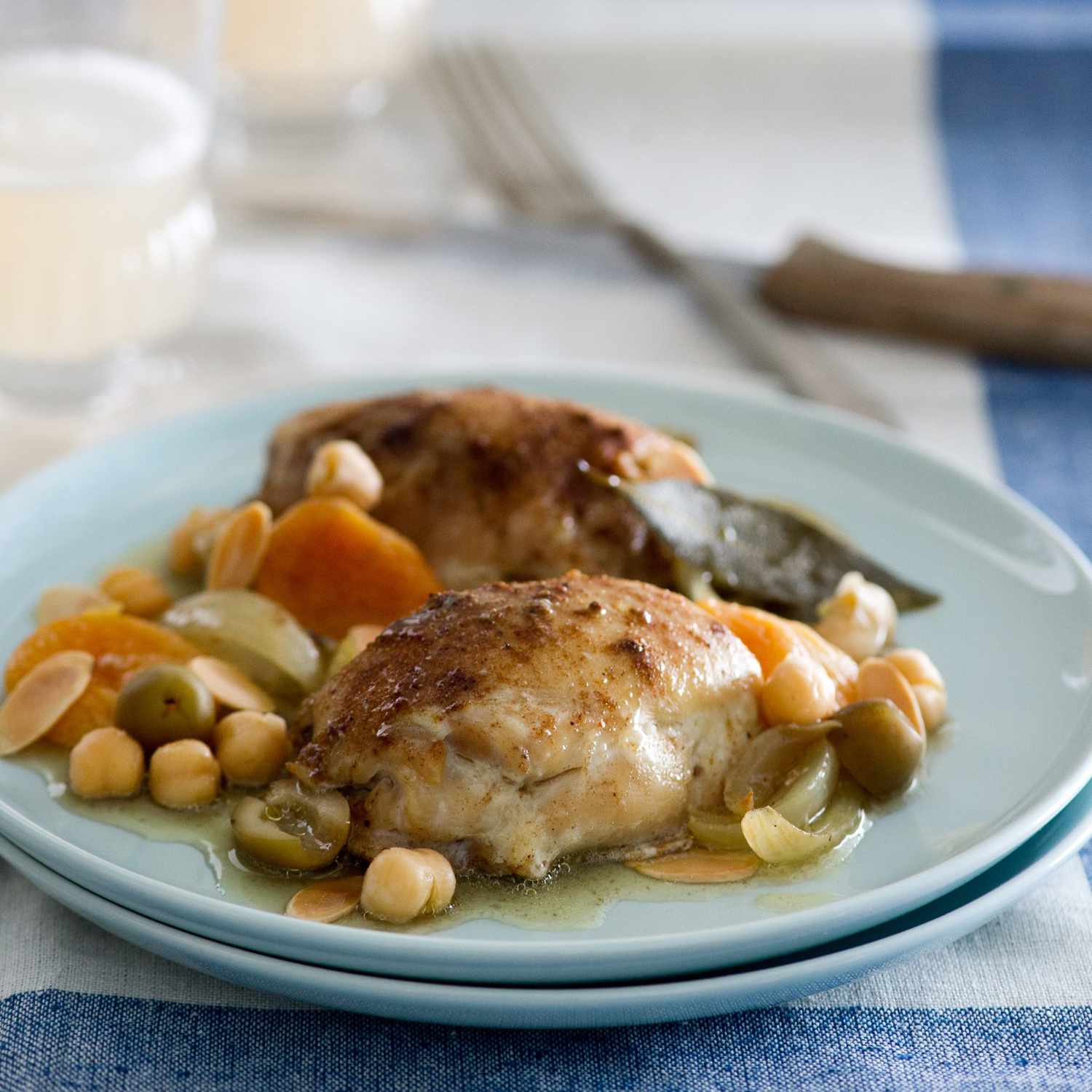
Slow-Roasted Moroccan Chicken with Preserved Lemon and Olives is the canonical version — 15 minutes of prep, 95 minutes in the oven, six servings at about 320 calories and 28g protein each. Bone-in, skin-on thighs and drumsticks only; breast meat turns chalky past 45 minutes. Green olives (Picholine or Castelvetrano) go in for the last 20 minutes so they stay firm.
For a weeknight version of the same flavor, Sheet Pan Za'atar Chicken with Preserved Lemon and Chickpeas does it in 55 minutes on one tray, with canned chickpeas crisping in the rendered fat. Za'atar is Levantine rather than Moroccan, but the lemon-thyme-sesame profile lands in the same place and it is easier to source than ras el hanout in most stores.
When you want heat, Half-Sheet Pan Harissa Chicken with Chickpeas and Carrots feeds six for about 450 calories a plate. The carrots caramelize against the harissa and pick up the sweetness that a fruit-based tagine would otherwise provide.
The hands-off option is Slow-Cooked North African Chicken with Harissa and Chickpeas: 15 minutes of morning prep, seven hours on low, 38g protein per serving. Hold back half the harissa and stir it in at the end — seven hours flattens it.
Lamb and beef: kefta meatballs, lamb tagine with prunes, spiced beef couscous
Lamb is the traditional centerpiece, and it rewards the long braise. Shoulder, shank and neck all have enough collagen to go three hours and come out shreddable.
Spicy Moroccan Lamb Tagine with Apricots and Almonds is the one to cook first — 20 minutes prep, two hours of braise, six servings at roughly 420 calories and 35g protein. The apricots go in during the final 30 minutes; any earlier and they dissolve into sugar. Toast the almonds separately and scatter them at the table so they stay crisp.
The prune version, Slow Cooker Moroccan-Spiced Lamb with Carrots and Prunes, is the classic lamb with prunes served at Moroccan celebrations. Seven hours on low, six servings, 40g protein each. Prunes carry more glycerol than apricots and give the sauce a noticeably glossier body.
For a weekend roast, Slow-Roasted Moroccan Lamb Shoulder with Preserved Lemons and Olives runs 280 minutes total and produces about 550 calories and 55g protein per serving — the highest-protein plate in this roundup. Slow-Braised Lamb Shanks with Moroccan Spices and Chickpeas is the same idea in individual portions, three hours, 650 calories a shank.
Kefta — spiced ground-lamb meatballs — is the fast lane. Fiery Harissa-Spiced Lamb Meatballs go from bowl to table in 35 minutes at 350 calories and 25g protein. Mix the harissa, cumin and parsley into the raw meat rather than the sauce; the interior seasoning is what separates kefta from a generic meatball.
Beef shows up most often with couscous. One-Pot Spiced Beef and Tomato Couscous is a 30-minute, 480-calorie weeknight plate where the couscous steams in the beef-and-tomato liquid, so nothing needs draining. And Sheet Pan Moroccan-Spiced Lamb with Roasted Carrots and Cauliflower covers the middle ground: 50 minutes, one tray, 42g protein.
Vegetarian mains: harira soup, chickpea and squash tagine, seven-vegetable couscous
Roughly half of the Moroccan repertoire is naturally plant-based, and chickpeas and lentils do the structural work that meat does elsewhere.
Harira Soup with Chickpeas and Lemon Zest is the national soup — chickpeas, lentils, tomato, a fistful of cilantro and parsley, finished with lemon. Fifty-five minutes, six servings, 180 calories a bowl. It is what breaks the fast during Ramadan and it reheats better than almost anything else here.
For a hearty tagine-style stew, One-Pot Moroccan Chickpea Stew with Harissa and Sweet Potatoes takes 45 minutes for four at 320 calories, and its close cousin One-Pan Moroccan-Spiced Chickpea and Sweet Potato Stew trims that to 280 calories with a lighter spice hand. Both are vegan as written.
If you want couscous underneath, Harissa-Spiced Lentil and Chickpea Stew with Couscous serves six at 320 calories with 14g of plant protein — the highest protein-per-calorie ratio on this list. Harissa-Spiced Chickpea Stew with Couscous is the smaller four-serving version.
The sweet-savory end of the vegetarian range is Spiced Chickpea and Date Tagine with Saffron Rice — 50 minutes, dates instead of apricots, saffron rice instead of couscous. And when you want a vegetable to be the plate rather than the side, Harissa-Spiced Roasted Cauliflower Steaks come in at 140 calories for 35 minutes of work. Serve them over Moroccan-Inspired Chickpea and Carrot Stew to build a full plate.
Fast Moroccan-inspired weeknight bowls (25 minutes)
These are not traditional tagines. They borrow the spice profile and skip the braise, which is a fair trade on a Tuesday.
Sheet Pan Moroccan-Spiced Salmon with Cauliflower Rice is the 25-minute anchor — 10 minutes prep, 15 in the oven, 350 calories and 38g protein. Cumin, paprika and a little cinnamon on salmon reads as unmistakably North African without any specialty ingredient.
Pan-Seared Chicken Thighs with Harissa Chickpeas hits 35 minutes and 38g protein for four; Harissa-Rubbed Chicken Thighs with Olives is the two-serving keto-friendly version at 350 calories. On the grill, Grilled Harissa-Spiced Lamb Skewers with Chickpea Salad needs 15 minutes of prep and 15 over coals.
Round any of these into a bowl with Lemon-Infused Herb Couscous Salad with Feta and Mint or Herb and Citrus Couscous Salad with Toasted Almonds — both are done in 15 minutes or less and hold three days in the fridge.
Curated recipes: 20 recipe cards with prep times and links
Every recipe below is on AislePrompt with full ingredients, instructions and a shopping list you can push straight to Instacart.
Three more worth bookmarking as sides and starters: Harissa-Spiced Carrot and Coconut Soup with Crispy Leeks, Harissa-Spiced Chickpea Stew with Couscous and Harissa-Rubbed Chicken Thighs with Olives.
3-day Moroccan-inspired meal plan and shopping list
This plan cooks one long braise on day one and rides it through day three. Total active time across the three days is under 90 minutes.
| Day | Dinner | Active time | Notes |
|---|---|---|---|
| Day 1 (Sunday) | Spicy Moroccan Lamb Tagine with Apricots and Almonds | 20 min | Serves 6 — plan on 2 servings of leftovers |
| Day 2 (Monday) | Sheet Pan Moroccan-Spiced Salmon with Cauliflower Rice | 10 min | Lightest night; the salmon uses the same spice mix |
| Day 3 (Tuesday) | Harira Soup with Chickpeas and Lemon Zest + leftover tagine | 25 min | Stir the leftover lamb into the soup for a second meal |
One combined shopping list:
- Protein: 3 lb boneless lamb shoulder, 4 salmon fillets (6 oz each)
- Produce: 3 yellow onions, 1 head garlic, 4 carrots, 1 head cauliflower, 2 lemons, 1 bunch cilantro, 1 bunch flat-leaf parsley, 2 tomatoes
- Pantry: 2 cans chickpeas, 1 can crushed tomatoes, 1 cup brown or green lentils, 1 cup dried apricots, 1 box couscous, blanched almonds
- Spice: ras el hanout, ground cumin, sweet paprika, cinnamon sticks, turmeric, harissa paste
- Dairy/other: plain Greek yogurt, olive oil, chicken or vegetable stock
Cost as of 2026 runs about $58–72 for three dinners feeding four, with lamb shoulder the single largest line item at roughly $9–13/lb. Swapping lamb for bone-in chicken thighs drops the total under $45 with no change to the spice list. If you want the full weekly version of this approach, our Meal Planning for Two guide walks through a 4-week rotation built the same way.
Essential gear: Dutch oven, chef's knife, mixing bowls
Moroccan cooking is not gear-heavy. Four items cover everything above.
A 5–7 quart enameled Dutch oven. This is the one purchase that matters. It sears at high heat, braises for three hours at 300°F, and goes from stovetop to oven. A 5.5 qt fits a 3 lb lamb shoulder; a 7 qt handles a double batch of harira. Our Cookware category tracks current pricing across the $60 budget tier and the $300+ enameled cast-iron tier — the performance gap is smaller than the price gap suggests, and the real difference is enamel durability over ten years.
A sharp 8-inch chef's knife. Every recipe here starts with a pile of onions, carrots and herbs. The chermoula and harira both call for finely chopped cilantro and parsley, which is miserable with a dull blade. See the Knives & Cutting picks for options and for a cutting board that will not dull the edge you just paid for.
Nesting mixing bowls and a fine grater. Kefta mixing, spice blending and yogurt sauces all want a bowl you can scrape clean. The Utensils & Tools category covers stainless nesting sets and microplanes for the preserved-lemon rind and fresh ginger.
Glass storage containers. Harira, both chickpea stews and the couscous salads all hold 4–5 days, and tagines genuinely improve on day two as the spices bloom into the fat. Straight-sided glass reheats better than plastic and does not stain from turmeric or harissa — see Storage & Containers.
Common pitfalls that flatten a Moroccan braise
1. Adding spices to liquid instead of oil. Bloom them in fat for 30–60 seconds first. This is the number-one fix for "my tagine tastes like nothing."
2. Using the preserved lemon pulp. Discard it. Rind only, sliced thin, added in the last 20 minutes.
3. Adding dried fruit too early. Apricots and prunes need 20–30 minutes, not two hours. Any longer and they melt and the sauce turns cloyingly sweet.
4. Boiling instead of simmering. A tagine should barely move — 195–205°F. A hard boil at 212°F tightens lamb shoulder into strings before the collagen has time to convert.
5. Salting at the start of a long reduction. Braises that cook down 40% will oversalt. Season lightly up front, correct at the end, and remember the olives and preserved lemon bring their own salt.
When Moroccan cooking is not the right call
Skip it on a true 20-minute night with no pantry prep. The flavor depends on a spice shelf you have already stocked; buying ras el hanout, harissa and preserved lemons on the same trip as dinner turns a $12 meal into a $40 one. Skip the long tagines if you cannot leave a pot alone for 90 minutes — the sheet-pan and skillet recipes above exist for exactly that reason. And if you are cooking for people who dislike sweet-savory combinations, choose the harissa and preserved-lemon recipes over the apricot and prune ones; the fruit-forward tagines are the most polarizing dishes on this page.
Where to go next
The neighboring cuisines share most of this pantry. Our 22 Middle Eastern dinners reuse cumin, tahini and chickpeas, and the 18 Persian recipes run on the same saffron-and-dried-fruit axis. For more of the braising technique itself, see 20 Dutch oven dinners, and for the lighter Mediterranean end, 22 Greek weeknight dinners.
Sources
- Serious Eats — Moroccan recipes — technique-first coverage of tagine construction, spice blooming and preserved-lemon handling.
- Bon Appétit — Moroccan recipes — modern home-cook adaptations of kefta, harira and vegetable tagines.
- NYT Cooking — Moroccan recipes — tested versions of chicken with preserved lemon, lamb with prunes and seven-vegetable couscous with US ingredient substitutions.
Frequently asked questions
Do I need an actual tagine pot to cook these recipes?
What is ras el hanout and what can I substitute?
How do I make preserved lemons at home?
Can these recipes be made vegetarian or vegan?
Are Moroccan recipes spicy?
Mediterranean recipes from the catalog
Save any of these to My Recipes — no account needed — and send the ingredients to Instacart in one tap.