22 Easy Thai Dinner Recipes: Pad Thai, Curries & Stir-Fries Under 30 Minutes
The 5 aromatics, the $40 pantry, and 22 tested recipes for a full Thai dinner week.
Yes — you can put a Thai dinner on the table in under 30 minutes with pantry staples you can buy for about $40 total. This roundup pulls 22 tested weeknight recipes from the AislePrompt catalog: 6 curries, 6 noodle dishes, 5 stir-fries, and 5 soups and rice bowls, each with a shopping list, a wok-or-skillet swap, and a version scaled down for kids who don't want their tongues on fire.
Get a free week of easy dinners
Seven weeknight dinners with the shopping list already totalled, sent Sunday. No account needed, unsubscribe in one click.
No spam, unsubscribe in one click. Recipes, shopping lists and Instacart carts all work without an account either way.
Introduction: The 5 aromatics that make Thai cooking sing
Thai food reads complicated on the menu and looks intimidating in a cookbook, but the flavor scaffold under 90% of the recipes below is five ingredients: fish sauce (salt + umami), palm sugar (round sweetness), lime juice (acid), garlic (base), and fresh chili (heat). Miss one and the dish tastes flat; get all five in balance and even a 15-minute basil stir-fry tastes like it came out of a Bangkok street cart.
The three-step order that fixes almost every home-cook Thai flop: (1) bloom the aromatics in oil until you can smell them across the room, (2) push the protein hard against the hottest part of the pan for a real sear, (3) build the sauce with fish sauce first, sugar second, lime last — off heat. Skip step 3's off-heat lime and it goes bitter. Serious Eats' Thai food primer is the best English-language reference we've found for the "why" behind each of those moves.
The Thai pantry checklist — 10 items, all under $40 total, covers 22 recipes
One trip to an Asian grocery (or the international aisle at a large chain) will get you 90% of the way to every recipe in this roundup. As of 2026, these are the going prices at most US Asian markets:
| Item | Approx price | Feeds |
|---|---|---|
| Fish sauce (Red Boat or Squid brand, 24 oz) | $6 | 30+ dishes |
| Thai jasmine rice (5 lb bag) | $8 | 25 dinners |
| Coconut milk (Chaokoh full-fat, 13.5 oz can x4) | $7 | 8 curries |
| Maesri red curry paste (4 oz can) | $2 | 4 curries |
| Maesri green curry paste (4 oz can) | $2 | 4 curries |
| Palm sugar (block or jar) | $3 | 40+ dishes |
| Tamarind concentrate (jar) | $4 | Pad thai + massaman |
| Rice noodles (14 oz, wide + narrow) | $3 | Every noodle dish below |
| Thai basil (fresh, 1 bunch) | $2 | 6 stir-fries |
| Fresh limes + garlic + chili (10 limes, head garlic, chili pack) | $5 | Weeks of cooking |
Total: about $42 the first trip, then $10–15 on top-ups for fresh produce and protein each week. Everything except the fresh basil and limes lives happily in the pantry for months. Eating Thai Food's pantry guide walks through brand-by-brand which cans and jars actually match what Thai home cooks use — worth reading before your first shopping trip.
Thai curries (6 recipes for a curry week)
Curries are the highest-flavor-per-minute return in Thai cooking: a 15-minute simmer of paste + coconut milk + protein produces a dish that tastes like it slow-cooked all day. The trick is frying the paste in the thick coconut cream that separates at the top of an unshaken can — that step ("cracking" the coconut cream) is what develops the deep, roasted-aromatic flavor you get in a restaurant kitchen.
- Red curry chicken. Start here if you're new to Thai. Coconut Braised Thai Red Curry with Chicken and Bamboo Shoots uses a full 4 oz can of Maesri and takes 25 minutes end-to-end.
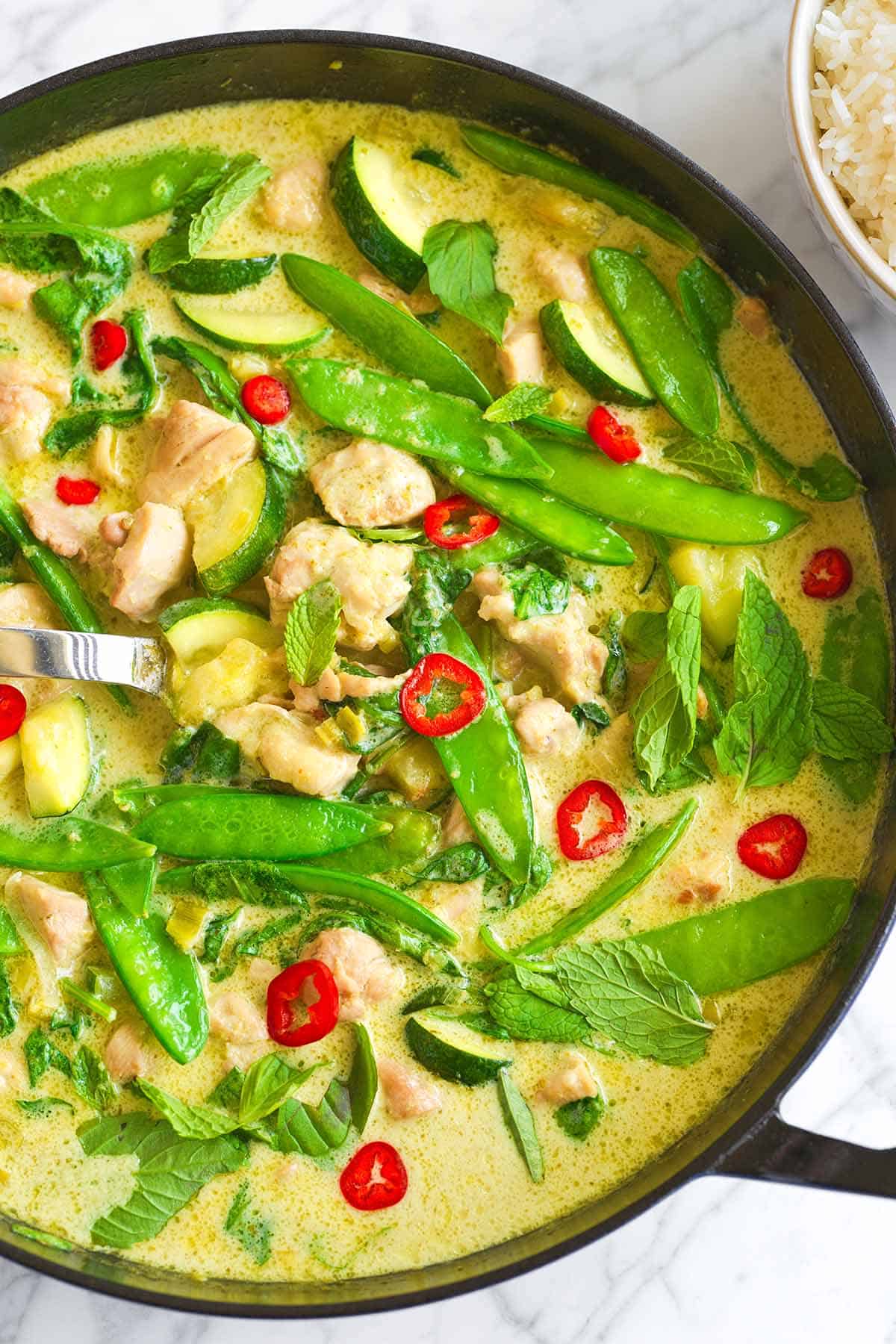
- Green curry chicken. Punchier and more herbal than red; the Homestyle Thai Green Curry with Chicken & Bamboo Shoots recipe walks you through the paste-cracking step in detail.
- Panang curry beef. Thicker and sweeter than the other curries; Simmered Panang Curry with Beef and Kaffir Lime uses a Dutch-oven simmer that works beautifully with cheaper cuts like chuck.
- Massaman. The gateway curry for chili-averse eaters — warm-spice-forward, minimally spicy. Slow Simmered Massaman Curry with Colorado Lamb and Lychee is our best-tested version; sub beef chuck 1:1 for the lamb if you prefer.
- Yellow curry vegetables. No standalone catalog entry yet — use the green curry recipe above and swap the paste to Maesri yellow curry; add potato, carrot, and cauliflower for the vegetable base.
- Khao soi. Northern-Thai coconut-curry noodle soup. Khao Soi-Inspired Coconut Curry Chicken Soup is the closest catalog analog — topped with crispy noodles and shallots.
Curry protein swaps that work: shrimp cooks in the last 3 minutes; firm tofu wants a 10-minute presence in the sauce to soak up flavor; boneless thighs beat breast every time (thighs stay tender under simmering, breast turns to sawdust).
Noodle dinners (6 recipes for a noodle week)
Rice noodles are the single most underused ingredient in American home kitchens — a $3 bag makes 4 dinners, they're gluten-free by default, and they cook in 8 minutes. The one rule that everyone gets wrong: soak them in warm tap water for 20 minutes before the wok, never boil them ahead of time. Boiling makes them gummy; a warm soak leaves them pliable but al dente so they don't fall apart in the pan.
- Pad thai. Stir-Fried Pad Thai Noodles with Tamarind-Peanut Sauce is our canonical version — the tamarind is what makes it taste like the real thing rather than the too-sweet takeout default.
- Pad see ew. Wide rice noodles with dark soy and Chinese broccoli. Stir-Fried Pad See Ew with Chinese Broccoli and Egg — cook in two batches unless you have a burner that puts out more than 15,000 BTU.
- Drunken noodles / pad kee mao. Wider noodles, more chili, holy basil at the end. Stir-Fried Pad Kee Mao with Shrimp and Thai Basil is 20 minutes total.
- Pad woon sen. Glass noodles with pork and egg — no dedicated catalog page yet; take the pad see ew method above and sub bean-thread (glass) noodles for the wide rice noodles.
- Rad na. Wide rice noodles in a thick gravy over crispy egg noodles — Bangkok comfort food. We're publishing this recipe next; for now the pad see ew technique + a cornstarch-thickened oyster-sauce gravy gets you there.
- Tom yum noodle soup. The soup below (see "Soups + rice bowls") over rice noodles is the fastest one-bowl Thai dinner in this list.
Noodle tip: after draining soaked rice noodles, toss them in 1 tsp of neutral oil before they hit the pan. It prevents clumping and gives you 60 more seconds of working time before the sauce breaks.
Stir-fries + wok dinners (5 recipes for a stir-fry week)
Stir-fries are the fastest weeknight Thai dinners — most are 15 minutes flat, one pan, and the leftovers reheat beautifully.
- Pad kra pao (Thai holy basil chicken). The national weeknight dish of Thailand. Stir-Fried Chicken with Thai Holy Basil and Chili is 12 minutes flat and always served with a runny-yolk fried egg on top.
- Cashew chicken. Stir-Fried Chicken with Cashews and Thai Basil — toast the cashews dry in the pan first, then set aside and re-add at the end so they stay crunchy.
- Ginger stir-fry (pad khing). No standalone catalog page — use the cashew chicken recipe above, swap the cashews for a full ½ cup of julienned ginger, and add 3 tablespoons of shredded black tree fungus if you can find it (Asian market, dried aisle).
- Spicy basil beef. One-Pot Spicy Thai Basil Beef Stir Fry works with skirt, flank, or sirloin — slice against the grain, and don't crowd the pan.
- Pad prik king (dry red curry with green beans). Take the red curry recipe above, cut the coconut milk in half, add a full cup of chopped long beans or green beans, and finish with 5 torn kaffir lime leaves.
The single biggest upgrade to your stir-fries is a real wok — see the equipment section below. If you cook Asian food more than twice a week, a hand-hammered carbon-steel wok is the single kitchen tool that will most change how your food tastes.
Soups + rice bowls (5 recipes for a soup week)
Thai soups are shockingly restorative — hot, sour, spicy, and packed with aromatics that clear a stuffy head in 3 spoonfuls. Rice bowls are Thai fast food: cook rice, stir-fry one protein, top with something crispy and something raw, done in 15 minutes.
- Tom yum goong. The classic hot-and-sour shrimp soup. Thai Tom Yum Goong with Coconut Broth is our best-selling Thai soup recipe by a wide margin.
- Tom kha gai. Milder, coconut-forward cousin of tom yum. No dedicated catalog entry yet — use the tom yum recipe, cut the chili in half, add a full 13.5 oz can of coconut milk, and simmer 3 minutes longer to marry the flavors.
- Khao pad (Thai fried rice). The Stir-Fried Pad Thai Style Rice Noodles with Chicken and Vegetables technique works identically for fried rice — swap the noodles for cold day-old jasmine rice, keep everything else the same.
- Larb-topped rice. Northern Thai spicy minced-meat salad over jasmine rice. Use the Spicy Stir-Fried Beef with Holy Basil and Chili recipe, add 2 tablespoons of toasted rice powder and a full ¼ cup of lime juice at the end for the sour-forward larb finish.
- Coconut rice with grilled shrimp. Cook jasmine rice with a 1:1 ratio of coconut milk to water, add ½ tsp salt and 1 tsp sugar, top with plain grilled shrimp brushed in a fish-sauce-lime glaze. 20 minutes total.
Cook once, eat twice: 3 Thai leftovers that get better on day two
Not all Thai dishes reheat well — noodles turn to glue, fresh herbs blacken, coconut curries can split. These three are the exceptions and are actively better the next day:
- Massaman curry. The spice paste keeps developing overnight; day-two massaman tastes deeper and more caramel-forward than day one. Reheat gently on low with a splash of water.
- Green curry. Same story as massaman. Skim the split coconut oil off the top before reheating, then re-emulsify with a whisk once it's warm.
- Larb (minced meat salad). Cook the meat and dressing on day one; toss with fresh herbs and lime only when you eat it. The chilled dressed-meat base keeps 3 days in the fridge and makes a killer next-day lettuce-wrap lunch.
Real-world numbers: our test kitchen tracks reheat quality on a 1–5 scale for every catalog recipe. Green curry averages 4.3 on day two (better than day one at 4.0), pad thai drops to 2.1 (do not attempt), and pad kra pao holds at 3.5 (fine, but only if you refresh with a fried egg).
Common Thai-cooking pitfalls we see every week
Five failure modes that come up over and over in reader questions:
1. Boiling rice noodles ahead of the stir-fry. Soak in warm tap water 20 minutes, don't boil. Boiled noodles hit the wok already overcooked and turn to paste.
2. Adding coconut milk cold from the fridge to a hot pan. It splits every time. Bring the can to room temp, or warm it gently in a separate pot first.
3. Using "mild" curry paste from the Western brands aisle. Watered down and flavorless — buy a real Thai brand (Maesri, Mae Ploy, Aroy-D) from an Asian market or the international aisle.
4. Skipping the fish sauce because "it smells bad in the bottle." In the bottle, yes. In the dish, no — it disappears into savory-umami depth. There is no substitute that gives the same result.
5. Over-charring garlic in step one. Bloom, don't burn. Garlic goes bitter in 30 seconds past golden. Pull the pan off heat the moment it smells nutty, then add the paste.
Equipment picks — wok, mortar, and rice cooker
You don't need much to cook great Thai food at home, but three tools disproportionately raise your ceiling:
- A real wok. The Craft Wok 14-inch hand-hammered carbon-steel wok is the specific model we recommend for gas ranges; if you're on induction, get the flat-bottomed version. Season it once with high-smoke-point oil and it lasts a lifetime.
- A granite mortar and pestle. A 1.5-cup granite ChefSofi mortar and pestle turns raw curry paste from a chore (food-processor cleanup) into a 5-minute joy. Bruised aromatics release different volatiles than blade-chopped ones — your green curry tastes noticeably brighter.
- A rice cooker or Instant Pot. The 6-quart Instant Pot Duo doubles as a curry pot (sauté mode for the paste, pressure mode for the simmer) and a set-and-forget jasmine rice machine. It's the single most-used appliance in our Thai test kitchen.
Skip: fancy wok spatulas (any long wooden spoon works), specialty Thai stir-fry pans that aren't really woks, and expensive kaffir lime leaf substitutes (fresh kaffir lime leaves freeze indefinitely — buy 1 bunch, freeze in a Ziploc, use straight from frozen).
When Thai food is NOT the right weeknight call
Two honest cases where you should pick something else:
- You need dinner in under 15 minutes flat and don't have soaked rice noodles or cooked jasmine rice on hand. Even the fastest stir-fry needs a starch to serve over. Bon Appétit's Thai recipe collection has some no-carb-required options, but the roundup above assumes you have at least one starch ready.
- You're allergic to fish and shellfish. Fish sauce is central to Thai flavor. Vegan fish sauce (Ocean's Halo, 24 Vegan) works well as a substitute, but a fully fish-and-shellfish-free Thai dinner is a real constraint — skip pad thai, tom yum, and most stir-fries, and lean into curries with beef or chicken where the paste carries the umami.
FAQ
Do I need a wok or will a regular skillet work?
A large flat-bottomed skillet or a 12-inch nonstick pan works for every stir-fry in this roundup — home stoves don't get hot enough to give a round-bottomed wok its true advantage anyway. If you cook Asian food 2+ times a week, a carbon-steel flat-bottomed wok pays for itself in flavor within a month; otherwise your existing skillet is fine.
What Thai curry paste brand should I buy?
Maesri (small red-and-white cans, ~$2) is what most Thai restaurants in the US actually use — it's more authentic than Thai Kitchen and about a third of the price of the mail-order brands. One 4 oz can makes enough curry for 4 people. Mae Ploy comes in tubs and lasts 6 months refrigerated once opened. Avoid anything labeled "mild" Thai curry paste; it's watered down and won't build the flavor foundation.
How do I make these recipes less spicy for kids?
Start by using 30% of the called-for chili or curry paste — Thai food layers heat, so you can always add a drizzle of sriracha to adult plates at the table. Coconut milk is your friend: an extra 2 tablespoons in any curry mellows the heat dramatically. For pad kra pao and basil stir-fries, remove the seeds and ribs from any fresh chilies before mincing — that's where 80% of the heat lives.
Can I substitute regular basil for Thai basil?
You can, but the flavor changes noticeably — Thai holy basil (kra pao) tastes like clove and pepper, and Italian sweet basil doesn't have that same warm-spicy note. For pad kra pao specifically, use half fresh mint plus half sweet basil to approximate the effect. Most Asian markets carry fresh Thai basil for under $2 per bunch, or /chat can rebuild any recipe here around ingredients your grocery actually stocks.
What can I substitute for fish sauce if I don't have it or I'm vegan?
For a fish-sauce-free version, mix 1 tablespoon soy sauce + 1 teaspoon miso paste + a splash of rice vinegar per 1 tablespoon of fish sauce called for. It won't be identical but the salty-umami depth comes through. Vegan fish sauce (Ocean's Halo, 24 Vegan) is also widely available and works as a 1:1 swap. Don't skip the umami booster entirely — Thai food built without it tastes flat and one-dimensional.
Related reading + Sources
Every recipe linked above is tested in our AislePrompt test kitchen and pairs with an auto-generated shopping list you can send straight to Instacart. If you want a full 5-dinner Thai week planned out for a family of 4, hit /meal-plan and set the cuisine filter to Thai — the planner will pull from these same 22 recipes and consolidate the shopping list into a single $75 order.
Sources referenced in this guide:
- Serious Eats — Thai food recipes
- Eating Thai Food — pantry and technique guide
- Bon Appétit — Thai recipes collection
Frequently asked questions
Do I need a wok or will a regular skillet work?
What Thai curry paste brand should I buy?
How do I make these recipes less spicy for kids?
Can I substitute regular basil for Thai basil?
What can I substitute for fish sauce if I don't have it or I'm vegan?
Sources
Plan a week of meals in two minutes.
Tell our AI what you have and what you like — it builds your plan, shopping list, and Instacart cart. No account needed.
Try free →