25 Instant Pot Dinners: 30-Minute Meals from Frozen or Fresh
The recipes worth pulling out the pressure cooker for, plus the ones a skillet still wins.
The fast answer: if a meal would normally braise or simmer more than an hour, the Instant Pot cuts that time by 50–70% and does the work unattended. If a meal already cooks in 20 minutes on a burner, the Instant Pot will be slower because it needs 10 minutes to come to pressure and 5–15 to release. Choose the tool that matches the recipe, and the pressure cooker earns its counter space on the same weeknights you would otherwise skip a real dinner.
Get a free week of Instant Pot dinners
Seven pressure-cooker dinners, one consolidated shopping list, sent Sunday. Every recipe one tap from an Instacart cart.
No spam, unsubscribe in one click. Recipes, shopping lists and Instacart carts all work without an account either way.
When the Instant Pot actually saves time (and when it doesn't)
The Instant Pot's superpower is compressing slow, wet cooking. Pot roast that used to need three hours in a Dutch oven is falling-apart tender in 60 minutes at high pressure. Dried beans that needed an overnight soak and an hour of simmering finish in 35 minutes from bone-dry. A whole chicken cooks in about 24 minutes plus a 15-minute natural release. Risotto, which usually demands 25 minutes of continuous stirring, is done in 6 minutes hands-off.
Where it loses is anything short and dry. Stir-fries, sautéed greens, quick pasta, seared steaks — all of those beat the Instant Pot on a burner or in a skillet, because pressure cooking needs at least a cup of liquid to build steam. If you find yourself sautéing in the pot and then adding almost no liquid, you are using the wrong tool.
A simple rule of thumb: if the traditional cooking method takes more than 45 minutes, the Instant Pot will beat it. Under 30 minutes, use a pan.
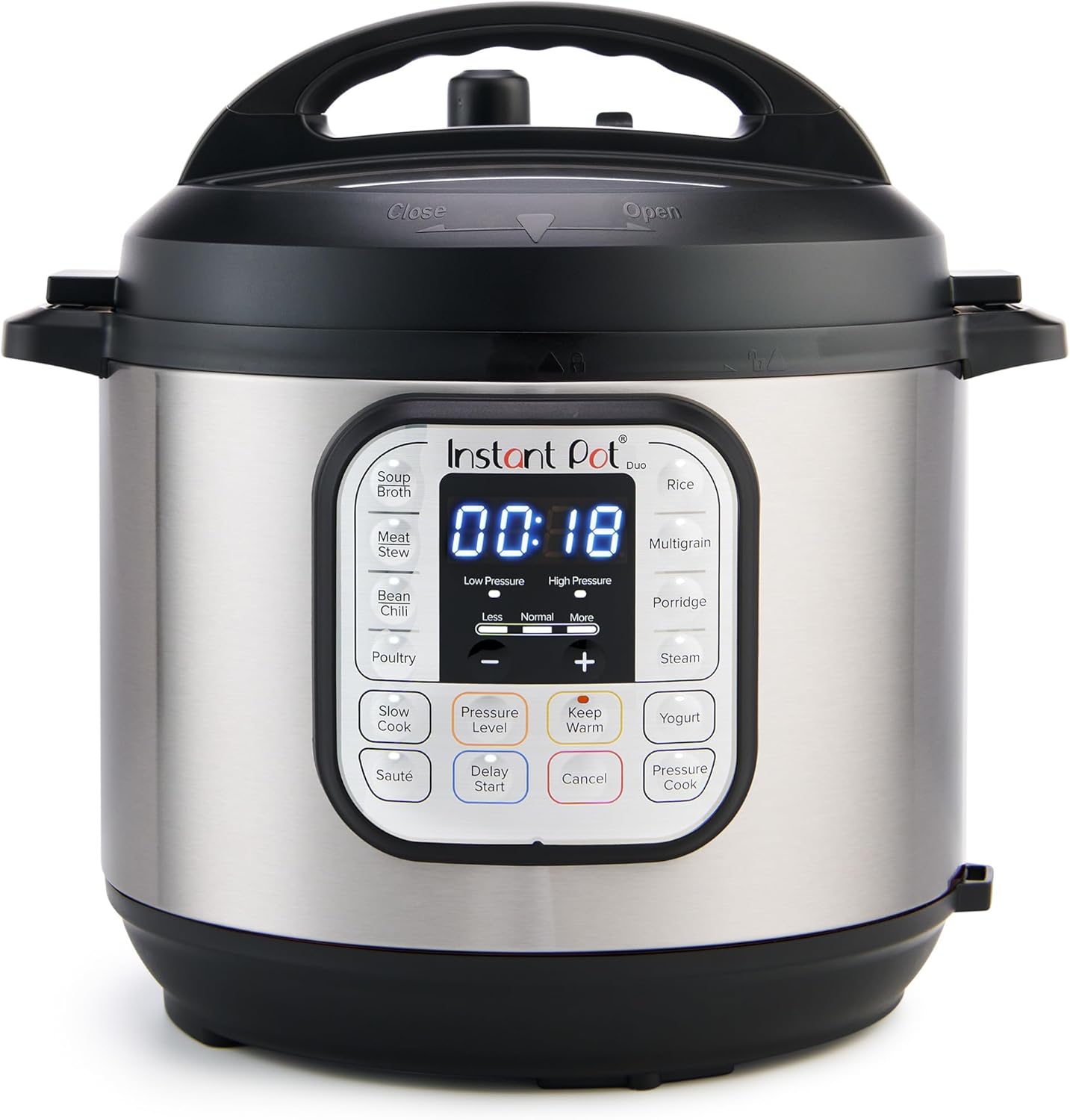
Estimated total capacity: a 6-quart Instant Pot Duo comfortably feeds a family of four with leftovers. Households of five or more should look at the 8-quart. Almost every recipe on this page is written for the 6-quart; scale liquids down by about 15% for the 8-quart to avoid a watery finish.
The pressure-cooking primer: sealing ring, PIP, natural vs quick release
Three things separate people who love their Instant Pot from people who leave it in a cabinet after two tries. Learn them once and every recipe below gets easier.
The sealing ring. The silicone ring that fits inside the lid absorbs odor. If you cooked chili last week and are making yogurt this week, the yogurt will taste faintly of cumin. Keep two rings — one for savory, one for sweet or dairy — and swap between them. Replace the ring every 12–18 months; a stiff or cracked ring is the number one cause of pressure loss and the "the pot never came to pressure" complaint.
Pot-in-pot (PIP). For anything you don't want to touch water — cheesecake, egg bites, rice served on top of a stew — set a trivet in the pot with a cup of water, then place a stainless or oven-safe ceramic dish on the trivet. Everything cooks by steam without becoming waterlogged. PIP also means you can cook two things at once: a stew below and a bowl of rice above.
Natural vs quick release. Quick release (opening the valve) drops pressure in 90 seconds and is right for vegetables, seafood, and pasta. Natural release lets the pot cool on its own over 10–20 minutes and is right for meat (the muscle fibers relax and reabsorb juice), rice (starches finish absorbing water), and beans (they don't rupture). Splitting the difference — a 10-minute natural release then quick — is the sweet spot for chicken thighs, ribs, and most soups.
Liquid minimums. You need at least 1 cup of thin liquid (water, broth, wine) at the bottom to build steam. Tomato paste, thick tomato sauce, and dairy count as zero — they're too viscous to boil. Layer them on top without stirring.
Get those four things right and 95% of Instant Pot failures disappear.
10 chicken and turkey dinners
Chicken is the workhorse of pressure cooking because dark meat becomes silky at pressure and breast meat stays juicy on a 10-minute natural release. Boneless thighs cook in 8 minutes, bone-in in 12, and a whole 4-lb chicken in 24.
The single highest-value recipe here is Instant Pot Chicken Tikka Masala — a takeout-tier sauce in about 25 minutes total, with tomato paste stirred in only after pressure cooking to avoid a BURN error. Follow it with Instant Pot Chicken Noodle Soup, which uses bone-in thighs plus dry egg noodles added at the very end so they don't turn to mush. For a one-pot rice dinner, Instant Pot Turmeric Chicken and Basmati Rice uses PIP: rice in a bowl on the trivet, seasoned chicken below, both finished together in 12 minutes.
Additional weeknight options — all built on the same 6-quart 1-cup-of-liquid template — round out the ten:
- Butter chicken with cashew cream (swap paneer for chicken if you want vegetarian).
- Salsa verde chicken over rice — three ingredients, 12 minutes, ready to shred for tacos.
- Whole 4-lb chicken on the trivet with lemon, garlic, and rosemary; 24 minutes at high pressure, 15-minute natural release, then broil the skin.
- Chicken pho with a 30-minute charred-onion broth; strain, cook rice noodles separately.
- Chipotle honey wings finished under the broiler for crisp skin.
- Turkey chili with three beans and a smoky adobo base.
- Chicken and 16-bean soup — the beans do not need an overnight soak.
Cross-check the Serious Eats pressure cooker recipe archive if you want to see the same recipes tested with different aromatics.
6 beef and pork mains
Pressure cooking transforms cheap cuts. Chuck roast, brisket, short ribs, pork shoulder, and beef shanks — all the cuts that are borderline inedible cooked fast — become the ones you plan around when you own a pressure cooker.
The two highest-conversion recipes for weeknight beef are Instant Pot Taiwanese-Style Beef Stew and Slow Braised Midwest Beef Pot Roast. The first is a 45-minute total after browning; the second is a Sunday-dinner meal delivered in the middle of a Tuesday. For a party dish, Spiced Red Wine-Braised Beef Short Ribs is 45 minutes at high pressure with a natural release; the pot roast time saves you three hours in the oven.
Pork is even faster. Instant Pot Carnitas with Citrus and Chipotle is the recipe most Instant Pot owners keep coming back to: a 3-lb pork shoulder in 60 minutes total, then the meat gets a screaming hot cast-iron sear to crisp the edges. Round out the six with a Filipino-style pork adobo (14 ingredients, 25 minutes), a pulled pork sandwich base with root beer or Dr. Pepper as the braising liquid, and a Sunday-gravy beef ragù ladled over pappardelle.
5 vegetarian and bean dinners
Dried beans are the single biggest reason to own a pressure cooker if you're vegetarian. A cup of dried chickpeas becomes fully cooked chana in 35 minutes with no soak; the same batch takes 60–90 minutes and constant babysitting on a burner. Dried black beans, kidney beans, cannellini, and pinto all cook in 25–35 minutes from bone-dry.
Start with Classic Chana Masala with Cumin — the chickpea version that anchors the vegetarian section of most Indian menus. Instant Pot Lentil and Sweet Potato Soup is 8 minutes of hands-on time before pressure. Instant Pot Mushroom and Arborio Rice Risotto turns the most demanding stove-top dish into a 6-minute pressure cycle with no stirring at all — the arborio and porcini do the work.
Round out the five with:
- Coconut-braised black bean tacos with pickled onions.
- White bean and kale minestrone (fresh Parmesan rind in the pot with the beans).
4 pasta and grain one-pot meals
Pasta in the Instant Pot lives or dies by ratio. Use half the cooking time listed on the box, add 2.5 cups of water per pound of pasta, and use quick release the second the timer hits zero — anything more and you get glue.
One-pot ground beef pasta. Brown 1 lb ground beef on Sauté, drain, add 1 lb rigatoni, a 24-oz jar of marinara, 2.5 cups water, and no salt. Pressure cook 4 minutes, quick release. Stir in shredded mozzarella at the end.
Chicken and orzo lemon-dill. A skillet mainstay adapted to pressure. Chicken thighs and orzo cook together with lemon zest and dill; the orzo gets al dente in 3 minutes.
Weeknight beef ragù with pappardelle (broken). Break the pappardelle in half — pressure cooking demands submerged noodles — and cook 5 minutes with jarred passata.
Cheesy broccoli quinoa. A vegetarian one-pot: rinsed quinoa, broccoli florets on top, sharp cheddar stirred in after the 1-minute quick release.
For all pasta cooks: never use more than half the pot's total capacity. Starch foam expands and can clog the valve.
Cooking from frozen: safety and adjusted times
You can cook meat straight from frozen in the Instant Pot, and it is safe — the USDA notes that any method that gets the interior to 165°F for poultry or 145°F for beef (with a 3-minute rest) is fine, and pressure blows past those numbers. The catch is that you cannot brown frozen meat and you must extend the pressure time.
Approximate adjustments (6-quart Duo, high pressure) — check with a probe thermometer:
| Cut | Fresh time | Frozen time | Release |
|---|---|---|---|
| Boneless chicken breasts | 8 min | 12 min | 5-min natural |
| Bone-in chicken thighs | 12 min | 15 min | 10-min natural |
| Whole chicken (4 lb) | 24 min | 32 min | 15-min natural |
| Boneless pork shoulder (3 lb) | 60 min | 75 min | Full natural |
| Beef stew meat (2 lb, cubed) | 25 min | 35 min | 10-min natural |
| Ground beef (1 lb, brick) | 6 min | 25 min | Quick |
| Ground turkey (1 lb, brick) | 6 min | 22 min | Quick |
| Salmon fillets (thick) | 3 min | 5 min | Quick |
Two rules for frozen: skip the sear (a wet frozen surface will not brown and will trip a BURN warning), and add ½ cup of extra liquid to compensate for water released as the ice melts.
Common pitfalls (and how the pot fails you)
Every failure I have seen falls into one of five buckets.
1. BURN error, tomato edition. You stirred tomato paste, marinara, or a cheese sauce into the bottom of the pot before pressurizing. Layer thick sauces on top without stirring; the boiling liquid underneath will incorporate them during pressure.
2. BURN error, deglaze edition. You browned meat, added liquid, and hit Cancel — Start without scraping. Every fond speck on the bottom becomes a burn point. Use a wooden spoon and go corner to corner.
3. Pot never came to pressure. The sealing ring is off, deformed, or the sealing valve is set to "Venting." Check both in that order.
4. Rice is gummy. You used the "Rice" preset for basmati or jasmine. Presets are calibrated for medium-grain white rice. For basmati: 4 minutes high pressure, 10-minute natural release, 1:1.25 rice-to-water ratio.
5. Beans are mushy on top, hard at the bottom. The pot came to pressure before all the beans were submerged. Stir before locking the lid.
When NOT to reach for the Instant Pot
Skip the Instant Pot for anything under 15 minutes of active cook time. Skillet stir-fries, seared salmon, sautéed vegetables, quick pasta with a raw sauce (pesto, cacio e pepe), and eggs of any kind cook faster and better with direct heat. The Instant Pot's steam-only environment ruins crisp textures — everything comes out braised — so if the goal is a crust, you either need a broiler pass after or a different appliance entirely. The Instant Pot official recipe library does not include a single stir-fry, and that is not an accident.
Which Instant Pot fits your kitchen
Every Instant Pot recipe on this page assumes the 6-quart Duo — the model that shows up in more American kitchens than any other multi-cooker. Two upgrades matter: the Duo Crisp (adds an air-fry lid) and the 8-quart Duo (bigger meals, same footprint). Skip the 3-quart Mini for a family of three or more — it will not fit a whole chicken, a boxed pound of pasta, or most 3-lb roasts.
Look at the small-appliances aisle for current pressure cookers, and pair with sturdy stainless PIP inserts and a good silicone trivet from cookware. Solid utensils — a silicone spatula, tongs, and a wooden spoon that won't scratch the pot — matter more than which model you buy.
Real-world time and cost numbers
Rough energy and time math across the same weeknight menu, 4 servings:
| Method | Active time | Total elapsed | Approx. kWh |
|---|---|---|---|
| Instant Pot pot roast | 12 min | 90 min | 0.9 |
| Oven-braised pot roast (325°F) | 18 min | 210 min | 3.6 |
| Slow cooker pot roast | 12 min | 480 min | 0.7 |
| Instant Pot black beans (dry, 1 lb) | 5 min | 45 min | 0.4 |
| Stovetop black beans (dry, 1 lb) | 15 min | 110 min | 2.1 |
The Instant Pot rarely wins on pure kWh vs the slow cooker, but it collapses total elapsed time by 5–6× — the meaningful axis on a Tuesday night. Compared with the oven, both time and energy fall by 60–75%.
Related weeknight roundups
Round out the rotation with the appliance-cluster articles: 20 Slow-Cooker Dinners for 8-hour set-and-forget days, 25 Air Fryer Weeknight Dinners when you want a crust the Instant Pot cannot deliver, and 25 Sheet-Pan Dinners for the nights the pressure cooker is already occupied with beans. When the whole week needs planning, The 5-Day Family Dinner Rotation handles the shopping list.
FAQ
Does the Instant Pot actually save time?
For anything that would otherwise braise or simmer over an hour — pot roast, dried beans, short ribs, risotto, whole chicken — yes, often by 50–70%. For quick sautés, stir-fries, or 20-minute pasta, no; a skillet is faster because the Instant Pot needs 10 minutes to come to pressure and another 5–15 to release. Choose accordingly.
Can I cook meat from frozen?
Yes for most cuts, and the USDA confirms it's safe as long as you extend the pressure time by roughly 50%. Skip the browning step and add 1/2 cup of extra liquid to compensate for the water frozen proteins release. Cook whole frozen chicken 8 minutes per pound, boneless chicken breasts 12 minutes total, and frozen ground beef 25 minutes with a natural release.
Why does my Instant Pot say BURN?
Almost always because the pot didn't have enough thin liquid at the bottom, or a starchy/dairy ingredient was sitting on the base plate. Deglaze thoroughly after sautéing, layer tomato products and dairy on TOP without stirring, use at least 1 cup of water or broth, and never add a slurry until after pressure cooking finishes.
Is the Instant Pot worth it if I already have a slow cooker?
If you cook most weeknight meals ad hoc without 8 hours of lead time, yes — the Instant Pot replaces a slow cooker (it has a Slow Cook function) and adds pressure cooking, rice, yogurt, and saute in one appliance. If your rhythm is set-and-forget in the morning, a slow cooker still wins on convenience and takes less counter space.
Which Instant Pot size should I buy?
The 6-quart Duo covers 90% of home cooks (2–5 people) and fits most kitchens. Households of 5+ or anyone who wants to fit a whole chicken with vegetables should size up to the 8-quart. The 3-quart Mini is only useful as a secondary pot for sides or for RV / dorm setups — it's too small for most family recipes.
Frequently asked questions
Does the Instant Pot actually save time?
Can I cook meat from frozen?
Why does my Instant Pot say BURN?
Is the Instant Pot worth it if I already have a slow cooker?
Which Instant Pot size should I buy?
Sources
Got the Instant Pot. Now what goes in it?
Ask our AI for a week of pressure-cooker dinners — it builds the shopping list and sends the cart to Instacart.
Get Instant Pot dinners →