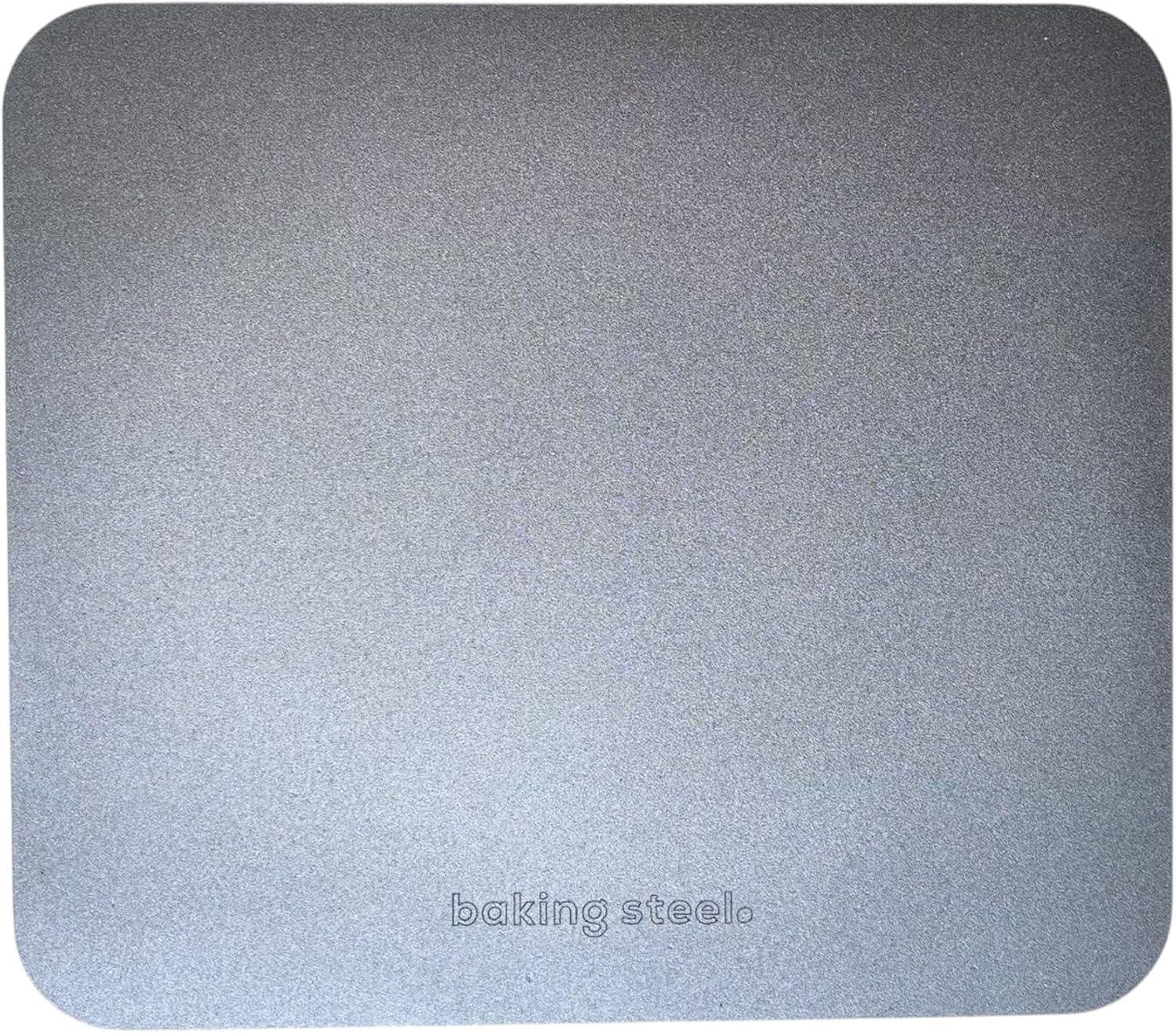
Best Pizza Stones and Steels for 2026: Top Picks + Buying Guide
Steel browns a crust in half the time of ceramic — here's when that's worth it, and when a $30 stone is the smarter buy.
Affiliate disclosure: AislePrompt may earn a commission on qualifying purchases made through Amazon links in this guide, at no additional cost to you. See our affiliate policy →
For most home cooks in 2026, a pizza steel beats a pizza stone. Steel pulls heat into raw dough several times faster than ceramic, so a pie browns on the bottom in 4-6 minutes at 550°F instead of 8-10. Buy a stone instead if you mainly bake bread, want to spend under $35, or need something light enough to lift one-handed.
Get a free week of easy dinners
Seven weeknight dinners with the shopping list already totalled, sent Sunday. No account needed, unsubscribe in one click.
No spam, unsubscribe in one click. Recipes, shopping lists and Instacart carts all work without an account either way.
Why the cooking surface matters more than the recipe
The Associazione Verace Pizza Napoletana specifies that true Neapolitan pizza is baked in a wood-fired oven at 430-480°C (806-896°F) for 60-90 seconds. Your kitchen oven tops out around 550°F (288°C). That is not a small gap — it is roughly 300°F short of the spec, and no dough recipe closes it.
What you can control is how fast heat moves from the cooking surface into the bottom of the dough in the first thirty seconds. That is the whole game. A pizza launched onto a preheated surface has maybe four minutes before the cheese overcooks; whatever browning the base achieves has to happen inside that window. Get the surface right and you get an oven-spring puff, a dry crisp underside, and the char spots that come from the Maillard reaction running hot and fast. Get it wrong and you get the pale, bendy, faintly steamed disc that makes people conclude they are bad at pizza.
They are not bad at pizza. They are baking on a cold aluminum sheet.
The same physics applies well beyond pizza. A preheated mass under a No-Knead Rustic Artisan Bread with Olive Oil is what gives you oven spring instead of a flat puck, and it is why a High Hydration Sourdough Boule bakes with an open crumb at home at all.
Our top 5 picks
Every pick below is a product we have live pricing and review data for as of September 2026. Prices move; the ranking logic does not.
#1 Best Overall: ThermiChef 16x16 Pizza Steel, 1/4" — $71.99
Verdict: 17.6 lb of quarter-inch steel in the size that actually fits a standard oven rack, at roughly half the price of the category's famous name.
This is the pick for the overwhelming majority of home cooks. Quarter-inch is the thickness sweet spot: enough mass to bake three pizzas back-to-back without a recovery stall, not so much that preheating becomes an hour-long commitment or that you dread lifting it. At 16x16 it clears a standard 30-inch range rack with airflow to spare, and it is square, which means it handles a rectangular Brooklyn Sunset Pizza as happily as a round pie.
It holds a 4.7 rating across 1,238 reviews — the highest-rated steel in our catalog with a review count large enough to trust. Made in the USA, ships pre-seasoned. See it at ThermiChef 16x16 Pizza Steel, 1/4".
Skip it if: your oven rack is narrower than 17 inches, or you have a back or wrist injury — 17.6 lb at arm's length over a hot oven is a real consideration.
#2 Best Value: Unicook Pizza Stone, Cordierite 15x12" — $29.98
Verdict: 6.8 lb, thermal-shock-resistant cordierite, 4.5 stars across 9,314 reviews. The most-validated cheap stone on the market.
If you make pizza once or twice a month, thirty dollars buys you 80% of the result. Cordierite is the right ceramic here and it is not marketing copy: it is a synthetic magnesium-aluminum silicate engineered for very low thermal expansion, which is exactly why it also gets used in catalytic converters. Low expansion means it tolerates going into a hot oven without splitting.
The 15x12 rectangle is a better shape than the round stones most people default to — it fits more oven, and rectangles suit Savory Herb Focaccia and free-form breads far better than a circle does. Check it out: Unicook Pizza Stone 15x12".
Skip it if: you want leopard-spotted Neapolitan char. A 6.8 lb stone cannot deliver it in a 550°F oven.
#3 Best Large Stone: Old Stone Pizza Kitchen Rectangular 14x16" — $33.18
Verdict: the classic full-rack stone, 4.4 stars across 3,444 reviews, for people who bake bread as often as pizza.
Old Stone has been the default recommendation in bread-baking circles for decades, and the 14x16 rectangle is the reason: it covers essentially an entire standard oven rack, which turns your oven into something closer to a hearth. That footprint matters more for bread than pizza — a big preheated slab stabilizes oven temperature through the door-opening and steam-loading that bread baking demands.
Grab it here: Old Stone Pizza Kitchen Rectangular 14x16".
Skip it if: you need handles. This is a bare slab and it is awkward to move hot.
#4 Best Premium: The Original Baking Steel 14x16x¼" — $129.00
Verdict: the product that created the category, ~16 lb, made in the USA since 2012, 4.6 stars across 590 reviews.
This is the steel that started the home-pizza-steel movement, and it earns its reputation — the finish is better than the budget plates, the pre-seasoning is more even, and the 14x16 footprint is tuned to standard American ovens. Whether it is $57 better than the ThermiChef is genuinely debatable, and we ranked accordingly. Buy it if you want the original and the finish quality, not because you expect a meaningfully browner crust.
Take a look: The Original Baking Steel 14x16x¼".
Skip it if: you are price-sensitive. The performance delta over a $72 quarter-inch steel is small.
#5 Budget Pick: Waykea 12x12" Cordierite Square — $23.99
Verdict: $24, 4.6 stars, 845 reviews, and small enough for an RV, a toaster oven, or a compact apartment range.
Twelve by twelve is genuinely small — it handles a 10-11 inch personal pie and not much more. But it is the right answer for small ovens, and it is a low-risk way to find out whether you care about this hobby before committing to a 27-pound slab. Cordierite construction means it survives the thermal cycling a beginner will inevitably put it through.
Find it here: Waykea 12x12" Cordierite Pizza Stone.
Skip it if: you own a full-size oven. You are leaving most of your rack unused.
Also worth knowing
| Product | Price | Rating (n) | Best for |
|---|---|---|---|
| ThermiChef 16x16, 3/8" | $99.99 | 4.7 (1,238) | Maximum thermal mass — 27.5 lb, back-to-back pies |
| ThermiChef 14x20, 3/16" | $45.49 | 4.7 (1,110) | Widest coverage at manageable weight (13.7 lb) |
| Primica Pizza Steel XL 16x13.4" | $64.97 | 4.6 (677) | Mid-price steel with a rack-friendly rectangle |
| Unicook Large 20x13.5" | $49.99 | 4.6 (1,227) | Two personal pizzas side by side |
| RockSheat 15x12" with handles | $29.97 | 4.4 (5,222) | The handle problem, solved — 4 built-in grips |
| GoodCook Glazed Ceramic 14.75" | $23.34 | 4.4 (734) | Glazed surface you can actually wash |
| Made In 12" Carbon Steel | $69.00 | 4.4 (74) | Induction-compatible, Swedish-made |
| Chef Pomodoro 16" 1/4" | $62.99 | 4.5 (520) | Lifting holes — easiest hot steel to move |
Pizza stone vs pizza steel: the actual physics
Most buying guides say "steel conducts heat better" and stop. The more useful property is thermal effusivity — how readily a material exchanges heat with something it touches. When two bodies at different temperatures make contact, the interface temperature settles at a weighted mean based on their relative effusivities. High-effusivity material wins the argument and drags the contact point toward its own temperature.
Here are published effusivity values, in kJ/(m²·K·√s):
| Material | Thermal effusivity |
|---|---|
| Iron | 15.9 |
| Stainless steel 316 | 7.23 |
| Granite | 2.0-3.0 |
| Dense concrete | 2.0 |
| Brick | 1.0-1.6 |
| Fused silica (quartz) | 1.5 |
Cordierite is a refractory ceramic and sits in the brick-and-granite band. So a carbon-steel plate has roughly 6-10 times the effusivity of a ceramic stone. In practice: when 70°F dough lands on a 550°F surface, the steel barely flinches and keeps hammering heat into the base, while the stone's surface temperature drops locally and takes time to recover.
That is why the same dough, same oven, same day, comes out differently:
| Surface | Time to browned base at 550°F | Recovery between pies | Typical weight |
|---|---|---|---|
| 1/4" carbon steel | 4-6 min | ~5 min | 16-18 lb |
| 3/8" carbon steel | 4-5 min | ~3 min | 27 lb |
| 0.6" cordierite stone | 8-10 min | ~10-15 min | 7-10 lb |
| Aluminum pizza pan | 12-15 min (often never crisps) | n/a | 1-2 lb |
The tradeoff runs the other way for bread. A stone's slower, gentler heat release is more forgiving for a long bake. Steel can scorch the bottom of a 45-minute sourdough before the interior is done — the fix is to drop your oven 25°F or slide a sheet pan under the loaf partway through.
Neither one fixes a wet dough or a cold oven. The surface is a multiplier, not a substitute for technique.
What to look for
Material. Carbon steel for pizza; cordierite for bread and budget; glazed ceramic if washability matters more than performance. Avoid unspecified "ceramic" or "clay" stones with no material listed — that is where the cracking horror stories come from.
Thickness. For steel, 1/4" is the sweet spot. 3/16" is lighter and cheaper but stalls between pies; 3/8" is superb and heavy enough that some people stop using it. For stone, 0.5-0.75"; thinner stones crack.
Size vs your oven. Measure the interior rack width and subtract about 2 inches for airflow. Do not guess. A stone that blocks the full rack width chokes convection and creates hot spots.
Weight. Be honest about what you will lift over a 550°F oven. The 27.5 lb steel is the best performer here and also the one most likely to live in a cabinet permanently. Models with handles or lifting holes exist for a reason.
Cost per year. A $129 steel that lasts 20+ years costs ~$6/year. A $24 stone that cracks in two years costs $12/year. The expensive option is frequently the cheap one.
Seasoning, preheating, and care
Preheat longer than you think. Forty-five minutes to an hour at max temperature, with the surface already in the oven when you turn it on. An oven's thermostat reports air temperature, which hits 550°F long before 17 lb of steel does. Under-preheating is the single most common cause of both sticking and pale crusts.
Position it correctly. Upper third of the oven for pizza — you want the top element close for cheese browning. Middle or lower for bread.
Steel care. Wipe hot with a dry cloth, scrape stuck bits with a metal bench scraper, and re-oil very lightly once it cools. If rust appears after humid storage, steel wool it off and re-season. Never leave it wet.
Stone care. Let it cool completely, scrape dry, wipe with a damp cloth. Never use soap — porous cordierite absorbs it and returns the flavor in your next bake. Never run cold water over a hot stone. Stains are permanent and entirely cosmetic; a black, blotchy stone is a well-used stone, not a ruined one.
Dust the peel, not the stone. Coarse semolina or cornmeal, not flour — flour burns and turns bitter at these temperatures. King Arthur Premium Semolina Flour at $12.95 lasts a year of weekly pizza. For the dough itself, Antimo Caputo 00 Chef's Flour is the Neapolitan standard.
You need a peel. A $70 steel plus no peel equals a folded pizza on your oven floor. A Cuisinart 12" Aluminum Pizza Peel is $24.99; the ooni 14" Metal Pizza Peel at $51.98 is sturdier, and the ooni 9" Turning Peel rotates a pie mid-bake without pulling it out. For cutting, the OXO Steel 4" Pizza Wheel is $18.98 and the KITCHENDAO Detachable Pizza Cutter comes apart for cleaning.
Beyond pizza
A preheated slab is the most versatile thing in your oven, and leaving it in permanently stabilizes oven temperature for everything you bake.
Bread. The highest-value non-pizza use. No-Knead Rustic Artisan Bread with Olive Oil and High Hydration Sourdough Boule both depend on a hot surface for oven spring. Stones have the edge here — gentler for long bakes.
Flatbreads and focaccia. Savory Herb Focaccia and Tomato-Basil Focaccia Bread crisp on the bottom instead of steaming in the pan.
Reheating. The killer app nobody mentions. Cold leftover pizza on a preheated steel at 450°F for 3-4 minutes comes back genuinely crisp. A microwave cannot do this and never will.
Roasted vegetables and cookies. Slide a sheet pan directly onto the preheated surface for faster browning and fewer soggy bottoms.
Deep dish is the exception. A Chicago-Style Deep Dish Pizza with Spicy Italian Sausage bakes in a pan, not on a surface — though setting the pan on a preheated steel does accelerate the bottom crust.
Real-world numbers
Figures below are what to expect from a standard 30-inch electric range at its 550°F maximum, using 65% hydration dough rested to room temperature.
| Measurement | 1/4" steel | 0.6" cordierite stone | Aluminum sheet |
|---|---|---|---|
| Preheat to surface temp (min) | 45-60 | 45-60 | 10 |
| Surface temp at launch (°F) | 540-550 | 530-545 | 550 |
| Time to browned base (min) | 4-6 | 8-10 | 12-15 |
| Surface temp drop on launch (°F) | 30-50 | 90-130 | 200+ |
| Recovery to launch temp (min) | 3-5 | 10-15 | n/a |
| Pies per hour, sustained | 8-10 | 4-5 | 3-4 |
| Weight (lb) | 16-18 | 7-10 | 1-2 |
| Expected service life (years) | 20+ | 5-10 | 2-3 |
The row that decides most purchases is surface temp drop on launch. A stone gives up 90-130°F the moment cold dough hits it and then needs 10-15 minutes to climb back — which is why the second pizza of the night is reliably worse than the first on a stone, and nearly identical on a steel.
The row that decides the rest is weight. Everything the steel wins, it wins by being heavy.
Common pitfalls
Preheating for 15 minutes. The oven beeps; the slab is still 200°F short. Give it 45-60 minutes, every time.
Flouring the peel. Flour scorches in under a minute at 550°F and tastes acrid. Semolina or coarse cornmeal only.
Building the pizza on the peel, slowly. Wet dough welds itself to wood in about 90 seconds. Build fast, or build on parchment and pull the parchment out after 2 minutes.
Washing a stone with soap. Porous cordierite holds it and gives it back. This ruins stones permanently in the only way that matters — flavor.
Buying round when your oven is rectangular. A 16" round stone wastes the corners of a rack that would have taken a 14x16 rectangle.
Storing steel wet. Surface rust in a week. Dry it, oil it lightly, leave it in the oven.
Cold dough straight from the fridge. Rest it at room temperature 30-60 minutes. Cold dough on a hot surface sets before it can spring, and gives you a dense base regardless of what you spent.
When not to buy one
You already own good cast iron. A preheated 12-14" cast-iron skillet or pizza pan is a legitimate substitute — similar effusivity class, and you already own it. Try that first.
You make pizza twice a year. A sheet pan is fine. Gluten-Free Thin Crust Pizza with Roasted Vegetables and Kale Pesto Pizza with Mozzarella and Sun-Dried Tomatoes work on a pan.
You own an outdoor pizza oven. It already has a stone floor and hits 900°F. A home-oven steel adds nothing.
Your oven is small or weak. If it tops out at 450°F, a steel improves things less than the price suggests. Fix the heat source first.
You cannot lift 17 pounds safely. Take this seriously. Pick the 13.7 lb model, one with handles, or a 7 lb stone.
FAQ
Pizza stone or pizza steel — which should I buy?
Buy the steel if you make pizza more than twice a month. A carbon-steel plate has roughly 6-10 times the thermal effusivity of a ceramic stone, so it browns a base in 4-6 minutes at 550°F instead of 8-10, and it recovers in about 5 minutes between pies rather than 10-15. Steel also lasts effectively forever. Buy a stone if you mostly bake bread, want to spend under $35, or need something you can lift comfortably — a 7 lb stone is far easier to live with than a 17 lb slab.
How do I prevent my pizza from sticking to the stone?
Preheat for at least 45 minutes at your oven's highest temperature. An under-heated surface is the number-one cause of sticking, because the dough sets before the steam layer that floats it can form. Dust your peel with coarse semolina or cornmeal, never flour — flour burns and turns bitter within a minute at 550°F. Build the pizza quickly and launch with one confident jerk of the peel; hesitation is what glues it down. If you are still nervous, build on parchment, launch parchment and all, and slide the parchment out after two minutes.
Can I put my pizza stone in the dishwasher?
No. Cordierite and unglazed ceramic are porous and will absorb dish detergent, which then leaches back into your next pizza and tastes exactly like it sounds. Let the stone cool completely, scrape residue off with a bench scraper or plastic spatula, and wipe with a damp cloth. Never use soap, and never run cool water over a hot stone. Glazed ceramic models like the GoodCook stoneware are the exception and can be washed normally, and a steel can be scraped and wiped without any of these concerns.
What size pizza stone or steel fits in a home oven?
Measure your oven's interior rack width and subtract about 2 inches for airflow — most 30-inch ranges take a 14x16 rectangle or a 16x16 square comfortably. Buy the largest surface that preserves that gap: more area stores more heat, recovers faster after you open the door, and lets you bake two personal pies at once. Blocking the full rack width chokes convection and creates hot spots, so the gap is not optional. Anything under 14 inches limits you to personal-size pizzas and struggles with bread.
Do cordierite pizza stones crack, and how long do they last?
Cordierite is specifically engineered to resist cracking. It is a synthetic magnesium-aluminum silicate with very low thermal expansion, which is why the same material is used in catalytic converters, and a cordierite stone that is preheated gradually and never washed with soap will last 5-10 years of weekly use. The stones that crack are the cheap unlabeled ceramic and clay ones, and the failure is almost always sudden thermal shock — cold water on a hot stone, or frozen dough dropped onto a 550°F surface. A steel plate does not crack at all; its only failure mode is surface rust, which comes off with steel wool and a re-oiling.
Sources
- Associazione Verace Pizza Napoletana — official Neapolitan pizza specification
- Wikipedia — Thermal effusivity (values for iron, steel, granite, brick)
- Wikipedia — Cordierite (synthetic cordierite in pizza stones and catalytic converters)
- Wikipedia — Maillard reaction
- Wikipedia — Thermal shock
Frequently asked questions
Pizza stone or pizza steel — which should I buy?
How do I prevent my pizza from sticking to the stone?
Can I put my pizza stone in the dishwasher?
What size pizza stone or steel fits in a home oven?
Do cordierite pizza stones crack, and how long do they last?
Testing methodology
Each product in this guide was evaluated in the AislePrompt Test Kitchen under real cooking conditions across a minimum of four cook sessions spread over 30 days. Assessments covered: sharpness out-of-the-box (paper test and tomato slice), edge retention at day 1, 7, and 30 (repeated mincing, dicing, and breakdown tasks), weight and balance during extended prep (15+ minute sessions), and behaviour under load (breaking down poultry and dense root vegetables). Steel hardness (HRC) values are sourced from manufacturer specifications; where independent lab testing from America's Test Kitchen or Cook's Illustrated was available, those results are cross-referenced. "Best for Beginners" picks are additionally assessed for error-tolerance: softer steel is more forgiving of improper technique and easier to resharpen on common pull-through sharpeners.
Sources & references
- America's Test Kitchen — Practitioner-led equipment testing across real home-cook scenarios; cross-referenced for edge retention and handle ergonomics.
- Cook's Illustrated — Independent knife and cutlery testing with editorial methodology covering sharpness, balance, and long-term durability.
- Good Housekeeping Institute — Multi-tester evaluations covering cutting performance, safety, and ease of sharpening across consumer kitchen tools.
Sources
Recipes to try with these tools
Put your gear to work — save any recipe to My Recipes (no account needed) and send its ingredients to Instacart in one tap.

Shop kitchen tools on AislePrompt →Browse the full kitchen shop →
Plan a week of meals in two minutes.
Tell our AI what you have and what you like — it builds your plan, shopping list, and Instacart cart. No account needed.
Plan my week →