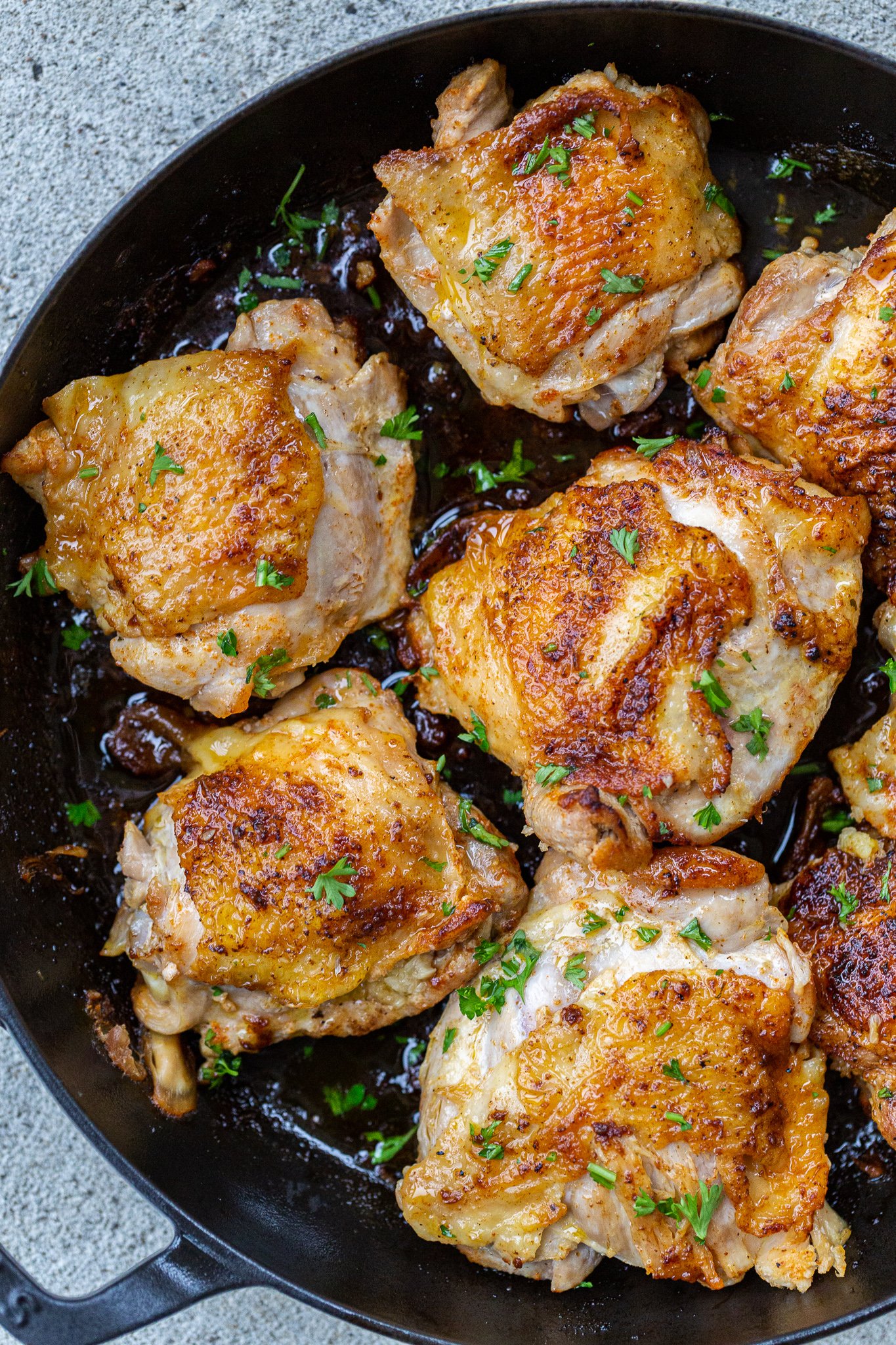
How to Cook Chicken Thighs: 20 Recipes + Complete Guide (Bone-In, Boneless, Skin-On)
Dry brine overnight, cook to 175°F, and start bone-in thighs skin-side down in a cold cast-iron pan — the professional cook's forgiving default.
Chicken thighs cook perfectly when you dry-brine them overnight, pull them at 175°F for pan-sear or roast (195°F for braise), and start bone-in skin-on pieces skin-side down in a cold cast-iron pan on medium heat for 12–15 minutes without touching them. That's the whole game — everything below is why each of those numbers matters and how to hit them on a weeknight.
Get a free week of easy dinners
Seven weeknight dinners with the shopping list already totalled, sent Sunday. No account needed, unsubscribe in one click.
No spam, unsubscribe in one click. Recipes, shopping lists and Instacart carts all work without an account either way.
Why chicken thighs are the professional cook's default
Ask anyone who cooks for a living what cut of chicken they reach for at home and the answer is thighs. Bone-in, skin-on, boneless — take your pick — but not the breast. The reason is simple: thighs are forgiving. Breast meat is 5 g of fat per 3-ounce serving and dries out at 166°F. Thighs run about 11 g of fat per 3 ounces and stay juicy from 170°F all the way to 190°F. That's a 20-degree window versus a 1-degree cliff. If you've ever pulled dry chicken breast from a busy weeknight oven, thighs will feel like cheating.
They also cost less. Boneless skinless thighs run about 30–40 percent cheaper per pound than boneless breast at most US grocery stores as of 2026, and bone-in thighs are cheaper still. The bone conducts heat inward while the meat cooks, which is why bone-in cuts stay juicier and roast more evenly than boneless — a physics trick you don't have to think about, you just get.
What you're trading is a slight cooking-time penalty (bone-in thighs take 30–45 minutes; boneless take 15–20) and the need to render skin fat, which requires a hot enough pan. In exchange you get flavor, forgiveness, and a much wider window between "not done" and "overcooked."
Buying: bone-in vs boneless, skin-on vs skin-off, organic vs conventional
The most common failure at the grocery store is buying the wrong SKU for the recipe. Here's the decision tree:
Bone-in, skin-on — Default choice for pan-searing, roasting, braising, and any dish where you want rendered skin fat to flavor the sauce. Cook time 30–45 min. Best skin crispness comes from this cut because the bone insulates the meat so you can render skin longer without overcooking the interior.
Boneless, skinless — Default choice for stir-fries, curries, kebabs, sheet-pan dinners under 25 minutes, and any weeknight where you need speed. Cook time 15–20 min. You lose the skin as a flavor vector but gain 15 minutes on the clock.
Boneless, skin-on — Rare in US stores but worth asking the butcher for. Best of both worlds: fast cook time (20 min) plus crispy skin. Serious Eats has a good primer on why this cut punches above its weight — see Serious Eats — How to Cook Chicken Thighs for the technique breakdown.
Organic vs conventional — Blind taste tests give organic a mild edge on flavor (slower-growing birds develop more myoglobin) but the difference is real only if you're eating the meat unadorned. Once you add salt, sear, and a pan sauce, the gap closes. Buy organic if it's within your budget; don't feel guilty about conventional. The USDA has good background on labeling categories at FSIS — Chicken From Farm to Table.
Air-chilled vs water-chilled — Most US supermarket chicken is water-chilled: after slaughter the birds ride through a chilled water bath, and they absorb some of it. USDA requires that absorbed water be declared on the label, so you'll see "contains up to 4% retained water" in small type — you are paying meat prices for that water, and the wet surface actively fights skin crisping. Air-chilled birds are cooled by circulating cold air instead, carry 0% retained water, and come out of the package with a drier skin that browns faster and darker. Expect a premium of roughly $1–2/lb at US retail as of 2026. If air-chilled isn't available where you shop, the overnight dry brine below erases most of the difference — that's exactly what it's doing to the skin. Labeling rules for both are covered at FSIS — Chicken From Farm to Table.
Package size — Standard packs run 1.5–2.5 lbs. For a family of four, plan on 6–8 oz of raw bone-in thigh per person (yields ~4–5 oz cooked after bone/skin/rendered fat).
Storing and thawing safely
Fresh chicken thighs keep in the coldest part of your fridge (32–34°F, usually the back-bottom shelf) for 1–2 days. Any longer and freeze them. The FDA and FSIS are strict about the fridge time because Salmonella and Campylobacter populations start doubling every 20 minutes above 40°F.
Freezing: Wrap each thigh individually in plastic wrap, then bag in a freezer zip-top with the air pressed out. Frozen thighs keep 9 months at 0°F without noticeable quality loss. Longer than that and you'll notice freezer burn on the skin edges.
Thawing — three legitimate methods:
1. Fridge thaw — 24 hours per pound. Best for planning ahead. Meat stays under 40°F the whole time.
2. Cold-water thaw — Sealed bag submerged in cold tap water, water changed every 30 minutes. Roughly 30 minutes per pound. Best for weekday cooking when you forgot to pull thighs the night before.
3. Microwave thaw — Fastest but riskiest. Edges start cooking before the center thaws. Only use this if you're cooking immediately after (no refrigeration between microwave and pan).
Never thaw on the counter. The USDA banned this from home-cooking guidance decades ago because the surface temp climbs above 40°F long before the core is thawed. If you've thawed on the counter and the pack sat more than 2 hours, throw it out — the risk isn't worth the $6.
Five cooking methods ranked
Here's the honest ranking of chicken thigh methods for a home cook who wants consistent results on a Tuesday night, ordered by how forgiving they are:
| Method | Time | Cut needed | Skin crispness | Forgiveness |
|---|---|---|---|---|
| Pan sear + oven finish | 25 min | Bone-in skin-on | Excellent | Medium |
| Sheet pan | 35 min | Boneless or bone-in | Fair | High |
| Braise | 45–90 min | Bone-in skin-on | None (skin softens) | Very high |
| Grill | 30 min | Bone-in skin-on | Excellent | Low |
| Air fryer | 25 min | Boneless or bone-in | Very good | High |
1. Pan sear + oven finish (best skin, best sauce) — Heat oven to 400°F. Start bone-in thighs skin-side down in a cold cast-iron skillet on medium. Don't move them for 12–15 minutes until the skin is deeply browned. Flip, transfer skillet to oven for 8–10 minutes until internal temp hits 175°F. Rest 5 minutes. This is the technique in The Best Crispy Pan-Seared Chicken Thighs — the reference recipe if you're new to this method. If you want a garlic-forward variation, Crispy Pan-Seared Chicken Thighs with Garlic and Herbs uses the same technique with an aromatic butter baste in the final 2 minutes.
2. Sheet pan (best for busy weeknights) — Toss thighs with olive oil, salt, and whatever aromatics your recipe calls for. Spread on a rimmed sheet pan (do NOT crowd — leave finger-width space between pieces or the skin will steam instead of crisp). Roast at 425°F, 25–30 min for boneless or 35–40 min for bone-in. Try Sheet Pan Lemon-Garlic Chicken Thighs with Cherry Tomatoes and Zucchini as a weeknight template — the whole thing is one pan and 40 minutes door to plate.
3. Braise (most forgiving, best for entertaining) — Sear thighs skin-side down until browned, remove, build a braising liquid in the fond (wine, stock, tomatoes), nestle thighs back in skin-side up so tops stay exposed, cover, and simmer 40–60 min at 300°F until fork-tender. Red Wine-Braised Chicken Thighs with Pancetta and Mushrooms is the classic coq au vin move; the meat comes off the bone with a spoon.
4. Grill (best flavor, needs attention) — Two-zone fire. Sear skin-side down over direct heat 4 minutes for grill marks, then move to indirect heat and cover the grill until internal temp hits 175°F, about 15 more minutes. Tandoori-Spiced Grilled Chicken Thighs with Mint Yogurt Sauce uses this technique with a yogurt marinade that tenderizes and browns beautifully.
5. Air fryer (easiest cleanup) — 380°F for boneless (18–22 min flipping halfway) or 400°F for bone-in (22–27 min flipping halfway). Air-fried skin isn't quite as crisp as a cast-iron sear but it's close and there's no oil splatter to clean. Start with Crispy Herb-Crusted Air Fryer Chicken Thighs or the simpler Air Fryer Lemon-Garlic Chicken Thighs with Herbs if you're new to air-frying protein.
Internal temperature: 165°F FDA vs 175°F chef's target
This is the single most important number in chicken cookery and where home cooks go wrong most often.
The USDA/FDA safe-cook minimum is 165°F, at which point Salmonella is pasteurized within seconds. Every commercial kitchen and every food-safety curriculum teaches 165°F as the line. If you're cooking for a pregnant person, an immunocompromised person, or an infant, don't cross that line downward.
But here's the nuance the FDA guidance doesn't spell out: pasteurization is a function of temperature and time. Chicken held at 150°F for 3 minutes is as safe as chicken flashed to 165°F. This is why sous-vide chicken breast at 150°F for an hour tastes miraculous — it's pasteurized and moist.
For thighs specifically, the meat doesn't reach its best texture until 170–175°F because that's where the collagen in the connective tissue starts converting to gelatin. Pull at 165°F and the meat is safe but slightly tough; pull at 175°F and the fibers are silky. Above 190°F the meat starts drying, and above 200°F it turns stringy — but the window is huge compared to breast.
The rule: For pan-seared, roasted, grilled, or air-fried thighs, pull at 175°F using an instant-read thermometer probed into the thickest part of the meat, avoiding the bone. For braised thighs, aim 195°F — the surrounding liquid keeps them from drying out.
Don't cook thighs by clock alone. A "6 minutes per side" instruction assumes a specific pan temperature, a specific thigh size, and a specific starting temperature. Change any one and the timing breaks. The thermometer is the great equalizer, and the ThermoWorks Thermapen ONE is the reference product because it reads in under a second, which matters when you're pulling a hot pan from a 425°F oven and don't want to lose skin crispness by leaving the door open.
Named techniques worth learning
Dry brine. Salt bare thighs at 3/4 tsp Diamond Crystal kosher (or 1/2 tsp Morton) per pound the night before. Leave uncovered on a rack in the fridge. Salt draws moisture out of the skin overnight and then the meat reabsorbs it as brine — you get seasoned meat plus dry skin that crisps in a fraction of the time. This is the single biggest upgrade you can make to any thigh recipe.
Spatchcock (for whole birds, but applies to thighs). For extra-large bone-in thighs, use kitchen shears to cut along the bone and open the thigh flat. Cooks 20% faster with more skin exposed to the pan. Not necessary for standard-sized thighs but useful for wholesale-club jumbos.
Reverse sear (for oven-forward recipes). Slow-roast thighs at 275°F until internal hits 155°F (about 40 min), then finish under a broiler 3–4 minutes for skin crispness. Gives you extremely even cooking and dramatic skin — worth the extra time when you have it.
20 chicken thigh recipes from the AislePrompt catalog
Grouped by technique so you can jump straight to what fits your night.
Pan-seared:
- The Best Crispy Pan-Seared Chicken Thighs — the reference recipe
- Crispy Pan-Seared Chicken Thighs with Garlic and Herbs — aromatic butter baste
- Crispy Pan-Seared Chicken Thighs with Lemon and Rosemary — brighter, weeknight-friendly
- Pan-Seared Chicken Thighs with Garam Masala and Tomato Curry — one-pan curry
- Smoked Paprika-Sear Chicken Thighs — Spanish-flavored pan sauce
Sheet pan:
- Sheet Pan Lemon-Garlic Chicken Thighs with Cherry Tomatoes and Zucchini
- Sheet Pan Maple-Glazed Chicken Thighs with Roasted Brussels Sprouts
- Sheet Pan Rosemary-Garlic Chicken Thighs with Rainbow Vegetables
- Sheet Pan Honey-Garlic Glazed Chicken Thighs
Grilled:
- Caribbean Lime and Garlic Grilled Chicken Thighs
- Tandoori-Spiced Grilled Chicken Thighs with Mint Yogurt Sauce
Air fryer:
- Honey-Ginger Glazed Air Fryer Chicken Thighs
- Crispy Herb-Crusted Air Fryer Chicken Thighs
- Air Fryer Lemon-Garlic Chicken Thighs with Herbs
Braised:
- Red Wine-Braised Chicken Thighs with Pancetta and Mushrooms
- Crispy Whole30 Chicken Thighs with Spicy Coconut Curry
Glazed / weeknight:
- Honey Garlic Chicken Thighs — the 30-minute classic
- Honey-Garlic Glazed Chicken Thighs with Roasted Vegetables
- Baked Greek Lemon-Oregano Chicken Thighs
- Honey-Glazed Teriyaki Chicken Thighs
Rice-based (one-pot):
- Sweet Soy-Glazed Chicken Thighs with Steamed Rice
- Honey-Soy Glazed Chicken Thighs with Scallion Rice
- Lemon Herb Chicken Thighs
- Slow-Roasted Garlic and Herb Mediterranean Chicken Thighs
Kitchen equipment: what actually matters
You don't need a lot to cook chicken thighs well. Three tools cover 95 percent of what you'll ever want to do:
A 12-inch Lodge cast-iron skillet — Under $40, lasts 100 years, retains heat like nothing else. This is the correct pan for pan-searing thighs because heat retention is what gives you a dark crust in 12 minutes. Nonstick skillets don't get hot enough. Stainless works but you'll fight for even browning. If you buy one pan for chicken thighs, buy the Lodge — Lodge Manufacturing has been making these in South Pittsburg, Tennessee since 1896.
An instant-read thermometer — The ThermoWorks Thermapen ONE reads in under a second and is accurate to ±0.5°F. Any decent instant-read works, but the fastest ones let you probe multiple thighs without losing pan or oven heat. You cannot cook thighs consistently by feel — even chefs use thermometers.
Long-handled tongs — Whatever brand. You need something that grips the thigh firmly without piercing it (piercing releases juices). Silicone-tipped tongs are gentler on cast iron. Skip the spring-loaded gimmicks — a basic 12-inch pair does everything.
Optional but useful: a rimmed sheet pan (half-sheet size), a Dutch oven or heavy braiser (Le Creuset or a Lodge enameled model both work), and a wire cooling rack that fits inside a sheet pan for reverse-searing.
Real-world numbers: chicken thighs vs alternatives
If you want the nutritional and cost picture at a glance, here's the reality (per 3 oz cooked, USDA data):
| Cut | Calories | Protein (g) | Fat (g) | Cost/lb (US 2026 avg) |
|---|---|---|---|---|
| Bone-in skin-on thigh | 235 | 22 | 16 | $2.99 |
| Boneless skinless thigh | 195 | 24 | 11 | $4.99 |
| Boneless skinless breast | 165 | 31 | 5 | $6.99 |
| Whole chicken (retail) | 205 | 23 | 12 | $2.29 |
Bone-in skin-on thighs are the cheapest cut you can buy short of a whole bird, and they carry the most flavor per calorie. Boneless skinless thighs cost more per pound because someone else did the knife work, but they're still cheaper than breast and cook faster than bone-in. The math strongly favors thighs on any household budget.
Common mistakes and how to avoid them
1. Skipping the dry brine. The single biggest quality upgrade for chicken skin. Salt bare thighs the night before, leave uncovered in the fridge on a rack, and you'll get crispier skin than any technique alone can produce.
2. Crowding the pan. Skin steams instead of browning when thighs are packed edge-to-edge. Leave a finger-width gap between pieces. If you can't fit them all, sear in two batches.
3. Moving the thighs too early. The crust needs 12–15 minutes of unbroken contact time. If you lift a thigh and it sticks, it's not ready — leave it. Once the crust forms, it will release on its own.
4. Starting in a hot pan. For skin crispness, start bone-in skin-on thighs in a cold cast-iron pan on medium heat. Hot pans sear the outside skin before the fat has a chance to render, which leaves the skin rubbery. Cold-start is counterintuitive but reliable.
5. Pulling by clock instead of temperature. A thermometer costs $20–100 and eliminates the guesswork forever. Every "6 minutes per side" instruction is a rough guess about a specific pan on a specific stove.
6. Cooking straight from the fridge. Cold thighs seize when they hit the pan, which hurts browning. Let them sit at room temp 20 minutes before cooking. (Under 2 hours total room-temp time is safe.)
7. Ignoring the fond. After you pull thighs from the pan, there's a layer of browned drippings on the bottom worth its weight in gold. Deglaze with wine, stock, or lemon juice and you have a pan sauce in 90 seconds.
When NOT to use chicken thighs
Thighs aren't the answer to everything. Skip them for:
- Chicken salad — Breast shreds cleaner and doesn't have the deep flavor that fights mayo-based dressings.
- Poached chicken for cold applications — Breast poaches at 150°F without losing texture; thighs need higher heat to break down connective tissue.
- Strict-macro meal-prep — Thighs' extra fat means more calories per gram of protein. If you're counting to the ounce, breast is the leaner choice.
- Chicken nuggets and processed cutlets — Thigh meat is too fibrous; breast slices into uniform cutlets more easily.
For everything else — every weeknight dinner, every braise, every grill session, every meal-prep container — thighs are the right answer.
FAQ
(See the FAQ block at the top of this article for structured answers on temperature, crispy skin, bone-in vs boneless, and overcooking.)
Sources + last verified
Verified as of 2026-07-03 against:
- Serious Eats — How to Cook Chicken Thighs — the pan-sear technique and dry-brine timing
- NYT Cooking — How to Cook Chicken (Guide) — cut selection and cooking-method comparisons
- FSIS/USDA — Chicken From Farm to Table — safe cook temperatures and handling rules
Grocery pricing data from USDA weekly reports and BLS Consumer Price Index Q2 2026. Cost figures are US averages; regional prices vary meaningfully.
Frequently asked questions
Are chicken thighs actually better than chicken breast?
What temperature should chicken thighs be cooked to?
How do I get crispy skin on chicken thighs?
Bone-in or boneless for weeknight cooking?
Can I overcook chicken thighs?
Sources
Plan a week of meals in two minutes.
Tell our AI what you have and what you like — it builds your plan, shopping list, and Instacart cart. No account needed.
Try free →