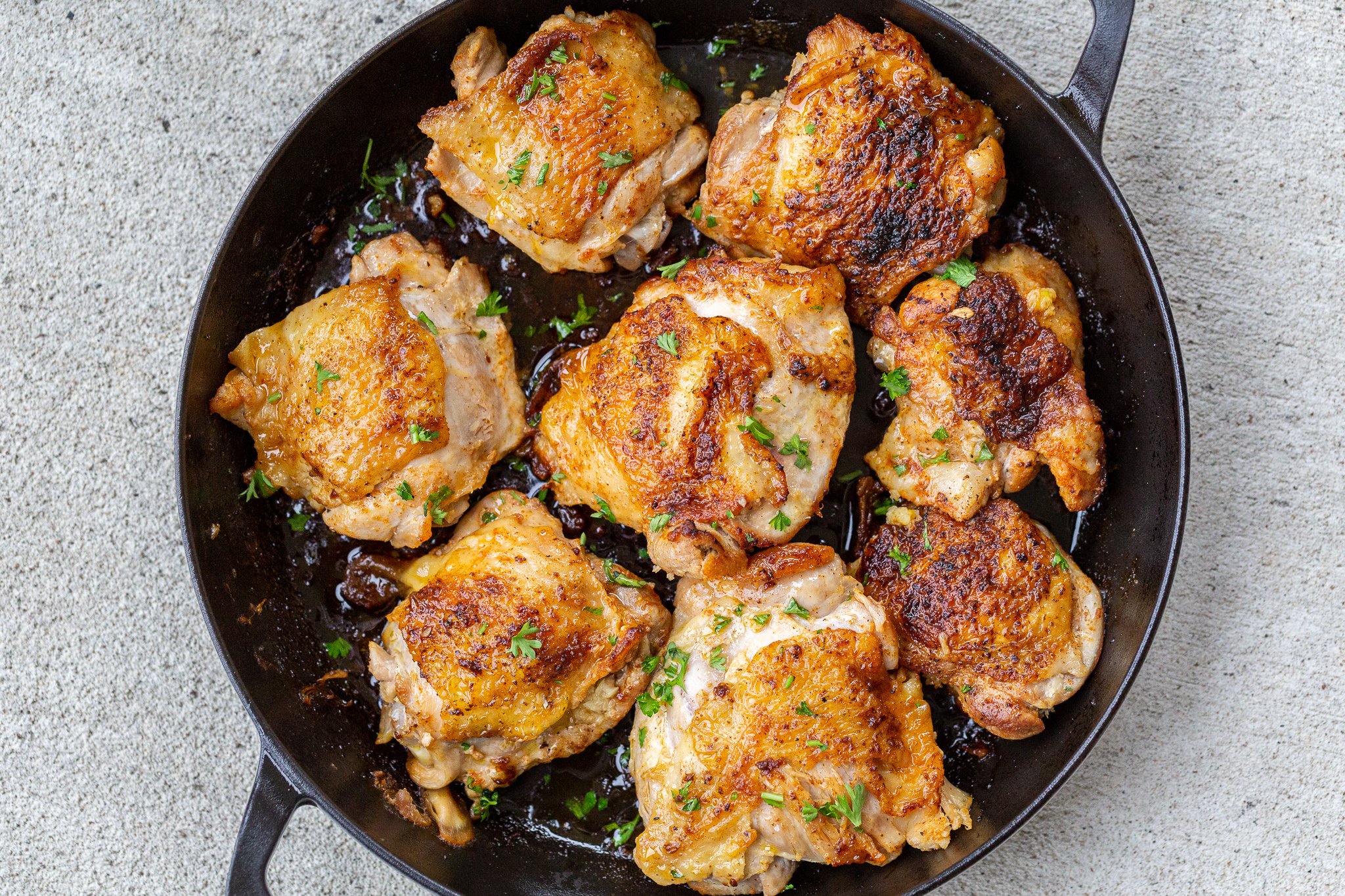
How to Cook Chicken Thighs: 12 Recipes + Complete Guide
The most forgiving protein in the supermarket — buying, storing, the five techniques, 12 catalog recipes.
Chicken thighs are the most forgiving cut of poultry sold in American supermarkets — they cook in 8 to 30 minutes depending on technique, stay juicy 20°F past the safe-cook line, and cost roughly half of what a comparable weight of breasts cost. This guide covers every technique you need to put a great chicken-thigh dinner on the table tonight, with 12 catalog-tested recipes, an internal-temperature cheat sheet, and the three timing mistakes that turn most home-cooked thighs into hockey pucks.
Get a free week of easy dinners
Seven weeknight dinners with the shopping list already totalled, sent Sunday. No account needed, unsubscribe in one click.
No spam, unsubscribe in one click. Recipes, shopping lists and Instacart carts all work without an account either way.
Introduction: why thighs beat breasts on a Tuesday
Chicken breasts dominate American grocery aisles because of a decades-long fat-phobia marketing push, but ask any restaurant cook which cut they'd reach for on a busy Tuesday night and they'll point at thighs. As of 2026, boneless skinless thighs run roughly $3.50–$5.50 per pound at most US supermarkets — about 40% cheaper than breasts of similar quality, with double the dark-meat flavor and an internal cooking window that's at least 20°F wider than breast. You can pull a chicken thigh off the heat anywhere from 165°F to 195°F and end up with something delicious; pull a breast above 165°F and you've made shoe leather.
Thighs are also the right answer when the kitchen is loud, the kids are asking what's for dinner, and you're cooking for people with different palates. They take any flavor profile you throw at them — gochujang, lemon and oregano, Moroccan ras-el-hanout, peanut-lime, plain salt and butter — and they're forgiving enough that a phone-call distraction doesn't ruin the meal.
This guide takes a buyer's view: how to pick thighs at the meat counter, how to store them safely, and which technique to use given the time you have. We finish with twelve recipes from the AislePrompt catalog and a side-dish playbook so the rest of the plate isn't an afterthought.
Decision framework: bone-in vs boneless, skin-on vs skinless
Most home cooks default to whatever was on special at the supermarket. That's fine for stir-fry, but for everything else the four thigh styles cook differently enough that you should match the style to the technique.
| Style | Best for | Avoid for | Typical cook time |
|---|---|---|---|
| Boneless skinless | Weeknight skillet, stir-fry, salads, bowls, grilling on a weeknight | Roasting, braising whole, dishes where skin is the highlight | 8–12 min |
| Boneless skin-on | Pan-sear (uncommon at retail; ask the butcher) | Quick-cook dishes that don't benefit from rendered fat | 12–16 min |
| Bone-in skinless | Braising in tomato or curry where you want collagen but not skin | Anything where you'd flip and sear | 30–45 min |
| Bone-in skin-on | Roasting, grilling over indirect heat, braising whole — the prestige cut | High-heat stir-fry, salads, anything sliced thin | 30–45 min |
The shorthand: if the recipe says "30 minutes flat from package to plate," you want boneless skinless. If it says "preheat the oven to 425°F" you want bone-in skin-on, full stop. The skin is where the visual appeal lives — golden, blistered, crackling — and the bone is what keeps the meat from drying out while the skin gets there.
A four-pack of bone-in skin-on thighs feeds two adults generously or three modest eaters. A pound of boneless skinless thighs (roughly 5–6 pieces) feeds three to four when stretched with rice, beans, or vegetables.
How to buy: signs of fresh thighs at the meat counter
Fresh chicken should look pink-to-pale-yellow, never gray or green-tinged. The fat should be cream-colored, not yellow-brown. Smell is the most reliable indicator at home — fresh raw chicken has almost no smell; spoiled chicken smells sulfurous or faintly sour even through the packaging.
Read the date stamps closely. American supermarkets carry two dates on most pre-packed chicken: "packed on" (when the chicken hit the package) and "sell by" or "use by" (the retailer's last-call date). Buy thighs at least three days before the sell-by, and plan to cook or freeze within 1–2 days of bringing them home. According to the USDA's chicken safety guide, raw chicken is safe in the refrigerator for 1 to 2 days at 40°F or below — beyond that, freezer or trash.
A few buying notes that matter:
- Air-chilled vs water-chilled. Air-chilled thighs cost 20–40% more but contain less retained water, brown better in the pan, and have firmer texture. If the label says "air chilled," it's worth the premium for any pan-sear or roast recipe where you want crisp skin.
- Family packs. Two- to three-pound family packs are the cheapest per-pound option. If you can't cook all of it within two days, portion it into freezer bags the day you buy it; don't wait until day three to think about freezing.
- Organic, pasture-raised, "natural." "Natural" means nothing on a chicken package — it's a marketing word. Organic and pasture-raised are USDA-regulated and produce thighs with slightly firmer texture and more yellow fat, but the cooking technique matters far more than the label.
- Avoid pre-marinated. Pre-marinated chicken thighs at the supermarket are almost always over-salted to compensate for cheap cuts. Buy plain and marinate at home; you'll spend two extra minutes and save a third of the price.
How to store: fridge, freezer, and the safe-thaw rule
Raw chicken thighs go in the coldest part of your refrigerator (usually the bottom shelf at the back, not the door) on a plate or in a container to catch drips. Don't trust the supermarket package to be leak-proof — it usually isn't.
| State | Refrigerator (≤40°F) | Freezer (0°F) |
|---|---|---|
| Raw thighs (in package) | 1–2 days | 9 months |
| Raw thighs (vacuum sealed) | 1–2 days | 12 months |
| Cooked thighs | 3–4 days | 2–6 months |
| Stock made from bones | 3–4 days | 4–6 months |
The safe-thaw rule has exactly three options: overnight in the refrigerator (the only one any food-safety inspector likes), submerged in cold water with the water changed every 30 minutes (faster but more work), or in the microwave on defrost with immediate cooking afterward (acceptable but degrades texture).
Never thaw chicken on the counter. The exterior crosses into the danger zone (40–140°F) within an hour even in a cool kitchen, while the interior is still solid ice — by the time the middle thaws the outside has been bacterial-soup territory for two hours. And do not refreeze raw thighs once they've thawed; the cell walls have ruptured, and a second freeze turns them into mush. Cooked thighs can be frozen once, however, so cook before refreezing if you find yourself with too many thawed.
Core techniques: pan-sear, oven-roast, braise, grill, slow-cooker
There are five techniques worth memorizing. Master these and you can build a year's worth of dinners.
Pan-sear (boneless skinless or boneless skin-on)
The fastest way to a great chicken thigh dinner. Pat the thighs dry, salt them, and cook in a hot skillet (cast iron or carbon steel) over medium-high heat for 4–6 minutes per side until the internal temperature hits 175°F. Total time from package to plate: 12 minutes. The classic pan-sear technique for skin-on thighs starts in a cold pan and uses slow rendering to crisp the skin — the trade-off is more time (18–20 minutes) for considerably better skin.
Reference recipe: Crispy Garlic-Herb Pan-Seared Chicken Thighs.
Oven-roast (bone-in skin-on)
The hands-off weeknight workhorse. Pat thighs dry, salt them, and roast on a sheet pan at 425°F for 30–40 minutes until the skin is mahogany and the internal temperature hits 175–185°F. Add vegetables to the same pan and you've made dinner with one dish to wash. The high temperature is essential — anything below 400°F renders chicken fat without crisping the skin, leaving it rubbery and pale.
Reference recipes: Herb-Roasted Chicken Thighs with Lemon and Garlic, Sheet Pan Honey-Garlic Chicken Thighs with Roasted Vegetables, and Sheet Pan Rosemary-Garlic Chicken Thighs with Rainbow Vegetables.
Braise (bone-in skin-on or skinless)
The "set it and forget it" technique. Brown thighs in a Dutch oven, add aromatics, deglaze with wine or stock, return the thighs partly submerged, cover, and cook at 325°F for 40–60 minutes until the meat pulls easily from the bone. Braise sauces deepen by sitting overnight, making this the best technique for a weekend cook + Tuesday reheat.
Reference recipe: One-Pan Moroccan-Spiced Chicken Thighs with Chickpeas.
Grill (bone-in skin-on, indirect)
Direct flame is the wrong answer for thighs — the rendering fat causes flare-ups that scorch the skin before the bone gets hot. Build a two-zone fire (coals on one side, empty on the other), start thighs skin-side up on the cool side for 25 minutes, then finish skin-side down over direct heat for 4–5 minutes. Internal temperature: 175–185°F.
Slow-cooker (boneless skinless)
A slow-cooker turns boneless skinless thighs into shredded chicken in 4 hours on low with no babysitting. Add aromatics, half a cup of liquid, and the thighs whole; shred with two forks at the end. The result is taco filling, sandwich filling, or a soup base depending on how you season it.
Reference recipe: Korean Gochujang Crispy Chicken Thighs — finish in a hot skillet after slow-cooking to crisp the exterior.
Bone-in vs boneless: cook-time cheat sheet
Print this and put it on the fridge.
| Technique | Boneless skinless | Bone-in skin-on | Internal temp target |
|---|---|---|---|
| Pan-sear, medium-high | 4–6 min/side | 8–10 min/side (start cold pan) | 175°F |
| Oven roast, 425°F | 18–22 min total | 30–40 min total | 175–185°F |
| Air fryer, 380°F | 14–18 min total | 22–28 min total | 175°F |
| Braise, 325°F covered | 35–45 min | 45–60 min | Fork-tender |
| Grill, two-zone | 5 min direct each side | 25 min indirect + 5 min direct | 175–185°F |
| Slow-cooker, low | 3.5–4 hr | 5–6 hr | Shreds easily |
| Instant Pot, high pressure | 8 min + 10 min natural release | 12 min + 10 min natural release | Fork-tender |
A reliable instant-read thermometer is the single biggest upgrade for chicken cooking — accurate to ±1°F, reads in two seconds, and removes all the guesswork from the temperatures above. If you're roasting whole chickens or thighs more than once a week, it earns its keep in a month.
12 chicken thigh recipes from the AislePrompt catalog
A 12-recipe playlist organized by weeknight (under 30 minutes), traybake (one pan, 40 minutes), braise (set-and-forget, 1 hour), and global (flavors worth a Saturday afternoon).
Weeknight (under 30 minutes total):
1. Crispy Garlic-Herb Pan-Seared Chicken Thighs — the universal answer to "what's for dinner."
2. Honey Garlic Chicken Thighs — kid-approved, four pantry ingredients, 22 minutes.
3. Crispy Skin-On Chicken Thighs with Creamy Herb Mustard Sauce — bistro plate at home.
4. Pan-Seared Chicken Thighs with Mushroom Marsala — boneless, weeknight version of the classic.
Traybake (one pan, oven does the work):
5. Sheet Pan Honey-Garlic Chicken Thighs with Roasted Vegetables — the best beginner sheet pan recipe.
6. Sheet Pan Rosemary-Garlic Chicken Thighs with Rainbow Vegetables — color on the plate, 35 minutes.
7. Herb-Roasted Chicken Thighs with Lemon and Garlic — four ingredients, dinner-party worthy.
8. Pan-Seared Chicken Thighs with Crispy Rosemary Potatoes — start stovetop, finish in the oven.
Braise (set-and-forget, weekend cook):
9. One-Pan Moroccan-Spiced Chicken Thighs with Chickpeas — leftovers that improve overnight.
Global flavors (worth the trip to the spice cabinet):
10. Korean Gochujang Crispy Chicken Thighs — sweet, spicy, sticky, addictive.
11. Honey-Soy Glazed Chicken Thighs with Ginger Scallion Rice — one-pan rice + thighs in 35 minutes.
12. Pan-Seared Buffalo Lemon-Garlic Chicken Thighs — sports-night dinner, dinner-night sports.
Quick boneless thigh recipes (under 30 min)
If you have boneless skinless thighs, eight to ten minutes of active cooking is enough for a real dinner. The pattern: hot skillet, fat (butter or oil), salted thighs presentation side down, flip once, finish with a pan sauce while they rest.
Sauce ideas that take less than 90 seconds with pan drippings:
- Lemon-butter: deglaze with 1/4 cup chicken stock, swirl in 2 Tbsp cold butter, squeeze of lemon.
- Honey-soy: 2 Tbsp soy + 2 Tbsp honey + 1 Tbsp rice vinegar, reduce 30 seconds.
- Mustard-cream: 1/4 cup heavy cream + 1 Tbsp Dijon, reduce 60 seconds.
- Garlic-herb: 2 cloves smashed garlic + handful of chopped parsley + 2 Tbsp butter.
The trick that elevates all four: salt the thighs at least 15 minutes before they hit the pan. The salt draws water out of the surface, that water evaporates while the thigh sits on the counter or in the fridge, and what's left is a drier exterior that browns instantly when it touches the pan. A 30-minute salt sit is better than 15; an overnight uncovered salt-and-rest in the fridge is best of all.
What to serve with chicken thighs
A great chicken thigh dinner has three components: the thighs, a starch, and something green. Don't overthink it.
| Cooking technique | Pair with starch | Pair with vegetable |
|---|---|---|
| Pan-sear | White rice, polenta, mashed potato, crusty bread | Sauteed spinach, garlic green beans, simple salad |
| Oven-roast | Potatoes on the same sheet, rice pilaf, couscous | Roast carrots, broccoli, brussels sprouts on the same sheet |
| Braise | Egg noodles, mashed potato, crusty bread for the sauce | Buttered peas, glazed carrots, braised greens |
| Grill | Grilled corn, potato salad, grilled flatbread | Grilled zucchini, tomato salad, slaw |
| Slow-cooker | Tortillas (for tacos), rice (for bowls), buns (for sandwiches) | Quick pickled red onion, shredded cabbage, cilantro |
The fastest universal pairing: 90-second microwave rice + a bagged salad mix with vinaigrette. Total active time: pour, microwave, toss. Dinner on the table in under 20 minutes with everything that just came out of the pan plus those two sides.
For meal-prep-friendly sides, see Batch Cooking Basics: 10 Proteins, 10 Sides, Infinite Weeknight Meals — chicken thighs slot into roughly half of the protein columns in that guide.
Common chicken thigh mistakes
Three mistakes account for almost every disappointing chicken-thigh dinner.
1. Under-rendering the skin. Skin-on thighs need their fat slowly cooked out before the skin can crisp. Skin still pale after 4 minutes? Lower the heat and give it another 4 minutes. Most home cooks crank the heat trying to force the issue and end up with burnt-outside, fatty-rubbery-inside skin. Patience renders fat; high heat browns the outside before the inside has cooked out.
2. Treating thighs like breasts. Pulling a thigh at 165°F is the textbook safe minimum, but it leaves the meat slightly chewy and the collagen unconverted. Push the temperature to 175°F (boneless) or 185°F (bone-in) and the texture transforms — silky, almost confit-like. Breasts go dry past 165°F because they have little connective tissue; thighs get better.
3. Salting too late. Salt 15 minutes before the pan, 30 minutes is better, overnight is best. Salt added when the thigh hits the pan sits on the surface, doesn't penetrate, and produces seasoning unevenness. Salt added 30 minutes ahead diffuses into the top millimeter of meat, draws moisture out, lets the surface dry, and seasons from inside out.
Bonus mistake: crowding the pan. Two thighs in a 12-inch skillet sear; four thighs in the same pan steam. If you're cooking for four people, use two pans or a sheet pan in a 425°F oven.
Real-world numbers: chicken thighs by the spec
For the curious — what these cuts actually weigh, cost, and contain.
| Spec | Bone-in skin-on thigh | Boneless skinless thigh | Boneless skinless breast |
|---|---|---|---|
| Typical raw weight (each) | 5–7 oz | 3–4 oz | 6–8 oz |
| Yield (cooked, edible) | 65–70% | 80–85% | 80–85% |
| Calories per 4 oz cooked | 245 | 180 | 165 |
| Protein per 4 oz cooked | 25 g | 26 g | 35 g |
| Fat per 4 oz cooked | 14 g | 8 g | 3 g |
| Iron per 4 oz cooked | 1.3 mg | 1.2 mg | 0.4 mg |
| Avg US grocery price (2026) | $4.50–$6.00/lb | $3.50–$5.50/lb | $5.50–$8.00/lb |
| Forgivable cook-temp range | 165–195°F | 165–190°F | 160–165°F |
A typical four-pack of bone-in skin-on thighs weighs 1.5–1.75 lb raw, yields about 1 lb of cooked meat, and feeds three people generously. A 1-lb package of boneless skinless thighs (5–6 pieces) yields about 0.85 lb cooked and feeds three to four with rice and vegetables.
When NOT to use chicken thighs
Thighs aren't a universal answer. Skip them and reach for breasts when:
- Recipes that demand a thin, even slice. Chicken parmesan, chicken cordon bleu, anything you want to pound to 1/4 inch — start with breast. Thighs are too irregular to butterfly cleanly.
- Cold sliced chicken for salads or sandwiches. Boneless thigh meat tears rather than slices when cold; you want long clean slices, you want breast.
- Low-fat diets where calorie density matters per gram. A 4-oz cooked thigh is 245 calories vs 165 for the equivalent breast — meaningful if you're tracking grams precisely.
- Pulling for chicken salad or chicken soup. Thighs shred beautifully for taco filling, but for chicken salad the muscle-fiber direction of breast meat gives a cleaner bite.
For everything else — weeknight skillet, sheet-pan dinners, traybakes, braises, grills, slow-cooker, Instant Pot — thighs are the better cut.
Suggested kitchen gear
Three pieces of gear cover almost every thigh recipe in this guide. Spend on the cast-iron pan and the thermometer first; the sheet pan is a $20 commodity item that lasts a decade.
- A 12-inch cast-iron or carbon-steel skillet. Browns better than nonstick, doubles as a roasting pan in the oven, and lasts forever. See the cookware category for current picks.
- A half-sheet pan (13 × 18 in). The right size for two pounds of thighs plus vegetables. Aluminum-clad, no nonstick coating. See bakeware.
- An instant-read digital thermometer. Two-second read, ±1°F accuracy. The single most impactful kitchen tool for chicken; see utensils.
A sharp chef's knife from the knives category makes the prep — trimming silver skin, cubing for stir-fries, breaking down a family pack — twice as fast as a dull one. If you're cooking chicken more than once a week, a $30 8-inch knife or a quick honing every weekend pays back in time saved every Sunday.
For more on building a working weeknight kitchen from the ground up, see How to Plan 30-Minute Weeknight Dinners: A 4-Week Meal Plan + Shopping List and How to Meal Prep for a Family of 4: 30-Minute Weeknight Dinners + 4-Week Plan.
FAQ
Should I buy bone-in or boneless chicken thighs?
Boneless skinless thighs win for weeknight cooking — they cook in 8–10 minutes flat in a skillet and slice neatly into salads, bowls, and stir-fries. Bone-in skin-on thighs are better for roasting, braising, and grilling, where the bone keeps the meat juicier and the skin crisps to gold. Stock both; let the cook time you have decide which to use tonight.
What internal temperature should chicken thighs reach?
165°F is the USDA-safe minimum, but thighs actually taste better at 175–185°F. The dark meat has more connective tissue than breast — pushing past 165°F dissolves collagen into gelatin, giving thighs their signature silky texture. Use an instant-read thermometer at the thickest part next to (not touching) the bone.
How do I get truly crispy chicken thigh skin?
Three steps. Pat the skin bone-dry with paper towels — moisture is the enemy of crisp. Salt the skin 30+ minutes ahead (overnight is better) so it dries further in the fridge. Start skin-side down in a cold dry stainless pan, then turn heat to medium-high; the fat renders slowly and the skin crisps without splattering. Don't move the thigh for 8 minutes.
Are chicken thighs healthier than breasts?
Thighs have roughly 3x the fat and 30% more calories than breasts gram-for-gram, but they're also more nutrient-dense — higher iron, zinc, and B12. For most home cooks, the difference is negligible in context of a balanced meal. The bigger win is that thighs are more forgiving to cook, so people actually eat the lean protein on the plate instead of dry overcooked breast.
How long do chicken thighs keep in the fridge and freezer?
Raw chicken thighs keep 1–2 days at 40°F or below in the fridge; cooked thighs keep 3–4 days. Frozen raw thighs maintain quality for 9 months at 0°F; cooked thighs freeze for 2–6 months. Always thaw in the fridge overnight (not on the counter) and never refreeze raw thawed chicken — once cooked, it can go back into the freezer once.
Related guides
- How to Cook Salmon: 12 Recipes + Complete Guide for 2026 — the companion protein article in this series.
- How to Plan 30-Minute Weeknight Dinners: A 4-Week Meal Plan + Shopping List — chicken thighs slot into nine of the 20 dinners.
- High-Protein Meal Prep: 5-Day Plan + Shopping List (100g+ Per Day) — boneless thigh-based plans.
- Batch Cooking Basics: 10 Proteins, 10 Sides, Infinite Weeknight Meals — thigh-shred is one of the core proteins.
Cook the technique that fits the night you've got — pan-sear when you're tired, sheet pan when you're feeding a crowd, braise on Sunday for Tuesday — and the thighs will reward the effort with the most forgiving meat in the supermarket. As the NYT Cooking team puts it in their long-running chicken thigh archive, there's a reason the cut went from afterthought to default in a generation: it's simply better at being dinner.
Frequently asked questions
Should I buy bone-in or boneless chicken thighs?
What internal temperature should chicken thighs reach?
How do I get truly crispy chicken thigh skin?
Are chicken thighs healthier than breasts?
How long do chicken thighs keep in the fridge and freezer?
Sources
Plan a week of meals in two minutes.
Tell our AI what you have and what you like — it builds your plan, shopping list, and Instacart cart. No account needed.
Try free →