How to Cook Salmon: 12 Recipes + Complete Guide for 2026
Five reliable methods, twelve recipes from the catalog, and the five tools that handle every one.
Salmon is the most forgiving fish you can buy. It has enough fat to survive a slightly overcooked center, enough firmness to flip without falling apart, and a flavor that pairs with almost any rub, glaze, or acid you already have in the pantry. If you have ever burned a tuna steak or turned cod into rubber, salmon is the place to rebuild your confidence at the stove. This guide walks through five reliable cooking methods, what to look for at the counter, how to tell when it is done, and the twelve recipes from the AislePrompt catalog we cook on actual weeknights.
Get a free week of easy dinners
Seven weeknight dinners with the shopping list already totalled, sent Sunday. No account needed, unsubscribe in one click.
No spam, unsubscribe in one click. Recipes, shopping lists and Instacart carts all work without an account either way.
Why salmon is the easiest fish to nail at home
Most fish failures come from two places: drying out lean fillets like cod or tilapia, and tearing delicate skin during the flip. Salmon sidesteps both. A 6-ounce farmed Atlantic fillet carries roughly 13 grams of fat — more than a beef tenderloin steak of the same size — and that fat keeps the muscle moist even when you overshoot the target internal by 5°F. The skin, once dried and seared properly, releases from the pan on its own and crisps to chip-grade crunch.
The other reason salmon is the gateway fish: the visual doneness cues are obvious. Translucent center, opaque exterior, a fork that slides through with light pressure. You don't need a thermometer to get a good result the first time, though we still recommend one (more on that below). And because salmon cooks fast — eight to twelve minutes for a half-inch-thick fillet on any method — you can run a one-pan dinner from raw protein to plate in less time than it takes to boil pasta.
For the American Heart Association's two-servings-per-week guideline on fatty fish, salmon is the most convenient route. A 3.5-ounce serving delivers roughly 2 grams of EPA + DHA omega-3s — more than five times what a similar serving of chicken or pork delivers, with the cardiovascular benefits the AHA cites.
How to buy salmon
There are four decisions to make at the counter: species, wild vs. farmed, fresh vs. frozen, and fillet vs. steak. Get these right and the cook method almost takes care of itself.
Species and origin
The five common species in US supermarkets, ranked by flavor intensity from mildest to most pronounced:
| Species | Wild or farmed | Color | Typical price (USD/lb) | Best for |
|---|---|---|---|---|
| Atlantic | Almost always farmed | Pale orange-pink | $9–14 | Weeknight dinners, kid-friendly |
| Coho | Wild or farmed | Medium red-orange | $14–20 | Roasts, grilling |
| Sockeye | Wild only | Deep crimson | $18–25 | Grilling, sushi-grade preps |
| King (Chinook) | Wild or farmed | Pale to deep red | $25–40 | Special occasions, low-and-slow |
| Pink | Wild only | Light pink | $5–9 | Cakes, chowder, budget meals |
Seafood Watch maintains an up-to-date sustainability rating for each species and source. As of 2026, US-farmed Atlantic in land-based recirculating systems and Alaska wild sockeye are both rated "Best Choice." Skip Chilean farmed Atlantic — it remains "Avoid" because of ongoing environmental and antibiotic concerns.
Fresh vs. frozen
Frozen wins more often than people think. Almost all "fresh" Atlantic salmon at a US supermarket counter has been previously frozen at sea, then thawed by the retailer — meaning you are paying a premium for thaw service and starting the freshness clock the moment it hits the case. If you can find vacuum-sealed frozen fillets (most warehouse clubs and the wild Alaska section of better grocers carry them), buy those instead. They thaw to a texture indistinguishable from never-frozen at home.
The one exception: if the case has a labeled "fresh — never frozen" sign and the fish has a tight, slightly springy texture with no fishy odor, that is genuinely fresh and worth grabbing for sashimi or ceviche where texture matters most.
Color, smell, and texture
Hold the fillet up to the light. You want a clean, even color without gray bruising along the edges and without dry-looking white "gaping" between muscle fibers — gaping means the fish was handled rough or sat too long. The flesh should spring back when pressed and look glossy, not dry. The smell should be clean and oceanic; any ammonia or "fishy" note is a hard pass.
Fillet, steak, or whole side
For all five methods below, a 6- to 8-ounce skin-on fillet is the right cut. Steaks (cross-section, bone-in) hold up to grilling but are harder to portion and serve. A whole side (1.5–3 lb) is the move for dinner parties and slow-roasting; ask the counter to leave the skin on and remove the pin bones.
How to store salmon
| Storage method | Window | Notes |
|---|---|---|
| Fridge, unopened, in original packaging | 1–2 days | Coldest shelf, usually the back-bottom |
| Fridge, opened or repacked | Cook within 24 hours | Pat dry and store on a paper towel over a plate |
| Freezer, vacuum-sealed | 3 months | No quality drop |
| Freezer, plastic-wrapped only | 4–6 weeks | After that, freezer burn dominates |
| Cooked salmon, fridge | 3 days | Eat cold or warm gently to 110°F |
The right thaw method matters more than people realize. Move the fillet from freezer to fridge 18–24 hours before you plan to cook for the cleanest texture. If you forgot, seal the still-frozen fillet in a zip-top bag and submerge in a bowl of cold tap water; a 6-ounce fillet thaws in 20–30 minutes. Never thaw at room temperature — the outside hits the bacterial danger zone before the inside is workable.
How to season salmon
Salmon's natural fat carries spice better than chicken or pork, so don't be timid. These four dry rubs work on every method below — pat the fillet dry, rub a thin layer of neutral oil on the flesh side first to help the spice stick, then dust evenly.
| Rub | Use when | Ingredients (per 4 fillets) |
|---|---|---|
| Classic salt-pepper-lemon | You want the salmon to taste like salmon | 1 tsp kosher salt, ½ tsp black pepper, zest of 1 lemon |
| Cajun blackening | Pan-sear or grill, crusty exterior | 2 tsp paprika, 1 tsp garlic powder, 1 tsp oregano, ½ tsp cayenne, 1 tsp kosher salt |
| Brown sugar + dill | Slow-roast or oven-bake | 2 Tbsp brown sugar, 1 Tbsp dried dill, 1 tsp salt, ½ tsp pepper |
| Miso-honey glaze | Air-fry or broil at the end | 2 Tbsp white miso, 1 Tbsp honey, 1 tsp soy sauce, 1 tsp rice vinegar |
For glazes (the miso-honey row), brush on in the last 2 minutes of cook time. Sugar in the glaze burns above 350°F surface temperature, so applying it early leaves you with bitter char instead of caramelization.
Method 1: Pan-seared salmon — step-by-step
This is the technique most home cooks botch, and the fix is almost always the same: the pan was not hot enough and the fish was not dry enough. Get those two right and pan-seared salmon takes 8 minutes start to finish.
You will need a 10- or 12-inch stainless or carbon-steel skillet. Non-stick works but you sacrifice the deep brown crust. Cast iron also works but heats unevenly on most home burners. A reliable mid-priced stainless skillet from our cookware buying guide handles this dish for life.
1. Pat the fillet bone-dry on every surface. Press paper towels into the skin side and the flesh side; if there is any moisture, the fish will steam instead of sear. This step alone fixes 80 percent of pan-stick complaints.
2. Salt the flesh side 10 minutes before cooking. Salt pulls a thin film of moisture out, then re-absorbs it as a brine. The result is firmer, more seasoned salmon.
3. Preheat the pan over medium-high for 2½ minutes. A drop of water should ball up and skate across the surface (Leidenfrost effect). Add 1 tablespoon of high smoke-point oil — avocado, refined sunflower, or grapeseed — and swirl. The oil should shimmer but not smoke.
4. Lay the fillet skin-side down, away from you. Press gently with a fish spatula for the first 15 seconds so the skin makes full contact. Then leave it alone.
5. Cook 4 minutes on skin side. The skin should crisp and release on its own — if you cannot slide a spatula under it, give it 30 more seconds. The flesh will go opaque about ⅔ of the way up the side; that is your visual cue to flip.
6. Flip once, cook 2 minutes on flesh side, off the heat. Carry-over does the rest. Pull at 125°F internal, rest 2 minutes, serve.
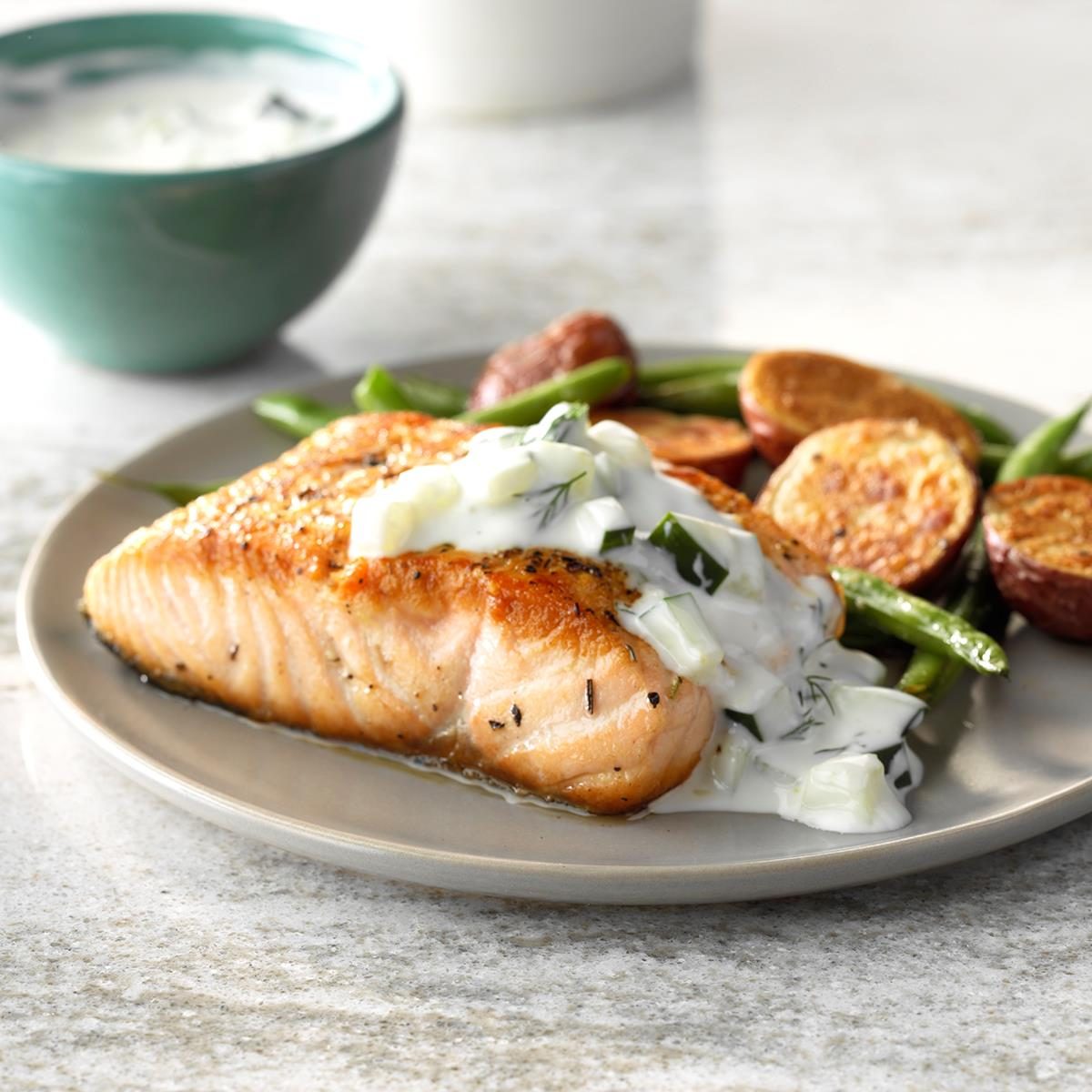
For the canonical execution with a pan sauce, see Pan-Seared Salmon with Lemon-Dill Sauce and Roasted Fingerling Potatoes — 287 ratings, 4.6 stars, and the photo at the top of this article.
Method 2: Oven-baked salmon at 400°F
The easiest weeknight method. One sheet pan, 12–15 minutes, almost zero technique.
Heat the oven to 400°F. Line a half-sheet pan with parchment. Lay the fillets skin-side down with at least an inch between them. Brush with olive oil, salt, pepper, and any rub from the table above. Bake until the thickest part reads 125°F — usually 12 minutes for a half-inch fillet, 15 for ¾-inch. Rest 3 minutes.
The half-sheet pan move: lay asparagus, broccoli, or cherry tomatoes around the fillets in the same pan. They roast in the salmon's drippings and you get a one-pan dinner. The reference recipe is Half-Baked Garlic Butter Salmon with Roasted Asparagus — works with any green vegetable that finishes in 12 minutes.
Method 3: Air-fryer salmon — 8 minutes
Air-fry has quietly become the fastest path from frozen-or-fresh fillet to dinner plate, with a textural payoff (crisp top, moist center) that beats the oven. The key numbers:
- Fresh, thawed fillet, ¾ inch thick: 8 minutes at 400°F
- Fresh, thawed fillet, 1 inch thick: 10 minutes at 400°F
- Frozen fillet, ¾ inch thick: 12–14 minutes at 380°F
No preheat needed on most modern baskets. Brush with oil so the surface dehydrates and crisps rather than going leathery. For frozen, pat dry hard with paper towels after 3 minutes once the surface ice melts — this is the single move that separates great air-fry salmon from soggy. The catalog reference is Air Fryer Teriyaki Salmon with Steamed Broccoli, which lands at exactly 8 minutes and pairs with our top picks in small appliances.
Method 4: Grilled salmon — wood plank or direct
Direct grilling sticks. Plank grilling does not. That is the entire decision.
Direct on grates: Oil the grates twice — once before pre-heat, once after the grates hit 450°F. Brush the salmon with oil. Lay skin-side down at a 45° angle. Cook 4 minutes, flip 90° (for grill marks), 2 more minutes, flip to flesh side for 1–2 minutes. Yields a crisp skin and a 125°F center if the fillet is ¾ inch thick.
On a cedar plank: Soak the plank in water for at least an hour. Light one side of the grill for indirect heat. Lay the salmon on the plank, place over the unlit side, close the lid, hold 350–400°F for 18–22 minutes. The plank smolders and infuses the fish with woodsmoke — no flipping, no sticking. This is the right move for whole sides serving 6+ people. The catalog reference is Roasted Wild Salmon with Cedar-Plank and Pine-Smoked Vegetables.
Method 5: Slow-roasted salmon — the foolproof dinner-party method
Slow-roasting at 250–275°F is the technique to pull out when you have guests and cannot babysit the oven. The temperature differential is so small between the oven air and the target internal that overcooking by 5 minutes does nearly nothing. The texture comes out silken, almost like good gravlax.
Heat the oven to 275°F. Brush a half-sheet pan with olive oil. Lay a whole side of salmon (1.5–3 lb) skin-side down. Salt, top with a few thinly-sliced lemon rounds and a handful of fresh dill or tarragon. Roast 25–35 minutes until the thickest part reads 120°F internal. Rest 5 minutes. Carry-over takes the center to 125°F by serving time.
This method also works for the make-ahead crowd. A whole side slow-roasted on Sunday yields 4–5 days of cold flaked salmon for grain bowls, sandwiches, and salads.
Top 12 salmon recipes from the AislePrompt catalog
The catalog ranks recipes by user ratings, ingredient availability, and how often readers actually save them to their meal plan. These twelve are the most-used salmon recipes across all five methods above.
| # | Recipe | Method | Cook time |
|---|---|---|---|
| 1 | Pan-Seared Salmon with Lemon-Dill Sauce and Roasted Fingerling Potatoes | Pan-sear | 30 min |
| 2 | Half-Sheet Pan Honey Garlic Salmon with Roasted Vegetables | Oven-bake | 25 min |
| 3 | Half-Baked Garlic Butter Salmon with Roasted Asparagus | Oven-bake | 20 min |
| 4 | Air Fryer Teriyaki Salmon with Steamed Broccoli | Air-fry | 15 min |
| 5 | Miso-Glazed Salmon and Quinoa Bowl with Steamed Broccoli | Oven-bake | 30 min |
| 6 | Japanese Miso-Glazed Salmon with Vegetable Rice Bowl | Oven-bake | 30 min |
| 7 | Sautéed Lemon-Dill Salmon with Asparagus | Pan-sear | 20 min |
| 8 | Baltimore Blackened Salmon with Herb Couscous | Pan-sear | 25 min |
| 9 | Miso-Glazed Teriyaki Salmon with Sesame Veggies | Oven-bake | 25 min |
| 10 | Roasted Wild Salmon with Cedar-Plank and Pine-Smoked Vegetables | Grill (plank) | 35 min |
| 11 | Herbed Salmon Foil Packets with Zucchini and Cherry Tomatoes | Grill or oven | 25 min |
| 12 | Honey-Glazed Maple Salmon with Crispy Asparagus | Oven-bake | 25 min |
If you cook just three from this list — pan-seared (#1), one-pan baked (#3), and air-fried teriyaki (#4) — you have weeknight, weekend, and last-minute dinner covered for the rest of the year.
What kitchen tools you actually need
The honest list is short. You do not need a sous-vide rig, a wood-pellet grill, or a $400 carbon-steel pan to cook excellent salmon. Five items handle every method on this page.
1. A thin, flexible fish spatula. Slips under crisping skin without tearing. The single biggest pan-sear upgrade. We cover the top picks in Knives & Cutting.
2. One 10–12-inch stainless skillet. Heats evenly, develops the brown crust, and cleans up with hot water and a paper towel after a deglaze. See our cookware picks.
3. A rimmed half-sheet pan. Methods 2 and 5. Aluminum 18-gauge is the sweet spot — heavier resists warping, lighter conducts better. Featured in our bakeware roundup.
4. An instant-read thermometer. ±1°F accuracy in under 2 seconds turns "I think it's done" into a calibrated decision. The Thermapen ONE is the long-term-value pick; budget-tier alternatives in the $25 range work fine for the first year.
5. An air fryer or convection toaster oven. Method 3 lives or dies on this. Any 4–6-quart basket from our small appliances collection handles a two-fillet dinner.
That is the entire stack. A second pan helps for batch-cooking, and a grill opens up Method 4 — but you can cook every recipe in the Top 12 list above with just those five tools.
Common salmon mistakes
These five mistakes account for nearly every "I cooked salmon and it was rubbery" complaint.
- Overcooking the center. USDA's 145°F target is for fully cooked; restaurant kitchens pull at 120–125°F. The difference between 125°F and 145°F is the difference between buttery and chalky. Buy the thermometer.
- Cold pan, wet fish. The single most common cause of stuck salmon and torn skin. Pat dry, heat the pan hot enough that water beads and skates, and don't move the fillet until it releases on its own.
- Flipping too early or too often. Salmon cooks 75 percent through on the skin side. Flip once, give the flesh side 90 seconds, off.
- Skipping the rest. Off-heat rest 2–5 minutes redistributes the juices and lets carry-over finish the cook. Slice or serve immediately and the moisture runs out onto the plate.
- Glazing too early. Honey, miso, and teriyaki glazes burn above 350°F surface temperature. Apply in the last 2 minutes, not the start.
Serious Eats has a detailed lab-style breakdown of the temperature-vs-texture curve if you want to dive deeper into the science behind these numbers.
When NOT to cook salmon at home
A few cases where salmon is the wrong call for the meal you have in mind:
- Crowd of 12+. A 12-person dinner means two whole sides (3+ lb each) and either staggered oven roasts or a grill. The total cost ($120+) and prep complexity exceed simpler options like a slow-roasted pork shoulder for the same yield.
- Kids under 5 with strong texture preferences. Salmon's fat layer and pin bones can be a barrier. Cod, halibut, or even chicken thighs are an easier sell.
- You don't have any acid in the pantry. Salmon needs lemon, vinegar, lime, or a vinegary sauce to balance the richness. Without acid, even great execution tastes one-note.
For everything else — Tuesday dinner, Saturday grill, Sunday dinner-party centerpiece, meal-prep protein for the week — salmon is the highest-ROI fish on the counter. Combine any of the twelve recipes above with a grain bowl from the meal plan and you have a complete dinner inside 30 minutes.
FAQ
Wild salmon or farmed salmon — which is better?
Wild has higher omega-3, lower saturated fat, and a firmer texture, but costs $18–25/lb and is seasonal. Farmed (typically Atlantic) costs $9–14/lb year-round and is mild and consistent — better for cooks who are new to fish. Buy wild for sashimi, ceviche, or special occasions; buy farmed for weeknight dinners. Both are recommended by the American Heart Association as 2x-per-week proteins.
How do I know when salmon is done?
Pull at 125°F internal for medium (USDA recommends 145°F for fully cooked but most chefs target 125–130°F for moist, slightly translucent center). Visual cue: the salmon should flake when pressed with a fork but still look glossy in the thickest part. Carry-over cooking adds 2–3°F off heat. Most overcooked salmon at home is overshot by 15–20°F because cooks stop at fully opaque.
Why does salmon stick to my pan?
Three causes, all fixable. One: pan isn't hot enough — preheat stainless 2–3 minutes, oil should shimmer. Two: fish was wet — pat skin and flesh fully dry with paper towel before it touches the pan. Three: you flipped too early — salmon releases when it's ready (60–90 seconds in a hot pan); fight it and the skin tears. A fish spatula buys you 30 percent more forgiveness on the flip.
Can I cook salmon from frozen?
Yes — frozen salmon goes straight into a 400°F oven for 22–25 minutes (vs 12–15 from thawed) or air fryer for 12–14 minutes. The only method that struggles is pan-searing — ice crystals dump water into the pan and you boil instead of brown. For pan-searing, thaw overnight in the fridge or under 20 minutes of cold running water sealed in plastic.
How often should I eat salmon?
The American Heart Association recommends at least two 3.5-ounce servings of fatty fish per week for the omega-3 cardiovascular benefit. Salmon, sardines, mackerel, and trout all qualify. Most readers in the AislePrompt meal-prep system land on salmon 2–3 dinners per week paired with a grain bowl or salad, which fits the AHA guideline and keeps the protein rotation interesting.
Related
- Browse the full seafood recipe collection for everything beyond salmon.
- Build a 7-day rotation in the meal plan — salmon slots into the protein column 2–3 times per week.
- Cross-shop the tools above in cookware, knives, small appliances, and bakeware.
Frequently asked questions
Wild salmon or farmed salmon — which is better?
How do I know when salmon is done?
Why does salmon stick to my pan?
Can I cook salmon from frozen?
How often should I eat salmon?
Sources
Plan a week of meals in two minutes.
Tell our AI what you have and what you like — it builds your plan, shopping list, and Instacart cart. No account needed.
Try free →