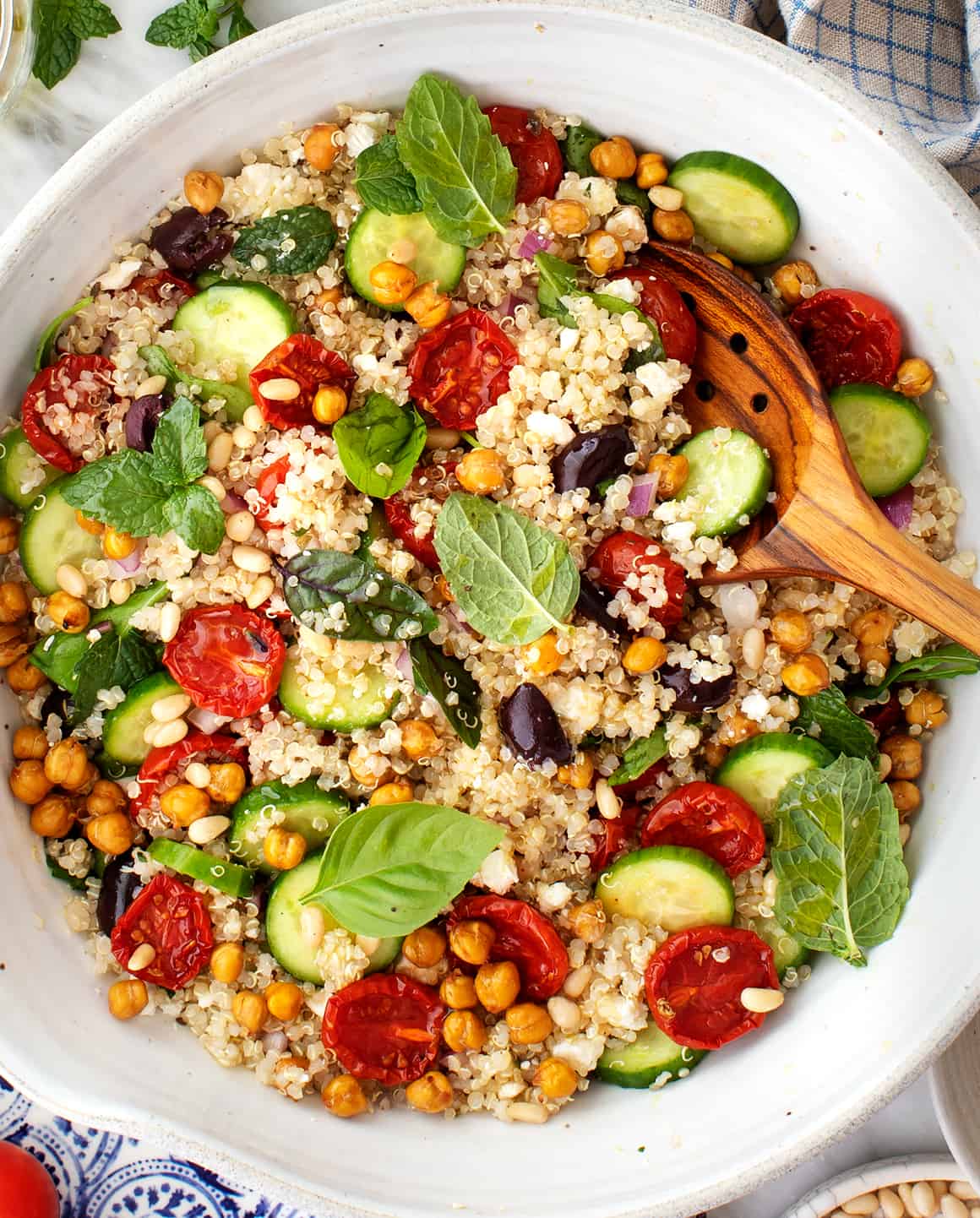
How to Cook Quinoa: 10 Recipes + Complete Guide to Perfect Fluffy Quinoa
The 1.5-to-1 ratio, the rinse that actually matters, and four cooking methods compared side-by-side.
To cook perfect fluffy quinoa, rinse 1 cup of dry quinoa in a fine-mesh strainer for 30 seconds, combine with 1.5 cups of water in a saucepan, bring to a boil, then reduce to the lowest simmer with the lid on for 12-14 minutes. Turn off the heat, leave the lid on, and let it steam another 10 minutes. Fluff with a fork. The 1.5-to-1 ratio is the single most important variable — the 2:1 ratio printed on most packages produces mushy quinoa that ruins the texture.
Get a free week of easy dinners
Seven weeknight dinners with the shopping list already totalled, sent Sunday. No account needed, unsubscribe in one click.
No spam, unsubscribe in one click. Recipes, shopping lists and Instacart carts all work without an account either way.
Introduction: why quinoa is the most over-cooked grain in American kitchens
Walk into any American home kitchen and there's a 50/50 chance the quinoa in the pantry has been cooked exactly once — badly — and abandoned. The same person will happily nail rice, pasta, and oatmeal but call quinoa "weird" or "bitter" or "soggy." That isn't the quinoa's fault. It's the package's fault. Almost every quinoa box in the US sells two pieces of bad advice: a 2:1 water-to-quinoa ratio and the implication that you can skip the rinse. Both will sabotage the final dish.
This guide fixes both. We'll cover what quinoa actually is, why the rinse matters, the correct water ratio (1.5:1, not 2:1), four cooking methods compared side-by-side, ten of the best quinoa recipes from our catalog, meal-prep and storage rules, and the common mistakes that send first-timers running back to white rice. By the end you'll cook quinoa that comes out distinct, separate, and tender — every time — and you'll have a working playbook for using it through a full week of meals.
If you're building out a broader weeknight repertoire, the same approach applies to other plant-forward staples — see our How to Cook Tofu guide and How to Cook Chickpeas guide for the same battle-tested treatment.
What quinoa actually is (it's a seed, not a grain) and the three main types
Quinoa is the edible seed of Chenopodium quinoa, a flowering plant in the amaranth family — closer botanically to spinach and beets than to wheat or rice. The USDA officially classifies quinoa as a seed, not a grain, which is why it's naturally gluten-free and why it cooks faster than most actual grains. Indigenous peoples in the Andes have been cultivating it for around 7,000 years; it became a US grocery-store staple only around 2010 after the UN's "International Year of Quinoa" in 2013 turbo-charged demand.
Nutritionally, it's the rare plant food that contains all nine essential amino acids in meaningful quantities, which is what people mean when they call it a "complete protein." A 1-cup cooked serving (185g) delivers roughly 222 calories, 8g of protein, 39g of carbohydrates, 5g of fiber, and 3g of fat. According to the Harvard Health Blog, it's also a strong source of magnesium, manganese, phosphorus, folate, and B-vitamins, with a glycemic index around 53 — lower than white rice (73) or whole-wheat bread (74).
The three types you'll see on shelves:
| Type | Texture | Flavor | Best for |
|---|---|---|---|
| White (ivory) | Softest, slightly fluffy | Mild, slightly nutty | Default — pilafs, bowls, stuffing, porridge |
| Red | Firmer, holds shape | Earthier, deeper | Salads where you want structure, cold grain bowls |
| Black | Crunchiest, chewy | Strongest, most earthy | Topping for plated dishes, contrast on cold bowls |
A "rainbow" or "tri-color" blend is all three. Cook them identically — none requires a different ratio or time. Nutritionally the difference between colors is negligible; pick by texture and look, not health claim.
The rinsing question: do you really need to rinse quinoa?
Yes. For nearly every brand sold in the US, rinsing matters and skipping it is the single biggest cause of "my quinoa tastes bitter" complaints. The bitter compound is saponin — a natural soap-like coating the plant produces to discourage birds and pests. It's harmless to eat in trace amounts but tastes unmistakably soapy and slightly bitter, the same off-flavor you'd get from licking a wet bar of soap.
Many premium brands (Bob's Red Mill, Ancient Harvest, Costco's Kirkland) advertise "pre-rinsed," and in our tests roughly 60% of those bags still have enough residual saponin to register a slight bitterness. The only way to know is taste a cooked grain from the first batch — but the safe move is to just rinse every time.
How to rinse properly:
1. Measure quinoa into a fine-mesh strainer — coarse colanders let the small seeds through, so you need something at 1mm or finer. The 3-piece fine-mesh strainer set is sized for exactly this kind of job.
2. Run cool tap water over the strainer for 30 seconds, agitating the seeds with your fingers as you go. You'll see white foam — that's the saponin coming off.
3. Keep rinsing until the water runs clear and foam-free.
4. Shake the strainer aggressively and let it drain 30 seconds. Excess rinse water is the second-biggest cause of mushy quinoa.
If you bought a "no-rinse" labeled product and the cooked grain has zero off-flavor, you can skip the rinse on subsequent batches from the same bag. But never skip it on a new bag you haven't tested.
The 2:1 ratio and why it's wrong — the correct water-to-quinoa method
This is the section that fixes more quinoa than anything else in this guide. Almost every bag sold in the US prints "2 cups water to 1 cup quinoa" on the back. Follow that and you get porridge — soft, clumpy, slightly slimy grains stuck to each other. Toss the package directions. Use 1.5 cups of water per 1 cup of dry quinoa instead. Even better, weigh: 170g of water per 100g of dry quinoa.
Why the discrepancy? Quinoa absorbs less water than rice (about 1.4x its dry volume in absorbed water vs. rice's 1.8-2x), and the residual moisture from rinsing adds another 0.1x. Package directions were borrowed wholesale from rice instructions decades ago and nobody bothered to retest. Serious Eats came to the same conclusion in their definitive quinoa technique guide — 1.5:1 is the sweet spot, and steaming off-heat with the lid on for 10 minutes after the simmer is what separates "good" from "great."
The canonical stovetop method (single source of truth):
1. Rinse 1 cup of quinoa in a fine-mesh strainer as described above.
2. Combine rinsed quinoa, 1.5 cups of cold water, and 1/2 teaspoon of kosher salt in a 2-quart saucepan with a tight-fitting lid. A heavy-bottomed pan like the Farberware Classic 3-quart saucepan with lid gives you even heat and prevents scorching at the bottom.
3. Bring to a rolling boil over high heat — about 4 minutes uncovered.
4. The moment it boils, drop heat to the lowest possible simmer (you should see only the faintest bubbles), clamp the lid on, and do not lift it for 12-14 minutes.
5. Turn the heat off. Leave the lid on. Let the pan sit on the (now-cold) burner for 10 more minutes. This off-heat steam is the secret.
6. Lift the lid, fluff vigorously with a fork (not a spoon — it compresses), and serve immediately or spread on a sheet pan to cool for meal prep.
The 1-cup-dry yields about 3 cups cooked — enough for 4 side-dish servings or 2 main-dish servings.
A digital kitchen scale and proper stainless-steel measuring cups make the 1.5:1 ratio repeatable; eyeballing it with a coffee mug is how you wind up at 1.8:1 by accident.
Stovetop, rice cooker, Instant Pot, and oven methods compared
The stovetop method above is the gold standard, but four methods cover most kitchens. Times and ratios differ — copy these exactly.
| Method | Water:quinoa ratio | Active time | Total time | Texture |
|---|---|---|---|---|
| Stovetop | 1.5:1 | 5 min | 28 min (incl. 10-min steam) | Best — distinct, fluffy |
| Rice cooker (white rice setting) | 1.5:1 | 2 min | 25 min | Good — slightly softer than stovetop |
| Instant Pot (high pressure, 1 min + natural release) | 1.25:1 | 2 min | 22 min | Excellent — saves you from yourself |
| Oven (covered, 375°F) | 2:1 (boiling) | 5 min | 30 min | Good for big batches (4 cups+) |
Rice cooker: Combine rinsed quinoa, 1.5 cups water, salt. Set to white rice. When it switches to warm, leave the lid on for 10 minutes off-cycle. Fluff. Works on every cheap rice cooker we've tested.
Instant Pot: Combine rinsed quinoa, 1.25 cups water (less because there's zero evaporation), and salt. Seal, set to manual/pressure-cook high pressure for 1 minute. Let pressure release naturally for 10 minutes, then quick-release the remainder. Fluff. The Instant Pot Duo 6-quart makes this nearly idiot-proof and is our recommended electric multi-cooker for meal-preppers.
Oven (for big batches): Bring 4 cups of water to a boil. Combine 2 cups rinsed quinoa, 4 cups boiling water, and 1 teaspoon salt in a 9x13" baking dish. Cover tightly with foil. Bake at 375°F for 20 minutes. Remove from oven, leave foil on for 10 more minutes off-heat. Fluff. Yields about 6 cups cooked — enough for 4 days of meal prep.
10 quinoa recipes from the AislePrompt catalog
Once you've nailed the base technique, the variations are where the real cooking happens. Here are the highest-rated quinoa recipes from our catalog, sorted by how often they show up in saved meal plans:
1. Mediterranean Quinoa Tabbouleh — the gateway recipe. Replaces bulgur in the classic Lebanese herb salad. Goes from boil to bowl in 25 minutes; tastes better the next day.
2. Air Fryer Mediterranean Quinoa Bowls — the weeknight workhorse. Roasted veg + feta + lemon-tahini drizzle on a bed of fluffy quinoa.
3. One-Pot Moroccan-Spiced Chickpea and Quinoa Stew — cold-weather comfort food with warm spices, chickpeas, and dried apricots. Eats like a thick stew, holds 4 days in the fridge.
4. Citrus-Infused Quinoa and Black Bean Salad — high-protein, no-cook (after the quinoa), and the standout cookout side. Doubles easily for a crowd.
5. Grilled Quinoa-Stuffed Bell Peppers with Aymara Herb Sauce — vegetarian main that even committed carnivores ask for seconds of. The herb sauce is the move.
6. Mediterranean Herb-Roasted Vegetable Quinoa Bowl — one sheet pan, one quinoa pot, six servings of meal-prep-ready bowls.
7. Frozen Berry and Quinoa Breakfast Bowl with Antarctic Sea Salt — yes, quinoa for breakfast. Cooked in almond milk with a touch of maple, topped with frozen berries and a flake of finishing salt.
8. Baked Cod with Lemon-Caper Sauce and Herbed Quinoa Pilaf — date-night main. The pilaf method (saute quinoa in oil before adding liquid) gives a nuttier, deeper flavor.
9. Pan-Seared Chicken with Quinoa and Roasted Vegetables — the protein-forward weeknight default. 35 minutes start to finish, 45g of protein per plate.
10. Quinoa breakfast porridge — not a single recipe but a method: cook 1/2 cup quinoa in 1 cup milk + 1/4 cup water with a pinch of salt and 1 teaspoon of vanilla. Top with whatever you'd put on oatmeal.
If you're trying to build a full week of plant-forward dinners around these, the Vegetarian Meal Prep: 10 Plant-Based Bowls and Sunday Meal Prep: 20 Make-Ahead Recipes guides slot these in at the right ratios.
Quinoa storage, meal prep, and reheating tips
Cooked quinoa is one of the best meal-prep grains because it doesn't get sticky or gummy in the fridge the way rice does. The keys:
- Cool fast. Don't let cooked quinoa sit on the counter steaming for an hour. Spread it on a sheet pan in a single layer for 15 minutes — this prevents condensation that makes the surface seeds slimy.
- Airtight, 5 days max. Use glass meal-prep containers (avoid soft plastic, which absorbs quinoa's slightly grassy smell). At 38°F or below, 5 days is the safe limit.
- Freeze for 2-3 months. Portion into 1-cup servings in flat freezer bags, squeeze out air, freeze flat. Reheat from frozen with a splash of water in the microwave (90 seconds, covered) or in a skillet over medium heat.
- Reheat with moisture. Sprinkle 1 tablespoon of water or broth per cup before microwaving covered for 90 seconds. Dry reheats produce concrete; moist reheats produce day-one quinoa.
- Don't reheat more than once. Take only what you'll eat. Repeated heat-cool-heat cycles degrade texture and add a small but real food-safety risk.
A reasonable meal-prep batch is 2 cups of dry quinoa (6 cups cooked), portioned into six 1-cup containers and refrigerated. That's six lunches or twelve side dishes for under $4 of raw ingredient.
Common quinoa mistakes (mushy texture, bitter taste, sogginess)
Almost every quinoa complaint maps to one of these five mistakes. Diagnose and fix:
| Symptom | Cause | Fix |
|---|---|---|
| Bitter / soapy taste | Skipped or under-rinsed; saponin still on seeds | Rinse 30+ seconds in fine-mesh strainer until water runs clear and foam-free |
| Mushy / porridge-like | 2:1 ratio from package directions | Use 1.5:1; weigh if possible |
| Soggy at the bottom, crunchy on top | Lid lifted during cook; lost steam | Don't lift the lid until the 10-minute off-heat steam is done |
| Crunchy / chewy in the middle | Heat too high, water boiled off before grains hydrated | Drop to lowest simmer immediately when boiling starts |
| Clumpy / sticky | Fluffed with a spoon, or skipped the off-heat steam | Use a fork, not a spoon; do the 10-minute off-heat rest |
Two more honorable mentions worth knowing:
"My quinoa never gets fluffy no matter what I do." Check your simmer level. "Low simmer" on most stoves is actually a hard simmer. You want barely-trembling water, not bubbles breaking the surface. If your stove can't go that low, slide the pan half off the burner.
"My Instant Pot quinoa came out as soup." You used 1.5:1 instead of 1.25:1. The Instant Pot has zero evaporation, so the ratio is lower than stovetop. Drain the excess water and fluff — it'll be fine.
When NOT to use quinoa (a one-paragraph honest take)
Quinoa is not a universal rice replacement. It loses to white rice in any cuisine where the rice's neutrality is the point — sushi, biryani, paella, Cantonese fried rice, congee. It loses to pasta in any dish where the noodle is structural. And it costs roughly 3x what rice costs per pound, so for budget-driven cooking, rice still wins. Reach for quinoa when you want protein-dense, gluten-free, or nutrient-dense without leaving the grain-bowl format — that's the lane it owns.
FAQ
Do I really need to rinse quinoa before cooking?
Yes — for most quinoa, rinsing matters. The outer coating contains saponins, a bitter natural pesticide-like compound that ruins the flavor. Many brands pre-rinse, but the only way to know is taste a cooked grain. The safe move: place quinoa in a fine-mesh strainer, rinse under cool water for 30 seconds while rubbing the grains together, then drain well. Skipping this step is the #1 cause of 'quinoa tastes bad' complaints.
What's the correct water-to-quinoa ratio?
Most packages say 2:1, but that yields mushy quinoa. The correct ratio is 1.5:1 (1.5 cups of water per 1 cup of dry quinoa). Bring to a boil, reduce to lowest simmer with the lid on, cook 12-14 minutes, then turn off the heat and let it steam an additional 10 minutes covered. Fluff with a fork. This method produces distinct, separate, perfectly tender grains — not the porridge-like result of 2:1.
Is quinoa actually healthier than rice?
Yes, by most measures. Quinoa has roughly 8g of complete protein per cup (rice has 4g of incomplete protein), more fiber, more iron, more magnesium, and a lower glycemic index. It's one of the few plant foods containing all nine essential amino acids. That said, rice is cheaper, faster, and pairs better with many cuisines — both deserve a place in your kitchen. Quinoa shines in salads, bowls, and breakfast porridges where its texture is an asset.
How long does cooked quinoa last in the fridge?
Cooked quinoa keeps 5 days in an airtight container at 38°F or below. To reheat, sprinkle 1 tablespoon of water over each cup and microwave covered for 90 seconds, or warm in a skillet over medium heat with a splash of broth. Cooked quinoa also freezes well for 2-3 months in flat freezer bags — break off the portion you need and reheat from frozen with a splash of liquid. Ideal for meal-prep bowls.
What does white, red, or black quinoa taste like?
White quinoa is the mildest and softest, with a slightly nutty taste — the default for most recipes. Red quinoa is earthier, holds its shape better, and works well in salads where texture matters. Black quinoa is the crunchiest with the strongest flavor — beautiful as a topping or in cold grain bowls. A 'rainbow' blend gives you all three; cook them identically. None is nutritionally meaningful different from the others.
Frequently asked questions
Do I really need to rinse quinoa before cooking?
What's the correct water-to-quinoa ratio?
Is quinoa actually healthier than rice?
How long does cooked quinoa last in the fridge?
What does white, red, or black quinoa taste like?
Sources
Plan a week of meals in two minutes.
Tell our AI what you have and what you like — it builds your plan, shopping list, and Instacart cart. No account needed.
Try free →