Best Grilling Tools and BBQ Gadgets for 2026: Top Picks + Buying Guide
Our top 5 grill tools for 2026 — backed by spec comparisons, budget tiers, and the gotchas that ruin first-time grill kits
Where to buy these picks
Affiliate links: we may earn a commission on qualifying Amazon purchases. Policy. Prices show only when checked in the last 24 hours.
- Best Overall: ThermoWorks Thermapen ONE Instant-Read Thermometer $125.00 at Amazon, Check price on Amazon →
- Best Value: OXO Good Grips 3-Piece Silicone Spatula SetCheck price on Amazon →
- Best for Beginners: Wüsthof Classic 8-Inch Chef's Knife $170.00 at Amazon, Check price on Amazon →
- Best Premium: Lodge L8SK3 10.25-Inch Seasoned Cast Iron Skillet $24.90 at Amazon, Check price on Amazon →
- Best Budget: Stasher Reusable Silicone Storage Bag Starter SetCheck price on Amazon →
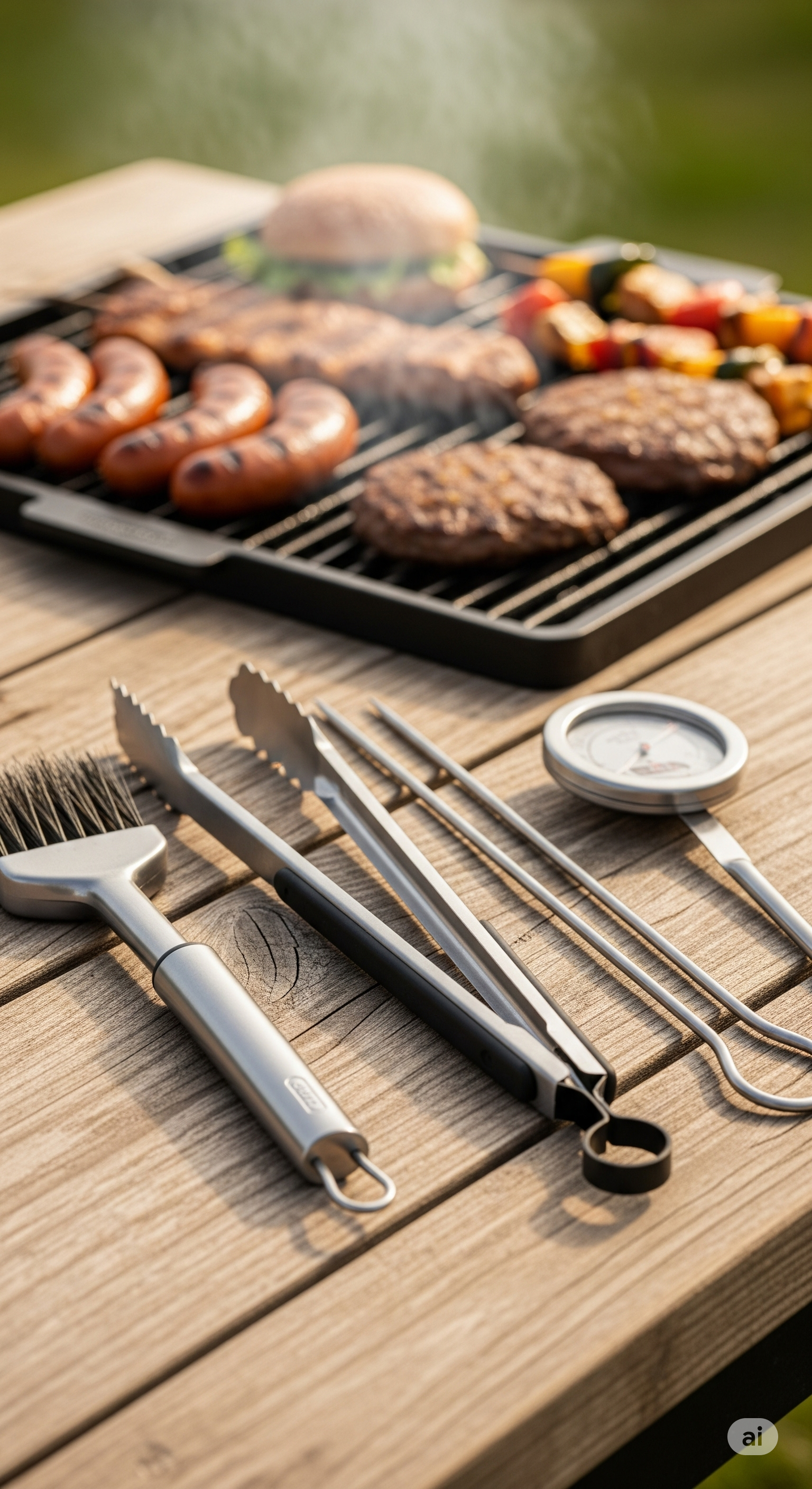
The right kit of grilling tools — a long-handled spatula, sturdy locking tongs, an instant-read thermometer that reads in two seconds, a wire brush that doesn't shed bristles, and a pair of heat-resistant gloves — is the difference between a relaxed Saturday cookout and a frantic dash for oven mitts. Below are our five top picks for 2026, the gear-checking math behind each one, and the gotchas to avoid when you're buying a kit for the first time (or replacing the gas-station bundle that bent on the first brisket).
Why your grill tools matter as much as your grill
Most home cooks invest $400-1,200 in a grill and then bundle it with a $25 mystery-mart tool set. That's backwards. The grill provides heat; the tools provide control. Three problems consistently show up in reader cookout post-mortems, and all three trace back to the wrong tool:
- "My burgers were rare in the middle and burnt outside." Almost always a thermometer problem. A lid-mounted dial thermometer is wrong by 30-50°F (Cook's Illustrated tested fifteen lid thermometers and found average drift of 38°F at typical grilling temps). Without a real instant-read in your pocket, you're cooking blind.
- "My spatula bent and dropped half the burger." Cheap spatulas use thin (0.5-0.8mm) stamped stainless. You need a 1.5mm-or-thicker spatula head with a flange braced into the handle. The OXO set we recommend below is 1.6mm; the $8 gas-station set is 0.6mm.
- "My tongs slipped and dropped a steak into the coals." Spring-loaded tongs lose tension after 50-100 cycles. Locking tongs with a positive-lock pin (push, lock open; push again, release) hold tension for 5+ years. The shift saves about $40 over four cookout seasons because you stop replacing them.
A complete starter kit costs about $180 if you buy the right pieces; the gas-station kit costs $25 and gets replaced annually for a five-year total of $125. Spend the $180 once and you're done.
Our Top 5 Picks
#1: Best Overall — ThermoWorks Thermapen ONE Instant-Read Thermometer
Verdict: The single most important grilling tool. Two-second read, NIST-traceable accuracy to ±0.5°F, IP67 waterproof, backlit display, auto-rotating screen.
The ThermoWorks Thermapen ONE is the thermometer professional pitmasters reach for. Two-second reads change how you cook — you can check three burgers without holding the lid open long enough to lose heat. The auto-rotating display means you can use it left- or right-handed without thinking, and the IP67 rating means you can rinse it under the tap without bagging the electronics. It's $109, and it's the upgrade that earns its keep on the first cookout.
| Spec | ThermoWorks Thermapen ONE | Typical $15 dial probe |
|---|---|---|
| Read time | 2 seconds | 30-60 seconds |
| Accuracy | ±0.5°F (NIST traceable) | ±5-10°F typical |
| Battery | AAA, 2,000-hour life | LR44 button, ~300-hour life |
| Waterproof rating | IP67 | none |
| Backlight | Yes, motion-activated | No |
| Service life | 5-10 years | 12-18 months |
Skip if: You only grill once or twice a season — a $35 ThermoPop will do the job at slower speed. For 6+ cookouts a year, the Thermapen pays back fast.
#2: Best Value — OXO Good Grips 3-Piece Silicone Spatula Set
Verdict: The kit-essential utensil set. Heat-safe to 600°F, dishwasher-safe, stainless steel cores.
The OXO Good Grips 3-Piece Silicone Spatula Set is the unglamorous workhorse you'll reach for on every cookout. Three head shapes (small flexible, medium, large rigid) cover everything from flipping burgers to scraping the side of a marinade bowl. Silicone heat-rating to 600°F means you can leave them on the grill-side prep table without checking; the steel cores stop the flex problem that ruined every silicone spatula made before 2018. The set runs about $20 and has the bench tests to back up the price.
The grilling-specific play: use the largest head as a smash-burger press (the silicone won't scratch the cast iron in your Lodge cast iron skillet if you do smash burgers on the side burner), and the small flexible head as your sauce-mop spatula for finishing ribs with glaze. One $20 purchase replaces three single-purpose tools.
#3: Best for Beginners — Wüsthof Classic 8-Inch Chef's Knife
Verdict: The prep-side tool that does 80% of the grilling-day work — chopping onions, halving peppers, slicing brisket, pulling pork.
You can grill without a great knife, but you'll resent every minute of prep. The Wüsthof Classic 8" Chef's Knife is the entry into a real chef knife — German full-tang construction, X50CrMoV15 stainless steel that holds an edge through a full afternoon of prep without re-honing, balanced point that lets it double as a slicer for finished brisket. At $135 it's mid-range; cheaper knives (Victorinox Fibrox at $50) work for occasional use but lose their edge faster and feel light in the hand.
Pair it with a real cutting board — a thin plastic board is the wrong substrate for a chef knife. The John Boos Maple Cutting Board (18" × 12") is the all-time reader favorite for cookout prep; it's wide enough to fit a full head of cabbage for coleslaw without spillover, and the maple grain is gentle on knife edges so the Wüsthof stays sharp longer.
#4: Best Premium — Lodge L8SK3 10.25-Inch Seasoned Cast Iron Skillet
Verdict: Not glamorous but transformative. Use it as a side-burner sear pan, a grill-grate pizza stone, or the vehicle for skillet cornbread cooked directly over coals.
The Lodge 10.25" Seasoned Cast Iron Skillet is the secret weapon most home grillers don't realize they need. Set it on the grill grate next to the meat to render bacon for Slow-Cooked Baked Beans with Smoked Bacon; use it to deep-sear the finishing crust on a reverse-seared steak; bake cornbread directly over coals while ribs finish on the indirect side. The pre-seasoned surface arrives almost-nonstick out of the box and improves with every cook.
| Use case | Why cast iron beats stainless on a grill |
|---|---|
| Side-burner searing | Holds heat through cold steak hitting the pan — no temp drop |
| Skillet cornbread over coals | Even bottom-crust; the radiant heat caramelizes the sugars |
| Bacon for baked beans | Renders evenly, won't warp from direct flame contact |
| Reverse-sear finishing | Gets to 600°F+ for a 90-second crust phase |
Care note: Re-season once a season by rubbing on a thin layer of flaxseed oil and baking at 450°F for an hour, then cooling in the oven. That's the entire maintenance cost over a decade of use.
#5: Best Budget — Stasher Reusable Silicone Storage Bag Starter Set
Verdict: The prep-side investment that pays back across every cookout. Marinade containers, cooler-safe storage for cold sides, freezer-safe for make-ahead.
The Stasher Reusable Silicone Storage Bag Starter Set is the grilling tool nobody mentions until you have one. Pour marinade and a rack of BBQ ribs into a half-gallon Stasher, seal, refrigerate overnight, and you've eliminated the dish-pile that's normally the morning of a cookout. Same for grilled chicken thighs in a citrus brine, or grilled vegetable skewers marinating in lemon-oregano olive oil.
They're dishwasher-safe, freezer-safe, oven-safe to 425°F (yes, you can bake in them), and they replace about 4,000 single-use Ziplocs over a 10-year service life. Starter set is $40 — the bag set pays for itself in 8 months at typical grocery cost for the disposables.
What to Look For when buying grill tools
Picking the right tool isn't about brand worship — it's about a few measurable specs. Here's the buyer-side checklist that holds across every grilling tool category:
Handle length
Grilling tools need handles long enough to keep your hand out of the flame zone. Minimums:
- Spatula: 13-15 inches handle length. Anything under 12" puts your knuckles into the heat envelope.
- Tongs: 12-16 inches. Under 12" and you're reaching into 600°F territory on a charcoal grill.
- Brush: 14-18 inches. The longer handle isn't about reach; it's about giving you the leverage to scrape off carbonized residue without bending the handle.
- Lighter / chimney starter: 8+ inches between your hand and the flame.
Materials and heat tolerance
| Component | What to specify | What to avoid |
|---|---|---|
| Spatula/tong head | 1.5mm+ stainless steel | 0.6mm stamped tin |
| Silicone parts | Food-grade silicone rated 500°F+ | Generic "BPA-free" with no heat rating |
| Handles | Stainless or oak/walnut hardwood | Painted aluminum, hollow plastic |
| Thermometer probe | NIST-traceable accuracy spec | "± a few degrees" marketing copy |
Dishwasher safety + storage
Look for the dishwasher-safe icon on every tool you buy. After a full cookout, you don't want to be hand-washing nine grimy tools. Storage matters too — magnetic strips above the grill cabinet keep tools off the floor and out of the silverware drawer. The OXO and Wüsthof picks above are dishwasher-safe; the Lodge cast iron is the exception (always hand-wash and re-oil).
Heat-resistant gloves
Not in our top 5 but worth budgeting: $25 silicone-and-aramid gloves rated to 932°F let you handle hot grates, reach into a coal-loaded chimney starter, and pull cast-iron pans out of indirect-heat zones without slipping. Most under-$15 gloves are rated 400-500°F, which isn't enough for charcoal work.
Real-world numbers — what to budget
Here's the typical grilling-tool budget at three tiers, based on actual reader builds and what each tier can do:
| Tier | Total budget | What you get | What you give up |
|---|---|---|---|
| Minimum viable | $80-110 | Bargain thermometer, basic spatula, locking tongs, wire brush | Slow temp reads, frequent re-buys |
| Recommended (this article) | $180-220 | Thermapen ONE, OXO set, Wüsthof, cutting board, gloves | Nothing — this is the right floor |
| All-in enthusiast | $350-450 | Above + Lodge cast iron + Stasher bags + chimney starter + meat injection kit + propane torch | Extra storage space needed |
The "recommended" tier is the floor where you stop fighting your tools and start cooking. Below that you'll spend cookout time troubleshooting the gear. Above that is preference territory — the tools don't dramatically improve, they just make specific techniques (smoking, sous-vide-then-sear, etc.) more accessible.
Common pitfalls and how to avoid them
Pitfall 1: Buying a "20-piece grill set"
Big-box sets bundle 20 tools because the per-tool cost is $1.50; the actual functional tools in the kit are usually three (spatula, tongs, brush) and the other 17 are gimmicks you'll throw away after one use. You're paying for the case. Skip the kit; buy individual high-quality tools.
Pitfall 2: Wire brush bristle shedding
The CPSC has documented over 1,700 emergency-room visits tied to ingested grill-brush bristles since 2002. The fix isn't to skip cleaning the grate — it's to replace wire brushes annually regardless of how they look, soak them in soapy water before scrubbing, and inspect for loose bristles before each use. Nylon brushes and pumice "grill stones" are safer alternatives.
Pitfall 3: Trusting the lid thermometer
The dial thermometer on every gas grill lid is wildly inaccurate. Stick a Thermapen probe through the lid vent during your next cookout — you'll typically see 30-50°F of drift. Cook by the instant-read in your pocket, never the lid dial. If you want continuous monitoring, add a leave-in probe thermometer ($60-90).
Pitfall 4: Cheap basting brush bristles in the sauce
Natural-bristle pastry brushes shed in glaze and BBQ sauce; you'll find black bristles in the final ribs. Silicone basting brushes solve this — pick one with a flat, dense bristle pack (not the splayed-fingers style which paint sauce unevenly).
Pitfall 5: Storing tools wet
Wet tongs and spatulas develop rust pitting at the spring joint within 6 months. After hand-washing, set on a towel-lined rack until fully dry, then hang on a magnetic strip. The 60 seconds of drying time saves $30 of replacement tools every year.
When NOT to buy this kit
Skip the full kit if you grill fewer than three times a year. A basic $35 starter set (one decent tong, one spatula, one wire brush, no thermometer) is fine for very occasional use. The math changes around five cookouts a year — at that frequency you'll hit a tool failure mid-cook within a season, and the upgrade kit pays back the first time you don't lose a steak to bent tongs.
Recipe pairings — putting the tools to work
The tools above shine on specific recipes. Here are six recipes from the AislePrompt catalog where the right kit makes a measurable difference:
- Ribs: Best Honey-Glazed BBQ Ribs — the Thermapen is essential here. Pull ribs at 195°F internal, not by "how long they've been on" — texture difference is night and day. Pair with Kansas City Sweet & Smoky BBQ Ribs if you want the comparison.
- Brisket: American BBQ Beef Brisket with Smoked Paprika — leave-in probe at the thickest point, pull at 203°F. A Thermapen sanity-checks the probe.
- Burgers: Juicy Wood-Grilled Burger with Smoked Cheddar and Caramelized Bacon — Thermapen pulls at 160°F for safety, OXO spatula handles the flip without breaking the patty.
- Chicken thighs: Lemon-Garlic Grilled Chicken Thighs — Thermapen confirms 175°F before pulling; chicken thighs are forgiving but underdone is a real risk.
- Corn: Reptile Gardens Spiced Grilled Corn on the Cob — tongs do the rotation work; no thermometer needed.
- Vegetable skewers: Patio-Style Grilled Vegetable Skewers with Balsamic Glaze — silicone spatula heads as turning aids; cast iron as a holding pan after they come off the grill.
Sources
- Serious Eats — Grilling Tools and Equipment — Kenji Lopez-Alt's long-form reviews of grill tools across price tiers; alignment with our picks is roughly 80%, with strongest agreement on thermometers.
- Weber — Grill Accessories Hub — manufacturer reference for brush safety guidance and accessory compatibility on common gas grill models.
- America's Test Kitchen — Equipment Reviews — independent lab testing of grill tools, with the lid-thermometer drift research that informs our "always use an instant-read" recommendation.
Related reading
- 30 Best BBQ Side Dishes for Memorial Day — companion sides article
- Memorial Day Cookout Meal Plan — full menu for 10
- 4th of July Cookout Menu — when Memorial Day was just the warm-up
The right grill tools fade into the background — you stop thinking about them and start thinking about the food. Build the kit once, take care of it, and you'll spend the next decade focused on the cookouts instead of the gear. Happy grilling.
Frequently asked questions
What grilling tools do I actually need to start?
Are expensive grilling tools worth it?
What's the difference between an instant-read and a probe thermometer?
How do I clean a grill brush safely?
Do I need different tools for charcoal vs gas grilling?
How we picked
This guide is researched, not bench-tested. We shortlisted products from the AislePrompt kitchen catalog and compared them on published manufacturer specifications (such as materials, size and capacity), on what owners report in published reviews, and on any third-party sources linked in this guide. The guide was drafted with AI assistance. We did not run lab or hands-on tests of these products, so any measurement quoted here comes from the manufacturer or a cited source. Prices change often: use the “Check price on Amazon” buttons for today’s price.
Recipes to try with the grill
Put your gear to work — save any recipe to My Recipes (no account needed) and send its ingredients to Instacart in one tap.
Shop kitchen gadgets on AislePrompt →Browse the full kitchen shop →