Best Sous Vide Machines 2026: Immersion Circulators Worth the Space
Temperature accuracy stopped being a differentiator years ago — here's what actually separates a budget circulator from a premium one.
Where to buy these picks
Affiliate links: we may earn a commission on qualifying Amazon purchases. Policy. Prices show only when checked in the last 24 hours.
The best sous vide machine for most home cooks in 2026 is the Anova Culinary Precision Cooker Nano 2.0 at around $62 — 750W, ±0.1°F stability, and small enough to live in a drawer. Step up to the Instant Pot Accu Slim at about $100 if you want a bigger touchscreen and 800W, or the Inkbird ISV-100W at roughly $77 if you want 1000W and app control for under $80.
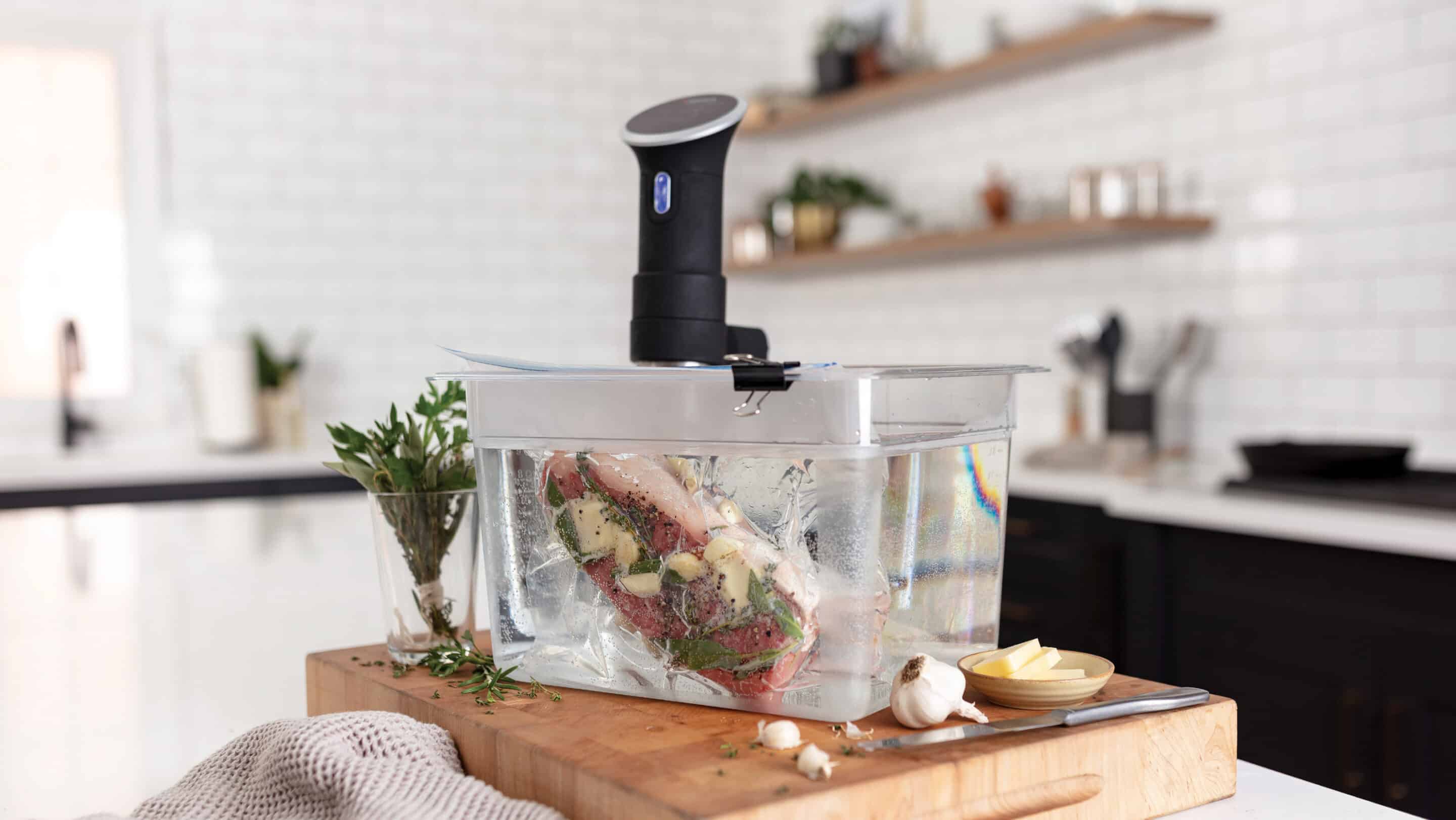
An immersion circulator is a heater, a pump and a thermostat on a stick. It holds a water bath within a fraction of a degree so food cooks to exactly the temperature you set and cannot overshoot. That is the whole value proposition, and it is why the cheap ones are genuinely fine.
How sous vide actually works, and what that means for buying
Sous vide is French for "under vacuum," which is a slightly misleading name — the vacuum is incidental. The technique is really about temperature equilibrium. Set the bath to 130°F and a steak cannot get hotter than 130°F no matter how long it sits, because there is nothing hotter than 130°F in the system. Conventional cooking works the opposite way: you apply 400°F heat and pull the food off at the right moment, hoping you guessed correctly.
A thermal immersion circulator does three jobs. It heats, it circulates so there are no cold pockets, and it regulates. Every unit on this list does all three competently. What separates them is heating wattage (how fast the bath comes up to temperature), pump flow rate (how large a vessel it can keep even), clamp design, and whether the app is useful or a nuisance.
Here is the buying implication most guides bury: temperature accuracy is not a differentiator anymore. Every circulator here holds ±0.1–0.2°F, which is well inside the tolerance any recipe cares about. Do not pay extra for precision. Pay for wattage if you cook large batches, and for build quality if you plan to run 24-hour cooks.
Top picks
#1: Anova Culinary Precision Cooker Nano 2.0
Verdict: Best for most people. ~$62, 750W.
The Anova Nano 2.0 is the default recommendation and has been for several years. It is 750W, which heats a 12-quart bath from tap-cold to 135°F in roughly 25–30 minutes — slower than a 1000W unit but fine if you fill from the hot tap. The clamp is an adjustable screw type that fits pot rims and container walls up to about an inch thick.
The reason it wins is size. It is about 12.8 inches long and slim enough to store in a kitchen drawer, which matters more than any spec, because the appliance you can put away is the one you keep using. Bluetooth app control is included; you do not need it, and the unit runs standalone from its own dial and screen.
Where it falls short: 750W struggles with baths over about 16 quarts, and it is Bluetooth rather than Wi-Fi, so you cannot check on a 12-hour cook from work.
#2: Instant Pot Accu Slim Sous Vide
The Instant Pot Accu Slim trades app connectivity for a genuinely large touchscreen and the simplest controls in the category. If you find phone-tethered appliances irritating, this is the pick. It is 800W, waterproof-rated, and noticeably quieter than the Anova under load.
The tradeoff is the price: you pay about $38 more than the Nano for a better screen and 50 extra watts. Worth it only if the no-app thing matters to you.
#3: Inkbird ISV-100W
Verdict: Best value for power. ~$77, 1000W.
The Inkbird ISV-100W is the wattage-per-dollar winner: 1000W and true Wi-Fi (not just Bluetooth) for under $80. That combination does not exist elsewhere at this price. The extra 250W over the Anova cuts preheat times by roughly a third and lets it hold a 20-quart container steady.
It also has a calibration function, which is genuinely useful on a multi-year-old unit whose thermistor has drifted. The app is more cluttered than Anova's and the 14 "preset recipes" are marketing filler, but the hardware is strong.
Where it falls short: it is physically larger than the Nano and the clamp is less refined.
#4: Inkbird ISV-200W bundle with vacuum sealer
Verdict: Best starter kit. ~$151 for circulator plus sealer.
If you are buying from zero, the ISV-200W bundle packages a 1000W Wi-Fi circulator with a vacuum sealer for about $151. Bought separately those two run closer to $175. Buy this only if you actually want a vacuum sealer — see the accessories section, because for a lot of cooking you do not.
Accessories: what you actually need
This is where guides oversell. You need a vessel and a way to keep bags submerged. Everything else is optional.
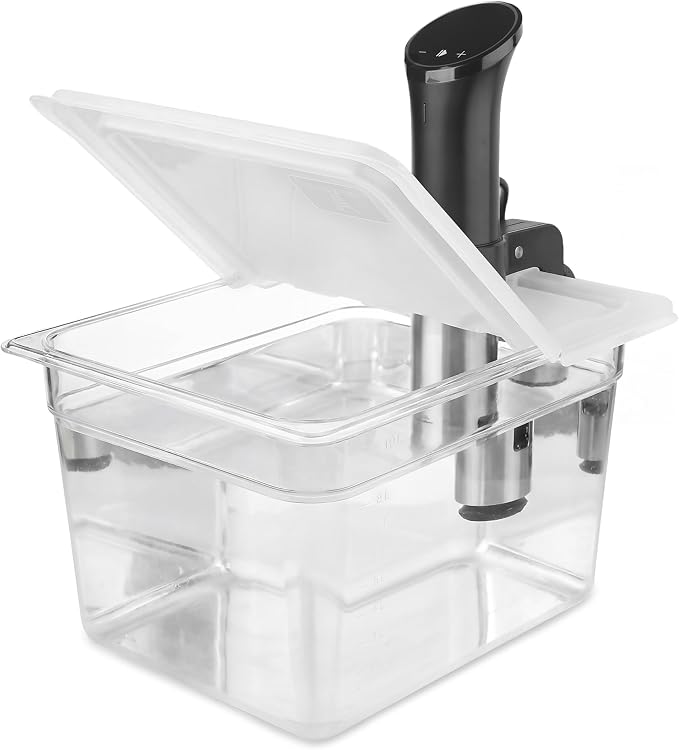
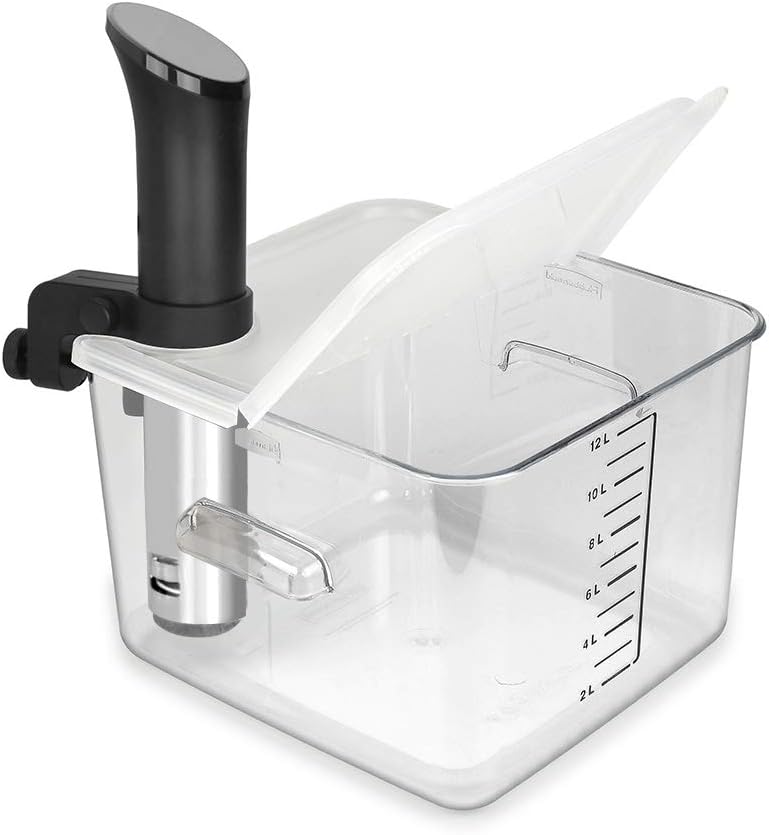
A container beats a stockpot. The EVERIE 12-quart sous vide container at around $35 is polycarbonate, insulates far better than a metal stockpot, and takes a lid that cuts evaporation. On a 12-hour cook, an uncovered stockpot can lose enough water to expose the circulator's minimum fill line and trigger a shutdown. That is the single most common overnight-cook failure.
If you already have a container, the EVERIE hinged lid is about $10 and solves the same problem on a Rubbermaid tub.
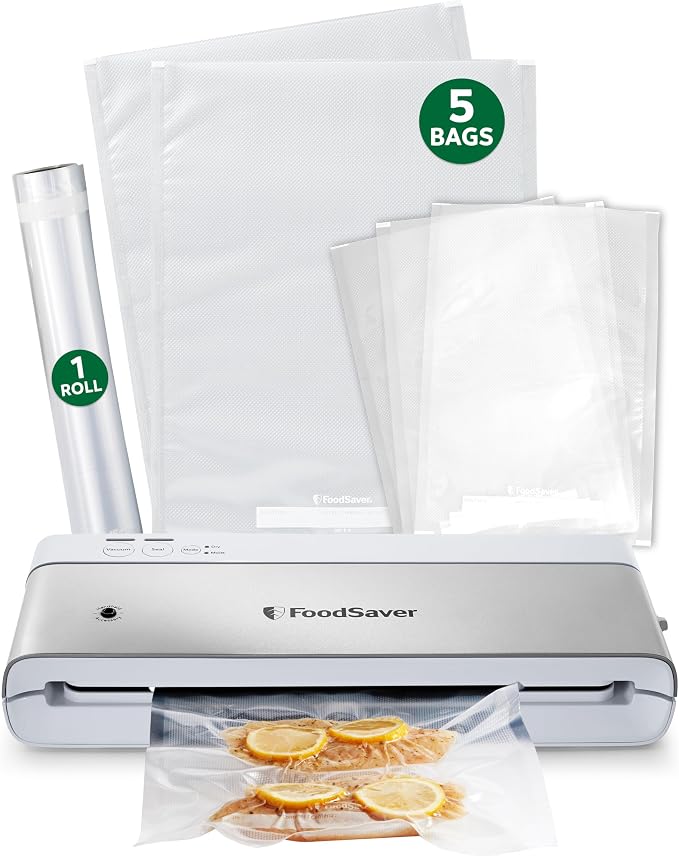
You probably do not need a vacuum sealer. The water-displacement method — zipper bag, lower it slowly into the bath, let water pressure push the air out, seal the last corner above the waterline — works for essentially everything under 8 hours. A sealer is worth it if you batch-cook and freeze, or if you cook a lot of things that float. The FoodSaver Compact at about $100 is the reasonable entry point.
Beyond that, a heavy skillet from cookware for the finishing sear and tongs from utensils. That is the whole kit.
How to choose between them in one minute
If you want the short version, three questions settle it.
How big is your biggest cook? Under 12 quarts — which covers four steaks, a whole chicken breast batch, or a dozen egg jars — any unit here works, so buy on size and price. Over 16 quarts, you want 1000W. Water has a specific heat capacity of about 1 BTU per pound per degree, and a 20-quart bath is roughly 40 pounds of water; getting that from 70°F to 135°F takes about 2,600 BTU, or roughly 45 minutes at 750W versus 33 at 1000W. That gap compounds every time you cook.
Where will it live? This decides more purchases than any spec. A circulator that has to be dug out of a deep cabinet gets used twice and then never again. The Nano is the only unit here that fits a standard kitchen drawer.
Do you want your phone involved? Wi-Fi is genuinely useful for cooks over about six hours, because you can confirm the bath is still at temperature without standing in the kitchen. For a one-hour chicken breast it is pure overhead. Only the Inkbird units offer true Wi-Fi at this price; the Anova Nano is Bluetooth, which means range of about 30 feet.
What changed in 2026
Two things worth knowing if you last looked at this category a few years ago.
First, prices have compressed hard. A 1000W Wi-Fi circulator under $80 would have been a $200 product in 2020. The mid-range has largely collapsed into the budget range, and the remaining premium units justify themselves on build quality and pump flow rather than accuracy.
Second, the "smart kitchen" angle has quietly deflated. Several manufacturers have wound down or paywalled their recipe-content apps, and a few older circulators became harder to control when their companion apps stopped being maintained. The practical lesson: buy a circulator that works fully standalone from its own dial and screen. Every unit recommended here does. Treat app control as a bonus that may not outlive the hardware, not as a feature you depend on.
Real-world numbers: times and temperatures
Temperatures are the interesting part of sous vide because they are absolute rather than approximate. These follow the Anova time and temperature guide and Douglas Baldwin's practical guide to sous vide cooking, which remains the best free technical reference on pasteurization times.
| Food | Temperature | Time | Notes |
|---|---|---|---|
| Steak, medium-rare | 130°F | 1–4 hr | Longer gets softer, not more done |
| Steak, medium | 137°F | 1–4 hr | Above 140°F texture changes sharply |
| Chicken breast | 145°F | 1–2 hr | Pasteurized at 145°F in ~60 min |
| Chicken thigh | 165°F | 2–4 hr | Collagen needs the higher temp |
| Pork chop | 140°F | 1–3 hr | Faintly pink and safe |
| Salmon | 122°F | 30–45 min | Silky; 130°F for flakier |
| Egg (soft) | 145°F | 45 min | The classic "63° egg" range |
| Carrots / root veg | 183°F | 1 hr | Plant cell walls need 180°F+ |
| Short ribs | 155°F | 24–48 hr | Long cook does the tenderizing |
Two things to take from this table. Vegetables need a much hotter bath than meat — around 183°F — because pectin and cellulose do not break down below about 180°F, so you cannot cook the steak and the carrots in the same bath. And time above the minimum mostly changes texture, not doneness: a steak at 130°F for four hours is the same shade of pink as one at two hours, just more tender.
Other gear this guide links
Prices are shown only when checked in the last 24 hours; otherwise check the current price on Amazon.
What to cook first
Sous Vide Salmon with Dill & Lemon Butter is the best first cook, because salmon is the protein where sous vide's advantage is most obvious — the window between raw and chalky is about 90 seconds in a pan and about an hour in a bath.
Sous Vide Garlic-Parsley Chicken Thighs and Sous Vide Miso-Glazed Black Cod with Pickled Daikon follow naturally.
For eggs, Herb-Scented Egg Bites with Spinach and Feta and Sage and Bacon Egg Bites adapt directly to jars in a 172°F bath for an hour.
And whatever you cook, finish it in a screaming-hot pan — the bath cannot brown anything. Use the technique from Pan-Seared Ribeye Steak with Tequila Bean Salsa: pat the protein bone-dry after the bag, 45–60 seconds a side, no longer. Skipping the sear is the reason people describe sous vide food as looking unappetizing.
Common pitfalls
Floating bags. Air trapped in the bag lifts food above the waterline, where it does not cook. Clip the bag to the container edge, or weigh it with a spoon.
Evaporation on long cooks. Covered above — use a lid, or float ping-pong balls.
Searing for too long. You already cooked it. A 90-second sear per side adds a gray band and undoes the point.
Cooking vegetables with meat. Different temperature requirements, as the table shows.
Assuming the machine will recover from a power blip. Circulators shut off when water drops below the minimum line, and many do not resume automatically after losing power. For a 48-hour short rib cook, check on it — and if the bath has been below 130°F for more than a couple of hours with food in it, throw the food out rather than gambling.
Seasoning as though it were a pan. Aromatics behave differently in a sealed bag. Raw garlic in particular becomes harsh and slightly metallic over a long low-temperature cook, and fresh herbs go grassy. Use less than you would in a braise, or add the aromatics to the finishing sear instead.
Cooking straight from frozen without adjusting. It works, but add roughly 50% to the time. A frozen chicken breast at 145°F needs about 90 minutes rather than 60.
When NOT to buy one
Skip sous vide if you cook mostly quick weeknight food. A 130°F steak still takes an hour in the bath plus a sear, versus eight minutes in a skillet, and the result is better but not eight-times-better on a Tuesday. It is also a poor fit if counter and storage space is genuinely tight, or if you rarely cook large or expensive cuts — the technique's value scales with how much you would regret overcooking the thing. Where it is transformative: thick steaks, whole chicken breasts, eggs, custards, short ribs, and any batch-cook-then-reheat workflow.
Sources
- Sous vide — Wikipedia
- Anova Culinary — Sous Vide Time and Temperature Guide
- Douglas Baldwin — A Practical Guide to Sous Vide Cooking
- Thermal immersion circulator — Wikipedia
Frequently asked questions
Do I need a vacuum sealer for sous vide?
Are plastic bags safe at sous vide temperatures?
How much wattage do I actually need?
Can I leave a sous vide cook running overnight?
Why does sous vide food need to be seared afterward?
How we picked
This guide is researched, not bench-tested. We shortlisted products from the AislePrompt kitchen catalog and compared them on published manufacturer specifications (such as materials, size and capacity), on what owners report in published reviews, and on any third-party sources linked in this guide. The guide was drafted with AI assistance. We did not run lab or hands-on tests of these products, so any measurement quoted here comes from the manufacturer or a cited source. Prices change often: use the “Check price on Amazon” buttons for today’s price.
Recipes to try with your small appliances
Put your gear to work — save any recipe to My Recipes (no account needed) and send its ingredients to Instacart in one tap.
Shop small appliances on AislePrompt →Browse the full kitchen shop →