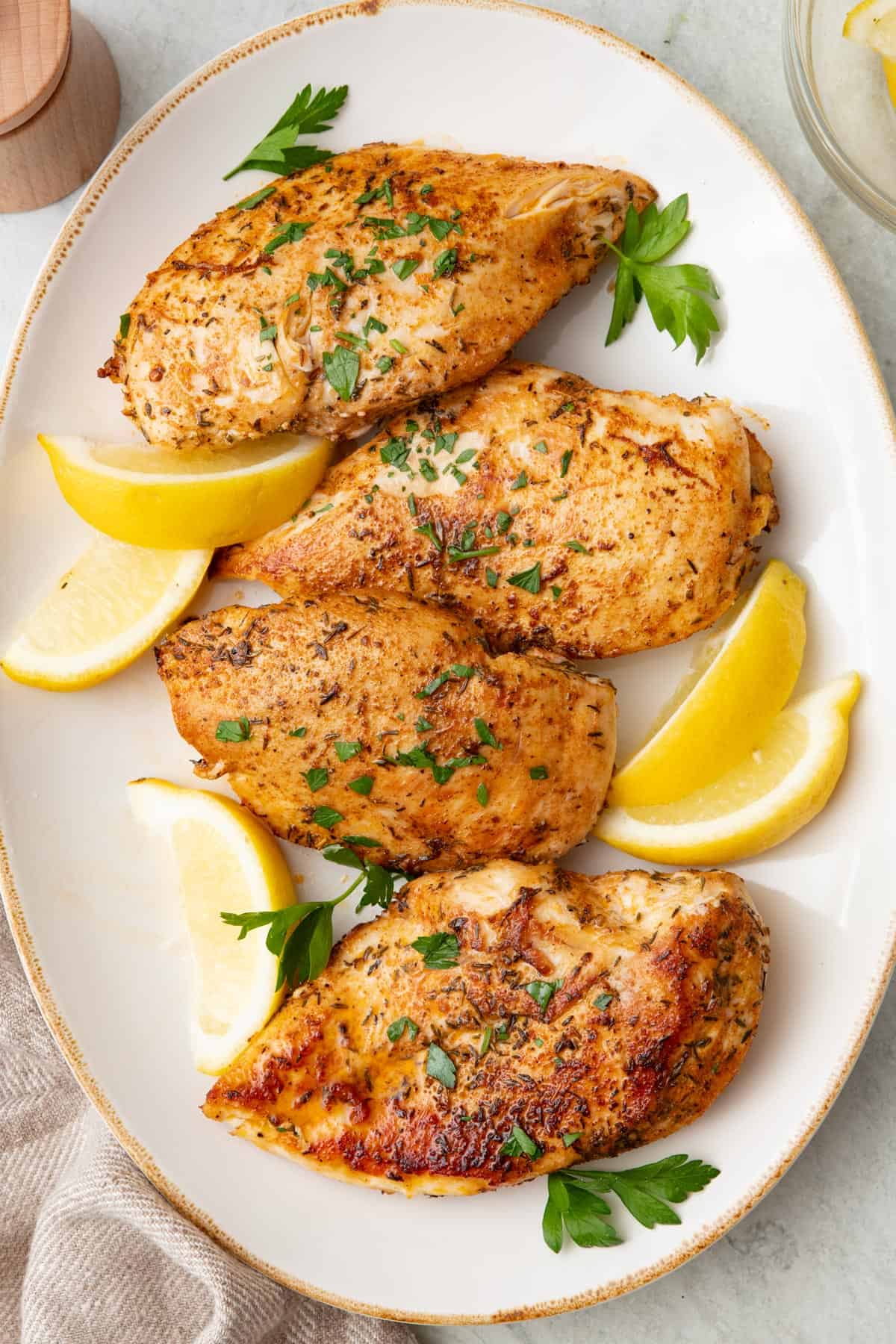
How to Cook Chicken Breast: 15 Recipes + Complete Guide
Five reliable methods, 15 catalog-tested recipes, and the one rule that fixes dry chicken.
Chicken breast cooks evenly and stays juicy when you pull it from heat at an internal temperature of 160°F and let it rest 5 minutes to coast up to a safe 165°F. That one rule — measured with an instant-read thermometer, not guessed by appearance — fixes 90% of dry-chicken complaints. The rest of this guide covers buying, brining, five reliable cooking methods, and the 15 recipes we'd send a friend to first.
Get a free week of easy dinners
Seven weeknight dinners with the shopping list already totalled, sent Sunday. No account needed, unsubscribe in one click.
No spam, unsubscribe in one click. Recipes, shopping lists and Instacart carts all work without an account either way.
How to buy chicken breast (air-chilled vs water-chilled, organic, free-range, what 'natural' means)
The label you actually want is air-chilled. Water-chilled chicken is dunked in a chlorinated tank after slaughter, which makes the breast soak up 4-12% of its weight in water — water you pay for by the pound and then watch sweat out of the pan. Air-chilled birds (Bell & Evans, Mary's, most Whole Foods house brands) cool on hooks in a refrigerated tunnel, so what you buy is what you cook. The USDA's poultry-from-farm-to-table guide is the canonical reference on chilling, sell-by dates, and safe-handling labeling.
The other labels matter less than people think. Organic means certified-organic feed and no antibiotics — a real welfare difference but not a flavor difference at typical home-cook salt levels. Free-range means the bird had access to the outdoors; access, not actual outdoor time. Pasture-raised is the only label that implies real outdoor foraging, and you'll feel it in the price ($14-18/lb at farmers markets vs $4-6 for conventional). Natural is meaningless on raw chicken — federal law already prohibits added colors or artificial ingredients in raw poultry, so the word is a marketing freebie.
Size matters most for even cooking. A 6-8 oz boneless skinless breast cooks in roughly the time windows the recipes below assume. Costco-style "jumbo" breasts that come in at 14-16 oz are 50% thicker through the lump and almost guarantee a dry exterior before the center is safe — butterfly them or buy a smaller pack.
How to brine and dry-brine for moisture insurance
Dry-brining beats wet-brining for boneless skinless chicken breast every single time. The technique: weigh the breasts, salt them at 3/4 teaspoon of Diamond Crystal kosher salt per pound (or 1/2 teaspoon Morton, which is denser), put them on a rack uncovered in the fridge for anywhere from 45 minutes to 24 hours. The salt pulls moisture out of the meat, dissolves into a concentrated brine, then reabsorbs back into the muscle taking seasoning with it. Net moisture loss when you cook is reduced by roughly 8-10% versus unsalted breasts in a controlled side-by-side.
Wet brining (1/4 cup salt per quart of water, 1-4 hours) works too but adds 6-8% water weight that boils off in the pan, undermining sear. Skip it for skin-on cuts where you want crispness, and for any breast you plan to grill — wet meat over coals just produces steam.
One caveat: many supermarket chickens are pre-brined. Read the label. If it says "enhanced with up to 12% solution of water, salt, and sodium phosphate," skip your own salt step or the meat ends up over-seasoned and rubbery. Air-chilled birds are essentially never enhanced — that's another reason to pay the extra dollar a pound.
How to pound or butterfly for even cooking
The thick lobe of a chicken breast is roughly twice as deep as the thin tail end. By the time the center of the lobe hits a safe 165°F, the tail has been north of 175°F for several minutes — that's the part that comes out chalky. Two fixes:
Pound to even thickness. Place the breast between two sheets of plastic wrap or in a gallon zip bag. Whack the thick end with the flat side of a meat mallet — or the flat bottom of a heavy skillet — until the breast is a uniform 1/2 to 3/4 inch thick. Use the textured side only for cutlets you intend to bread; the smooth side gives you intact muscle fibers.
Butterfly for stuffing or even faster cooking. Lay the breast flat, hold your chef's knife parallel to the cutting board, and slice horizontally through the lobe, stopping about 1/2 inch from the far edge. Open like a book. You now have a piece of meat half as thick and twice as wide that cooks in 4-5 minutes per side. Butterflied breasts are also what every recipe titled "stuffed chicken breast" expects — the Three-Cheese Stuffed Chicken Breast with Roasted Broccoli walks through it in pictures.
A pair of kitchen shears makes trimming the silver skin and the fatty triangle along the bottom edge a 10-second job — those trims render slowly and end up chewy.
Method 1: Pan-seared chicken breast — 8 minutes
The fastest method, the highest reward-to-effort ratio, and the one Kenji López-Alt's Food Lab measured every variable on. The short version:
1. Dry-brine 45 minutes minimum, ideally 4-12 hours.
2. Pat the surface dry with paper towels — water on the surface is what stops browning.
3. Heat 1 tablespoon of neutral oil in a 12-inch skillet (stainless or cast iron) over medium-high until shimmering.
4. Lay the breast in the pan away from you, lobe-side first. Don't move it. Sear 4 minutes.
5. Flip once. Sear 3-4 more minutes until an instant-read thermometer reads 160°F in the thickest part.
6. Rest 5 minutes on a cutting board. Carryover takes it to 165°F.
The pan you choose matters. A heavy enameled cast-iron skillet holds heat through the cold of the meat and gives you a darker, more even crust than thin nonstick. Nonstick is fine for weeknight ease but you'll get pale spots wherever the breast isn't flat against the pan. The Pan-Seared Chicken Breast with Lemon and Thyme recipe is our canonical version and uses a stainless skillet — it's also the source of the hero image at the top of this guide.
| Pan type | Sear quality | Cleanup | Best for |
|---|---|---|---|
| Cast iron | Excellent — deepest fond | Hand-wash | Weekend cooking, building pan sauces |
| Stainless tri-ply | Excellent — even browning | Dishwasher OK | Pan sauces, deglazing with wine |
| Nonstick | Good but pale | Dishwasher OK | Weeknight speed, beginner-friendly |
| Carbon steel | Excellent | Hand-wash, season | Restaurant-style sear, lighter than cast iron |
The leftover fond in the pan is the most valuable byproduct of pan-searing. Deglaze with 1/2 cup of dry white wine, 1/2 cup chicken stock, a tablespoon of capers, and finish with cold butter and lemon juice — that's One-Skillet Chicken Piccata with Lemon-Caper Sauce without the recipe card. Or hit it with sliced cremini, marsala, and cream for Pan-Seared Chicken with Creamy Mushroom Marsala Sauce.
Method 2: Oven-baked at 425°F
The most forgiving method, and the only one that works at scale (4+ breasts at once). High and fast beats low and slow for boneless skinless cuts — the breast is so lean that any extended time in the oven dries it out.
1. Heat the oven to 425°F. Convection works; cut 25°F off.
2. Toss breasts with olive oil (1 teaspoon per breast), salt, pepper, and dried herbs of choice.
3. Lay on a heavy half-sheet pan with at least 1 inch between pieces — crowded chicken steams.
4. Bake 18-22 minutes for 6-oz breasts. Start checking with a thermometer at minute 16.
5. Pull at 160°F. Rest 5 minutes.
The 425°F sheet-pan method is the workhorse behind every "dump dinner" you've ever cooked, including Sheet Pan Honey-Mustard Glazed Chicken with Root Vegetables. It also scales — eight breasts on two sheets, rotated halfway, take the same 22 minutes. Useful when you're meal-prepping lunches for the week.
Method 3: Air-fryer chicken breast
The air fryer is essentially a small convection oven with aggressive top-down airflow. For chicken breast specifically, that airflow gives you a Maillard crust without a pan-sear, in roughly half the wall time of the oven.
1. Brush both sides of the breast with oil and season.
2. Preheat the air fryer 3 minutes at 375°F (most need a preheat; baskets that fit 6+ inches don't).
3. Cook 11-13 minutes for a 6-oz breast, flipping at 7 minutes.
4. Pull at 160°F. Rest.
The Air Fryer Harissa Chicken Breasts with Roasted Vegetables recipe is a one-basket meal where the harissa-rubbed breasts share the basket with cubed sweet potato and cauliflower — done in 18 minutes from a cold start.
A real failure mode of the air fryer is jumbo breasts. Anything past 9 oz pushes you past the airflow's ability to cook the center before the surface dries. Butterfly first.
Method 4: Poached chicken breast (the best texture, period)
If "best texture" means most tender, most evenly cooked, never overdone — poaching wins. The downside is you sacrifice all browning, so the meat needs to be sauced, sliced cold, or shredded for the next day's salad. Worth it for meal prep and any recipe where the chicken will be cold or warm-not-hot.
1. Lay breasts in a single layer in a saucepan. Cover with cold water by 1 inch.
2. Add salt (1 teaspoon per quart), 2 bay leaves, a few peppercorns, half an onion, and a smashed garlic clove. A splash of white wine if you have it.
3. Bring to a bare simmer over medium heat — never let it boil hard. Bubbles should pearl, not roll.
4. Cover, kill the heat, leave it 15-18 minutes for 6-oz breasts.
5. Test with a thermometer (160°F target). Move to a plate.
America's Test Kitchen's chicken-poaching method is essentially this with a slightly more elaborate aromatic mix; their controlled tests find that residual-heat poaching from 175°F water beats live-heat simmering at 160°F by about 30% on a tenderness panel.
This is the chicken that goes into Keto Caesar Salad with Grilled Chicken and Parmesan Crisps for the next-day version (replace "grilled" with "poached" — it slices cleaner cold), or into chicken-salad sandwiches, or into a pot of stock for ramen.
Method 5: Grilled chicken breast (the marinades that work)
Grilling rewards prep and punishes inattention. Three things move the needle:
A. Marinate with acid + oil + salt. Yogurt-based marinades (think tikka masala) work because lactic acid is mild enough not to denature the surface into mush even at 12-24 hours. Lemon and vinegar marinades cap at 2 hours before texture starts to degrade. A garlic-citrus-olive-oil marinade in the Citrus-Marinated Grilled Chicken Fajitas with Peppers and Onions recipe is a 30-minute soak — enough.
B. Set up a two-zone fire. Hot side for the sear (direct heat, 450-550°F at the grate), cool side to finish through without burning the surface. Sear 2 minutes per side over the coals, then move to the cool side and close the lid 4-6 minutes more.
C. Pull at 160°F, not 165°F. Carryover on a hot grill is real — 5°F+ over a 5-minute rest. Cutting into a breast that hits 175°F internal is the difference between juicy and chalky, and you can't taste your way back from it.
The Grilled Peri-Peri Chicken with Spicy Paprika Marinade recipe is the closest thing we have to the Portuguese-South-African chain-restaurant version — bird-eye chiles plus paprika plus lemon plus garlic, 4-hour marinade, 12-minute cook.
Top 15 chicken breast recipes from the AislePrompt catalog
These are the ones we'd send a friend to first, ordered roughly by skill level. Each links to the full recipe with ingredients, method, and a verified hero image.
1. Pan-Seared Chicken Breast with Lemon and Thyme — the canonical pan-sear, 20 minutes including dry-brine.
2. Baked Herb-Ricotta Stuffed Chicken Breast — butterfly + stuff + bake, 35 minutes start-to-finish.
3. Grilled Peri-Peri Chicken with Spicy Paprika Marinade — overnight marinade, 12-minute grill.
4. Air Fryer Harissa Chicken Breasts with Roasted Vegetables — one-basket, 18 minutes.
5. Pan-Fried Chicken with Lemon-Garlic Sauce — the easiest pan sauce in this list.
6. Sheet Pan Honey-Mustard Glazed Chicken with Root Vegetables — feeds 4, one pan.
7. One-Skillet Chicken Piccata with Lemon-Caper Sauce — restaurant-tier in 25 minutes.
8. Pan-Seared Chicken with Creamy Mushroom Marsala Sauce — date-night staple.
9. Buffalo Chicken Bowls with Cauliflower Garlic Rice — meal-prep friendly.
10. Keto Caesar Salad with Grilled Chicken and Parmesan Crisps — uses the same grilled-breast method as #3.
11. Three-Cheese Stuffed Chicken Breast with Roasted Broccoli — the butterfly technique in action.
12. Citrus-Marinated Grilled Chicken Fajitas with Peppers and Onions — the marinade base for half a dozen other recipes.
13. One-Pot Creamy Tuscan Garlic Chicken and Spinach — comes together in one skillet, 30 minutes.
14. Chicken Stir-Fry — the weeknight-Asian default; slice across the grain.
15. Chicken Tikka Masala — yogurt-marinated cubes, finished in a tomato-cream sauce.
For an alphabetical browse of every chicken recipe in the catalog (over 700 of them), use the chicken category page. If you're planning a week of dinners around these, the meal plan tool will build the shopping list and tell you which ingredients overlap.
What kitchen tools you actually need (an instant-read thermometer is non-negotiable)
You can cook every recipe above with a sharp knife, a heavy skillet, and one tool you probably don't own. That tool is an instant-read thermometer. The recommended pick, the ThermoWorks Thermapen ONE, reads to within 0.5°F in under one second, and pays for itself the first time it stops you from over-cooking a 14-oz Costco breast.
The short tool list:
- Instant-read thermometer — the only non-negotiable item on the list.
- 8-inch chef's knife — sharp matters more than expensive. Hone before each cook.
- Locking tongs — turn the breast without piercing the surface and bleeding juice.
- Kitchen shears — trim silver skin in seconds.
- A heavy 10-12 inch skillet — cast iron, stainless tri-ply, or carbon steel. Le Creuset's enameled cast iron is the lifetime-buy version; a $40 Lodge bare cast iron skillet does the same job for one-tenth the price.
- A half-sheet pan with a rack — for dry-brining in the fridge and for oven-baking 4+ breasts at once.
Skip: meat mallets (a heavy skillet does the job), brining bags (a half-sheet pan is reusable), poultry shears (kitchen shears suffice for boneless breast), single-purpose chicken cookers (a pan and a thermometer beat every gadget on the market).
Common chicken-breast mistakes (overcooking, no rest, dry skillet, wrong size)
The five failures that account for almost every dry-chicken complaint we've seen:
1. Cooking to 175°F. Pull at 160°F, rest to 165°F. The 10°F window between safe and dry is where chicken texture lives.
2. Skipping the rest. Slicing immediately bleeds the juices that should be redistributing through the muscle fibers. Five minutes minimum. Tent loosely with foil if you're impatient.
3. Cooking unbrined, unpatted, straight-from-the-package breast. Water on the surface stops browning. Salt under the surface stops dryness. Either of those is a 20% improvement; both are a 50% improvement.
4. Crowding the pan. Steam, not sear. If the breasts touch, you're poaching them in their own released moisture. Cook in two batches or upgrade to a larger pan.
5. Cooking jumbo (12+ oz) breasts whole. Butterfly or pound. The center won't reach safe before the surface goes leathery — physics, not technique.
Two more honorable mentions: cold-from-the-fridge breast (let it sit out 20 minutes — the temperature gradient is what causes uneven cooking), and overflipping (one flip per side gives you the darkest crust; constant flipping resets the Maillard clock).
FAQ
What temperature should chicken breast be cooked to?
165°F internal at the thickest part — USDA safe minimum. Pull from heat at 160°F because carry-over adds 5°F during a 5-minute rest. Going past 170°F is where chicken breast goes dry. An instant-read thermometer pays for itself the first cook; visual cues like 'juices run clear' are imprecise and routinely overshoot by 10-15°F.
Should I brine chicken breast?
Yes — and dry-brine is easier than wet. Salt the breasts (3/4 tsp kosher salt per pound) and rest uncovered in the fridge for 1-24 hours. The salt draws moisture, dissolves, and reabsorbs with seasoning baked in — net moisture goes up about 8-10% and seasoning gets into the meat instead of sitting on the surface. Skip brining only if your chicken is pre-brined (check the label for 'enhanced with solution').
Why does my chicken breast turn out dry?
Three causes, ranked by frequency. One: overcooking to 175°F+ — the muscle fibers contract past 165°F and squeeze out moisture. Two: uneven thickness — the thin end cooks 50% faster than the thick end, so by the time the middle is safe the edges are jerky. Pound or butterfly for even thickness. Three: no rest — slicing immediately bleeds out the juices that should redistribute during a 5-minute rest.
Is it safe to cook chicken from frozen?
Yes in the oven and air fryer; no for pan-searing or grilling. Oven: 50% longer cook time at 350°F (e.g. 35-40 minutes for a 6-oz breast). Air fryer: about 18-22 minutes at 380°F vs 12 minutes from thawed. Always verify 165°F internal — frozen-from-cold can hide cold spots. Pan-searing dumps water into the pan and you end up boiling, not browning.
Can I meal-prep chicken breast for the week?
Yes — cooked chicken breast keeps 3-4 days refrigerated and 2-3 months frozen in single portions. Slice or shred before storing so it reheats fast and cool fully before lidding the container. Reheat at 50% power in 30-second pulses to avoid the rubber-texture problem. For best texture, undercook by 2-3°F on Sunday since reheating finishes the cook.
Related
- Browse every chicken recipe in the catalog — 700+ recipes filtered by cuisine, cook time, and dietary tag.
- Plan a full week of dinners with the AislePrompt meal plan tool — it builds a consolidated shopping list and surfaces ingredient overlaps so you cook from one cart.
Frequently asked questions
What temperature should chicken breast be cooked to?
Should I brine chicken breast?
Why does my chicken breast turn out dry?
Is it safe to cook chicken from frozen?
Can I meal-prep chicken breast for the week?
Sources
Plan a week of meals in two minutes.
Tell our AI what you have and what you like — it builds your plan, shopping list, and Instacart cart. No account needed.
Try free →