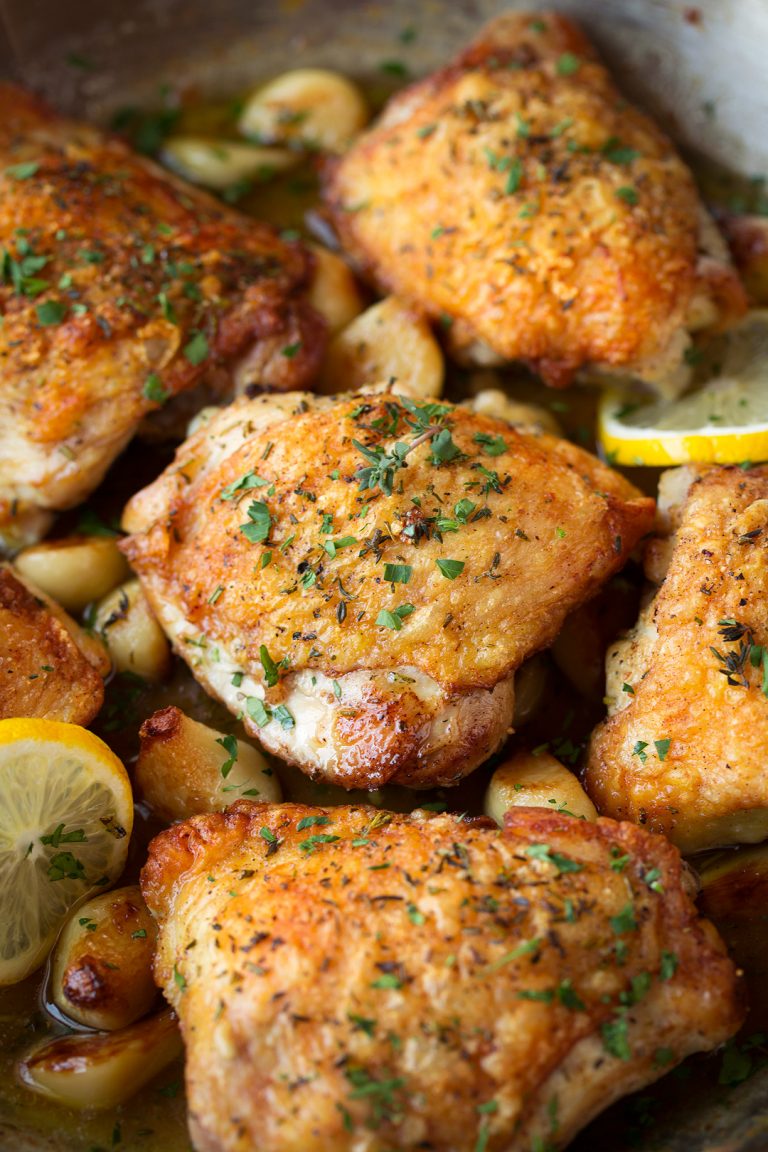
How to Cook Chicken: 30 Recipes + Complete Guide for Beginners
Cuts decoded, brining demystified, 160°F not 165°F — and 30 catalog recipes that turn the most-overcooked protein in America into your easiest weeknight dinner.
Introduction: chicken is the most-cooked protein in America — and the most overcooked
Get a free week of easy dinners
Seven weeknight dinners with the shopping list already totalled, sent Sunday. No account needed, unsubscribe in one click.
No spam, unsubscribe in one click. Recipes, shopping lists and Instacart carts all work without an account either way.
The average American eats roughly 100 pounds of chicken a year. A significant share of that is dry. Not because chicken is hard to cook — it's not — but because most home cooks were taught the same wrong number (165°F everywhere, every cut) and the same wrong technique (lay it in a cold pan, hope for the best). This guide is the correction: how the cuts actually differ, how to buy without paying for marketing, how to cook each method to the right number, and 30 catalog recipes to put the technique to work.
The short answer for the impatient reader: brine your chicken breast for 20 minutes, pat it dry, sear it in a hot pan for 3 minutes per side, finish in a 400°F oven if it's thicker than 3/4 inch, pull at 160°F (residual heat brings it to 165°F), rest 5 minutes. Slice across the grain. That's the whole curriculum for the cut that gives most people the most trouble.
The rest of this guide goes deeper — the cuts decoded, the temperatures by cut and why they differ, the five methods every kitchen needs, the 30 recipes that put it to work, and the mistakes that wreck even good chicken. Read it once and you will cook chicken better than 80% of home kitchens in America. The bar is, frankly, low.
Cuts decoded: breast vs thigh vs drumstick vs whole — when to use which
Chicken comes from one bird; the cuts are not interchangeable. Choose by what you're cooking and how forgiving you need the recipe to be.
| Cut | Fat (per 4 oz) | Cook to | Forgiveness | Price/lb (2026) | Best for |
|---|---|---|---|---|---|
| Breast (boneless, skinless) | 3 g | 165°F | Low (5°F overshoot = dry) | $4-7 | Meal prep, salads, fast weeknights |
| Breast (bone-in, skin-on) | 5 g | 165°F | Medium (skin protects) | $3-5 | Roasting, schnitzel base |
| Thigh (boneless, skinless) | 8 g | 175°F | High (forgives ±10°F) | $3-5 | Weeknight stir-fries, curries, bowls |
| Thigh (bone-in, skin-on) | 10 g | 175°F | Highest | $2-4 | Sheet-pan, roasting, braises |
| Drumstick | 8 g | 175°F | Highest | $1-3 | Grilling, frying, kid food |
| Wings | 12 g | 180°F | High | $3-5 | Frying, baking, grilling |
| Whole bird (3-5 lb) | varies | 165°F breast / 175°F thigh | Medium | $1-3 | Roasting, weekend project |
The decision matrix is shorter than the table suggests:
- Weeknight, you want it fast and lean: boneless skinless breast. Brine, sear hard, pull at 160°F.
- Weeknight, you want forgiving and meaty: boneless skinless thigh. Sear or stir-fry; the higher fat content means you can't really overcook them in 8 minutes.
- Sheet-pan, family dinner: bone-in skin-on thigh. Skin crisps, dark meat juices baste the vegetables, kids eat it without complaint.
- Roasting a whole bird: spatchcock (remove the backbone, flatten), roast at 450°F for 45 minutes. Even cooking, crispy skin, no cavity to mess up.
The Best Classic Chicken Parmesan is a breast recipe; Crispy Lemon-Herb Chicken Thighs with Garlic Roasted Broccoli is the thigh standard; both work as a Tuesday-versus-Wednesday split in the same week.
How to buy: organic, free-range, air-chilled — what's marketing and what matters
The chicken aisle has more labels than the wine aisle. Most of them are marketing. Three actually matter:
1. Air-chilled. Conventional chicken processing dunks each bird in a chlorinated cold-water bath to bring it down to safe temperature. The bird absorbs 5-15% of its weight in water, which you pay for at the register and which makes the skin difficult to crisp because it's already saturated. Air-chilled chicken is cooled by air alone — no water uptake, drier skin, deeper flavor, and you pay for chicken instead of water. Premium grocery chains and most butchers carry it. Pay the extra $1-2/lb; it is the single most impactful upgrade in the aisle. The USDA's farm-to-table chicken safety guide covers the processing details if you want the full picture.
2. Organic (USDA certified). Means: no antibiotics, no animal byproducts in the feed, organic feed. Costs roughly 50-100% more. The taste difference is real but small — slightly cleaner flavor. The main reason to buy organic is antibiotic-resistance concerns, not flavor. If you cook chicken 4+ times a week, the cumulative case for organic strengthens; if 1-2x a week, conventional from a good farm is fine.
3. Pasture-raised. "Free-range" is a near-meaningless label (means the bird had "access" to the outdoors — a door that's open for an hour daily counts). Pasture-raised means the birds actually live outside, eating bugs and grass. The flavor difference is the biggest of the three labels — pasture-raised tastes more like chicken used to. Expensive ($8-15/lb) and worth it for a Sunday roast where the protein is the centerpiece.
Skip these labels: "natural" (regulated, but means very little), "hormone-free" (federal law already bans hormones in chicken — every chicken is hormone-free), "vegetarian-fed" (chickens are not vegetarians; this is bad), and "Amish-raised" (no regulatory definition).
For ground chicken, buy thigh-meat ground if you can find it — much juicier than breast ground for burgers, meatballs, and stir-fry.
Storage and prep: brining, drying, trimming, butterflying
Chicken keeps 1-2 days in its original packaging, 3-4 days in a sealed container after cooking, 9 months in the freezer raw. Don't refreeze thawed chicken — the second freeze damages the cell walls and the texture goes mushy.
To brine or not. Brining is the difference between juicy chicken breast and dry chicken breast. There are two paths:
- Wet brine (best for breast): 2 tablespoons kosher salt + 1 tablespoon sugar dissolved in 1 quart cold water; submerge the breasts 20 minutes; pat dry. The chicken gains about 10% moisture that stays in during cooking. For thighs, skip — there's enough fat that brining doesn't move the needle.
- Dry brine (best for whole birds and skin-on thighs): sprinkle the skin and flesh with 3/4 teaspoon kosher salt per pound, leave uncovered on a rack in the fridge for 4-24 hours. The salt draws moisture out, the dry surface re-absorbs the seasoned water, the skin dehydrates and crisps better than any wet method. This is the technique behind every great roast chicken you've eaten.
Drying. Always pat the chicken dry with paper towels before cooking, no matter the method. Wet chicken steams; dry chicken sears. Five seconds of pat-down per piece is the difference between a brown crust and a gray exterior.
Trimming. Boneless skinless breasts have a band of silver skin and a thin strip of fat along one edge — trim both with a sharp chef's knife from the knives shop before cooking. Skin-on thighs sometimes have excess skin flaps; tuck them under the thigh so they crisp instead of curl.
Butterflying. For pan-seared and grilled breast, butterfly: slice horizontally through the thick part of the breast (don't cut all the way through), open it like a book. The piece is now uniform thickness and cooks in 6 minutes total instead of 12. This is the single most underused technique for fast weeknight chicken.
Spatchcocking. For roasted whole bird, remove the backbone with kitchen shears (cut down both sides of the spine, lift it out), flatten the bird on the cutting board, palm the breastbone to crack it flat. The bird now cooks in 40-45 minutes at 450°F instead of 70-80 minutes — and the white and dark meat finish at the same time.
For sheet-pan techniques, a couple of half-sheet pans from the bakeware shop and a 12-inch cast-iron or stainless skillet from the cookware shop handle every recipe in this guide.
Five cooking methods (pan-seared, oven-roasted, sheet-pan, grilled, poached) with HowTo steps
These five methods cover 95% of chicken cooking.
Method 1: Pan-seared (boneless breast or thigh). Heat 1 tablespoon neutral oil in a 12-inch skillet over medium-high until shimmering. Pat the chicken dry, season heavily on both sides (1/2 teaspoon kosher salt per piece). Place flesh-side down, don't move it for 3 minutes. Flip; cook 2-4 minutes more depending on thickness. For breast thicker than 3/4 inch, finish in a 400°F oven for 5-7 minutes after the second sear. Pull at 160°F internal (breast) or 170°F (thigh) for residual cooking to bring it to 165°F/175°F respectively. Rest 5 minutes. The Pan-Seared Chicken Breast with Lemon and Thyme is the canonical version.
Method 2: Oven-roasted (bone-in, skin-on or whole bird). For bone-in thighs: 425°F, skin-up on a rimmed sheet pan, 30-35 minutes until skin is deeply golden and internal temperature reads 175°F. For a spatchcocked whole bird: 450°F, 40-50 minutes, breast reading 160°F (climbs to 165°F resting). No basting needed — the dark meat fat self-bastes the breast above it.
Method 3: Sheet-pan (the weeknight workhorse). Cut vegetables (potatoes, carrots, broccoli) into bite-sized pieces, toss with oil and seasoning, spread on a half-sheet pan, roast 10 minutes at 425°F. Move vegetables to the sides, place seasoned bone-in skin-on chicken thighs in the middle, roast 25 more minutes. Everything done at once, one pan, 35 minutes total. The Sheet Pan Honey-Garlic Chicken with Roasted Vegetables is the cleanest execution.
Method 4: Grilled (boneless breast, butterflied thigh, drumstick, wings). Preheat grill to medium-high (about 450°F surface temperature). Oil the grates. Lay the chicken across the grates at a 45° angle to the bars for diamond grill marks. Cook 3 minutes per side for butterflied breast, 4-5 for thighs, 12-15 for drumsticks (turning every 4 minutes). Pull at the cut's target temperature. Rest on a board, tented with foil, 5 minutes. The Grilled Peri-Peri Chicken with Spicy Paprika Marinade is a high-heat grilling masterclass.
Method 5: Poached (lean, weeknight-easy, salad-prep gold). Place boneless skinless breasts in a saucepan, cover with 1 inch of cold water, add 1 tablespoon salt, 2 garlic cloves, a bay leaf, a few peppercorns. Bring just to the bare bubble; immediately reduce to a bare simmer; cover; cook 10 minutes for a 6-oz breast; turn off heat and let sit covered another 5 minutes. Pull at 160°F. The breast is silky, evenly cooked, and absolutely never dry. Use for chicken salad, soup, taco filling, or rice bowls. The Genuine Herb-Poached Chicken with Lemon-Garlic Butter is the recipe most home cooks haven't tried that becomes a permanent rotation after they do.
Doneness by the numbers: 165°F breast, 175°F thigh, why the temps differ
Two numbers, one buy. The numbers:
- Breast: pull at 160°F; rests to 165°F. White meat tightens fast above 165°F; dries hard above 170°F.
- Thigh: pull at 170°F; rests to 175°F. Dark meat connective tissue (mostly collagen) starts dissolving above 165°F. At 175°F it's silky and tender. At 165°F it can still feel tough and chewy — too low for dark meat.
- Whole bird: pull when the breast hits 160°F and the thigh hits 170°F. The two finish within minutes of each other on a spatchcocked bird.
The buy: an instant-read thermometer. $15-20 for a good one, lasts a decade. The thermometer is the difference between consistent juicy chicken and gambling.
Why the temps differ: white meat protein (myoglobin-poor) denatures and squeezes out moisture above 165°F. Dark meat has more connective tissue (collagen) that needs the heat to break down into gelatin — that's what makes thigh meat feel juicy at 175°F instead of stringy. Cook them to the same temperature and you'll always disappoint one or the other.
The USDA's explicit answer on whether to wash chicken — don't covers the food-safety side; the temperatures above come from the same agency's poultry guidance. Serious Eats's properly-cooked chicken breast piece goes deeper into the food-science reasoning if you want the full kinetics on why 160°F pull works.
30 chicken recipes from the AislePrompt catalog
Organized by cut and method.
Boneless skinless breast (8):
1. Pan-Seared Chicken Breast with Lemon and Thyme — the canonical version; 25 minutes; weeknight standard.
2. Genuine Herb-Poached Chicken with Lemon-Garlic Butter — never dry; salad-prep gold.
3. The Best Classic Chicken Parmesan — Sunday-night project; 50 minutes total.
4. Chicken Piccata — Italian; lemon + capers + butter pan sauce; 35 minutes.
5. Lemon Pepper Grilled Chicken — butterflied; 15 minutes total on the grill.
6. Chicken Marsala — mushroom + wine cream sauce; 30 minutes.
7. Buffalo Chicken Wraps — leftover-friendly; uses poached breast.
8. Chicken Caesar Salad — poached breast hero.
Bone-in skin-on thighs (8):
9. Crispy Lemon-Herb Chicken Thighs with Garlic Roasted Broccoli — 40 minutes; sheet-pan; crisp skin guaranteed.
10. Garlic-Rosemary Roasted Thighs — 35 minutes; pantry-easy.
11. Honey-Soy Glazed Thighs — kid-friendly; sweet + salty.
12. Crispy Thigh Schnitzel — pounded, breaded; fast weeknight.
13. Sheet-Pan Thighs with Sweet Potato and Sage — fall comfort.
14. Sheet-Pan Thighs with Brussels Sprouts and Maple — sweet-savory.
15. Braised Thighs with White Beans — 1-hour Sunday; soup-adjacent.
16. Coq au Vin — special-occasion thigh braise; 90 minutes.
Boneless skinless thighs (6):
17. One-Pan Tuscan Chicken with Sun-Dried Tomatoes — creamy; 35 minutes; restaurant-grade.
18. Stir-Fry Chicken with Black Bean Sauce — 20 minutes; pantry pull.
19. Chicken Tikka Masala — Indian classic; 45 minutes; freezes well.
20. Thai Basil Chicken — 25 minutes; uses ground or chopped thigh.
21. Korean Bulgogi Chicken — overnight marinade; grill or pan-sear.
22. Chicken and Dumplings — Sunday comfort; 75 minutes.
Grilled + skewers (4):
23. Grilled Peri-Peri Chicken with Spicy Paprika Marinade — Portuguese; weekend showstopper.
24. Citrus-Marinated Grilled Chicken Fajitas with Peppers and Onions — taco night.
25. Yakitori Chicken Skewers — Japanese; 30 minutes including skewering.
26. Grilled Chicken Souvlaki — Greek pita night.
Whole bird (2):
27. Spatchcocked Roast Chicken with Lemon — 50 minutes total; centerpiece.
28. Beer-Can Chicken — backyard grill night.
Wings + drumsticks (2):
29. Crispy Oven Wings — baking powder trick; restaurant-crisp without frying.
30. Garlic-Soy Drumsticks — sweet-savory kid food.
Common chicken mistakes (under-seasoning, cold pan, slicing too soon, dry breast)
Five mistakes account for almost every bad chicken dinner.
1. Under-seasoning. Chicken needs more salt than most home cooks use. The rule: 1/2 teaspoon kosher salt per piece (4-6 oz), applied 10-15 minutes before cooking. The salt pulls moisture out, then the moisture reabsorbs seasoned. Salt at the pan and the surface stays wet; salt 15 minutes ahead and the chicken seasons the way restaurants do.
2. Cold pan. For chicken (unlike salmon), hot pan is mandatory. Wait for the oil to shimmer. Lukewarm oil gives you a gray, steamed exterior; properly hot oil gives you a brown, crusty sear. The audible cue: when you lay the chicken in, it should hiss aggressively. If it doesn't, take it out and let the pan get hotter.
3. Slicing too soon. Rest 5 minutes. Always. The juices redistribute through the muscle fibers; cut early and they spill onto the cutting board, dehydrating the chicken you just cooked perfectly. The other half of this rule: slice across the grain, not with it. Look at the muscle fibers; cut perpendicular to them. Slicing with the grain produces stringy, chewy chicken even when it was cooked right.
4. Dry breast. The cumulative result of skipping the brine, overcooking, and slicing too soon. Fix all three and chicken breast becomes the lean, juicy meal-prep workhorse it's supposed to be. If you only have time for one fix: pull at 160°F instead of 165°F.
5. Washing raw chicken. This is a food-safety mistake, not just a technique mistake. Don't wash chicken. The USDA explicitly recommends against it because rinsing sprays bacterial water droplets across a 3-foot radius onto counters, sinks, and dish racks. Pat dry with paper towels (better for browning anyway), throw the towels in the trash, wash your hands.
FAQ
What's the difference between chicken breast and chicken thigh? Breasts are leaner (about 3g fat per 4 oz) and faster to cook but unforgiving — overcook by two minutes and they're dry. Thighs have more fat (about 8g per 4 oz) and connective tissue, so they stay juicy across a wider temperature window and forgive imprecise cooking; they also taste meatier. For weeknight cooking, default to thighs; for high-protein, low-fat meal prep or speed-grilling, breast is the right call. Price-wise, thighs are usually 30-40% cheaper.
How do I cook chicken breast without it drying out? Three rules. First, pound the breast to even thickness (½ inch) so the thin end doesn't overcook while the thick end finishes. Second, brine for 20-30 minutes in 2 tablespoons salt per quart of water — it adds about 10% moisture by weight that stays in the meat. Third, pull at 160°F (residual cooking brings it to 165°F) and rest 5 minutes before slicing. Done right, chicken breast is juicy; done wrong, it's particle board.
Is it safe to eat chicken that's slightly pink near the bone? Yes, if the internal temperature read 165°F at the thickest part. Pink color near the bone is a marrow reaction — proteins leach out and turn pink during cooking — and has nothing to do with safety. Trust the thermometer, not the color. The reverse trap is more dangerous: chicken can look fully white throughout and still be 145°F inside, especially in cold spots near bone. Always temp before serving.
Do I need to wash raw chicken before cooking? No — and the USDA explicitly recommends against it. Rinsing raw chicken sprays bacterial water droplets across a 3-foot radius onto counters, sinks, dish racks, and cutting boards, contaminating surfaces that are now harder to clean than the chicken itself. The cooking temperature kills surface bacteria; rinsing does not. Pat the chicken dry with paper towels (better for browning anyway), throw the towels straight in the trash, and wash your hands.
How long does cooked chicken keep in the fridge? 3-4 days in a sealed container — that's the USDA-published number for any cooked poultry. After day 4 the risk of Listeria growth climbs noticeably even though the chicken may smell and look fine. For meal prep that runs Sunday through Friday, freeze Wednesday's portions on Sunday and thaw them Tuesday night. Cooked chicken also freezes well for 2-3 months; portion it before freezing so you thaw only what you need.
Sources & last verified
This guide was last verified on June 14, 2026.
- USDA FSIS — Chicken from Farm to Table
- USDA — Is It Safe to Wash Raw Chicken?
- Serious Eats — How to Cook Chicken Breasts Properly
Frequently asked questions
What's the difference between chicken breast and chicken thigh?
How do I cook chicken breast without it drying out?
Is it safe to eat chicken that's slightly pink near the bone?
Do I need to wash raw chicken before cooking?
How long does cooked chicken keep in the fridge?
Sources
Plan a week of meals in two minutes.
Tell our AI what you have and what you like — it builds your plan, shopping list, and Instacart cart. No account needed.
Try free →