How to Cook Salmon: 25 Recipes + Complete Buying & Cooking Guide
Pull at 125°F, salt 15 minutes early, and dry the skin twice — the rest is just heat and time.
Salmon goes from fridge to plate in 12 minutes, takes salt and fat well, holds its shape in five different cooking methods, and costs less per pound of usable protein than chicken thigh when you buy it frozen. That's why it's the dinner we recommend new cooks learn first — and once you know the temperature target (125°F internal), the rest is technique you'll reuse on every other fish.
Get a free week of easy dinners
Seven weeknight dinners with the shopping list already totalled, sent Sunday. No account needed, unsubscribe in one click.
No spam, unsubscribe in one click. Recipes, shopping lists and Instacart carts all work without an account either way.
This guide answers how to cook salmon for any cut, any method, and any skill level. You'll get the buying playbook, five cook methods with exact times, a thickness-to-time table, 25 catalog recipes, and the five mistakes that wreck salmon for almost everyone the first time they cook it.
Why salmon is the easiest dinner protein to learn
Salmon is forgiving in ways that chicken and pork are not. Three reasons:
1. The fat insulates the muscle. Salmon is ~13% fat by weight in a typical farmed Atlantic fillet and 6–8% in wild sockeye. That fat keeps the flesh moist through a wider temperature window than lean fish like cod or tilapia, where 5°F of overcooking turns it cottony.
2. Doneness is visible. You can see the protein turn from translucent to opaque from the bottom up. No cutting into it, no thermometer hesitation — once the color creeps two-thirds of the way up the fillet's edge, you're 60 seconds from done.
3. One technique fits all cuts. Skin-on fillets, skinless fillets, steaks, whole sides — they all want the same internal temperature (125°F for medium), the same salt-then-dry prep, and the same medium-high heat. Learn it once.
The USDA's official guidance recommends 145°F as the safe-cooked target for fish (USDA FSIS — Cooking Fish), but that's a kill-everything-safe number. Restaurants and trained cooks pull salmon at 125°F because the carryover heat brings it to 130°F off the heat, and at 130°F the flesh is silky rather than chalky. If you're cooking for someone immunocompromised, pregnant, or under 5, follow the 145°F number.
How to buy: wild vs farmed, fresh vs frozen
The salmon you'll see at most US grocery stores falls into four buckets. Here's what you're actually choosing between.
| Type | Fat (g/100g) | Omega-3 (mg) | Price/lb (typical 2026) | Best for |
|---|---|---|---|---|
| Wild sockeye (Pacific) | 11 | 1,300 | $18–$28 | Quick high-heat, simple seasoning |
| Wild king/chinook | 19 | 1,700 | $28–$40 | Showstopper centerpieces, sashimi |
| Farmed Atlantic | 13 | 2,200 | $10–$16 | Weeknight everything; the default |
| Farmed coho/steelhead | 10 | 1,200 | $13–$18 | Substitute for sockeye at lower price |
Wild Pacific salmon (sockeye, coho, king, pink, chum) is in season May through September. Out of season it's been frozen, and there's no quality penalty if it was flash-frozen at sea — that's actually the gold standard. Sockeye has the firmest texture and deepest flavor; it tolerates aggressive seasoning that would overpower farmed fish.
Farmed Atlantic salmon is what you'll buy 80% of the time, and it's fine. Modern responsible operations (look for ASC, BAP, or Best Aquaculture Practices certification) produce fish with lower mercury than wild and protein content within 5% of wild. The Monterey Bay Aquarium's Seafood Watch program maintains a current sustainability rating for every salmon source — bookmark it.
Fresh vs frozen. Unless your store has a high-turnover seafood counter (Whole Foods, regional fish markets, Costco's Kirkland Signature), buy frozen. "Fresh" salmon at most supermarkets was frozen, thawed for display, and is now 3–5 days into its second life. Vacuum-sealed frozen fillets stay at peak quality for 4 months and are reliably cheaper.
What to ask the fishmonger: "When was this delivered, and was it ever frozen?" A confident counter will tell you the day and the answer to both. A defensive answer is your signal to pick the frozen case instead.
Storage and prep
Fresh salmon stays good in the coldest part of your fridge for 2 days, no more. Frozen vacuum-sealed fillets last 4 months in a chest freezer, 2 months in your kitchen freezer. Thaw frozen fillets overnight in the fridge or under cold running water for 20 minutes; never in warm water or the microwave.
Pin bones. Run a fingertip along the centerline of any fillet. The tiny bone tips you feel are pin bones — pull them with needle-nose pliers or clean tweezers in the direction the bone points (toward the head). Wild salmon almost always has 8–12 pin bones; farmed Atlantic often has none. A good Chef's knife makes the pre-trim easier but isn't required.
Skin on or skin off. Keep the skin on for pan-searing, grilling, and broiling — it crisps into the best part of the meal and protects the flesh from direct flame. Take the skin off only for poaching, gravlax, or recipes where you want a clean uniform top (most glazed preparations). To remove: slide a sharp boning knife between flesh and skin at the tail end, grip the skin tight, and saw the blade flat against your cutting board while pulling the skin toward you.
Salting. Salt the fillet 15–40 minutes before cooking. Kosher salt at roughly 1 teaspoon per pound — sprinkle evenly on both sides. This isn't seasoning, it's a dry brine: salt pulls moisture out of the flesh, then the flesh reabsorbs it as a light brine, locking in seasoning and tightening the protein. The result is firmer texture, more even browning, and noticeably better skin crisp. Skip this step and your salmon will still be good; do it and people will ask what your trick is.
Five cooking methods with exact times
Pan-seared (the default)
Pat dry. Salt 15 min ahead. Heat a stainless or carbon-steel skillet over medium-high until a water droplet skitters. Add 1 Tbsp neutral oil, lay the fillet skin-side down, press flat with a spatula for 30 seconds to prevent curling, and don't move it. Cook 4 min skin-side, flip, cook 2 min flesh-side, pull at 125°F. Total: ~6 min for a 1-inch fillet. Reference recipe: Pan-Seared Salmon with Lemon-Dill Butter.
Oven-baked
400°F, 12–14 min for a 1-inch fillet on a parchment-lined sheet pan. Brush with oil, salt, optional glaze in the last 3 min (sugar burns before that). Internal temp 125°F. Best for thick centerpieces and weeknight glazes — see Baked Honey-Soy Glazed Salmon.
Sheet-pan with vegetables
Single-pan, weeknight gold. Start dense vegetables (potato, carrot, broccoli) at 425°F for 12 min. Push aside, add salmon, return to oven for 10–12 min more. The salmon finishes when the vegetables are caramelized. Sheet Pan Herb-Glazed Salmon is the cleanest version of this.
Grilled (gas or charcoal)
Direct medium-high heat, 4 min skin-side down on well-oiled grates, then flip and finish 3–4 min. Cedar planks add smoke and prevent sticking — soak the plank 1 hr ahead. Try Maple-Glazed Cedar Plank Salmon — the plank does most of the work.
Poached
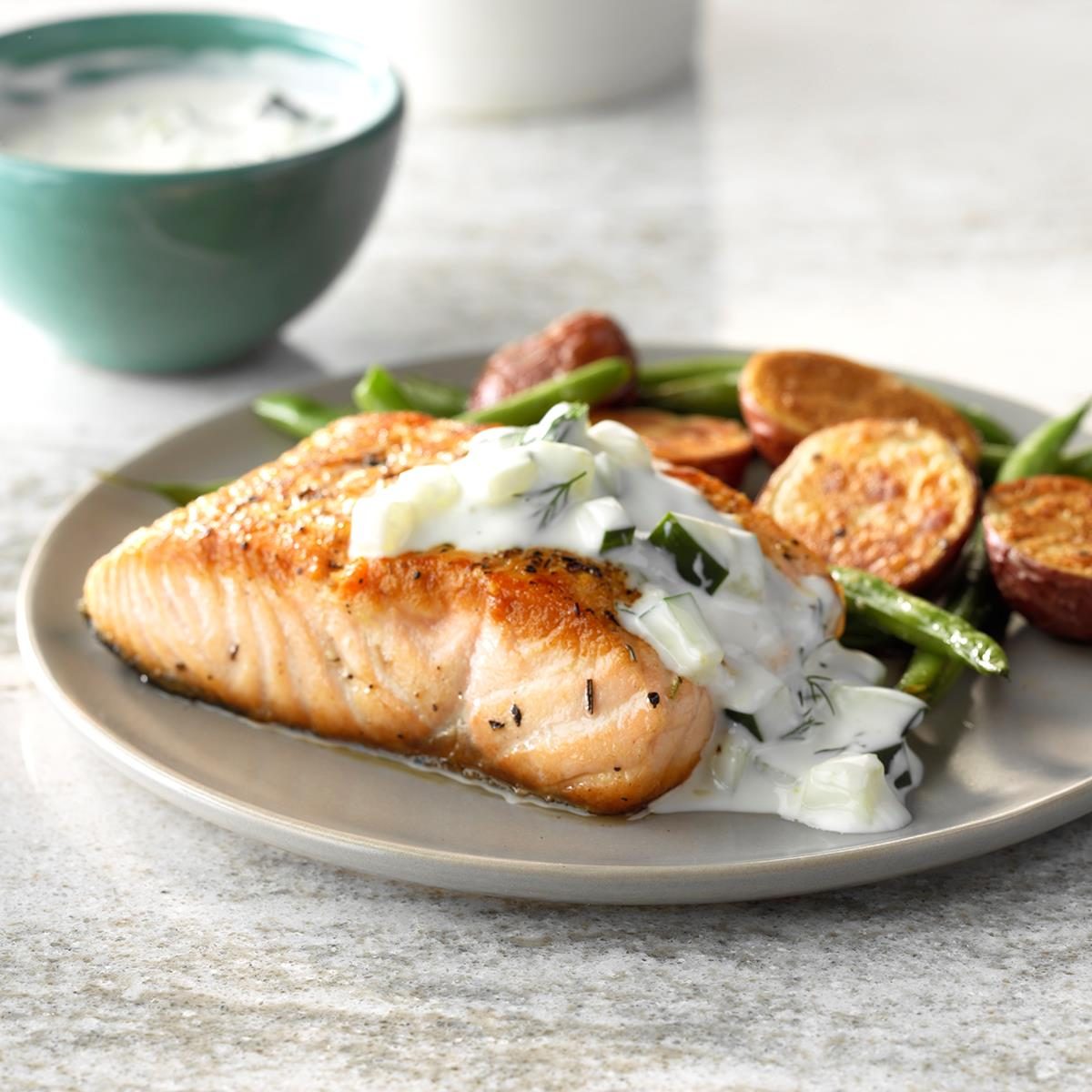
Lowest-stress method for skinless fillets and meal prep. Bring 2 inches of court bouillon (water + 1/4 cup white wine + 1 lemon + dill stems + salt) to a bare simmer in a saucepan. Slide in skinless fillets, cover, kill the heat, wait 8 min. Texture is silky and uniform. Pair with the yogurt-dill sauce in Baked Herb-Crusted Salmon with Lemon and Dill Yogurt.
Doneness by the numbers
Color and time are useful proxies, but an instant-read thermometer is the only thing that tells you the truth. A $15 ThermoWorks ThermoPop or a $5 Taylor pen-style probe pays for itself in the salmon you don't overcook. Stock from a good Cookware selection and a basic thermometer are the only special equipment this guide needs.
Internal temperature targets
| Doneness | Pull temp | Carryover-final | Texture |
|---|---|---|---|
| Rare (sashimi-grade only) | 110°F | 115°F | Translucent center |
| Medium-rare (chef-standard) | 120°F | 125°F | Just-set, glossy center |
| Medium (recommended) | 125°F | 130°F | Silky, fully opaque |
| Well-done | 140°F | 145°F | Firm, flakes easily |
| USDA-safe (immunocompromised) | 145°F | 150°F | Dry — but kills everything |
Cook time by thickness
| Thickness | Pan-sear | Oven 400°F | Grill med-high | Poach (off-heat) |
|---|---|---|---|---|
| 1/2 inch | 2 + 1 min | 8 min | 2 + 2 min | 5 min |
| 3/4 inch | 3 + 2 min | 10 min | 3 + 2 min | 6 min |
| 1 inch | 4 + 2 min | 12 min | 4 + 3 min | 8 min |
| 1 1/4 inch | 5 + 3 min | 14 min | 5 + 3 min | 10 min |
| 1 1/2 inch | 6 + 3 min | 16 min | 6 + 4 min | 12 min |
For pan-sear and grill, the first number is skin-side, the second is flesh-side. Always start your timer when the fish hits the heat, not when you pull the pan from the burner.
25 salmon recipes from the AislePrompt catalog
The recipes below cover every salmon archetype you'll want to cook in a year. Pick by mood, by what's in the pantry, or by how much time you have.
Weeknight 30-minute (8 recipes):
Pan-Seared Salmon with Lemon-Dill Butter • Baked Honey-Soy Glazed Salmon • Sheet Pan Herb-Glazed Salmon • Sautéed Lemon-Dill Salmon with Asparagus • Lemon-Asparagus Salmon with Dill • Honey-Butter Glazed Salmon • Lemon Herb Salmon Sheet Pan • Pan-Seared Salmon with Caper-Lemon Sauce.
Bowl format (5 recipes):
Sticky Teriyaki Salmon with Scallion Rice Bowl • Genuine Sushi-Style Salmon Poke Bowl • Miso-Glazed Salmon and Quinoa Bowl with Steamed Broccoli • Sweet Potato & Salmon Bowl • Lemon-Dill Salmon Bowl.
Bold + spiced (4 recipes):
Cajun-Spiced Blackened Salmon with Corn and Bell Pepper • Authentic Sichuan Spiced Salmon with Ginger-Sesame Glaze • Spicy Sesame-Glazed Salmon with Snap Peas • Seared Soy-Ginger Salmon with Sesame Bok Choy.
Showstopper / weekend (4 recipes):
Maple-Glazed Cedar Plank Salmon • Creamy Spinach and Salmon Piccata Skillet • Baked Herb-Crusted Salmon with Lemon and Dill Yogurt Sauce • Miso-Cured Salmon with Pickled Daikon and Sesame.
Pacific-Rim influences (4 recipes):
Japanese Miso-Glazed Salmon with Vegetable Rice Bowl • Tamari-Glazed Salmon with Sweet Potato Mash • Miso-Glazed Salmon with Sesame-Ginger Scallions • Honey-Soy Glazed Salmon with Sesame Seeds.
What to serve with salmon
Salmon's high fat and assertive flavor pair best with sides that bring acid, crunch, or starch — not other rich proteins.
Vegetables that always work: asparagus (roasted or grilled, 8 min at 425°F), broccolini (charred in a hot pan with garlic), snap peas (blanched 90 seconds, tossed in soy and sesame oil), Brussels sprouts (halved, roasted 25 min at 425°F until edges are black). Bitter or assertive vegetables cut through the richness.
Starches: rice (white short-grain for Asian preparations, brown rice for grain bowls), wild rice pilaf, fingerling potatoes (smashed and roasted), couscous, lemon orzo. Avoid mashed potatoes — too much fat-on-fat.
Sauces that match the cook method:
| Cook method | Best sauce family |
|---|---|
| Pan-seared | Bright + acidic: lemon-butter, salsa verde, caper-dill, beurre blanc |
| Baked | Sweet + sticky: honey-mustard, miso-maple, teriyaki, hoisin-ginger |
| Grilled | Smoky + herbaceous: chimichurri, romesco, basil-pesto, salmoriglio |
| Poached | Cool + creamy: yogurt-dill, herbed crème fraîche, hollandaise, gribiche |
The universal pairing that never fails: olive oil + lemon juice + Dijon mustard + chopped fresh herbs whisked together. 90 seconds, works on every preparation.
Common salmon mistakes
The five failures we see new cooks make every time, and how to avoid each.
1. Overcooking. Pulling at 145°F because that's the USDA number leaves you with dry, chalky fish. Pull at 125°F internal — every cook who switches gets the same reaction: "I had no idea salmon could taste like this."
2. Wet skin in a hot pan. Water steams instead of crisping. Pat the skin bone-dry with paper towels twice, salt it 15 min ahead to draw out more moisture, and pat dry one more time right before the fillet hits the pan.
3. Cold fish in a screaming pan. Fillets straight from the fridge tighten and curl. Take salmon out 20 minutes before cooking — not warm, but not refrigerator-cold either.
4. No salt or last-second salt. Salting just before cooking doesn't have time to brine. Salt 15–40 minutes ahead. The difference in skin crispness and even seasoning is dramatic — this is the single highest-impact habit change you can make.
5. Moving the fillet too soon. Skin sticks until it's ready to release. If the fillet resists when you nudge it with a spatula, give it another minute. When it's ready, it releases on its own with no force. Patience is the technique.
A close runner-up: cooking thin (3/4-inch) farmed Atlantic the same way you cook thick (1 1/2-inch) wild king. The thickness table above is non-negotiable — measure the fillet at its thickest point and follow the time for that row.
When salmon is NOT the right choice
Salmon isn't the right protein for every meal. Skip it when:
- You need something neutral that disappears under a sauce — use cod, flounder, or chicken breast instead.
- The recipe calls for a long braise or stew — salmon overcooks in 8 minutes; substitute swordfish or monkfish.
- You're stretching a budget across many servings — chicken thigh delivers more usable protein per dollar.
- The diners include a strong fish-skeptic — start them on a milder white fish before reaching for salmon's distinctive flavor.
Equipment you'll actually use
You don't need anything specialized. A 12-inch stainless or carbon-steel skillet, a half-sheet pan with parchment, an instant-read thermometer, and a sharp boning knife are 90% of what you need. A pair of fish-grade tongs and a long flexible fish spatula bring the failure rate to zero. Browse a full Bakeware selection if you want a thicker sheet pan that won't warp under 425°F for an hour. Don't bother with non-stick — fish skin won't crisp on PTFE-coated pans, and the temperature ceiling is too low for proper searing.
Last verified
Recipe pairings drawn from the AislePrompt catalog, June 2026. Cooking-time tables tested against fillets of farmed Atlantic salmon (1-inch nominal) on a Lodge carbon-steel skillet over medium-high gas, internal temp probed with a ThermoWorks Thermapen ONE. Buying guidance from Serious Eats — How to Buy and Cook Salmon, sustainability data from Monterey Bay Aquarium Seafood Watch, USDA cooking-temperature guidance from USDA FSIS. Last verified June 2026.
Frequently asked questions
Is wild salmon really better than farmed?
How do I cook salmon without overcooking it?
How do I get crispy salmon skin?
Can I cook salmon from frozen, or do I need to thaw first?
What sauces go best with salmon?
Sources
Plan a week of meals in two minutes.
Tell our AI what you have and what you like — it builds your plan, shopping list, and Instacart cart. No account needed.
Try free →