Summer Grilling Guide 2026: 25 BBQ Recipes + Technique Tips
Two-zone setup, 25 cookout-ready recipes, marinade-by-protein chart, and the five tools that actually matter.
Best summer grilling recipes for 2026: a complete BBQ guide with 25 cookout-ready dishes, the two-zone setup that fixes most home-grill failures, marinades and rubs by protein, and a no-nonsense gear list. Use the recipes below straight off the page, or work the technique chapters first if you've been burning the outside before the inside cooks through.
Get a free cookout plan for a crowd
Mains, sides and quantities scaled to your headcount, with one Instacart cart instead of a spreadsheet.
No spam, unsubscribe in one click. Recipes, shopping lists and Instacart carts all work without an account either way.
Introduction — gas vs charcoal and why it matters less than you think
You can spend an hour reading forum arguments about gas vs charcoal and walk away convinced you bought the wrong rig. Skip it. Temperature is what matters, and both fuels can reach the same temperatures. A modern 3-burner gas grill preheats to 500°F in 8–10 minutes and holds it within ±15°F all afternoon. A chimney of charcoal hits 600°F in about 20 minutes and gives you 90 minutes of working heat before it fades. Pellet grills sit in between: 5-minute startup, automated temp control, real wood smoke.
The honest tradeoff is convenience vs flavor ceiling. Gas wins on weeknights — push a button, throw on chicken thighs at 7:15 p.m., eat at 7:45 p.m. Charcoal wins on Saturdays — 25 minutes of setup buys you peak temperatures gas can't reach (650°F+) and the wood-smoke aroma your gas burner physically can't make. Pellet smokers win for 6+ hour cooks where you don't want to babysit coals.
For 90% of the recipes in this guide, the cooking instructions are identical across all three. Where it actually matters — a 200°F low-and-slow for 12 hours on a brisket — we'll call it out. Until then: cook on what you own, get comfortable with two-zone heat, and stop blaming the equipment.
Set up your grill for two-zone cooking (the technique that fixes most home-grill failures)
If you only learn one thing from this guide, learn this. Two-zone cooking is the single technique that fixes burned-outside, raw-inside chicken, dried-out steaks, and flare-ups that send dinner to the dog.
Two-zone setup means one half of your grill runs hot (direct heat) and the other half is unlit or low (indirect heat). You sear over the hot side, then move the food to the cool side to finish cooking through. No more standing over the grill with a spray bottle.
Gas grill, 3-burner:
- Light the left and middle burners on high.
- Leave the right burner off entirely.
- Close the lid for 10 minutes to preheat the cooking grate.
Gas grill, 2-burner:
- Light the left burner high, leave the right one off.
Charcoal grill (kettle):
- Light a full chimney of briquettes (about 100 coals).
- When the top coals ash over (~20 min), dump them on ONE side of the lower charcoal grate.
- Place the cooking grate on top, lid on, vents wide open. Preheat 10 minutes.
The hot side will run 450–550°F (gas) or 600°F+ (charcoal). The cool side sits at 250–325°F. You now have a sear zone and a roast zone on one grill. That's it. That's the whole technique. Serious Eats covers a dozen variations, but the kettle-and-burner version above works for everything in this guide.
When to flip food from hot side to cool side: as soon as you have a hard sear on both faces (usually 90 seconds to 2 minutes per side). Move it across the grate, close the lid, and let convection finish the job.
The 4 grilling fundamentals: heat, oil, salt, rest
Most home grilling mistakes are violations of these four rules. Get them right and almost any recipe works.
Heat: preheat for 10 minutes minimum, lid closed. Cold grates make food stick and steam instead of sear. A properly preheated grate hisses violently when wet, and a drop of water dances and evaporates in under 2 seconds. If you can hold your hand 4 inches above the grate for 4+ seconds, it's not hot enough yet.
Oil: oil the food, not the grate. Brushing oil onto the grate just smokes off in seconds and seasons the steel — fine for maintenance, useless for cooking. Brush oil on the food (about 1 tsp per portion) right before it hits the grill. Vegetables especially: a vegetable that goes on dry will stick; oiled vegetables release cleanly.
Salt: salt 40 minutes before, or right before. This sounds like nitpicking but it changes texture. Salt sprinkled 10–30 minutes ahead pulls moisture to the surface, which then can't sear properly — you steam the protein. Salt 40+ minutes ahead and the moisture reabsorbs as a brine. Or salt right before you put it on the grate. Pick one; avoid the dead zone.
Rest: 5 minutes for thin steaks, 10 minutes for thick cuts, 20 minutes for whole birds. Rest under loose foil. Juices redistribute and stop pouring out when you slice. This is non-negotiable; resting is the difference between a juicy steak and one that sits in a pool of pink liquid on the plate.
25 BBQ recipes — burgers, chicken, ribs, steak, fish, veg
These are the cookout-ready recipes we run constantly. Each one assumes two-zone setup; cook times are for direct heat unless we say otherwise.
Burgers + sausages (4 recipes)
The single most-grilled food in the country. Two rules: don't press the patty with a spatula (you're literally squeezing juices into the flame), and pull burgers at 155°F internal — carryover heat takes them to 160°F by the time they reach the plate.
1. Northern-Style Grilled Elk Burger with Juniper and Caramelized Onions — 8-oz patties, lean elk needs a 70/30 fat ratio so blend with bacon fat or pork. 4 min/side direct, 425°F.
2. Classic smashburger on a flat-top griddle (or cast iron over the grill) — 4-oz balls, smashed flat with a spatula in the first 10 seconds, cooked 90 seconds per side.
3. Chicken thigh smashburger — same technique, ground chicken thigh (not breast) for the fat content.
4. Bratwurst, indirect 25 min then direct sear — boil-and-grill is a myth, this method keeps the casings intact.
Chicken (5 recipes)
Bone-in pieces are the most forgiving. Boneless thighs are the weeknight workhorse. Breasts need brining or marinating or they dry out before the inside hits temp.
5. Grilled Citrus-Marinated Chicken Thighs with Herb Yogurt Sauce — 2-hour marinade, 5 min direct per side at 450°F. Pull at 175°F.
6. Charcoal-Grilled Bourbon-Glazed Chicken Wings with Blackberry Sauce — indirect 30 min at 375°F, glaze in last 5 minutes only (sugar burns).
7. Spatchcocked whole chicken, indirect 60 min at 400°F over the cool zone, finish 5 min direct skin-side down.
8. Buttermilk-brined chicken legs — 12-hour brine, direct grill 30 min at 375°F, internal 180°F.
9. Chicken kabobs with bell pepper + onion — wood skewers soaked 30 min, 12 min total turning every 3 minutes.
Ribs (3 recipes)
10. Mesquite-Smoked Baby Back Ribs with Sweet and Tangy Glaze — 3-2-1 method: 3 hours unwrapped at 225°F, 2 hours wrapped in foil with apple juice, 1 hour unwrapped with glaze.
11. St. Louis spare ribs, dry rub only, 5 hours at 250°F, no foil.
12. Country-style pork ribs (actually shoulder meat), direct grill 30 min at 350°F flipping every 5 min — these aren't ribs at all but they grill like steak.
Steak (4 recipes)
Steaks want maximum heat for sear and minimum time at high heat after. Two-zone is non-negotiable.
13. Grilled Chimichurri Flank Steak with Roasted Sweet Potato Wedges — flank wants 130°F for medium-rare, 4 min/side direct at 550°F, slice across the grain.
14. Reverse-seared ribeye — indirect 30 min at 275°F to internal 110°F, then 90 seconds/side direct at 600°F. Best technique for thick (1.5"+) steaks.
15. Hanger steak with garlic butter, 3 min/side direct at 500°F, pulled at 125°F.
16. Skirt steak fajitas — 90 seconds/side direct, sliced thin against the grain.
Pork beyond ribs (3 recipes)
17. Slow-Smoked Pulled Pork Shoulder with Mesquite BBQ Sauce — 8-pound shoulder, 12 hours at 225°F, internal 203°F, rest 1 hour wrapped in foil and a towel inside a cooler.
18. Grilled Chipotle-Lime Pork Tenderloin with Avocado Cilantro Sauce — direct 4 min, indirect 12 min at 400°F. Pull at 140°F.
19. Bone-in pork chops, brined 4 hours, reverse-seared like ribeye.
Fish + seafood (3 recipes)
Fish sticks unless the grate is screaming hot. Oil the fish, not the grate.
20. Maple-Glazed Cedar Plank Salmon with Grilled Asparagus — soak the plank 2 hours, indirect 15–18 min at 375°F, internal 125°F.
21. Charcoal-Grilled Garlic Butter Shrimp Skewers — peel-and-devein U-15 shrimp, 2 min/side direct at 500°F. Done when opaque, not curled tight.
22. Whole branzino stuffed with lemon + thyme, direct 6 min/side at 450°F over oiled grate.
Vegetables (3 recipes that earn their place on a meat menu)
23. Honey-Lime Grilled Corn on the Cob with Chili Butter — husk on, direct 15 min turning every 4 min. Husk off for the last 3 minutes for char.
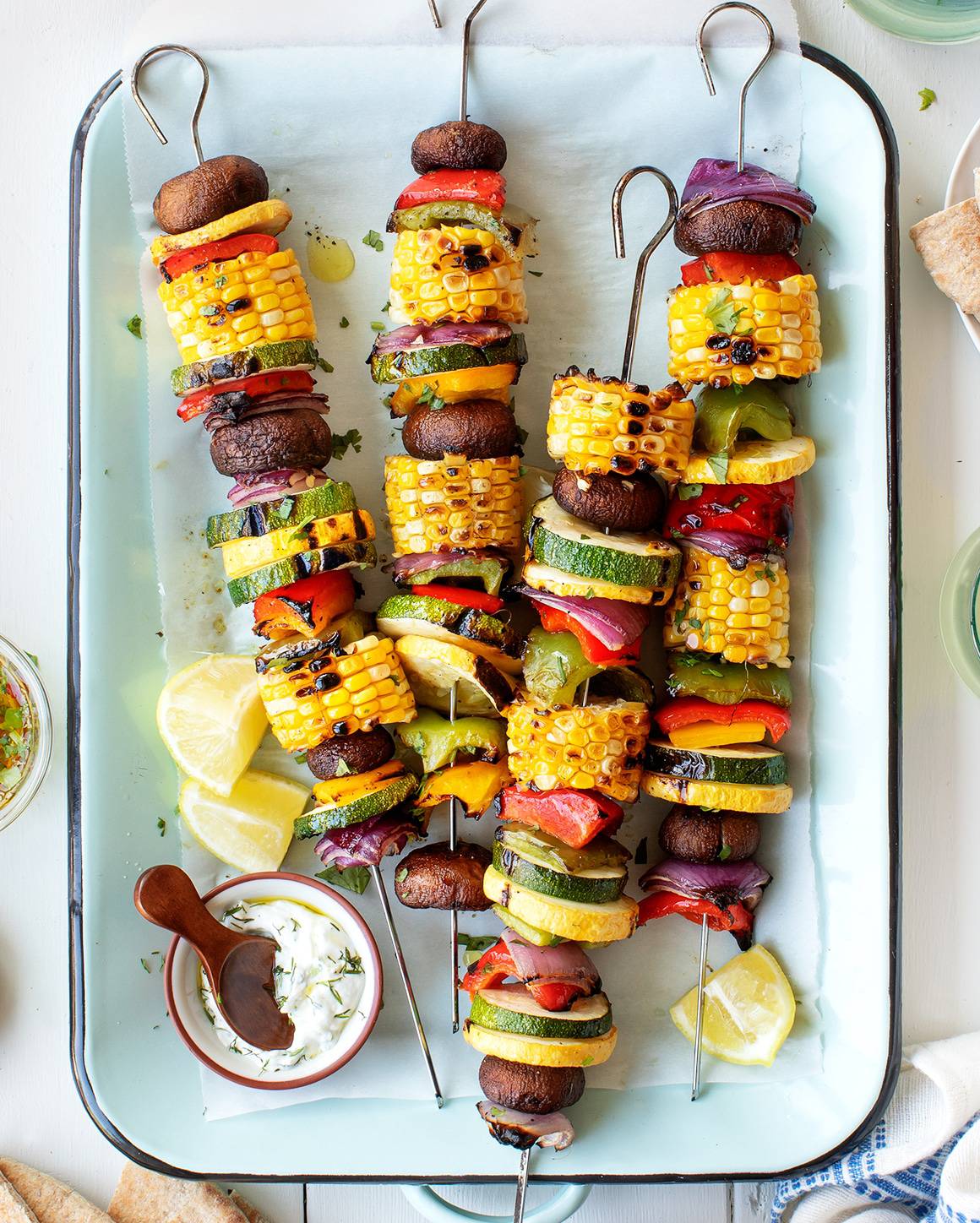
24. Herb-Infused Grilled Vegetable Platter with Balsamic Glaze — zucchini, bell peppers, red onion, asparagus, mushrooms — oiled and salted, direct 8 min total.
25. Charcoal-Grilled Portobello Mushrooms with Balsamic Glaze — gill-side down 5 min, flip and fill with cheese + breadcrumb mix, indirect 8 more.
Best grilling marinades and dry rubs by protein
The right marinade is acid + oil + salt + flavor. Acid breaks down surface proteins; oil carries flavor and stops sticking; salt seasons; aromatics make it interesting. Don't marinate more than 4 hours unless the recipe says otherwise — acid past that point turns the surface mushy.
Dry rubs are 50% salt + sugar + 50% spice by weight. They go on 40+ minutes ahead (to brine the surface) or right before the grill.
| Protein | Marinade base (4-hour max) | Dry rub (40 min ahead) |
|---|---|---|
| Chicken breast | Buttermilk + garlic + lemon | 2:1 salt-to-paprika + cumin |
| Chicken thighs/wings | Soy + ginger + lime + honey | Brown sugar + smoked paprika + chipotle |
| Beef steak | Skip marinade; salt 40 min ahead | Coarse salt + black pepper + garlic powder |
| Flank/skirt | Soy + lime + cilantro | Cumin + smoked paprika + brown sugar |
| Pork tenderloin | Mustard + maple + bourbon | Brown sugar + smoked paprika + onion powder |
| Pork shoulder | Skip marinade; rub heavy | Salt + brown sugar + paprika + black pepper |
| Salmon | Soy + brown sugar + ginger (30 min) | Brown sugar + dill + lemon zest |
| Shrimp | Olive oil + garlic + lemon (15 min) | Salt + Old Bay + paprika |
| Vegetables | Olive oil + balsamic + thyme | Salt + smoked paprika + garlic powder |
The single biggest rookie mistake is putting sugary BBQ sauce on too early. Sugar burns at 350°F. Brush on the last 5–10 minutes of cooking, not at the start.
Side dishes that hold up at room temp
Cookout food sits out. The best sides survive 90 minutes on a picnic table in 80°F sun without going off.
Hold up at room temp:
- Grilled Corn and Peach Salad with Honey Thyme Dressing — vinaigrette-based dressings are food-safe at room temp for hours.
- Vinegar-based coleslaw (mayo-based does NOT — 2-hour max).
- Pasta salad with oil-and-vinegar dressing.
- Watermelon-feta salad with mint.
- German potato salad (vinegar dressing, not mayo).
- Pickled vegetables.
- Grilled bread, baguette slices brushed with olive oil and grilled 90 seconds/side.
Don't leave out more than 2 hours (USDA limit): mayo-based potato salad, deviled eggs, cheese plates, cooked chicken, sour-cream dips. USDA Food Safety calls out 90°F+ ambient temps where the safe holding window drops to 1 hour.
A simple rule: if it has dairy or eggs in the dressing, it gets a cooler. If it has vinegar or olive oil, it lives on the table.
Vegetable grilling — the 6 vegetables nobody grills (and should)
Everyone grills corn, peppers, and asparagus. These six are better.
1. Cabbage wedges — cut a head into 8 wedges, brush with oil, direct 6 min/side at 450°F. Char + tender + slight bitterness.
2. Romaine hearts — halved lengthwise, oiled, 2 min/side direct. Caesar-with-char.
3. Whole onions in foil — quarter through the root, drizzle with butter and balsamic, indirect 45 min at 375°F. Turns into onion jam.
4. Sweet potatoes — sliced 1/2" thick, oiled, direct 5 min/side at 400°F. Better than oven-roasted because of the char.
5. Eggplant — 1/2"-thick rounds, salt 30 min and pat dry, oiled, direct 4 min/side. The salt draws out bitterness.
6. Whole heads of garlic — top sliced off, drizzled with oil, wrapped in foil, indirect 45 min at 400°F. Roasted garlic for everything you cook for the next week.
The hidden gain: grilled vegetables earn their place on a meat-heavy menu. Pile a platter of them next to the steak and your meat budget stretches further.
Grill maintenance: clean it after every cook
Carbon buildup on grates is what makes food stick and gives it that bitter, acrid taste people blame on the marinade. A clean grate is the cheapest performance upgrade you'll ever make.
After every cook (5 minutes):
1. Run the gas burners on high for 10 minutes with the lid closed (or close a charcoal lid with vents shut for the same effect). Carbonizes residue into ash.
2. Scrape with a stainless-steel grate brush or a balled-up sheet of foil held with tongs. Don't use a brass-bristle brush — bristles break off and end up in food (real ER visit risk, and the basis for the FDA grill-brush advisory).
3. Wipe the grate with a folded paper towel held in tongs, dipped in vegetable oil. Seasons the steel for next cook.
Monthly (30 minutes):
- Remove the grates and soak in hot soapy water 20 minutes; scrub with a grate brush.
- Vacuum out the grease tray. Empty the drip pan.
- Wipe down the lid interior with a damp cloth.
Annually:
- Replace gas burner tubes if they've started rusting through. ~$30 each.
- Replace the heat deflectors. ~$25 each.
- A gas grill kept clean lasts 12+ years; a neglected one fails in 4.
What to buy: tongs, thermometer, basket, grill brush
You don't need a $1,200 grilling kit. You need five tools.
| Tool | What to buy | Approximate cost |
|---|---|---|
| Long tongs (16") | OXO Good Grips, locking — kitchen tongs are too short and burn your knuckles | $20 |
| Instant-read thermometer | ThermoWorks ThermoPop or Lavatools Javelin Pro — 2-second reads | $30–$45 |
| Grill basket | Weber large basket — holds shrimp + cut vegetables that fall through grates | $25 |
| Grate brush | Stainless steel or coiled bristle-free — never brass bristle | $20 |
| Chimney starter (charcoal only) | Weber rapidfire — lights a full chimney in 20 minutes without lighter fluid | $20 |
The single biggest accuracy upgrade is the instant-read thermometer. Most home cooks overcook chicken by 15°F and undercook pork by 10°F because the visual cues are unreliable. A $30 ThermoPop fixes both within one cook.
For shopping by category we keep a curated list of grilling-friendly gear in /k/utensils (tongs, spatulas, baskets, planks) and the heavy-duty pieces — dutch ovens, cast iron, smoker boxes — in /k/cookware. The electric chimney starters and pellet hopper add-ons live under /k/small-appliances, and the /k/knives page covers the boning and slicing knives that actually matter for breaking down a brisket. Hit those before the big-box stores; the curation skips the gimmicks.
One tool to skip: branded grill-fork sets, novelty branding irons, "smoking guns" that make cold smoke. They're gifts, not tools. Bon Appétit's grilling roundup has a similar minimalist take — fewer toys, better technique.
Real-world numbers — internal temps that actually matter
The single best grill upgrade most people don't make is an instant-read thermometer. Pull at the LOWER end of each range — carryover heat takes the meat 5–10°F higher while resting.
| Protein | Pull at | Final after rest | Notes |
|---|---|---|---|
| Chicken breast | 155°F | 165°F | Carryover gets you to USDA-safe |
| Chicken thighs/legs | 175°F | 180°F | Higher = collagen melts, juicier |
| Whole chicken | 160°F (breast) | 165°F | Spatchcock for even cooking |
| Pork tenderloin | 140°F | 145°F | USDA dropped from 160°F in 2011 |
| Pork shoulder | 203°F (probe slides like butter) | 203°F | Hold 1 hr in cooler before pulling |
| Pork ribs (baby back) | 198°F + bend test | 198°F | Bend test: lift one end, bark should crack |
| Ground beef | 160°F | 160°F | No carryover — eat at temp |
| Steak (medium-rare) | 125°F | 130°F | Most asked range |
| Steak (medium) | 130°F | 135°F | Add 5°F per doneness step |
| Brisket | 203°F + probe-tender | 203°F | Hold wrapped 2 hrs minimum |
| Salmon | 120°F | 125°F | Pink center, flakes cleanly |
| Shrimp | 120°F | 120°F | Opaque, "C" shape — not "O" |
Common pitfalls — the 5 mistakes that ruin cookouts
1. Flipping too often. Sear marks form after 2 minutes of unbroken contact, not 30 seconds. Flip ONCE per side for steaks, burgers, and chops. Move to indirect heat instead of flipping again.
2. Saucing too early. Sugary BBQ sauce burns at 350°F. Brush on the LAST 5–10 minutes only. Apply at the start and the outside chars black before the inside is done.
3. Cooking cold meat straight from the fridge. Take meat out 30–45 minutes ahead. A 40°F steak going onto a 500°F grate develops a gray, overcooked band an inch deep before the center hits temp. Room-temp meat cooks evenly.
4. Cutting into meat to check doneness. Releases the juices you spent an hour developing. Use a thermometer.
5. Skipping the rest. 5 minutes for thin cuts, 10 for thick, 20 for whole birds. The most overcooked-looking steak that's actually medium-rare just wasn't rested.
When NOT to grill
Some foods belong elsewhere. Skip the grill for: thin fish fillets without a plank (they stick and tear), very lean game (no fat = dry), raw vegetables that need to soften before browning (parboil first), and anything that requires controlled simmering. The grill is a high-heat dry-cook tool; if the recipe calls for moist heat or precise temperature control under 200°F, use the oven.
FAQ
What's two-zone grilling and why does everyone recommend it?
Two-zone setup means one half of the grill runs direct-high-heat (for sear) and the other half is unlit or low-heat (for indirect roasting). On gas, leave one burner off. On charcoal, pile coals on one side. This single technique fixes the most common home-grill failure — burned outside, raw inside — by letting you sear and then move food to gentler heat to finish without flare-ups.
Should I grill with the lid up or down?
Lid down for anything thicker than 1 inch (chicken thighs, steaks, ribs, whole chickens) — the closed grill becomes a convection oven and cooks the inside while the outside crisps. Lid up only for thin items that cook in under 5 minutes per side (burgers, thin steaks, shrimp, vegetables). On gas, lid-down also stabilizes temperature; lid-up loses 100°F+ within 2 minutes.
How do I know when grilled meat is done without cutting it?
Instant-read thermometer — a $15 ThermoPop is the single best grill upgrade most people don't make. Targets: chicken thighs/legs 175–185°F, chicken breast 155°F (carryover to 165°F), pork 145°F, ground beef 160°F, steaks 125°F rare/130°F medium-rare/135°F medium/140°F medium-well. The poke test and cut-and-peek are unreliable and dry your meat out by releasing juices early.
Why does my grilled chicken always char on the outside before cooking through?
Two problems: heat is too high, or you skipped two-zone. Bone-in chicken cooks at 350–400°F indirect for 30–40 minutes, then you finish with 2–3 minutes of direct heat for the char marks. Boneless thighs handle 425–450°F direct for 4–5 minutes per side. Sugar-heavy marinades and BBQ sauces should only go on in the last 5–10 minutes — applied early they burn before the meat is done.
Do I need different recipes for gas vs charcoal grills?
No — temperature is what matters, and both can reach the same temps. Gas is faster to preheat (10 min vs 25 min for charcoal), more controllable, and easier to two-zone. Charcoal hits higher peak temperatures (650°F+ vs gas around 500–550°F) and adds smoke flavor. For 90% of recipes the cooking instructions are identical; only true low-and-slow smoking (10+ hour ribs and briskets) genuinely favors charcoal or pellet smokers.
Sources + last verified date
- USDA Food Safety and Inspection Service — Grilling and Smoking guidance (safe internal temperatures, holding times, cross-contamination)
- Serious Eats — Grilling recipes archive (technique deep-dives on reverse sear, two-zone, and charcoal arrangements)
- Bon Appétit — Best grilling recipes roundup (recipe inspiration and seasonal angles)
Last verified: June 2026. Internal temperatures match the current USDA guidance for 2024–2026. Thermometer pricing and gear recommendations checked against current retail listings.
Frequently asked questions
What's two-zone grilling and why does everyone recommend it?
Should I grill with the lid up or down?
How do I know when grilled meat is done without cutting it?
Why does my grilled chicken always char on the outside before cooking through?
Do I need different recipes for gas vs charcoal grills?
Sources
Plan the whole cookout in one go.
Ask our AI for mains, sides and quantities for your headcount — one Instacart cart, no spreadsheet.
Plan my cookout →