Summer Grilling Marinades & Rubs: 15 Recipes for 4th of July & Beyond
Five marinades, five dry rubs, five wet rubs and pastes — plus the timing chart and the 4th of July menu we cook off them.
Affiliate disclosure: AislePrompt may earn a commission on qualifying purchases made through Amazon and Instacart links in this article, at no additional cost to you. See our affiliate policy →
A great summer grill session is decided two days before the cookout, in your refrigerator and your spice drawer. Pick the right marinade for the cut, give it the right amount of time, and finish with a dry surface and a hot grate, and a $15 sirloin will out-eat a $40 ribeye thrown on naked. This guide is the working playbook we use at AislePrompt for July 4th and the rest of summer 2026: five marinades, five dry rubs, five wet rubs and pastes, the timing chart that keeps any of them from going wrong, a three-marinade July 4th sample menu, and the small kit of gear that does most of the work.
Marinades and rubs do different jobs — pick the right one
Marinades and rubs are not interchangeable, and treating them as the same is the most common mistake we see in summer grilling questions. A marinade is a wet solution — usually acid plus fat plus aromatics plus salt — that flavors and tenderizes the outer quarter-inch of the protein and adds a thin layer of moisture to lean cuts. A dry rub is a spice and salt blend you press onto a dry surface; under hot grilling it caramelizes and bonds with the proteins on the meat's surface, building a thick, dark bark you cannot get any other way. Wet rubs and pastes sit in between — thicker than a marinade, looser than a dry rub, and intense enough to need only a short rest.
The decision is mostly about fat content and cut thickness. Lean and thin cuts — boneless chicken breast, pork loin, shrimp, vegetables, flank steak — dry out fast on a hot grill and respond well to marinades, which buy you a small buffer of surface moisture. Fatty and thick cuts — ribs, pork shoulder, brisket, big steaks — produce their own moisture as fat renders, so you want a dry rub that won't get washed off by liquid and that crusts into bark when it hits the grate. Wet rubs and pastes work on both, with the caveat that anything containing sugar will burn at high direct heat — keep those for indirect-heat zones or for the last few minutes.
If you ignore that one decision and slather a brisket with a citrus marinade, you'll spend eight hours waiting for a bark that never forms. If you dust a chicken breast with Memphis dry rub and slap it on direct high heat, the rub will scorch in two minutes and the meat will taste of burnt paprika. Match the technique to the cut.
The marinade formula: acid + fat + aromatic + salt
Every working marinade in this article — and almost every working marinade anywhere — is some ratio of four parts. Get the ratio right and the specific ingredients don't matter much; get the ratio wrong and no amount of expensive sherry vinegar will save it.
Acid is the tenderizer and flavor carrier. Citrus juice, vinegar, wine, yogurt, buttermilk, soy sauce, and even tomato all qualify. The job of acid is to slightly denature the surface proteins so flavor carriers can soak in. Too much and the surface turns mushy and gray — "ceviche-grilled" is the failure mode. Aim for 20–30 percent of the marinade volume from acid, and lean toward the low end with delicate proteins like fish and shrimp.
Fat is the flavor solvent and the anti-stick coating. Oil dissolves the fat-soluble aromatic compounds in garlic, herbs, and chiles that water and acid can't reach, and it lubricates the surface so the protein doesn't weld itself to the grates. Olive oil, neutral seed oils, sesame oil, and rendered animal fats all work. Aim for 40–50 percent of the marinade by volume.
Aromatic is everything else doing flavor work — garlic, ginger, herbs, chiles, mustard, peppercorn, citrus zest, fish sauce. This is where the marinade gets its identity. Aim for 10–20 percent total, mostly by feel.
Salt is non-negotiable. Salt drives flavor into the protein by ionic migration, not by mechanical soaking, and unsalted marinades produce bland meat no matter how aggressive everything else is. Aim for roughly 1 teaspoon kosher salt per cup of marinade as a floor, more for tougher cuts. If you're using soy sauce, fish sauce, or miso for your acid or aromatic, count their salt and dial the added salt back.
The Food Lab's in-depth marinade testing at Serious Eats confirms a counterintuitive finding worth knowing: marinades penetrate the surface much less than people think — measured in millimeters, not centimeters — but the salt and surface flavor still carry the meat. Don't waste premium aged balsamic in a marinade where the volatile aromatics will mostly evaporate; save it for the finish.
5 marinades for chicken, steak, pork, shrimp, and vegetables
These are the five workhorses. Each follows the acid-fat-aromatic-salt formula, each is sized to one to two pounds of protein, and each has a target timing window in the chart further down.
1. Citrus-herb chicken marinade
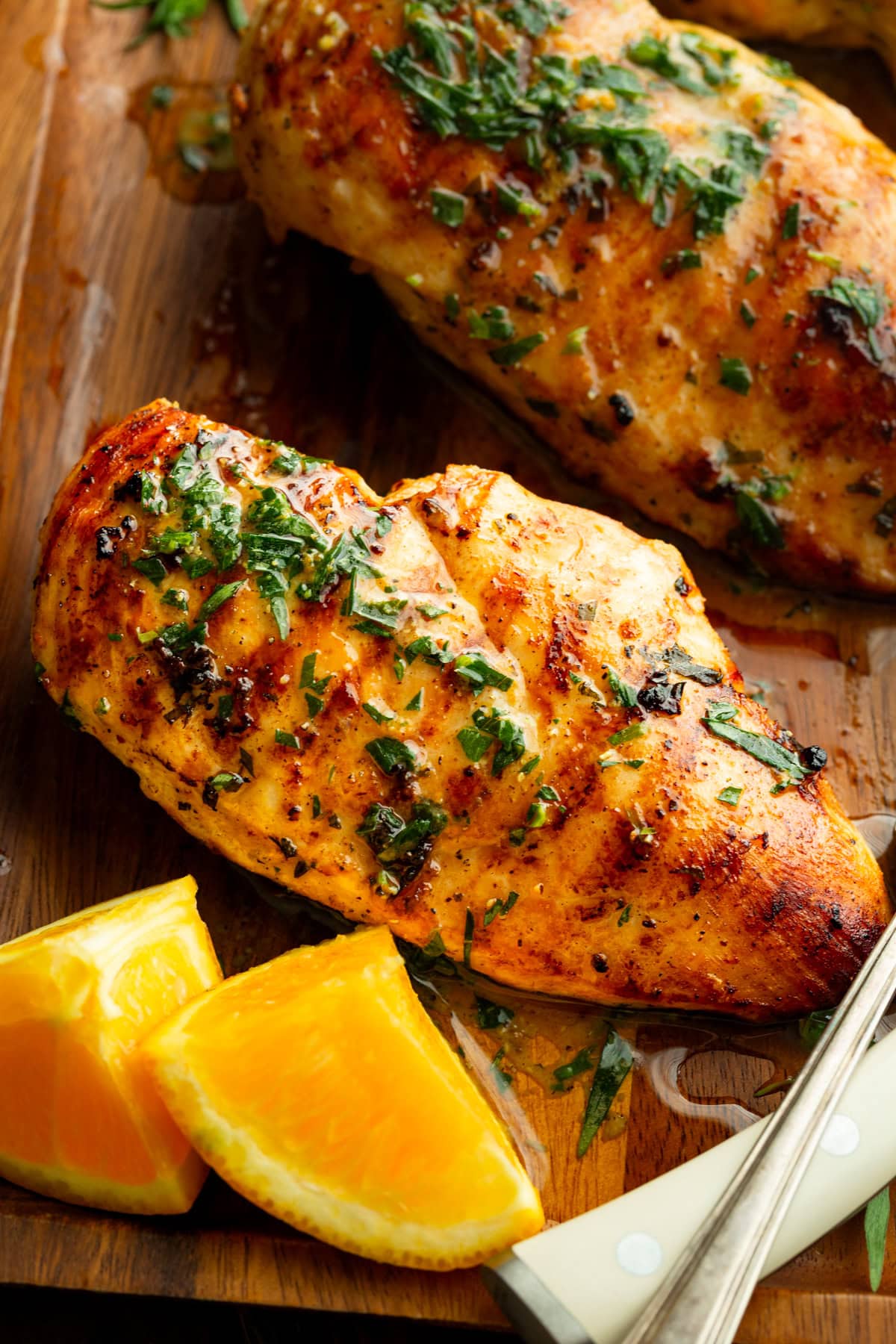
Orange juice, lemon juice, olive oil, smashed garlic, fresh oregano, fresh thyme, kosher salt, black pepper. Roughly 25 percent acid, 50 percent oil, herbs and aromatics for the rest. Best on boneless skin-on thighs and chicken breast; 2–4 hours is the sweet spot. The Brazilian-Style Grilled Chicken with Citrus Herb Marinade is the exact recipe we cook out of for July 4th — the orange juice plus thyme combination is reliably crowd-pleasing and works on a charcoal kettle, a gas grill, or a cast-iron grill pan indoors.
2. Classic steak marinade
Worcestershire sauce, soy sauce, neutral oil, balsamic vinegar, brown sugar, smashed garlic, cracked black pepper. This is the high-umami workhorse for less-expensive steaks (flank, skirt, sirloin, hanger, flat iron) that need flavor help. 4 hours is plenty; 8 starts to soften the surface noticeably. For an unusual venison or game variation, the Grilled Nebraska Venison Steaks with Juniper Berry Marinade uses juniper berries and red wine on the same skeleton — game-meat lovers should bookmark it.
3. Korean BBQ pork marinade
Soy sauce, mirin, brown sugar, toasted sesame oil, grated Asian pear or apple, minced ginger, minced garlic, gochujang or gochugaru. The fruit is the key — its enzymes do real tenderizing work that no other marinade ingredient pulls off, and the natural sugars caramelize beautifully under hot direct heat. Best on pork shoulder cut thin or pork belly; 4–12 hours. For a great example of the gochujang variant, see Charred Korean BBQ Pork Belly with Spicy Cucumber Salad.
4. Garlic-lime shrimp marinade
Lime juice, lime zest, olive oil, lots of minced garlic, smoked paprika, kosher salt, a pinch of cayenne. Shrimp marinate fast — 15 to 30 minutes maximum — and any longer turns the surface chalky from the citric acid. Marinate in a bowl, not a zip bag, so the lime juice doesn't pool on one side. The Sautéed Garlic-Ginger Shrimp with Chili-Lime Butter is the indoor cousin — use the same flavor profile and finish on the grill instead of the stove for a fast July 4th appetizer.
5. Balsamic vegetable marinade
Balsamic vinegar, good olive oil, Dijon mustard, fresh thyme, honey, garlic, kosher salt. Vegetables are forgiving — they can sit in this for 30 minutes or four hours and you won't ruin them. Aim for half-inch slabs (zucchini, eggplant, summer squash, bell peppers, red onion) for the best char-to-tender ratio. Aperol-Roasted Vegetable Salad with Balsamic uses the same balsamic + thyme + olive oil base — substitute the grill for the oven and you've got a beautiful side dish.
5 dry rubs for ribs, brisket, chicken, salmon, and vegetables
Dry rubs need an even, dry surface and at least 30 minutes of sit time so the salt starts to draw moisture, which then dissolves the rub into a paste-like layer that bonds with the protein during cooking. Overnight is better for thick cuts. Cover loosely and refrigerate.
6. Memphis dry rub for ribs
Brown sugar, paprika (sweet plus a touch of smoked), kosher salt, black pepper, garlic powder, onion powder, mustard powder, cayenne. Memphis ribs are about bark first, sweetness second, and a little tang from the vinegar mop near the end. Press it on hard with the heel of your hand so it grabs. The canonical version is Memphis-Style Sticky Ribs with Spiced Dry Rub — about 2 tablespoons per slab is right.
7. Brown sugar and coffee brisket rub
Light brown sugar, dark-roast espresso powder or finely ground coffee, kosher salt, smoked paprika, black pepper, garlic powder, onion powder, dried oregano. Coffee adds bitterness that balances the brown sugar and produces an unbelievably dark bark over 8–12 hours of low and slow. The principle works on hot-and-fast cuts too — for the all-purpose brisket version see Hickory-Smoked Beef Brisket with Garlic and Brown Sugar Rub.
8. Smoky paprika chicken rub
Smoked paprika, sweet paprika, kosher salt, garlic powder, onion powder, brown sugar, ground cumin, ground coriander, black pepper, cayenne. This is the one chicken rub we keep in a mason jar all summer. Best on whole chickens, half chickens, and chicken wings; not great on lean breasts (the rub burns before the breast hits 160°F). Grilled Bourbon-Glazed Chicken Wings with Smoky Paprika Rub is the exact pour.
9. Fennel-pepper salmon rub
Toasted fennel seeds, cracked black pepper, kosher salt, lemon zest, brown sugar, dried dill or fresh chopped dill. Salmon takes a much shorter rub time than red meat — 20 minutes is enough — and the sugar plus pepper builds a crisp crust in about 4 minutes a side over direct medium-high heat. Skin-side-down first, then flip for 60–90 seconds to finish.
10. Italian herb-roast rub for vegetables and chicken
Dried oregano, dried basil, dried thyme, garlic powder, onion powder, kosher salt, fennel seed, red pepper flakes. The all-purpose summer rub that hits sheet-pan chicken, grilled vegetables, and even garlic bread off the grill. Toss vegetables in olive oil first, then sprinkle the rub generously and grill in a basket. See Italian Herb-Rubbed Sheet Pan Chicken with Roasted Vegetables for the technique that adapts straight to grilling.
5 wet rubs and pastes (jerk, harissa, chimichurri, gochujang, herb)
Wet rubs sit between marinades and dry rubs — pungent enough that 30 minutes is real flavor work, thick enough to stay put on the meat during grilling, intense enough to lean on a couple of standout aromatics.
11. Jamaican jerk paste
Scotch bonnet chiles (or habaneros), scallions, garlic, fresh ginger, fresh thyme, allspice berries, brown sugar, soy sauce, lime juice, neutral oil — blend into a thick paste. Jerk is supposed to be aggressive; don't dial back the chiles or you'll lose the point. Best on bone-in chicken thighs and pork shoulder; 4–24 hours. Jamaican Jerk Grilled Shrimp Skewers is the fast variation — use a quarter of the paste, marinate 30 minutes, grill 90 seconds a side.
12. Moroccan harissa marinade
Prepared harissa paste (rose harissa if you can find it), olive oil, lemon juice, ground cumin, ground coriander, smashed garlic, honey, kosher salt. Slightly thicker than a true marinade, slightly looser than a paste — perfect on lamb skewers, chicken thighs, and big eggplant slabs. The base flavor profile shows up in the comforting One-Pot Moroccan Chickpea Stew with Harissa and Sweet Potatoes — pull the same harissa-cumin-garlic base out and put it on lamb chops for the grill.
13. Argentinian chimichurri
Fresh flat-leaf parsley, fresh oregano, garlic, red wine vinegar, kosher salt, red pepper flakes, olive oil — chopped fine, not blended. Chimichurri is both a wet rub (use a quarter cup as a 30-minute coating before grilling) and a sauce (spoon another quarter cup over the rested meat). Best on hanger and skirt steaks, lamb chops, and pork tenderloin. The canonical pairing is Argentinian-Inspired Barbecue Lamb Chops with Chimichurri — make a double batch and use half as a sauce.
14. Gochujang pork glaze
Gochujang, soy sauce, rice vinegar, sesame oil, brown sugar, grated ginger, minced garlic, toasted sesame seeds. Sticky, sweet-hot, and made for direct-heat grilling once the meat is about 80 percent done — brush on, flip, brush on the other side, flip again. Best on pork belly, pork ribs, and skin-on chicken thighs. The reference version is Pan-Fried Korean Pork Belly with Spicy Gochujang Glaze — convert to grilled in 10 minutes.
15. Herb-garlic wet rub for fish
Fresh parsley, fresh dill, fresh chives, smashed garlic, lemon zest, lemon juice, olive oil, kosher salt, cracked black pepper — chopped into a coarse paste. Best on whole fish (snapper, branzino, sea bass) and thick fillets (halibut, cod, swordfish). Don't blend it smooth; you want texture so it grips the fish surface. See Steamed Lemon-Garlic Ginger Fish with Herbal Broth for the indoor version — convert to a paste, rub on, grill 4 minutes a side.
Timing chart: how long to marinate (and when you've gone too long)
This is the chart we wish we'd had ten years ago. Times assume the marinades and rubs in this article (moderate acid percentage, kosher salt floor). Adjust down for high-acid versions, up for oil-heavy versions.
| Protein | Minimum | Sweet spot | Too long |
|---|---|---|---|
| Shrimp, scallops, squid | 15 min | 20–30 min | over 45 min (chalky surface) |
| Fish fillets | 20 min | 30 min | over 1 hour (mushy edges) |
| Chicken breast (boneless) | 30 min | 2 hours | over 8 hours (rubbery surface) |
| Chicken thighs, drumsticks | 1 hour | 4 hours | over 24 hours |
| Pork tenderloin | 1 hour | 2–4 hours | over 12 hours |
| Pork chops (1 inch+) | 2 hours | 4–8 hours | over 24 hours |
| Skirt, flank, hanger steak | 2 hours | 4 hours | over 12 hours (gray surface) |
| Ribeye, strip, sirloin | 30 min (salt-mostly) | 1–2 hours | over 4 hours (soft surface) |
| Pork shoulder, ribs | 4 hours | 12–24 hours | 48 hours (excessive surface salting) |
| Brisket | 1 hour | 12–24 hours (dry rub) | n/a if dry-rubbed |
| Vegetables | 30 min | 30 min – 2 hours | over 4 hours (oil-saturated) |
Two failure modes from going too long that are worth knowing. Acid burn shows as gray or pale surfaces and a mushy texture, especially around the edges. The fix is to pat hard and dry, then sear hot and fast to crust the exterior; the inside will still be fine. Surface salting shows as overly tight, dry meat after grilling. The fix is to rinse and re-pat — you lose some salinity, but you save the cut.
4th of July sample menu — three marinades, one cookout
This is the menu we'd cook for 8 people on a single 22-inch kettle or a mid-size gas grill, with three of the marinades from this article doing the work.
Two days before — pick up groceries, mix the citrus-herb chicken marinade and the Memphis rub.
The day before — apply the Memphis rub to two racks of St. Louis-cut ribs, wrap in foil, refrigerate overnight. Mix the chimichurri (it needs at least 4 hours, ideally overnight, for the flavors to come together). Marinate two flank steaks in chimichurri (reserving half as the finishing sauce).
Morning of — start the ribs at 250°F over indirect heat at noon. Marinate 3 pounds of boneless chicken thighs in the citrus-herb marinade for 2–4 hours.
Around 4:00 PM — rest the ribs in foil with a tablespoon of butter and a splash of apple juice. Get the grill back up to 500°F+ for the chicken and steak.
5:30 PM — sear the chicken first (2 minutes a side direct, then move to indirect to finish to 165°F). Then the flank steak at full heat, 3–4 minutes a side for medium-rare, rest 8 minutes, slice against the grain, top with the reserved chimichurri.
6:00 PM — eat. The whole thing comes off the grill within a 30-minute window because all three proteins are timed against the same finish point.
A traditional July 4th menu can absolutely also lean on the make-ahead 4th of July sides and desserts playbook — cold sides, slaw, potato salad, and corn salads carry the table while the proteins finish on the grill.
Real-world numbers — what surface temperature gets you bark vs. burn
Bark formation peaks around 300–350°F on the meat's surface. Below that, the Maillard browning that builds bark is too slow and the rub bleeds out. Above about 450°F surface temp the sugars in the rub burn before the salt-coffee-paprika compounds finish caramelizing — that's the brittle, bitter crust people complain about.
In practice, that means direct high heat is wrong for sugar-heavy rubs. A standard 22-inch kettle at full charcoal load runs around 600°F at grate level — far too hot for the Memphis rib rub or the gochujang glaze. Build a two-zone fire (charcoal pile on one side, empty grate on the other), keep the rubbed protein on the indirect side until 80 percent done, and only briefly slide over the coals to finish the bark. Gas-grill users: cut the burners under one half of the grill to low or off and run the other half at high.
For an instant-read on grate-level temperature — the only one that actually matters once your dome thermometer is reading nonsense from radiant heat — drop a ThermoWorks Thermapen ONE onto the grate for two seconds. It's faster than the Alpha Grillers Meat Thermometer Digital (an honest 2–3 second probe at about a third the price) and is the single biggest upgrade most home cooks can make to their grill kit in 2026.
Common pitfalls — five failure modes we've seen
Five problems that turn up at cookout after cookout, with fixes.
1. Sugar-heavy rub on direct heat. Brown sugar in the rub plus 600°F coals equals charcoal in 90 seconds. Fix: indirect heat first, sear last.
2. Acid-heavy marinade for too long. Anything over 4 hours in a lemon-juice-based marinade on chicken breast turns it gray and rubbery. Fix: keep acid percentages under 30 and shorten the time as the acid goes up.
3. Reusing marinade as a basting sauce. Marinade that touched raw protein is contaminated. Fix: reserve a quarter cup BEFORE the protein goes in, and use that clean portion for basting. If you forgot, boil the leftover for a full minute at a rolling boil — per USDA Food Safety and Inspection Service, this is non-negotiable.
4. Grilling cold from the fridge. Cold meat releases water onto a hot grate, which steam-poaches the surface and prevents bark formation. Fix: pull the meat 20–30 minutes before it hits the grate (lean cuts) or up to 60 minutes (whole roasts). Pat the surface bone-dry with paper towels just before grilling.
5. Pre-saucing the protein. Sugar-containing BBQ sauces burn on direct heat in under two minutes. Fix: only apply BBQ sauce in the final 5 minutes of cooking, brush thin, and flip often.
When NOT to marinate
Marinades are not always the right tool. Skip the marinade and use salt-only seasoning for: prime-grade or wagyu steaks (the fat is the flavor), dry-aged anything (you'll dilute the concentrated beefiness you paid for), wet-brined turkey or pork (already saturated), and delicate white fish like sole or trout (the texture won't hold up). For these, salt 40 minutes ahead (dry-brine), pat dry, grill hot, finish with a flake-salt squeeze of lemon.
What to buy — grills, tongs, thermometers from the kitchen shop
The gear list is short. We don't believe in the eight-piece BBQ tool set — most of those pieces never come out of the drawer.
Instant-read thermometer. Non-negotiable. The ThermoWorks Thermapen ONE is the gold standard — 4.9 average rating, one-second reads, accurate to ±0.5°F. If the $109 price tag is too much, the Alpha Grillers Meat Thermometer Digital is the workhorse alternative under $25, well-reviewed for grill use specifically.
12-inch long-handled tongs. OXO Good Grips 12-Inch Stainless-Steel Locking Tongs — silicone-tipped variants exist but they melt over open coals. Stainless is the right call here.
Wire grill brush. Stiff wire bristles; replace it every season because loose bristles in food are a known ER visit. Weber's grill-skills mastering-marinades guide is also a useful free read on the subject.
Heat-resistant gloves. For managing coals, moving the chimney starter, and pulling foil-wrapped ribs without burning yourself. Welder's gloves work too if you don't want to buy specialty BBQ versions.
Browse the rest of the gear in the Kitchen Gadgets shop — thermometers and probes live there. Tongs, brushes, and spatulas are in the cookware and utensils sections of the AislePrompt kitchen shop.
Sources
- Weber, Mastering Marinades — Grill Skills. Manufacturer reference on marinade chemistry and rest times.
- Serious Eats, The Food Lab: The Truth About Marinades. Peer-tested experiments on how far marinades actually penetrate and what acid concentration accomplishes.
- USDA Food Safety and Inspection Service, Grilling Food Safely. Primary source on marinade reuse, safe internal temperatures, and cross-contamination during cookouts.
Updated for summer 2026 — last reviewed June 2026.