How to Plan a Week of Weeknight Dinners in 30 Minutes: 4-Week AI Meal Plan
A 5-step framework, 4 rotation themes, and one 45-minute Sunday prep block — the exact system that keeps a weeknight meal plan alive past week two.
A weeknight dinner meal plan takes about 30 minutes to build from scratch if you follow a simple five-step framework — pick a rotation theme, choose five dinners from that theme, generate a shopping list grouped by aisle, add one batch-prep block on Sunday, and lock in a backup night. Do that once a week and you'll cover a family of four in roughly $85 to $120 of groceries, one 45-minute prep block, and dinners that hit the table in under 30 minutes on weeknights. Every plan below uses recipes from the AislePrompt catalog and rebuilds automatically at /meal-plan or /chat.
Get a free week of easy dinners
Seven weeknight dinners with the shopping list already totalled, sent Sunday. No account needed, unsubscribe in one click.
No spam, unsubscribe in one click. Recipes, shopping lists and Instacart carts all work without an account either way.
Introduction: Why Weeknight Meal Planning Fails (and How to Fix It in 30 Minutes)
Most weeknight meal plans die in week two. You start Sunday full of ambition, buy $180 of groceries, cook two dinners you love — then Wednesday hits, someone has a game, dinner turns into a frozen pizza, and the arugula you planned for Thursday's salad turns to slime by Saturday. The plan didn't fail because you're disorganized. It failed because it wasn't a plan — it was a wish list.
The single biggest mistake families make is planning by inspiration ("what looks good?") instead of by system ("what fits Tuesday between soccer and homework?"). Inspiration produces a beautiful Sunday roast and four ad-hoc weeknights. A system produces five dinners you'll actually cook, one grocery trip that covers them, and a shopping list your household stocks against instead of adds to. According to the USDA's food and nutrition guidance, households that plan their weekly meals waste 25-40 percent less food and spend meaningfully less on impulse groceries — the two biggest drains on the weeknight food budget.
The framework below is what a good AI meal-planner does behind the scenes and what you can do yourself in 30 minutes. Once you have it down, AislePrompt's AI chat can rebuild the whole week in under two minutes when someone gets sick, a kid comes back with a new allergy, or Wednesday needs to become slow-cooker.
The 30-Minute Planning Framework: 5 Steps From Blank Slate to Shopping List
Set a 30-minute timer. Sit down with your calendar, a notebook (or the AislePrompt /meal-plan tab), and last week's grocery receipt. Then walk through these five steps in order.
Step 1: Pick a rotation theme (2 minutes)
Themes stop decision paralysis. Pick one of these four (we walk through each below): Comfort, Global Flavors, One-Pan, or Set-and-Forget. Themes force cohesion — one shopping trip covers five dinners because they share pantry staples, produce, and protein categories.
Step 2: Choose five dinners (8 minutes)
Five dinners cover Monday through Friday. Weekends are for leftovers, takeout, or a project meal — don't try to plan them. Within your theme, pick dinners that use overlapping ingredients (a rotisserie chicken that becomes wraps the next night, sausage from Monday that reappears Thursday in pasta).
Step 3: Generate the shopping list, aisle-grouped (10 minutes)
Group by aisle: produce, meat/seafood, dairy, pantry, frozen. This single move cuts store time by half. Cross off anything you already own. The AislePrompt shopping list at /shoppinglist does this automatically and hands off to Instacart in one click.
Step 4: Add one batch-prep block (7 minutes to plan, 45 minutes to execute Sunday)
Batch-prep means one Sunday block where you do the annoying knife work for the week: dice onions for three meals, rinse and dry three heads of lettuce, cook a pound of rice, pre-portion protein into freezer bags with marinade. See "Batch-Prep Sunday" below.
Step 5: Assign a backup night (3 minutes)
Pick a night — usually Wednesday or Thursday — and pre-load a 10-minute fallback meal (frozen meatballs over pasta, pre-cooked rotisserie chicken over salad kit, scrambled eggs on toast). If a real dinner gets skipped, everything shifts forward one day and the week still lands. This is the single most durable habit in weeknight cooking.
Week 1: Classic Comfort Rotation (5 Dinners, 1 Grocery Trip)
Comfort week is the friendliest starting point — familiar flavors, forgiving recipes, and the tightest ingredient overlap of any theme. Total active cook time across the week is roughly 90 minutes; passive time is another 90.
| Night | Recipe | Active time | Passive time |
|---|---|---|---|
| Monday | One-pan chicken pasta | 15 min | 20 min |
| Tuesday | Instant Pot butter chicken | 10 min | 30 min |
| Wednesday | One-pan baked ziti | 15 min | 25 min |
| Thursday | Backup night (leftovers or fallback) | 5 min | — |
| Friday | Slow-cooker beef stew | 15 min | 6 hr passive |
Recipes: One-Pan Chicken Pasta with Garlic-Lemon Cream Sauce, Instant Pot Butter Chicken with Creamy Tomato Sauce, One-Pan Baked Ziti with Italian Sausage and Spinach, Slow Cooker Chutney Beef Stew with Root Vegetables.
Shared groceries: garlic, onions, heavy cream, chicken breast, pasta, canned tomatoes. Trip cost for a family of four averages $95-$110. Total cleanup: four pans across the whole week.
The comfort rotation is also the safest starting point for kids. Every recipe here is customization-friendly — swap chicken for tofu, ziti for penne, or the ragu for a marinara — without rebuilding the shopping list. Cookware requirements are basic: a 12-inch skillet, a Dutch oven or slow cooker, and a large rimmed sheet pan.
Week 2: Global Flavors (Mexican, Thai, Italian, Greek, American)
Global week trades comfort for variety. It's the antidote to "we've had chicken four times this week" — every night hits a different flavor register, and total cook time actually drops because most cuisines outside the American tradition were designed for weeknight cooking.
| Night | Cuisine | Recipe | Active time |
|---|---|---|---|
| Monday | Mexican | Shrimp tacos with mango salsa | 20 min |
| Tuesday | Thai | Stir-fried chicken with cashews and Thai basil | 15 min |
| Wednesday | Italian | Baked ziti (leftover from Week 1 or fresh) | 15 min |
| Thursday | American | Veggie quesadillas | 12 min |
| Friday | Japanese | Teriyaki salmon bowls | 20 min |
Recipes: South Padre Island Shrimp Tacos with Spicy Mango Salsa, Stir-Fried Chicken with Cashews and Thai Basil, Dinosaur-Themed Veggie Quesadillas with Black Bean Dip, Genuine Japanese Teriyaki Salmon Bowls.
Pantry investment for global week is real: fish sauce, soy sauce, mirin, cornstarch, rice vinegar, jasmine rice, tortillas, sesame oil. Buy once and it lasts three to four rotations. Expect the first-time shopping trip to run $130-$150; every subsequent Global week drops back to $95-$110.
The Utensils & Tools collection covers the two pieces you'll actually miss if you don't have them: a Y-peeler for julienned veggies (Thai stir-fries) and a fish spatula for salmon that won't tear the skin. A single wok or 14-inch stainless skillet handles every stir-fry in this rotation.
Week 3: One-Pan and Sheet-Pan Focus (Minimum Cleanup)
The absolute lowest-cleanup week in the rotation. Every dinner uses one sheet pan or one skillet, protein and vegetables cook together, and total dishes at the end of the week hit five items (three sheet pans, two mixing bowls). Perfect for weeks with heavy calendar load.
| Night | Sheet-pan or one-pan | Recipe | Cleanup |
|---|---|---|---|
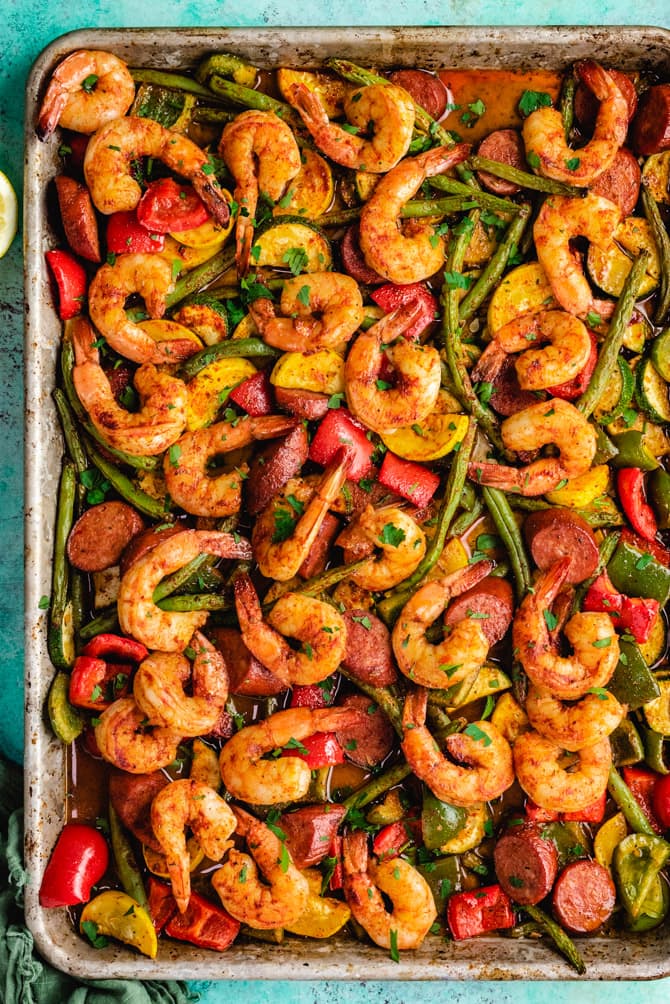
| Monday | Sheet-pan | Cajun shrimp and sausage with peppers | 1 pan |
| Tuesday | One-pan | Chicken pasta | 1 skillet |
| Wednesday | One-pan | Baked ziti | 1 skillet |
| Thursday | Sheet-pan | Salmon and asparagus | 1 pan |
| Friday | Backup | Rotisserie chicken over salad kit | 0 dishes |
Recipes: Sheet Pan Cajun-Spiced Shrimp and Sausage with Roasted Peppers, One-Pan Chicken Pasta with Garlic-Lemon Cream Sauce, One-Pan Baked Ziti with Italian Sausage and Spinach, Keto Sheet Pan Salmon with Asparagus and Lemon.
The single upgrade that makes sheet-pan week land is a heavy-gauge rimmed sheet pan (18-inch, aluminum, three-eighths-inch rim). Thin sheet pans warp under high heat and pool grease off-center; heavy pans distribute heat and roast vegetables evenly. Both go in the dishwasher; total end-of-week cleanup is under 10 minutes. The Bakeware collection has a rimmed sheet-pan set that covers this exact use case.
Sheet-pan technique note: preheat the empty pan in a 425°F oven for 8-10 minutes before adding food. Cold pan = soggy vegetables. Hot pan = the sear you actually want. This one habit is worth more than any recipe.
Week 4: Slow-Cooker and Instant Pot Set-and-Forget Week
Set-and-forget week is what saves the calendar-heavy household. Every dinner is either running on a timer or holds indefinitely once cooked. Active time across the whole week is under 60 minutes — most of it is chopping vegetables Sunday for the whole week's slow-cooker loads.
| Night | Device | Recipe | Active time | Total time |
|---|---|---|---|---|
| Monday | Slow cooker | Beef stew with root vegetables | 15 min | 6 hr low |
| Tuesday | Instant Pot | Butter chicken | 10 min | 30 min total |
| Wednesday | Slow cooker | Slow-cooked pulled pork (catalog) | 10 min | 8 hr low |
| Thursday | Instant Pot | Bean chili (catalog) | 10 min | 45 min total |
| Friday | Backup | Rotisserie chicken over salad | 5 min | — |
Recipes: Slow Cooker Chutney Beef Stew with Root Vegetables, Instant Pot Butter Chicken with Creamy Tomato Sauce.
The unlock for set-and-forget week is Sunday-morning prep. On Sunday, dice all the onions, garlic, carrots, and celery for both slow-cooker meals. Portion into labeled freezer bags with the raw protein and marinade. Monday morning, you open the fridge, dump one bag into the slow cooker, set it to 6 hours on low, and walk out the door. According to the Harvard T.H. Chan School of Public Health's Healthy Eating Plate, the durable habit isn't the individual meal — it's the routine of pre-portioning vegetables and lean protein together so the healthy choice is also the easy choice.
Instant Pot and slow-cooker recipes also freeze beautifully. Double any recipe on Sunday and portion half into meal-prep containers for the following week — this is how a family of two builds a rotating 10-meal freezer stash without ever "meal prepping" in the aggressive Sunday-food-tupperware sense. The Small Appliances collection covers both devices; a 6-quart Instant Pot or a 6-quart programmable slow cooker are the two purchases that unlock this entire week.
How AislePrompt's Chat Rebuilds the Plan for Allergies or Preferences
Every rotation above assumes an "average" household — no severe allergies, mixed protein preferences, kids who'll try new things once. Real households have constraints: nut allergies, dairy sensitivities, one vegetarian, one keto, a picky 7-year-old, or a shellfish allergy that eliminates a full quarter of the recipes above.
The AislePrompt AI chat rebuilds any plan around any constraint in about 60 seconds. Type "rebuild this week nut-free, dairy-free, no seafood, one vegetarian at the table" and the chat swaps recipes, adjusts the shopping list, and outputs the new plan without changing the meal-prep structure or shopping cadence. Behind the scenes it's running the same five-step framework you'd run manually, but at machine speed and against the full 148,000-recipe catalog.
Common rebuilds we see: nut-free (Thai stir-fries swap cashews for water chestnuts), dairy-free (butter chicken uses coconut cream, baked ziti uses cashew cream), gluten-free (ziti swaps for chickpea pasta, wraps become rice bowls), no-seafood (shrimp tacos become chicken tacos, salmon becomes chicken), kid-friendly (spice levels drop, unfamiliar textures get swapped for familiar ones). Each rebuild takes about a minute and hands off directly to the shopping list view so you're never manually re-listing groceries.
For genuinely hard constraints (celiac + tree-nut allergy + dairy-free, all in the same household) the chat runs multi-constraint filtering across the catalog and only surfaces recipes that satisfy every constraint. If the intersection is too thin — fewer than 12 candidate recipes — it says so explicitly instead of shipping a plan that quietly excludes a family member.
Batch-Prep Sunday: The 45-Minute Setup That Saves 4 Hours Later
Sunday batch-prep is not aggressive Sunday meal prep. It's not portioning 15 identical containers of chicken-and-broccoli. It's the 45-minute block where you do the annoying knife work and low-value chopping for the week so weeknight cooking becomes assembly instead of prep.
The Sunday block, in order:
1. Rice or grain (10 min active). Cook 3 cups of jasmine or brown rice in the Instant Pot (12 minutes total including pressurize time) or on the stove. Cool and refrigerate in one container. Reheats in 90 seconds midweek.
2. Vegetables (12 min). Dice onions for the week (three medium yellow onions, one container). Mince garlic (one full head, one container). Wash, dry, and stem three heads of lettuce or greens; store in a sealed container with a paper towel. Chop bell peppers if any recipe uses them.
3. Protein pre-portion (10 min). If your Week 4 has slow-cooker or Instant Pot dinners, portion the raw protein into labeled freezer bags with marinade. Label with the recipe name and the day you're cooking it.
4. Sauces or dressings (8 min). If the week uses a stir-fry sauce or salad dressing more than once, mix and store in a Mason jar. Store dressings unmixed if they'd separate (oil + vinegar shake before use).
5. Snack prep (5 min). Wash a container of grapes, portion snap peas or carrot sticks into three grab-and-go bags. This is the lever that keeps everyone out of the pantry between meals and reduces mid-week grocery-run pressure.
Total: 45 minutes on Sunday. The payoff across the week is 3-4 hours of weeknight cooking reduced to 15-20 minutes per night, because everything is prepped, portioned, and labeled. This is what "meal prep" actually is when it works — not five identical containers, but the leverage that makes tonight's cooking take a third of the time.
Common Weeknight Planning Mistakes to Avoid
Mistake 1: Ambitious mid-week recipes. A three-hour braise or a from-scratch pizza on Tuesday night collapses the plan when soccer runs late. Save project meals for Saturday. Weeknights are for recipes with less than 25 minutes of active work.
Mistake 2: No overlap between recipes. Buying five totally distinct proteins for five totally distinct dinners is how a $95 grocery trip becomes $180. Aim for at least two proteins that repeat, at least three vegetables that reappear, and one sauce or spice mix that carries across two nights.
Mistake 3: No backup night. Every plan needs one 10-minute fallback dinner pre-loaded (frozen meatballs, rotisserie chicken, canned tuna over a salad kit). Wednesday and Thursday are the highest-collapse nights; put the backup there.
Mistake 4: Building the list on the fly at the store. Shopping without an aisle-grouped list adds 30-40 percent to the trip's total cost through impulse buys. Use AislePrompt's shopping list or write the list Saturday night, not Sunday morning. Groceries you plan for at home cost less than groceries you plan for in the store.
Mistake 5: Ignoring the calendar. A plan that ignores Wednesday's parent-teacher conference and Thursday's kids' practice will die by Tuesday. Look at the calendar first, then choose recipes to fit the actual windows you have on each night.
Mistake 6: Buying trend-vegetables you won't cook. Half a fennel bulb, an entire romanesco, three fresh herbs you'll use for one recipe — these are the items that wilt in the drawer and drive up food waste. Stick to a rotation of 12-15 "home-team" vegetables you actually cook with and use one specialty item per week, not five.
Mistake 7: Skipping the batch-prep block. Every household that "tried meal planning and it didn't work" skipped this block. Chopping onions Tuesday at 6:15 PM is what makes cooking a chore. Chopping them Sunday at 10:15 AM is what makes cooking on Tuesday a 20-minute assembly job.
Real-World Numbers: What This Actually Costs
For a family of four, running this rotation for 12 weeks:
| Metric | Ad-hoc weekly shopping | This framework |
|---|---|---|
| Weekly grocery spend | $150-$220 | $85-$120 |
| Weekly food waste | 25-30% of purchase | 5-10% |
| Nights of takeout per week | 1.8 (avg US household) | 0.4 |
| Weekly active cook time | 6-8 hours | 3-4 hours |
| Annualized cost delta | — | $3,900-$6,800 saved |
These numbers assume actual execution, not aspirational execution. According to the USDA Economic Research Service data on food waste, the average American household throws away roughly $1,500 in food per year — and structured weekly planning cuts that by 60-75 percent on its own, before any calorie or macro optimization. The framework here doesn't ask you to eat differently. It asks you to shop and cook against a plan instead of against inspiration.
The math also holds for smaller households. For a family of two, expect $55-$75 weekly grocery spend, $2,600-$3,900 saved annually, and slightly higher freezer stash yield because doubling recipes for two people creates a free future dinner every night.
FAQ
How long does this meal plan actually take to shop for each week?
About 25-35 minutes if you batch the shopping list by aisle — which the AislePrompt shopping list does automatically. The framework above generates a plan in 5 minutes at /meal-plan or /chat, previews the grocery list in 2 minutes, and one grocery trip covers all 5 dinners. Plan for an extra 10 minutes if your store doesn't stock one or two specialty items — the recipes here use common pantry staples that almost every supermarket carries.
Can I substitute ingredients if my family has picky eaters or allergies?
Yes — every recipe in these rotations has 2-3 substitution suggestions built in. The AislePrompt AI chat at /chat also rebuilds any weekly rotation around a specific constraint (nut-free, dairy-free, gluten-free, no seafood, kid-friendly) without changing the meal-prep structure or shopping cadence. The rebuild takes about 60 seconds and outputs a new shopping list you can send straight to Instacart.
Will this work for a family of 4 or a single person?
Default servings are sized for 4; every recipe has a scaling stepper (2, 4, 6, or 8) that recalculates quantities and updates the shopping list automatically. For a single person, we recommend scaling to 2 servings and treating one as lunch the next day — this cuts total cook time per meal to under 20 minutes and reduces food waste dramatically. For families of 5+, the 6-serving setting works better than doubling the 4-serving recipes because pan capacity often becomes the binding constraint.
What do I do if I don't feel like cooking one night?
Build a "backup night" into every weekly plan — a meal that takes under 10 minutes of active work (a frozen homemade meatball marinara over pasta, a pre-cooked rotisserie chicken over a salad kit, a scrambled-egg-and-toast dinner). Reserve it for Wednesday or Thursday when weeknight fatigue peaks. If you use it, great; if not, everything holds one more day and you push the week forward by one. This single habit is what separates plans that survive the month from plans that collapse in week 2.
How does this actually save money compared to takeout or Instacart-shopping randomly?
A structured 5-dinner weekly plan for a family of 4 runs $85-$120 in grocery cost (roughly $4-$6 per serving), versus $180-$260 for the equivalent five takeout meals ($36-52 per family per meal). Ad-hoc grocery trips without a plan average 30% higher food waste and 20-40% more spend on impulse items. The framework in this article treats your plan as a shopping intent, so you buy exactly what recipes call for — no random "this looks good" half-bags of arugula that wilt on Sunday. Annualized, this is $4,000-$7,000 back per household.
Sources
- USDA — Food and Nutrition topic overview
- Harvard T.H. Chan School of Public Health — Healthy Eating Plate
- Serious Eats — Weeknight Dinners archive
Frequently asked questions
How long does this meal plan actually take to shop for each week?
Can I substitute ingredients if my family has picky eaters or allergies?
Will this work for a family of 4 or a single person?
What do I do if I don't feel like cooking one night?
How does this actually save money compared to takeout or Instacart-shopping randomly?
Sources
Plan a week of meals in two minutes.
Tell our AI what you have and what you like — it builds your plan, shopping list, and Instacart cart. No account needed.
Try free →