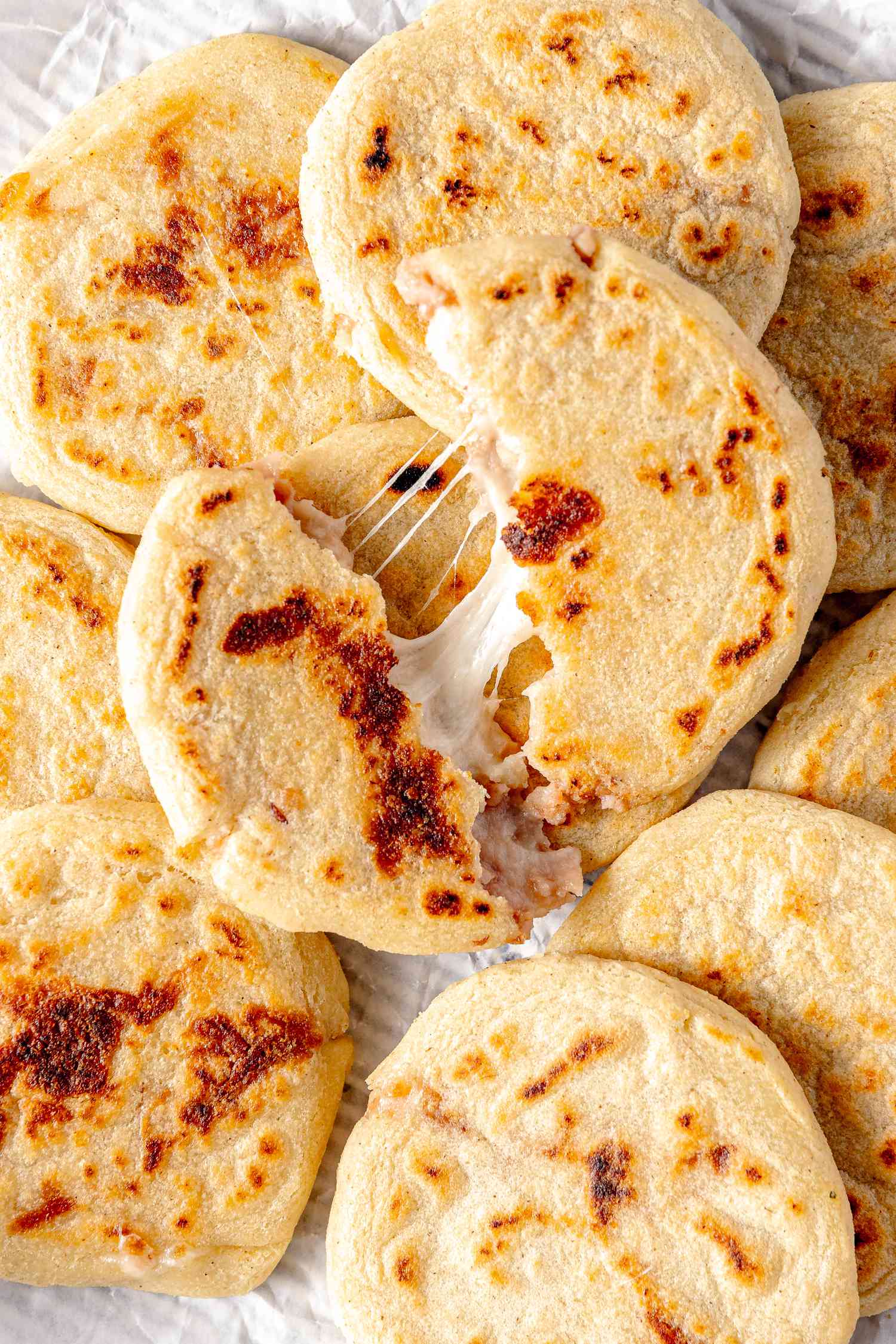
18 Salvadoran Recipes: Pupusas, Yuca Frita & Central American Dinners
Salvadoran cooking is masa, curtido, and slow tomato-achiote braises — here's the eight-item pantry and the 18 dishes that use it.
Salvadoran cooking runs on three things: corn masa, a fermented cabbage slaw called curtido, and long-simmered stews built on tomato, achiote, and bell pepper. Pupusas are the entry point — a stuffed masa disc griddled until blistered, ready in about 40 minutes — but the canon runs from 15-minute curtido to a 7-hour slow-cooker pork stew.
Get a free week of easy dinners
Seven weeknight dinners with the shopping list already totalled, sent Sunday. No account needed, unsubscribe in one click.
No spam, unsubscribe in one click. Recipes, shopping lists and Instacart carts all work without an account either way.
Salvadoran cooking beyond pupusas
El Salvador is the smallest country in Central America and the one with the most concentrated culinary identity. Where Mexican food fans out across 32 regional cuisines, Salvadoran cooking narrows to a handful of techniques executed obsessively: masa worked by hand, beans cooked twice, meat braised until it shreds, and everything served with something acidic on the side.
The corn masa canon is the backbone. Pupusas are the national dish — the country celebrates Día Nacional de las Pupusas on the second Sunday of November — but the same nixtamalized masa becomes tamales steamed in plantain leaves, riguas grilled on a comal, and the thick tortillas that arrive with every plate of stew. Masa is not a side. It is the plate.
The indigenous Pipil influence shows up in the ingredients that have no Spanish-colonial equivalent: loroco (the edible flower bud of Fernaldia pandurata, which tastes like a cross between artichoke and asparagus), chipilín greens, and the practice of thickening sauces with toasted pumpkin seeds rather than flour. The coastal influence shows up in the seafood soups of La Libertad and Usulután, and in the ubiquity of yuca — boiled, then fried, then buried under curtido and chicharrón.
What Salvadoran food is not: spicy. Chiles appear as flavor, rarely as heat. A Salvadoran plate leans savory, slightly sweet from achiote and bell pepper, and gets its punch from vinegar-forward curtido rather than capsaicin. If you have been cooking Mexican food and expect chile heat, recalibrate.
Three numbers frame the shopping: a 4-pound bag of Maseca masa harina runs $4–6 and makes roughly 60 pupusas; a pound of queso duro blando runs $7–9; a head of green cabbage for curtido runs $2. A dinner for six from this list costs $12–18 in ingredients.
The Salvadoran meal decision framework
Every recipe below sorts on three axes. Pick your row and the menu writes itself.
| Base | Best protein | Occasion | Total time | Start here |
|---|---|---|---|---|
| Masa (pupusa) | Cheese, beans, pork | Weeknight, kid-friendly | 35–50 min | Pupusas with queso and curtido |
| Masa (tamal) | Chicken, pork | Weekend, batch cook | 105 min | Salvadoran tamales in plantain leaves |
| Rice + beans | Chicken, beef | Sunday dinner | 60–140 min | Braised chicken in tomato-pepper sauce |
| Yuca / plantain | Pork, none | Snack, side, party | 15–45 min | Fried yuca sticks |
| Soup / stew | Beef, pork | Cold night, feeds 6 | 70–440 min | Slow-cooked beef yuca stew |
The 40-minute rule. If you have under an hour, you are making pupusas or a griddled masa dish. Everything else in Salvadoran cooking is a braise, and braises want 70 minutes minimum. Do not try to shortcut a Salvadoran stew — the tomato-achiote base needs time to lose its raw edge.
The batch rule. Masa and curtido both scale for free. Doubling a pupusa recipe adds about 12 minutes of griddle time, not double. Curtido at 15 minutes for six servings is the same 15 minutes for twelve. Make both in quantity.
Serve-with defaults. Pupusas get curtido plus a thin tomato salsa, always. Stews get rice, beans, and a stack of thick tortillas. Fried things get curtido too. There is no Salvadoran plate that doesn't want something pickled next to it.
18 Salvadoran recipes, grouped by category
Pupusas and masa dishes (6)
1. Pan-Fried Salvadoran Pupusas with Queso and Curtido — 40 minutes, serves 4, 320 calories. The baseline. Masa harina, water, salt, and quesillo, griddled dry until spotted. If you make one recipe on this page, make this one.
2. Pan-Fried Salvadoran Pupusas with Quesillo and Refried Beans — 45 minutes, serves 4, 350 calories. Pupusas de frijol con queso, the second-most-ordered variety in El Salvador. The beans must be refried and cooled or they tear the masa.
3. Pan-Fried Pupusas with Revueltas Filling and Tangy Curtido — 50 minutes, serves 4, 450 calories. Revueltas means "mixed": chicharrón, beans, and cheese together. This is the flagship order at any Salvadoran pupusería.
4. Chicken and Loroco Pupusas with Tomato Salsa — 45 minutes, serves 6, 280 calories. Loroco is the ingredient that makes a pupusa taste unmistakably Salvadoran rather than generically Latin. Frozen loroco works; jarred works; skip the recipe rather than substitute if you can find neither.
5. Pan-Fried Pupusas with Refried Red Beans and Quesillo — 40 minutes, serves 4, 320 calories. Red silk beans instead of black. Sweeter, softer, and closer to what you'd be served in San Salvador than the black-bean version most US recipes default to.
6. Steamed Salvadoran Tamales Wrapped in Plantain Leaves — 105 minutes, serves 6, 350 calories. Plantain leaves, not corn husks — that is the Salvadoran signature, and it makes the masa noticeably moister than a Mexican tamal. A weekend project that freezes for three months.
Stews and soups (4)
7. Slow-Cooked Salvadoran Beef Yuca Stew — 140 minutes, serves 6, 450 calories. Yuca goes in at the 90-minute mark; any earlier and it disintegrates into the broth.
8. Slow-Cooked Salvadoran Beef Stew with Corn and Potatoes — 140 minutes, serves 6, 420 calories. The Sunday version. Corn goes in on the cob, cut into 2-inch rounds, and everyone gnaws it.
9. Slow-Cooked Salvadoran Chicken Stew with Tomatoes and Peppers — 70 minutes, serves 4, 380 calories. The fastest braise here and the best weeknight entry to Salvadoran stews.
10. Slow Cooker Salvadoran Pork and Vegetable Stew — 440 minutes, serves 6, 450 calories. Seven hours on Low. Load it at 8 a.m., ignore it, eat at 4 p.m. The single best set-and-forget dish on this list.
Rice, beans, and mains (4)
11. Braised Salvadoran Chicken with Tomato and Bell Pepper Sauce — 60 minutes, serves 4, 400 calories. Bell pepper, not chile, is the flavor engine. Cook the peppers until they collapse — 15 minutes, not 5.
12. Slow-Simmered Salvadoran Chicken with Tomato and Achiote — 65 minutes, serves 4, 320 calories. Achiote paste does the coloring and about 30% of the flavor. Bloom it in fat before the tomato goes in.
13. Grilled Salvadoran Chicken with Citrus Mojo Marinade — 30 minutes, serves 4, 320 calories. The one genuinely fast main here. Sour-orange marinade, hot grill, done.
14. Refried Guatemalan Black Beans with Toasted Garlic — 80 minutes, serves 4, 180 calories. Central American refried beans are looser and darker than the Mexican style. This is the pot you use to fill pupusas and to plate under everything else.
Fried and street food (4)
15. Cabbage and Carrot Curtido with Vinegar and Oregano — 15 minutes, serves 6, 40 calories. Non-negotiable. Make it first; it improves for a week.
16. Crisp Fried Yuca Sticks with Spicy Huancaína Dip — 35 minutes, serves 4, 320 calories. Yuca frita. Boil the yuca first, then fry — raw-fried yuca stays woody in the center every time.
17. Pan-Fried Green Plantains with Garlic-Lime Sauce — 30 minutes, serves 4, 250 calories. Green plantains fry into tostones; ripe ones caramelize into plátanos fritos. Both belong next to a stew.
18. Salvadoran Sweet Rice Pudding with Cinnamon and Coconut — 45 minutes, serves 6, 250 calories. Arroz con leche, coconut-forward. The dessert every Salvadoran household actually makes.
Two more worth adding once you're comfortable: Butter-Rich Salvadoran Cheese Quesadilla (35 minutes) — a sweet cheese pound cake, not a tortilla dish, and a genuine surprise for anyone expecting the Mexican meaning of the word — and Slow-Simmered Salvadoran Chicken Pepián with Roasted Pumpkin Seeds (80 minutes), which shows off the pumpkin-seed thickening technique the region is built on.
Building the Salvadoran pantry
Eight items cover every recipe above. Six are at a standard supermarket; two are not.
| Ingredient | Where | Typical price | Substitute |
|---|---|---|---|
| Masa harina (Maseca) | Walmart, Target, most groceries | $4–6 / 4 lb | None — cornmeal will not work |
| Achiote / annatto paste | International aisle, Latin market | $2–3 / 3.5 oz | Paprika + a pinch of turmeric |
| Queso duro blando | Latin market | $7–9 / lb | Cotija + a little mozzarella |
| Quesillo | Latin market | $6–8 / lb | Low-moisture mozzarella |
| Salvadoran crema | Latin market | $4–5 | Sour cream thinned with milk |
| Loroco (frozen or jarred) | Latin market | $4–7 | Spinach + garlic, honestly not the same |
| Yuca (fresh or frozen) | Most groceries, frozen aisle | $2–4 / lb | Frozen is fine; it is already peeled |
| Green cabbage | Anywhere | $2 / head | None needed |
Masa harina is the one you cannot fake. Nixtamalization — cooking the corn in an alkaline lime solution before drying and milling — is what makes masa pliable and gives it that specific toasted-corn aroma. Regular corn flour, cornmeal, and polenta are all un-nixtamalized. They will crumble in your hands. Maseca is the workhorse brand; Masienda ships heirloom single-varietal masa nationally if you want to taste the difference.
Finding a Salvadoran market. Search your maps app for "Latino market", "carnicería", or "tienda salvadoreña" plus your zip. In the US, the largest Salvadoran communities are in the DC metro, Los Angeles, Houston, and Long Island — but even mid-sized cities usually have one Central American grocer stocking loroco, queso duro, and fresh masa by the pound. Fresh masa, if you find it, cuts pupusa prep by 10 minutes and is meaningfully better.
Storage. Masa harina keeps 9–12 months sealed in a cool pantry. Made-up masa dough keeps 24 hours refrigerated, covered with a damp towel. Curtido keeps 7–10 days. Cooked pupusas freeze 3 months; uncooked shaped pupusas freeze 3 months and cook straight from frozen at 375°F for 6–8 minutes a side.
What to buy for Salvadoran cooking
You need less equipment here than for almost any other cuisine. Three items, and two of them you probably own.
A comal or 12-inch cast-iron skillet. This is the whole game. Pupusas want a dry, evenly hot surface at roughly 400°F held for 8–10 minutes at a stretch. Cast iron holds that; thin nonstick does not, and it scorches the masa before the inside sets. A 12-inch pan cooks three pupusas at once, which is the difference between dinner in 40 minutes and dinner in 70. Browse Cookware for cast-iron skillets and griddles.
A flexible bench scraper and a wide spatula. Masa is sticky and pupusas are fragile until the crust sets. A thin metal spatula gets under a 4-inch disc without tearing it; a silicone one flexes and folds it. See Utensils & Tools.
A sharp chef's knife for the curtido. Curtido is cabbage, carrot, and onion cut fine — about ⅛-inch shreds. A dull knife bruises cabbage instead of slicing it and the slaw weeps. This is the one place in Salvadoran cooking where knife quality is visible in the result. See Knives & Cutting.
Optional but useful: a tortilla press (line both plates with a cut freezer bag) for anyone who wants uniform pupusas without the hand technique, and a 6-quart slow cooker or Dutch oven from Small Appliances for the 140-minute and 440-minute braises. A molcajete is traditional for salsa but a food processor gets 90% of the way there in a tenth of the time.
The technique most people skip: resting the masa
Here is the single change that separates a pupusa that cracks from one that puffs.
Mix your masa harina with warm water and salt to a texture like soft play dough — it should hold a fingerprint without sticking to your palm. Then cover it and walk away for 15 minutes.
What happens in those 15 minutes is hydration. Masa harina is dried, milled nixtamalized corn; the starch granules on the outside of each particle absorb water almost instantly, but the interiors take time. Mix and shape immediately and you are working dough where the outside is wet and the inside is still dry powder. It tears at the edges when you press it, and those tears are where the cheese escapes and welds itself to your pan.
After a 15-minute rest, the water has equalized. The dough goes from crumbly to genuinely elastic. You can flatten a ball to a 4-inch disc, cup it around a tablespoon of filling, seal it, and pat it back to a quarter-inch thickness without a single crack.
The test: roll a ball, flatten it between your palms. If the edges fissure, rest it longer or add water a teaspoon at a time. If it sticks to your hands, wet your palms lightly with water — not oil, and not more masa.
The second thing people skip: the pan must be genuinely hot before the first pupusa goes down. Test with a drop of water — it should skitter and evaporate in about two seconds. A lukewarm comal steams the masa gray instead of blistering it, and no amount of extra time fixes it once it starts wrong.
Third: do not press pupusas down with the spatula while they cook. The steam trapped inside is what puffs them. Press them and you get a dense masa cracker.
Common mistakes with Salvadoran food
- Substituting cornmeal for masa harina. The most common failure by a wide margin. It does not hydrate the same way and the dough will not hold together.
- Overfilling. A tablespoon of filling per pupusa. Two tablespoons feels generous and blows out on the griddle every time.
- Skipping the curtido. It reads as optional and it is not. The pupusa is rich, soft, and one-note; the curtido is the acid and crunch that makes the plate work.
- Using pre-shredded cabbage for curtido. It's cut too thick and it's already dried out at the edges. Ten minutes with a knife is the difference.
- Rushing a stew. Salvadoran braises are 70–140 minutes because the tomato-achiote base needs that long to sweeten. At 40 minutes it tastes raw and thin.
- Frying raw yuca. Boil to fork-tender first, then fry. Always.
Sources
- Serious Eats — Pupusas for the masa hydration ratios and griddle-temperature testing behind the resting technique above.
- NYT Cooking — Pupusas for the revueltas filling ratios and a well-tested curtido brine.
- Bon Appétit — A guide to Salvadoran food for regional context on loroco, queso duro blando, and the coastal seafood traditions.
Where to go next
If this is your entry point into Latin American cooking, the neighbors are worth a look: 20 Colombian & Venezuelan recipes covers arepas, which use the same masa logic with a different corn treatment; 18 Cuban recipes shares the citrus-mojo marinade technique; and 20 Peruvian recipes is where the huancaína sauce on those yuca fries comes from. For the wider region, Caribbean recipes by island maps the whole neighborhood.
Frequently asked questions
What is masa harina and where can I buy it?
Do I need a tortilla press to make pupusas?
What is curtido and why is it on every pupusa plate?
Can I freeze pupusas for meal prep?
What Salvadoran ingredients need a specialty store?
Sources
Cook Salvadoran at home this week.
Ask our AI for a week of Salvadoran dinners — it writes the recipes, builds the shopping list, and sends the cart to Instacart. No account needed.
Plan my Salvadoran week →