20 Peruvian Recipes: Ceviche, Lomo Saltado & Aji de Gallina Home Dinners
One $6 jar of aji amarillo paste unlocks most of the classic repertoire — and almost every dish here is faster than the pasta you were going to make instead.
Peruvian recipes at home rest on three chili pastes — aji amarillo, aji panca, and rocoto — plus limes, a screaming-hot skillet, and good potatoes. Buy one 7.5 oz jar of aji amarillo paste for about $6 and roughly two-thirds of the classic repertoire opens up immediately, no specialty trip required.
Get a free week of easy dinners
Seven weeknight dinners with the shopping list already totalled, sent Sunday. No account needed, unsubscribe in one click.
No spam, unsubscribe in one click. Recipes, shopping lists and Instacart carts all work without an account either way.
Introduction: why Peru is the sleeper hit of South American cooking
Peru has been near the top of every "world's best food" list for fifteen years running, and yet it is the South American cuisine American home cooks are least likely to have tried. Everyone has made a Brazilian feijoada or an Argentine chimichurri. Almost nobody has made an aji de gallina.
The reason Peruvian food punches so far above its weight is that it is not one cuisine — it is four, layered on top of each other over 500 years. There is the indigenous Andean base: potatoes (Peru grows more than 3,000 varieties), corn, quinoa, and chilies. There is the Spanish colonial layer: rice, wheat, beef, dairy. There is chifa, the Chinese-Peruvian tradition that arrived with 100,000 Cantonese laborers in the 1850s and gave the country the wok and soy sauce. And there is nikkei, the Japanese-Peruvian tradition that reshaped how the country handles raw fish.
That layering is why lomo saltado — a beef stir-fry with soy sauce, served over both french fries and rice — makes complete sense in Lima and sounds insane anywhere else.
For a home cook, the practical upshot is that Peruvian dishes are fast. Ceviche cures in ten minutes. Lomo saltado is eight minutes of actual cooking. The long-cooked dishes are the exception, not the rule. As of 2026, aji amarillo paste is stocked at most Latin markets, Whole Foods, and every major online grocer.
The Peruvian pantry: aji amarillo, aji panca, huacatay, purple corn
Aji amarillo is the one that matters. Despite "amarillo" (yellow) it is a bright orange chili with a fruity, almost apricot-like flavor and moderate heat — roughly 30,000–50,000 Scoville, but the fruitiness dominates. It is the backbone of aji de gallina, papa a la huancaina, causa, and most sauces. Buy it as paste in a jar; fresh and frozen pods are wonderful but rarely available.
Aji panca is the dark red one — mild (1,000–1,500 SHU), smoky, berry-ish, closer to an ancho. It is the marinade chili: anticuchos, pollo a la brasa, seco. If you can only buy one more jar after aji amarillo, buy this.
Rocoto is the dangerous one. It looks like a small apple, has black seeds, and runs 30,000–100,000 SHU with a sharp, immediate heat. It shows up in rocoto relleno and in table salsas. Handle it the way you would a habanero.
Huacatay (black mint) is a pungent, marigold-family herb with no real substitute — think mint crossed with basil and tarragon. It comes as a jarred paste and a little goes very far. Skip it on your first pass if you cannot find it.
Purple corn (maiz morado) is a deep-violet dried corn used to make chicha morada, the ubiquitous non-alcoholic drink. Also skippable at first.
| Ingredient | Heat (SHU) | Form to buy | Cost | Used in |
|---|---|---|---|---|
| Aji amarillo paste | 30,000–50,000 | 7.5 oz jar | $5–7 | Aji de gallina, huancaina, causa |
| Aji panca paste | 1,000–1,500 | 7.5 oz jar | $5–7 | Anticuchos, pollo a la brasa, seco |
| Rocoto paste | 30,000–100,000 | 7.5 oz jar | $6–8 | Rocoto relleno, table salsa |
| Huacatay paste | 0 | 7.5 oz jar | $6–9 | Ocopa, green sauces |
| Yellow potatoes | — | Fresh, Yukon Gold | $1/lb | Causa, huancaina, salchipapas |
| Limes | — | Fresh, key limes ideal | $0.30 ea | Ceviche, everything |
Two non-negotiables: fresh limes (bottled juice kills ceviche — the flavor is flat and the cure is uneven) and Yukon Gold or similar waxy-to-medium potatoes, which stand in acceptably for Peru's papa amarilla.
Ceviche fundamentals: fish choice, leche de tigre, and the 10-minute rule
Peruvian ceviche is not Mexican ceviche. It is not marinated for hours until the fish turns opaque and chalky. Modern Limeño ceviche cures for as little as two to ten minutes — the fish should still be translucent at the center — and the marinade itself, leche de tigre, is served in the bowl and often drunk separately.
The rules that matter:
1. Buy firm white fish, sashimi-grade if you can. Sea bass (corvina) is classic; flounder, halibut, snapper, and fluke all work. Avoid oily fish — salmon and mackerel go mealy in acid.
2. Cut ¾-inch cubes. Smaller cubes over-cure in the time it takes to plate.
3. Ice-cold everything. Chill the fish, the bowl, and the lime juice. Warm ceviche goes soft.
4. Juice by hand, don't press. Squeezing a lime in a mechanical press extracts bitter oil from the pith. Ten limes gets you roughly ¾ cup of juice.
5. Salt first, acid second. Salt the fish 60 seconds before the lime goes in — it firms the exterior and seasons through.
Leche de tigre is the marinade: lime juice, a little fish stock or a small piece of the fish blitzed in, garlic, ginger, aji amarillo, cilantro stems, salt. Blend, strain, keep ice cold. It is also the classic hangover cure, served in a shot glass.
Serve with red onion sliced paper-thin and rinsed (raw onion is harsh), boiled sweet potato for sweetness, and choclo (giant Peruvian corn) or plain corn kernels. Our Peruvian-style ceviche with pisco citrus dressing follows the short-cure method, and Peruvian chicken ceviche is the version to make when you do not trust the fish counter. For a fish-forward salad take, citrus-cured fish salad with aji amarillo stretches the same idea into a full plate.
Lomo saltado: Chinese-Peruvian chifa in a hot skillet
Lomo saltado is the dish that explains Peru. Beef sirloin, red onion, tomato, and aji amarillo, stir-fried hard in a wok with soy sauce and a splash of vinegar, then served over rice with french fries in the dish. The fries are not a side. They go in the pan at the end and soak up sauce.
The technique is Cantonese, not Latin. What you are chasing is wok hei — the seared, faintly smoky character you get only from very high heat and a nearly-dry pan.
Getting it right:
- Pat the beef bone dry and salt it 20 minutes ahead. Surface moisture is the enemy.
- Cut against the grain into ½-inch strips, not cubes. More surface area, faster sear.
- Get the pan to 450°F+. Carbon steel or cast iron. Nonstick physically cannot do this.
- Cook in two batches. A pound of beef in one batch drops the pan temperature 150°F and you get gray, steamed meat.
- Onions go in for 45 seconds only. They should still have a bite. Limp onions mean you overcooked the whole dish.
- Tomatoes last, for 30 seconds. They are there for acid and moisture, not to break down.
- Fries separate, added at the very end — fry or oven-roast them while the mise en place is going, toss them in off the heat.
Total cook time once the pan is hot: about eight minutes. Try spiced Peruvian lomo saltado stir fry or seared lomo saltado with caramelized onions and toasted rice. The fries-in-the-pan version is best captured by stir-fried sirloin with aji amarillo and french fries. Pork works too — spicy Peruvian-style pork stir fry with aji amarillo uses tenderloin at half the cost of sirloin.
Aji de gallina and other creamy chicken classics
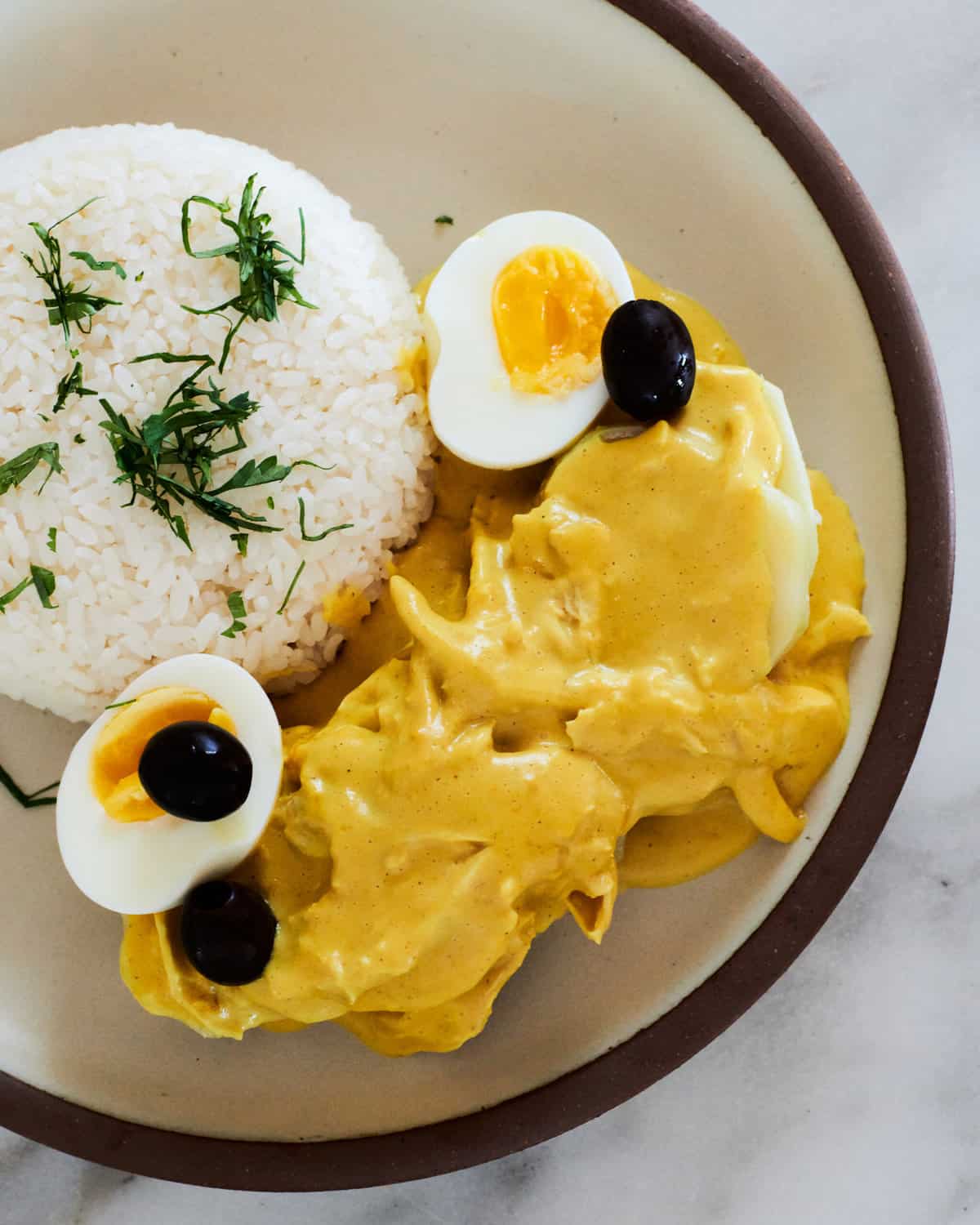
Aji de gallina — literally "hen chili" — is poached shredded chicken in a thick, mildly spicy sauce of aji amarillo, milk-soaked bread, walnuts, and parmesan, served over boiled potatoes and rice with black olives and a halved hard-boiled egg. It is Peru's answer to comfort food, and it is a genuinely unusual sauce: the thickener is bread, not flour, which gives it a plush, almost velvety body no roux replicates.
Two structural details:
- Use white sandwich bread, crusts removed, soaked in evaporated milk. Evaporated milk is not a shortcut here; it is what Peruvian cooks actually use, and its slight caramelization is part of the flavor.
- Poach the chicken and keep the broth. You will need a cup of it to loosen the sauce. Breast is traditional; thighs are more forgiving.
Start with authentic Peruvian aji de gallina. For the aji amarillo sauce technique in a faster format, sautéed Peruvian chicken with aji amarillo sauce and pan-seared chicken with Peruvian aji amarillo sauce both land in about 30 minutes.
Aji verde — the green sauce every Peruvian rotisserie chicken joint serves — is the other one to learn. Cilantro, jalapeño, garlic, lime, mayonnaise, and a little cotija, blended smooth. It goes on everything. Seared Peruvian-style chicken with aji verde sauce and roasted Peruvian-style chicken with aji verde sauce both build it from scratch.
Pollo a la brasa is Peru's national weeknight dinner: whole chicken marinated in soy sauce, aji panca, cumin, garlic, and vinegar, then spit-roasted. A home oven at 425°F on a rack does fine. Grilled Peruvian-style pollo a la brasa with aji verde sauce is the version to cook. Marinate a minimum of four hours; overnight is meaningfully better.
Anticuchos and papa a la huancaina for a family spread
Anticuchos are Peru's great street food — skewers marinated in aji panca, cumin, garlic, and vinegar, grilled hard and fast, and brushed with the marinade as they cook. Traditionally beef heart, which is lean, cheap, and tastes like a very clean steak. If that is a bridge too far, sirloin works and nobody at your table will complain. Grilled beef anticuchos with aji amarillo sauce is the recipe; marinate 4–24 hours and cook over the hottest fire you can build, 2–3 minutes per side.
Papa a la huancaina is boiled yellow potatoes under a cold sauce of aji amarillo, queso fresco, evaporated milk, and soda crackers, served on lettuce with olives and egg. It appears at essentially every Peruvian gathering as a first course. The sauce takes four minutes in a blender. Huancaina-style creamy yellow pepper sauce with boiled potatoes is the classic form, and crisp fried yuca sticks with spicy huancaina dip repurposes the same sauce as a party dip.
Round out a spread with corn and potato humintas with aji amarillo sauce — steamed corn cakes wrapped in husks — and sweet corn humintas wrapped in corn husks for the sweet version.
20 Peruvian recipes to cook this month
Raw and cold (10–20 minutes)
1. Peruvian-style ceviche with pisco citrus dressing
3. Citrus-cured fish salad with aji amarillo
4. Huancaina-style creamy yellow pepper sauce with boiled potatoes
Fast skillet dinners (20–35 minutes)
5. Spiced Peruvian lomo saltado stir fry
6. Seared lomo saltado with caramelized onions and toasted rice
7. Stir-fried sirloin with aji amarillo and french fries
8. Spicy Peruvian-style pork stir fry with aji amarillo
9. Sautéed Peruvian chicken with aji amarillo sauce
10. Pan-seared chicken with Peruvian aji amarillo sauce
11. Pan-seared chicken with Peruvian-inspired aji verde sauce
12. Pan-seared trout with aji amarillo sauce
13. Pan-seared Peruvian-style pork chops with chimichurri
Roasts and grills (45–90 minutes plus marinade)
14. Grilled Peruvian-style pollo a la brasa with aji verde sauce
15. Roasted Peruvian-style chicken with aji verde sauce
16. Grilled beef anticuchos with aji amarillo sauce
17. Roasted Peruvian corn and aji amarillo chicken
18. Sheet pan Peruvian-spiced chicken with roasted sweet potatoes
Slow and comforting
19. Authentic Peruvian aji de gallina
20. Seco de pollo chicken stew with citrus and cilantro
For a drink, pisco sour with fresh lime and egg white foam is the national cocktail; mango pisco sour cocktail with fresh lime and egg white foam is the fruit variation.
A 5-day Peruvian home dinner plan
Built so Sunday's work carries Monday and Tuesday, and the aji amarillo jar gets used four times before it can go bad.
| Day | Dish | Active time | Carries over |
|---|---|---|---|
| Sunday | Pollo a la brasa + aji verde | 25 min + 75 min roast | Chicken for Monday, sauce all week |
| Monday | Aji de gallina (uses Sunday's chicken) | 30 min | Sauce for Tuesday potatoes |
| Tuesday | Papa a la huancaina + green salad | 20 min | — |
| Wednesday | Lomo saltado | 25 min | — |
| Thursday | Ceviche + sweet potato | 20 min | Leche de tigre for Friday |
Shopping once. One whole chicken (~4 lb), 1 lb sirloin, 1 lb white fish, 3 lb Yukon Gold potatoes, 1 sweet potato, 2 red onions, 3 tomatoes, 2 bunches cilantro, 12 limes, evaporated milk, queso fresco, walnuts, white bread, soy sauce, red wine vinegar, and the two chili pastes. Roughly $55–65 for five dinners for four.
The one rule: open the aji amarillo jar on Sunday and plan to finish it inside two weeks. Refrigerated, it holds about a month; frozen in ice-cube trays, six months.
Kitchen equipment: a hot skillet, sharp knife, and citrus juicer
A carbon-steel or cast-iron skillet, 12 inches. Lomo saltado and anticuchos both need surface temperatures above 425°F, and nonstick coatings degrade past roughly 500°F. Carbon steel heats faster and weighs less than cast iron, which matters when you are tossing. Look through cookware for a 12-inch carbon-steel pan — expect $40–70, and it will outlive you.
A genuinely sharp knife. Ceviche is a knife dish. Ragged cubes cure unevenly and shed protein into the marinade, turning the leche de tigre cloudy. A 7–8 inch chef's knife or a santoku, honed before you start, is the whole trick. Browse knives; if you already own a decent knife, spend the money on a whetstone instead.
A hand citrus press. You need ¾ cup of lime juice for a four-person ceviche, which is 10–12 limes. Doing that by hand is miserable and doing it in a reamer-style electric juicer extracts pith bitterness. A simple hinged hand press costs about $15 in utensils and is the highest-value cheap tool in this article.
Also worth having: a blender that can handle thick pastes (the huancaina and aji verde sauces are both blender jobs), a mandoline for paper-thin red onion, and enough refrigerator containers from storage to hold three sauces at once — Peruvian meal planning is really sauce planning.
Common pitfalls
- Bottled lime juice in ceviche. It is pasteurized, so it lacks the fresh enzymes and bright top notes. The fish cures gray instead of white and the dish tastes metallic.
- Over-curing the fish. Past 20 minutes the proteins tighten past pleasant and go rubbery. Cure, taste at 5 minutes, serve.
- Crowding the lomo saltado pan. The single most common failure. Two batches, always.
- Substituting habanero for aji amarillo. Wrong flavor entirely — habanero is floral-tropical, aji amarillo is stone-fruity. If you must sub, use ½ yellow bell pepper plus ¼ habanero, blended.
- Skipping the rinse on raw red onion. Sliced onion rinsed in cold water for 60 seconds, then dried, loses its sulfurous bite while keeping the crunch.
FAQ
Where do I buy aji amarillo paste and what if I can't find it?
Any Latin American grocery, most Whole Foods locations, Amazon, and specialty online grocers stock 7.5 oz jars for $5–7 as of 2026; Peruvian brands like Doña Isabel and Inca's Food are widely available. If you truly cannot source it, purée one roasted yellow bell pepper with half a habanero (seeds removed), a teaspoon of lime juice, and a pinch of sugar. It is not identical — you lose the apricot note — but it gets the color and roughly the right heat level.
Is ceviche safe to make at home?
Yes, with sensible sourcing. Lime juice denatures surface proteins but does not kill parasites the way heat does, so buy fish labeled sushi-grade or previously frozen — commercial freezing at -4°F for seven days kills parasites and is the standard FDA guidance. Keep the fish below 40°F right up until it hits the acid, cure for under 20 minutes, and serve immediately. Skip raw preparations entirely if you are pregnant or immunocompromised.
What cut of beef should I use for lomo saltado?
Sirloin is the standard and the best value at roughly $9–12 per pound. Ribeye or tenderloin work and are more forgiving of a slightly cool pan. Skip flank and skirt — they are too fibrous for the short cook, and the cross-grain slicing that makes them tender also makes them shred in the toss. Whatever you use, pat it completely dry and salt it 20 minutes before it hits the pan.
Do I need a wok?
No. A 12-inch carbon-steel or cast-iron skillet on a home burner actually outperforms a round-bottom wok, because residential burners cannot deliver the 100,000+ BTU output a wok is designed around. What you need is mass, a flat surface in full contact with the burner, and the discipline to cook in batches. Preheat five minutes before the first piece of beef goes in.
What makes Peruvian food different from other Latin American cuisines?
Three things: the chilies are fruity rather than smoky or earthy, the Chinese and Japanese influences are structural rather than decorative, and potatoes are a primary ingredient rather than a side. Peru domesticated the potato and grows over 3,000 varieties, so dishes like causa and papa a la huancaina treat potato as the center of the plate. The soy sauce in lomo saltado is not fusion — it has been standard there since the 1800s.
Sources
- Serious Eats — Peruvian Ceviche on short-cure timing and leche de tigre construction.
- Bon Appétit — Lomo Saltado on batch-searing and the fries-in-the-pan finish.
- Food Network — Aji de Gallina on the bread-and-evaporated-milk thickening method.
Related reading: 20 Colombian recipes, 18 Cuban recipes, and 18 Puerto Rican recipes.
Peru is one stop on a long continent. For the lesser-covered kitchens — Ecuadorian, Chilean, Bolivian, Paraguayan and Uruguayan — see 22 Latin American Dinners.
Frequently asked questions
Where do I buy aji amarillo paste and what if I can't find it?
Is ceviche safe to make at home?
What cut of beef should I use for lomo saltado?
Do I need a wok for Peruvian stir-fries?
What makes Peruvian food different from other Latin American cuisines?
Sources
Cook Peruvian at home this week.
Ask our AI for a week of Peruvian dinners — it writes the recipes, builds the shopping list, and sends the cart to Instacart. No account needed.
Plan my Peruvian week →