Caribbean Recipes by Island: Trinidad, Cuba, Puerto Rico & DR
Jamaica gets the spotlight, but the best weeknight Caribbean cooking hides one island over — in Trinidad's pelau pot, Cuba's ropa vieja, Puerto Rico's pilón and the Dominican caldero.
Affiliate disclosure: AislePrompt may earn a commission on qualifying purchases made through Amazon and Instacart links in this article, at no additional cost to you. See our affiliate policy →
Authentic Caribbean dinner recipes start with one pot, one aromatic base and one chile. Brown the meat hard, build a sofrito or green seasoning, add coconut milk or stock, drop in a whole Scotch bonnet, and simmer. That single template produces Trinidadian pelau, Cuban ropa vieja, Puerto Rican arroz con pollo and Dominican pollo guisado — four different dinners from four different islands.
Introduction — one region, many islands, one shared table
The Caribbean is not one cuisine. It is roughly thirteen sovereign nations and a dozen territories spread across 1.06 million square miles of sea, each with its own colonial history, its own African and Indian and Indigenous inheritance, and its own answer to the question of what to make on a Tuesday. What they share is a technique stack: hard browning, an aromatic paste, a long-simmered starch, and heat that comes from one chile rather than a spice rack.
If you have cooked Caribbean food at home, you have probably cooked Jamaican food. Jerk chicken and curry goat are the region's export ambassadors, and we cover them in depth in 20 Caribbean Dinner Recipes: Jerk Chicken, Curry Goat & Rice and Peas. This guide goes one island over. It is organized by nation — Trinidad and Tobago, Cuba, Puerto Rico, the Dominican Republic, Haiti and the Eastern Caribbean — because that is how the flavors actually divide, and because "Caribbean seasoning" in a supermarket jar flattens six distinct culinary traditions into one brown powder.
Every dinner below is a real recipe in our catalog with real numbers attached: calories, grams of protein, prep minutes, cook minutes. Nineteen of the twenty come in under 500 calories a serving. Eleven are on the table in under 45 minutes total. The Caribbean cuisine overview is a useful map of the region's history; this is the weeknight execution.
What you will get here:
- The six-ingredient pantry that unlocks all six islands
- Twenty tested dinners sorted by nation, not by a generic "tropical" bucket
- The Scotch bonnet handling rules that keep the heat in the pot and off your hands
- Real cook times, so you know which dishes are Tuesday food and which are Sunday food
The Caribbean pantry: allspice berries, Scotch bonnet, culantro, coconut milk, thyme, browning
Six ingredients cover every recipe in this guide. Buy them once and you can cook any island on this list without another special trip.
Allspice berries (pimento). Whole, not ground. Allspice is a single dried berry from a Jamaican tree — it is not a blend, despite the name. Toast the berries in a dry pan for 60 seconds and grind them; pre-ground allspice loses most of its eugenol within about six months of milling. A 2-ounce jar of whole berries costs roughly $4 and lasts two years.
Scotch bonnet. The regional chile, 100,000–350,000 on the Scoville scale against a jalapeño's 2,500–8,000. Its point is not only heat — it carries a distinctly fruity, almost apricot aroma that habanero approximates and jalapeño does not touch at all. Most island stews use it whole and unpierced, so you get perfume without fire. See the handling section below.
Culantro (chadon beni / recao). Long serrated leaves, not the round-leafed cilantro you know. It is roughly three to four times more pungent and it survives a 45-minute simmer where cilantro would vanish. It is the backbone of Trinidadian green seasoning and Puerto Rican sofrito. If your grocer does not stock it, use double the cilantro and add it in two stages — half at the start, half off the heat.
Full-fat coconut milk. Canned, 17–22% fat. Light coconut milk breaks under a long simmer and gives you a watery pelau. One 13.5-ounce can runs $2–3 and thickens four servings. That can is also the backbone of the broader tropical recipe collection, which sorts by fruit — mango, pineapple, coconut — rather than by island.
Fresh thyme. On the stem, dropped in whole and fished out at the end. Caribbean cooking uses thyme the way French cooking uses bay — as a structural background note, not a garnish.
Browning. Burnt-sugar caramel, sold in a bottle, and the reason Jamaican and Guyanese stews are mahogany rather than beige. You can make it — sugar cooked past caramel to just-before-acrid, then killed with hot water — but the bottled version is $3 and consistent.
Stock these in a dedicated bin and the whole guide becomes a weeknight project. A set of airtight storage containers keeps ground allspice and dried thyme usable for a full season instead of three months.
Jamaican Mains — jerk chicken, curry goat, oxtail, ackee & saltfish, escovitch fish
Jamaica is the island most American home cooks already know, so this section is deliberately short — the full treatment lives in our Caribbean dinner recipes guide. Here are the three that belong in any island-by-island survey.
Jerk Chicken with Mango Salsa — 400 cal, 35 g protein, 20 min prep + 25 min cook, serves 4. Real jerk is a smoking method over pimento wood, not a rub. At home, the closest approximation is indirect heat with soaked wood chips and a marinade heavy on allspice, thyme, scallion and Scotch bonnet. Marinate at least four hours; overnight is better.
Oxtail Stew with Scotch Bonnet and Allspice — 550 cal, 40 g protein, 20 min prep + 180 min cook, serves 4. This is Sunday food. Three hours is not negotiable: oxtail collagen converts to gelatin somewhere between 2.5 and 3 hours at a bare simmer, and that gelatin is the entire dish. Pull it early and you get chewy meat in thin liquid.
Brown Stew Chicken with Caribbean Thyme and Scotch Bonnet — 450 cal, 40 g protein, 20 min prep + 45 min cook, serves 4. The weeknight member of the Jamaican canon. Browning sauce, hard-seared thighs, thyme, a whole bonnet, 45 minutes. If you cook one Jamaican dish on a Wednesday, cook this one.
Saltfish shows up across the region, not only in Jamaica's ackee-and-saltfish. Saltfish and Callaloo Stew (400 cal, 20 g protein, 20 + 40 min, serves 4) is the version that travels furthest — Trinidad, Grenada and Barbados all make a close cousin.
Trinidadian & Guyanese — doubles, chicken pelau, roti, chow mein
Trinidad is where the Caribbean meets South Asia. Roughly 35–40% of the population traces ancestry to indentured Indian laborers who arrived after 1845, and Trinidad and Tobago cuisine is the result: curry powder and geera (cumin) sitting alongside African-derived one-pot rice and Chinese-Trini stir-fries. Nothing else in the region tastes like it.
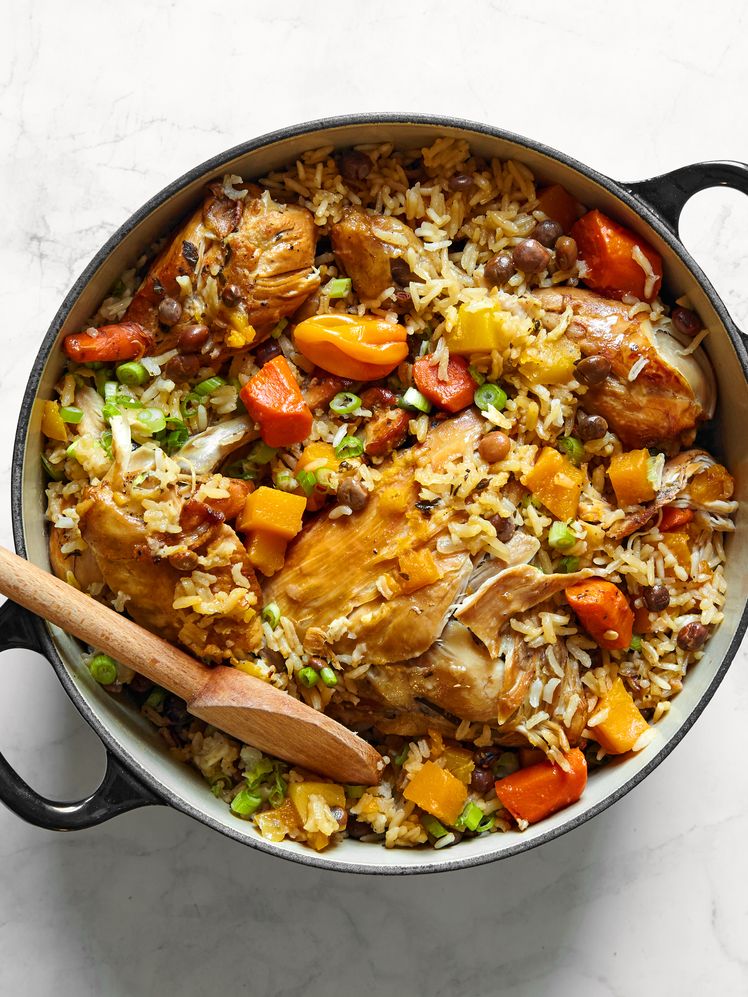
Pelau is the national weeknight dinner. Pelau starts with sugar burned in oil until it is genuinely dark — past golden, into the color of strong coffee — then chicken dropped straight into the caramel to lacquer. Rice, pigeon peas, coconut milk and a whole Scotch bonnet go in on top, and it finishes in one pot.
- Spiced Trinidadian Chicken Pelau with Coconut Rice — 450 cal, 35 g protein, 20 min prep + 40 min cook, serves 6. The reference version, and the most economical per serving on this whole list.
- Curried Chicken Pelau with Coconut Rice — 520 cal, 38 g protein, 15 + 45 min, serves 4. Adds a bloomed curry step before the rice.
- Curry-Spiced Chicken Pelau with Caramelized Peas — 520 cal, 38 g protein, 15 + 45 min, serves 4.
Doubles is Trinidad's breakfast, street food and hangover cure, and it makes an excellent light dinner. Two soft turmeric-yellow bara flatbreads sandwich curried channa (chickpeas), then tamarind and pepper sauce go on top. Doubles is entirely vegan by default.
- Double-Cooked Doubles with Curried Channa and Tamarind Chutney — 350 cal, 12 g protein, 20 min prep + 30 min cook, serves 6.
- Vegetarian Doubles with Curried Chickpeas and Tamarind Chutney — 280 cal, 10 g protein, serves 6. Note the 80-minute prep: that is dough proofing, and almost all of it is hands-off.
Bake and shark, minus the shark. Pan-Fried Trinidadian Bake with Spicy Saltfish Filling — 350 cal, 18 g protein, 45 + 20 min, serves 4 — is the fried-bread-plus-filling format that Maracas Bay made famous, built around salt cod instead.
For a meatless curry with real body, Curried Jackfruit 'Goat' Curry with Flatbread — 410 cal, 10 g protein, 20 + 35 min, serves 4 — uses green jackfruit's stringy texture to stand in for goat, with the same geera-and-curry base. Roti itself is a weekend project (dhalpuri takes a practiced hand and a tawa); this flatbread version gets you the same plate on a weeknight.
Cuban & Puerto Rican — ropa vieja, arroz con pollo, mofongo, picadillo
Both islands cook from a Spanish base with African and Taíno technique layered in, and both build nearly everything on sofrito. The difference is emphasis: Cuban cuisine leans on cumin, oregano and sour orange; Puerto Rican cuisine leans on culantro, ají dulce and achiote-colored oil.
Cuba's signature braise. Ropa vieja — "old clothes" — is flank or skirt steak simmered until it shreds into strands, then finished in a pepper-and-tomato sofrito.
- Authentic Cuban Ropa Vieja with Plantains — 520 cal, 35 g protein, 15 min prep + 485 min cook, serves 4. That eight-hour cook time is a slow cooker; hands-on time is a quarter hour.
- Ropa Vieja Beef Tacos with Cabbage Slaw — 420 cal, 32 g protein, 20 + 145 min, serves 4. A stovetop route in under 2.5 hours.
Cuba gets a guide of its own: 18 Cuban Recipes: Ropa Vieja, Mojo Pork & Arroz Con Pollo goes deeper on the mojo marinade, the pressed sandwich and the full braise-to-leftovers rotation.
Picadillo is the cheapest good dinner in this guide. Ground beef, olives, raisins or capers, tomato — 15 minutes of prep and it holds five days in the fridge.
- Picadillo with Ground Beef and Green Olives — 380 cal, 25 g protein, 15 + 30 min, serves 4, easy.
- Beef Picadillo with Sweet Plantains — 450 cal, 30 g protein, 30 + 60 min, serves 4.
- Picadillo de Res: Puerto Rican Ground Beef with Tomatoes and Olives — 380 cal, 25 g protein, 15 + 30 min, serves 4. The Puerto Rican reading, sofrito-forward.
Arroz con pollo is the island's one-pan answer to a full dinner.
- Puerto Rican One-Pan Arroz con Pollo — 420 cal, 28 g protein, 15 + 30 min, serves 4. Forty-five minutes, one pan, done.
- Saffron-Scented Puerto Rican Arroz con Pollo — 520 cal, 38 g protein, 20 + 25 min, serves 4. The highest protein-per-serving rice dish here.
Mofongo is a technique, not a recipe. Green plantains fried, then mashed in a wooden pilón with garlic, salt and pork fat or olive oil. Mofongo is served as a dome with something saucy over or beside it.
- Mofongo con Pollo — 380 cal, 32 g protein, 30 + 35 min, serves 4.
- Mofongo con Pollo y Chorizo — 480 cal, 34 g protein, 30 + 25 min, serves 4.
- Grilled Mahi-Mahi with Mofongo — 380 cal, 25 g protein, 20 + 15 min, serves 4. Thirty-five minutes total, the fastest mofongo plate on the list.
Two more worth cooking: Puerto Rican Mojo-Marinated Grilled Chicken (320 cal, 35 g protein, 30 + 20 min, serves 4) and Sancocho de Pollo (Chicken Stew) (320 cal, 25 g protein, 25 + 45 min, serves 6) — sancocho being the root-vegetable stew that half the Spanish-speaking Caribbean claims. For a cold plate, Cuban-Style Rum-Infused Mango Shrimp Salad is 280 cal, 30 g protein and 16 minutes start to finish.
Dominican & Haitian — la bandera, griot, diri ak djon djon
The two nations share Hispaniola and almost nothing else at the stove. Dominican Republic cuisine is Spanish-Caribbean, built on sofrito and sazón. Haitian cuisine is French-Caribbean, built on epis — a raw green marinade of parsley, thyme, scallion, garlic and bell pepper — and it is markedly more chile-forward.
La bandera dominicana — "the Dominican flag" — is the daily lunch plate: white rice, stewed beans, stewed meat, salad. The meat is nearly always pollo guisado.
- Dominican-Style Pollo Guisado with Sofrito — 350 cal, 35 g protein, 8 g carbs, 15 min prep + 60 min cook, serves 4. The single most-eaten dinner in this guide's entire geography.
- Slow-Cooked Dominican Chicken with Plantains and Mojo Sauce — 480 cal, 38 g protein, 20 + 40 min, serves 4, easy.
- Pan-Seared Chicken with Dominican Mojo Sauce — 320 cal, 35 g protein, 10 + 20 min, serves 4. Thirty minutes total and the leanest protein-dense plate here.
Pork, two ways. Mojo Pork Chops — 340 cal, 32 g protein, 25 + 20 min, serves 4, easy — is the weeknight version. Slow-Cooked Dominican Pernil with Garlic Mojo — 480 cal, 45 g protein, 15 min prep + 300 min cook, serves 8 — is the party version, and at eight servings it is the best cost-per-plate on this page.
Mofongo crosses the channel too. Dominican-Style Mofongo with Garlic Shrimp — 450 cal, 30 g protein, 20 + 15 min, serves 3 — is 35 minutes total.
For the long-simmer slot: Sancocho de Res con Yuca — 410 cal, 32 g protein, 30 + 90 min, serves 6. Two hours, and the yuca does something to the broth that potato cannot.
Haiti is thinly covered in most American recipe collections, and ours is no exception. Griot — pork shoulder marinated in epis and sour orange, boiled, then fried until the edges shatter — and diri ak djon djon, rice steeped in black Haitian mushrooms until it turns near-charcoal, are both genuinely worth learning, and neither is in our catalog yet. What we do have is Haitian Salt Cod Fritters with Lime-Cilantro Sauce — 380 cal, 12 g protein, 20 min prep + 12 min cook, serves 4 — the accras that open a Haitian meal. If you want griot tonight, the Dominican pernil above is the nearest thing on this list, and the sour-orange marinade is nearly identical.
Rice & Peas Every Way — coconut rice, red beans, gungo peas, pigeon peas
"Peas" in the Caribbean means beans. Jamaican rice and peas uses red kidney beans most of the year and gungo (pigeon) peas at Christmas. Puerto Rican arroz con gandules uses pigeon peas year-round. Cuban moros y cristianos uses black beans. The technique is identical: bloom aromatics, toast rice, add coconut milk or bean liquor, simmer covered without stirring.
| Rice dish | Island | Calories | Protein (g) | Carbs (g) | Total time |
|---|---|---|---|---|---|
| Arroz con Gandules | Puerto Rico | 400 | 15 | 60 | 90 min |
| Moros y Cristianos | Cuba/PR | 450 | 12 | 65 | 60 min |
| Rice with Pigeon Peas and Sofrito | Puerto Rico | 380 | 12 | 65 | 40 min |
| Stewed Rice with Pigeon Peas and Olives | Puerto Rico | 350 | 12 | 50 | 40 min |
| Best-Caribbean Coconut Rice | Pan-Caribbean | 280 | 4 | 56 | 50 min |
- Arroz con Gandules: Traditional Puerto Rican Rice & Pigeon Peas — the national dish, 400 cal, serves 6. The 70-minute cook buys you the pegao, the toasted crust at the bottom of the pot, which is the whole point.
- Moros y Cristianos (Pigeon Peas and Rice) — 450 cal, serves 4, easy.
- Rice with Pigeon Peas and Sofrito — 380 cal, 40 minutes total, easy. The weeknight default.
- Stewed Rice with Pigeon Peas and Olives — 350 cal, 40 minutes, easy.
- Best-Caribbean Coconut Rice — 280 cal, easy, and the most flexible side here.
Vegetables and sides that carry a plate:
- Crispy Fried Plantains — 220 cal, 10 + 35 min, serves 4. Green for tostones, black-spotted for sweet maduros. There is no in-between stage worth frying.
- Callaloo Stew with Coconut & Okra — 320 cal, 12 g protein, serves 4. Callaloo means taro leaf in Trinidad and amaranth in Jamaica; both work, and so does spinach with a handful of okra for body.
- Barbadian Coconut Chicken with Callaloo — 380 cal, 28 g protein, 15 + 20 min, serves 4. Thirty-five minutes, Eastern Caribbean.
- Sweet Potato and Callaloo Stew with Scotch Bonnet — 220 cal, 15 + 25 min, serves 4. The lightest dinner on this page.
- Vegan Caribbean Black Bean and Sweet Potato Stew — 320 cal, 10 g protein, 45 minutes total.
- Coconut Fish Stew with Callaloo — 350 cal, 30 g protein, 25 + 25 min, serves 4, easy.
- Caribbean-Style Coconut Shrimp Skillet — 380 cal, 24 g protein, 30 minutes total. The fastest complete dinner in this guide.
How to handle Scotch bonnets without setting your kitchen on fire
Capsaicin is oil-soluble and water-insoluble. Every rule below follows from that one fact.
Cook the pepper whole and unpierced. Drop it in at the start of the simmer, fish it out before serving. You get the fruity aroma and maybe 5–10% of the heat, because capsaicin concentrates in the placental membrane inside and stays there if the skin is intact. This is how most island home cooks actually use it, and it is why authentic stews taste of Scotch bonnet without being punishing. If the pepper bursts, remove it immediately.
Scale the heat deliberately. Whole and unpierced is mild. Pierced once with a knife tip is moderate. Halved with seeds and membrane removed is hot. Minced with the membrane in is very hot — one bonnet will carry six servings comfortably past most people's tolerance.
Wear gloves, or work with a barrier. Nitrile gloves cost about $0.05 a pair. Without them, capsaicin binds to skin oils and survives multiple soap washes — the classic failure is touching your eye four hours later. If you have no gloves, coat your hands in neutral oil first, cut on a dedicated board, then wash with dish soap (a degreaser) rather than hand soap.
Never rinse the board with hot water in a small kitchen. Hot water aerosolizes residual capsaicin and you have effectively made pepper spray. Wipe the board with an oiled paper towel first, then wash with cool water and detergent.
Fix an over-hot pot with fat and acid, not water. Full-fat coconut milk, a spoon of oil, or dairy will bind free capsaicin. A squeeze of lime shifts perception. Adding water only dilutes everything else and leaves the burn proportionally intact.
Substitutions, honestly: habanero is the only widely-stocked chile in the same family and heat band. Jalapeño is not a substitute — you would need four or five to approach one bonnet's heat and you would still miss the fruit entirely. Bottled Scotch bonnet pepper sauce is a reasonable fallback; add it at the end, off heat, a teaspoon at a time.
Kitchen gear (Dutch oven, mortar & pestle for jerk marinade, cast-iron)
Four tools cover this entire guide. None of them is exotic.
A 5–7 quart enameled Dutch oven is the one non-negotiable. Pelau, ropa vieja, oxtail, sancocho, pollo guisado and every rice dish here want the same thing: a heavy base that holds a hard sear, then a tight lid that holds a bare simmer for an hour without scorching. Browse cookware for options — anything with at least a 3 mm base and a genuinely flat bottom works. A thin stockpot will scorch your burnt-sugar base in about 40 seconds.
A wooden pilón, or a large mortar and pestle. Mofongo genuinely requires it. A food processor turns fried plantain into paste; a pilón leaves the fibrous texture that makes the dish. The same tool pounds jerk marinade and green seasoning far better than a blender, which whips air into the paste and dulls it. Look under kitchen gadgets and utensils.
A 10–12 inch cast-iron skillet for jerk, escovitch, tostones and anything that needs a hard fry. Cast iron holds temperature when cold plantain hits it; thin nonstick drops 60–80°F on contact and you get greasy instead of crisp.
A sharp 8-inch chef's knife. Green plantain is dense and slippery, yuca is woody, and oxtail needs a confident hand. A dull knife on green plantain is the most common cut in Caribbean home cooking. Our knives category covers the basics.
Optional but useful: a rice cooker for the arroz dishes if you cannot resist stirring — the pegao suffers, but weeknight consistency improves. A mandoline is unnecessary. A dedicated spice grinder for allspice pays for itself in one season.
Real-world numbers: what these dinners actually cost you in time and calories
Nineteen of the twenty mains here land under 500 calories a serving. The spread that actually matters on a Tuesday is total time.
| Dinner | Island | Calories | Protein (g) | Total time | Serves |
|---|---|---|---|---|---|
| Pan-Seared Chicken with Dominican Mojo | Dominican Rep. | 320 | 35 | 30 min | 4 |
| Caribbean-Style Coconut Shrimp Skillet | Pan-Caribbean | 380 | 24 | 30 min | 4 |
| Grilled Mahi-Mahi with Mofongo | Puerto Rico | 380 | 25 | 35 min | 4 |
| Dominican-Style Mofongo with Garlic Shrimp | Dominican Rep. | 450 | 30 | 35 min | 3 |
| Barbadian Coconut Chicken with Callaloo | Barbados | 380 | 28 | 35 min | 4 |
| Sweet Potato and Callaloo Stew | Pan-Caribbean | 220 | 5 | 40 min | 4 |
| Rice with Pigeon Peas and Sofrito | Puerto Rico | 380 | 12 | 40 min | 4 |
| Jerk Chicken with Mango Salsa | Jamaica | 400 | 35 | 45 min | 4 |
| Puerto Rican One-Pan Arroz con Pollo | Puerto Rico | 420 | 28 | 45 min | 4 |
| Saffron Arroz con Pollo | Puerto Rico | 520 | 38 | 45 min | 4 |
| Picadillo with Green Olives | Cuba | 380 | 25 | 45 min | 4 |
| Mojo Pork Chops | Dominican Rep. | 340 | 32 | 45 min | 4 |
| Double-Cooked Doubles | Trinidad | 350 | 12 | 50 min | 6 |
| Coconut Fish Stew with Callaloo | Pan-Caribbean | 350 | 30 | 50 min | 4 |
| Curried Jackfruit 'Goat' Curry | Trinidad | 410 | 10 | 55 min | 4 |
| Spiced Trinidadian Chicken Pelau | Trinidad | 450 | 35 | 60 min | 6 |
| Curried Chicken Pelau | Trinidad | 520 | 38 | 60 min | 4 |
| Brown Stew Chicken | Jamaica | 450 | 40 | 65 min | 4 |
| Dominican Pollo Guisado | Dominican Rep. | 350 | 35 | 75 min | 4 |
| Sancocho de Res con Yuca | Dominican Rep. | 410 | 32 | 120 min | 6 |
| Oxtail Stew with Scotch Bonnet | Jamaica | 550 | 40 | 200 min | 4 |
| Slow-Cooked Dominican Pernil | Dominican Rep. | 480 | 45 | 315 min | 8 |
What the table tells you. Eleven dinners are under 50 minutes — that is your weeknight rotation. The three over two hours are Sunday food and should be cooked in double batches. Protein density peaks with the pernil (45 g) and the two Jamaican long-cooks (40 g); the vegetarian entries cluster at 10–12 g, which is why doubles and callaloo stew work better as a second plate than as a standalone dinner for anyone tracking protein.
Cost per serving favors the big-batch dishes. Pernil at eight servings from one shoulder and pelau at six servings from four chicken thighs plus a cup of rice are the two cheapest complete dinners here — both well under $3 a plate at 2026 US grocery prices.
Common pitfalls: six mistakes that flatten island cooking
1. Using ground allspice from a jar that has been open for two years. Allspice is the defining aroma of half these dishes and it fades fast. Whole berries, toasted and ground to order, are a different ingredient.
2. Not browning hard enough. Pelau's burnt sugar should genuinely alarm you — dark coffee, wisping smoke, right at the edge. Pull it at golden and you get sweet rice, not pelau. Same for browning sauce in Jamaican stews: pale means bland.
3. Stirring the rice. Every rice dish here is covered, left alone, and not touched until the timer ends. Stirring releases starch, breaks the grain, and destroys the pegao. If you need to check, look at the edge, do not fold.
4. Light coconut milk. It breaks under a 40-minute simmer and gives you thin, grey pelau. Full-fat only. If you want fewer calories, use less full-fat milk topped up with stock — not a lighter can.
5. Mincing the Scotch bonnet by default. The pepper is an aromatic first and a heat source second. Whole and unpierced is the house standard across the region, and it is the single change that makes home cooking taste like the restaurant version rather than a dare.
6. Substituting cilantro for culantro one-for-one. Culantro is three to four times more pungent and heat-stable. A one-for-one cilantro swap in green seasoning or sofrito reads as flat, and adding it at the start means it disappears entirely. Double it and add it in two stages.
When NOT to cook Caribbean on a weeknight
Be honest about the clock. Skip oxtail, pernil and ropa vieja on a Tuesday — 3 to 8 hours is not a weeknight, and rushing the collagen conversion produces genuinely worse food than not making the dish. Cook them Sunday, portion, reheat.
Skip mofongo if you have no pilón. The food-processor version is a different, worse dish, and you will conclude you do not like mofongo when what you do not like is plantain paste.
Skip doubles unless you have 80 minutes of proofing time in the plan — most of it is hands-off, but it is not a 6 p.m. decision.
Skip anything Scotch-bonnet-forward if you are cooking for children or heat-averse guests without the whole-pepper method. Use the whole unpierced technique or leave the pepper out and serve hot sauce at the table.
If you have 25 minutes, cook the Pan-Seared Chicken with Dominican Mojo Sauce or the Caribbean-Style Coconut Shrimp Skillet and skip the rest of this guide until the weekend. Both are honest island cooking that happens to be fast.
Meal-prep math: one Sunday, five island dinners
Caribbean stews are among the best meal-prep candidates in any cuisine because nearly all of them improve on day two as the aromatics redistribute.
| Sunday cook | Yield | Reheats to | Holds |
|---|---|---|---|
| Slow-Cooked Dominican Pernil | 8 servings | Tacos, sandwiches, over rice | 4 days |
| Spiced Trinidadian Chicken Pelau | 6 servings | Straight, add fresh lime | 4 days |
| Dominican Pollo Guisado | 4 servings | Over rice and beans | 4 days |
| Arroz con Gandules | 6 servings | Side for any of the above | 5 days |
| Picadillo with Green Olives | 4 servings | Over rice, in empanadas | 5 days |
Cook the pernil and pelau simultaneously — one in the slow cooker, one on the stove — and you have 14 servings from about 90 minutes of active work. Build the shopping list once and the pantry staples carry into next week. Our meal plan tool groups island staples so a single trip covers the set, and a set of stackable storage containers makes the portioning trivial.
For adjacent cuisines that use the same one-pot technique, see our Brazilian dinner recipes, Peruvian recipes and Cajun and Creole dinners — Creole in particular shares the trinity-plus-long-simmer logic almost exactly. The Spanish colonial rice lineage runs back through Spanish recipes: paella, tapas and gazpacho, which is where arroz con pollo and arroz con gandules ultimately come from.
Related guides
- 20 Caribbean Dinner Recipes: Jerk Chicken, Curry Goat & Rice and Peas — the Jamaica-focused companion to this guide
- 20 Brazilian Dinner Recipes: Feijoada, Grilled Meats & Rice Bowls
- 18 Peruvian Recipes: Ceviche, Lomo Saltado & Ají Weeknight Dinners
- 22 Cajun & Southern Dinner Recipes: Gumbo, Jambalaya & Shrimp Boils
- 20 Dutch Oven Dinners: One-Pot Braises, Stews & Roasts
- Spanish Recipes: Paella, Tapas, Gazpacho & Tortilla
Frequently asked questions
What's the actual difference between Jamaican, Trinidadian, Cuban and Dominican cooking?
How spicy is a Scotch bonnet compared to a jalapeño, and can I use jalapeños instead?
Is Caribbean food gluten-free?
What kitchen equipment do I really need for Caribbean cooking?
Can I meal-prep Caribbean food for the week?
Sources
- en.wikipedia.org: Arroz con gandules
- en.wikipedia.org: Callaloo
- en.wikipedia.org: Caribbean cuisine
- en.wikipedia.org: Cuban cuisine
- en.wikipedia.org: Dominican Republic cuisine
- en.wikipedia.org: Doubles (food)
- en.wikipedia.org: Griot (food)
- en.wikipedia.org: Haitian cuisine
- en.wikipedia.org: Jerk (cooking)
- en.wikipedia.org: Mofongo
- en.wikipedia.org: Pelau
- en.wikipedia.org: Pigeon pea
- en.wikipedia.org: Pimenta dioica
- en.wikipedia.org: Puerto Rican cuisine
- en.wikipedia.org: Ropa vieja
- en.wikipedia.org: Sancocho
- en.wikipedia.org: Scoville scale
- en.wikipedia.org: Sofrito
- en.wikipedia.org: Trinidad and Tobago cuisine