20 Colombian & Venezuelan Recipes: Arepas, Bandeja Paisa, Empanadas & Hallacas
Masarepa, warm water, salt — that is the whole arepa recipe, and it is the door into two cuisines that share a corn cake and almost nothing else.
To make arepas at home you need exactly three things: masarepa (precooked corn flour — not masa harina, not cornmeal), warm water, and salt. Mix 1 cup masarepa to 1.25 cups warm water plus a teaspoon of salt, rest five minutes, shape, and griddle 6–7 minutes a side. That's the whole recipe, and it's the gateway to two entire cuisines.
Get a free week of easy dinners
Seven weeknight dinners with the shopping list already totalled, sent Sunday. No account needed, unsubscribe in one click.
No spam, unsubscribe in one click. Recipes, shopping lists and Instacart carts all work without an account either way.
Introduction: Colombia and Venezuela share the arepa and diverge from there
Colombians and Venezuelans will both tell you the arepa is theirs, and both are right — the corn cake predates either country by centuries. What differs is what they do with it, and the split is a clean one.
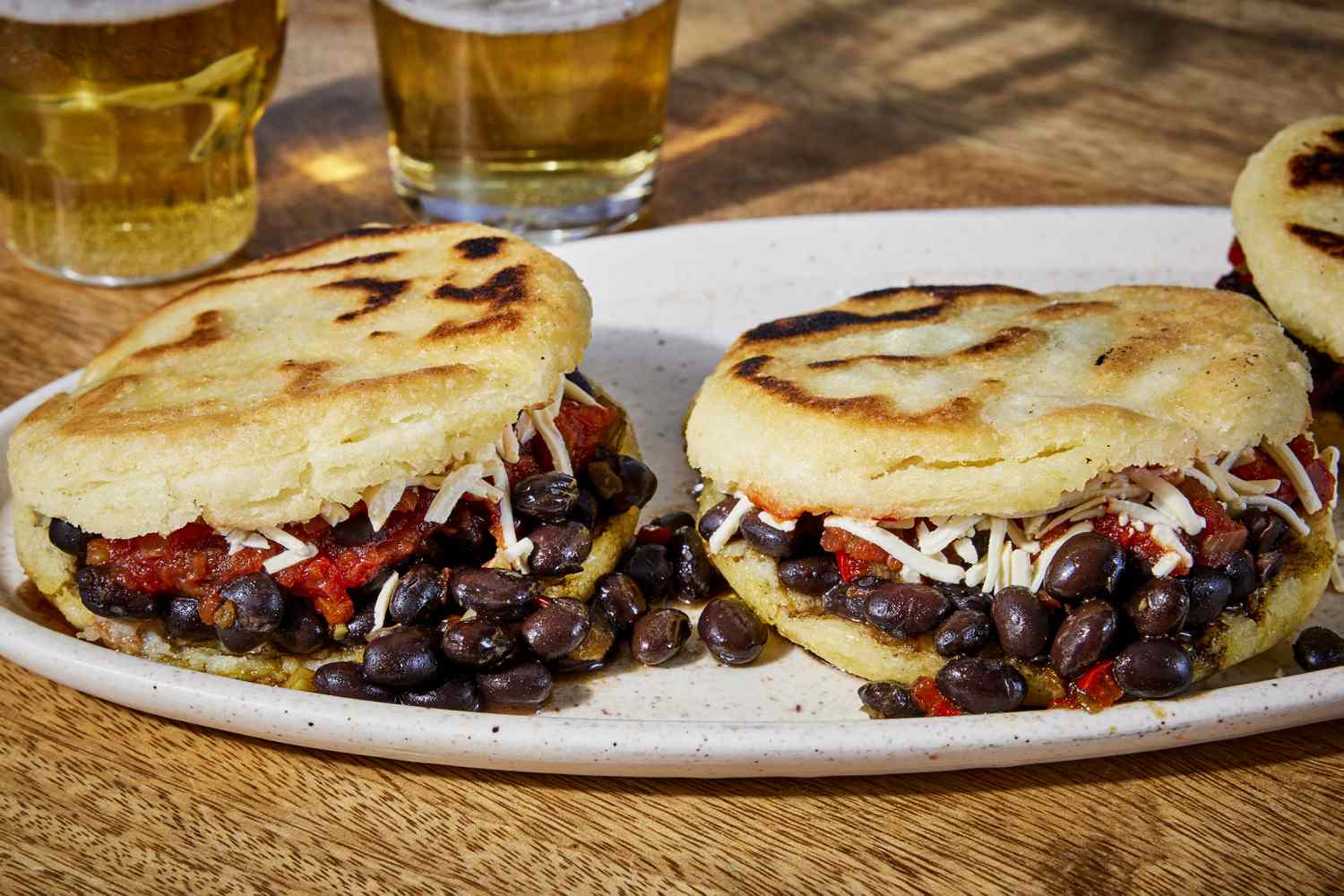
Venezuelan arepas are thick (about ¾ inch), split like a pita, and stuffed. The filling is the dish, and the fillings have names: reina pepiada, dominó, pelúa, catira, sifrina. A Venezuelan arepa is a sandwich.
Colombian arepas are thinner (¼ to ½ inch), usually topped or eaten plain alongside a meal rather than stuffed. Regional versions vary hugely — arepa de choclo is sweet and made from fresh corn, arepa de huevo from the coast has a whole egg fried inside, arepa con queso has cheese mixed into the dough.
Past the arepa, the two cuisines separate. Colombian food runs toward hearty highland stews (ajiaco, sancocho) and the enormous composite plates of Antioquia (bandeja paisa). Venezuelan food leans on the coast and the plains — shredded beef, black beans, plantain, and the Christmas hallaca, which is one of the most labor-intensive dishes in the Americas.
Both are inexpensive to cook. As of 2026, a 2-pound bag of masarepa is about $4 and makes roughly 20 arepas. That's twenty cents a serving for the base of most of what follows.
Arepas 101: masarepa, the 3-ingredient dough, and how to cook them
Get the flour right. This is the single failure point. You need masarepa — corn that has been cooked, dried, and ground, sold as P.A.N., Goya Masarepa, or Areparina. You do not want masa harina (nixtamalized with lime, for tortillas and tamales — different flavor, wrong texture) or cornmeal (raw, will not hydrate into a dough). Yellow and white masarepa are interchangeable; white is more common in Venezuela, yellow in Colombia.
The dough. Dissolve salt in warm water first, then rain in the masarepa while stirring. Let it rest 5 minutes — this is not optional, the flour needs time to fully hydrate. Knead 2 minutes. The finished dough should feel like soft Play-Doh: if it cracks at the edges when you flatten a ball, add water a tablespoon at a time; if it sticks to your palms, add masarepa.
Shaping. Roll into a ball, then press between your palms, rotating and smoothing the edge with a fingertip as you go. Cracked edges mean dry dough. Venezuelan: ¾ inch thick, 4 inches across. Colombian: ¼–½ inch, 4–5 inches across.
Cooking, three methods:
| Method | Temp/time | Result |
|---|---|---|
| Griddle or skillet | Medium, 6–7 min per side | Crisp shell, soft interior — the default |
| Griddle then oven | 5 min/side, then 400°F for 10 min | Puffed, hollow, best for stuffing |
| Deep fry | 350°F, 4–5 min | Colombian coastal style; crisp all through |
The griddle-then-oven method is what gets you a true separation between shell and crumb, and it's what makes Venezuelan stuffed arepas work — the interior steam-puffs and pulls away from the crust, leaving a natural pocket.
Start with Venezuelan Cornmeal Arepas with Avocado and Fresh Cheese Filling or Pan-Fried Arepas with Black Beans and Queso.
Venezuelan arepa fillings: reina pepiada and the named ones
Venezuelan arepa fillings are a catalog with real names, and knowing four of them covers most menus:
Reina pepiada — shredded chicken, mashed avocado, mayonnaise, lime, cilantro. Invented in 1955 at a Caracas arepera and named for a Miss World winner. It's the most famous one and the best entry point: Venezuelan Reina Pepiada Chicken Salad Sandwich.
Dominó — black beans and grated white cheese. Named for the color contrast. Cheap, vegetarian, excellent.
Pelúa — shredded beef (carne mechada) and grated yellow cheese. "Hairy," for the shredded beef.
Catira — shredded chicken and yellow cheese.
Sifrina — reina pepiada plus yellow cheese. "Posh."
For shredded-beef versions: Pan-Fried Arepas with Shredded Beef and Avocado Salsa, Pan-Fried Arepas with Shredded Beef and Black Beans, Arepa Cornmeal Cakes with Shredded Beef and Avocado Salsa, and the grilled version with Venezuela's avocado-herb sauce, Grilled Arepas Stuffed with Slow-Cooked Shredded Beef and Guasacaca.
Guasacaca deserves its own note: avocado, bell pepper, onion, cilantro, parsley, vinegar, and oil, blended into a loose green sauce. It is not guacamole — the vinegar and the herbs push it somewhere closer to a chimichurri with avocado in it, and it goes on everything grilled.
Colombian arepas: choclo, con queso, and de huevo
Arepa de choclo is made from fresh sweet corn rather than masarepa, blended into a batter with a little flour and sugar, griddled, and served folded around a slab of melting cheese. It's sweet, tender, and closer to a corn pancake than to a Venezuelan arepa. See Cachapa Corn Pancakes with Fresh Cheese and Butter — the Venezuelan cachapa is essentially the same idea, and the two are cousins.
Arepa con queso mixes grated cheese directly into the masarepa dough, so the whole thing is savory and browns harder in the pan. This is the Colombian breakfast arepa, eaten with hot chocolate. Cheese-Stuffed Colombian Arepas with Butter is the closest in the catalog.
Arepa de huevo is a coastal (Barranquilla, Cartagena) specialty: fry a thin arepa until it puffs, cut a slit, slip a raw egg inside, and fry again to set. It is a genuinely tricky technique and completely worth learning if you like a project.
For a breakfast plate: Arepa Breakfast Bowl with Scrambled Eggs and Avocado deconstructs the idea, and Plantain and Cheese Arepa with Avocado Crema leans on plantain, the other staple both countries share.
This guide is weighted toward arepas and the Venezuelan table. For the rest of Colombia's regional cooking — aborrajados, arequipe, buñuelos, and natilla — see 20 Colombian Recipes: Arepas, Bandeja Paisa, Sancocho & Ajiaco.
Bandeja paisa: the plate that eats a whole day
Bandeja paisa is the national plate of Antioquia and it is enormous — a platter, not a plate, carrying red beans, white rice, ground or shredded beef, chorizo, chicharrón, a fried egg, fried sweet plantain, an arepa, avocado, and often a hogao (tomato-onion sauce) on top. It was farmworker food, designed to fuel a full day in the coffee mountains.
You don't cook a bandeja paisa as one recipe; you assemble it from five or six components, most of which you already have if you cook Colombian regularly. Build it from:
- Red beans — One-Pot Colombian Black Bean Stew with Smoked Pork is the closest catalog analogue; make it with red kidney beans and add a chopped plantain to the pot, which is the Antioquian trick that gives the beans body.
- Beef — Slow-Braised Colombian-Style Beef with Aji Sauce
- Chicharrón — Slow-Cooked Pork Chicharrón with Garlic and Citrus; the Puerto Rican Pan-Fried Mofongo with Garlic and Chicharrón shows the same fried pork belly in a different context.
- Plantain — Tostones with Garlic-Lime Mojo Sauce for green, or fry ripe plantain (maduro) for the sweet side.
- Arepa, rice, fried egg, avocado — assembly.
Realistically: make the beans and the chicharrón on Sunday, and the bandeja assembles in 20 minutes on a weeknight when you want it.
Empanadas: Colombian yellow-corn vs Venezuelan wheat
This is a real and consistent difference, not a regional blur.
Colombian empanadas use a masarepa-based yellow corn dough, are filled with seasoned beef or pork and potato, and are deep-fried. The corn shell fries into something shatteringly crisp and slightly gritty in a good way, and they're served with ají picante. See Pan-Fried Colombian Empanadas with Spiced Beef Filling.
Venezuelan empanadas also use masarepa dough but are typically larger, often filled with cheese, shredded beef, or fish, and eaten as a breakfast street food. Spiced Venezuelan Chicken Empanadas with Aji Sauce covers the style.
Both are shaped by pressing the dough between two sheets of plastic (a cut-open zip bag works), placing filling on one half, and folding the plastic over to seal — corn dough tears if you handle it directly.
Hallacas and tamales: the holiday masterpiece
Hallacas are the Venezuelan Christmas dish and they are a full-family, full-weekend production. A cooked corn dough colored with annatto oil is spread on banana leaves, topped with a guiso of beef, pork, and chicken that has been stewed for hours, then studded with olives, capers, raisins, almonds, and strips of pepper and onion. Each one is folded, tied with string, and boiled.
The counts are real: a Venezuelan family making hallacas produces 50 to 100 in a day, with different people assigned to dough, guiso, adornments, folding, and tying. It is a social institution more than a recipe.
The home-scale approach: make the guiso a day ahead (it's better anyway), buy banana leaves frozen at a Latin or Asian market, and accept that your first batch of ten will take four hours. See Chicken Hallacas Wrapped in Banana Leaves.
The raisins-and-olives combination is the part Americans push back on. Don't remove it. That sweet-briny-savory interplay is the entire character of the dish, and a hallaca without it is just a tamale.
Sancocho and ajiaco: the two great soups
Sancocho is the pan-Latin-American three-meat-and-root-vegetable soup, and Colombia has a dozen regional versions — sancocho de gallina (hen), de res (beef), trifásico (three meats), de pescado (fish on the coast). The constant is yuca, plantain, and corn on the cob simmered until the broth turns starchy and thick. See Dominican-Style Sancocho with Root Vegetables for the technique and Arroz con Pollo and Vegetable Soup for a faster weeknight cousin.
Ajiaco is specifically Bogotá: chicken, three varieties of potato (one of which — papa criolla — dissolves and thickens the soup), corn, and guascas, a herb that grows as a weed in the Andes and tastes faintly of artichoke. Guascas is the non-negotiable ingredient; without it the soup is chicken-potato soup. It's sold dried in Latin markets for about $4 a bag. Served with capers, cream, and avocado stirred in at the table. See Bogotá-Style Ajiaco with Guascas.
Other regional stews worth knowing: Pabellón Criollo Beef Stew with Plantains and Rice — Venezuela's national plate of shredded beef, black beans, rice, and fried plantain — and Ecuadorian Fish Encebollado Stew with Yuca.
20 Colombian and Venezuelan recipes from the AislePrompt catalog
Arepas and corn
1. Venezuelan Cornmeal Arepas with Avocado and Fresh Cheese Filling
2. Venezuelan Reina Pepiada Chicken Salad Sandwich
3. Pan-Fried Arepas with Black Beans and Queso
4. Pan-Fried Arepas with Shredded Beef and Avocado Salsa
5. Pan-Fried Arepas with Shredded Beef and Black Beans
6. Arepa Cornmeal Cakes with Shredded Beef and Avocado Salsa
7. Grilled Arepas Stuffed with Slow-Cooked Shredded Beef and Guasacaca
8. Plantain and Cheese Arepa with Avocado Crema
9. Arepa Breakfast Bowl with Scrambled Eggs and Avocado
10. Cachapa Corn Pancakes with Fresh Cheese and Butter
Empanadas and hallacas
11. Pan-Fried Colombian Empanadas with Spiced Beef Filling
12. Spiced Venezuelan Chicken Empanadas with Aji Sauce
13. Chicken Hallacas Wrapped in Banana Leaves
Stews, plates, and sides
14. Bogotá-Style Ajiaco with Guascas
15. Braised Cabbage and Potato with Hogao
16. Pabellón Criollo Beef Stew with Plantains and Rice
17. Slow-Braised Colombian-Style Beef with Aji Sauce
18. One-Pot Colombian Black Bean Stew with Smoked Pork
19. Slow-Cooked Pork Chicharrón with Garlic and Citrus
20. Fried Tequeños with Garlic Cream Dipping Sauce
Plus, two modern Colombian-inspired weeknight dishes — Grilled Colombian-Inspired Citrus Pork Skewers and Sheet Pan Colombian Coffee-Rubbed Chicken Thighs — and neighbours from the wider region that share the same pantry: Dominican-Style Sancocho with Root Vegetables, Tostones with Garlic-Lime Mojo Sauce, the Puerto Rican Pan-Fried Mofongo with Garlic and Chicharrón, Ecuadorian Fish Encebollado Stew with Yuca, Arroz con Pollo and Vegetable Soup, and for dessert Guatemalan Coffee-Infused Tres Leches Cake.
Pantry checklist: masarepa, panela, plantains, ají
| Item | Cost | Keeps | Used in |
|---|---|---|---|
| Masarepa (P.A.N. or Goya), 2 lb | $4 | 1 year | ~20 arepas |
| Guascas, dried, 0.5 oz | $4 | 1 year | Ajiaco only, but essential |
| Panela (unrefined cane sugar), 1 lb | $4 | Indefinite | Aguapanela, sauces |
| Annatto/achiote seed or paste | $4 | 2 years | Hallacas, rice, guiso |
| Green + ripe plantains, 4 | $3 | 1 week | Tostones, maduros |
| Queso fresco or queso blanco, 12 oz | $5 | 2 weeks | Arepas, everything |
| Banana leaves, frozen, 1 lb | $4 | Frozen indefinitely | Hallacas, tamales |
| Yuca, frozen, 2 lb | $4 | Frozen 1 year | Sancocho, frita |
| Ají picante or bottled hot sauce | $5 | 1 year | Table condiment |
About $37, and masarepa at $4 for twenty arepas is the cheapest per-serving staple in this whole article.
Kitchen equipment
A flat griddle or heavy skillet. Arepas want even, moderate heat across a flat surface for 12–14 minutes. A cast-iron griddle or a 12-inch cast-iron skillet is ideal; a Venezuelan budare is the traditional tool and is basically a comal. Browse cookware.
A tostonera or a flat-bottomed glass. Tostones are fried, smashed, and fried again — a $7 tostonera makes uniform smashes, though the bottom of a heavy glass works. See utensils.
A large Dutch oven, 6+ quarts. Sancocho and ajiaco are big-volume soups with whole corn cobs and chunks of yuca; you need the width. Cookware covers it.
A blender. Guasacaca, ají, hogao, and arepa de choclo batter all want one. Nothing exotic — a $40 countertop blender from small appliances is plenty.
Common pitfalls
- Buying masa harina instead of masarepa. The single most common failure. Masa harina is nixtamalized for tortillas and tastes wrong; cornmeal is raw and won't hydrate. Look for "harina de maíz precocida" on the bag.
- Not resting the dough. Five minutes minimum after mixing. Unrested dough cracks when you shape it and stays gritty after cooking.
- Cooking arepas too hot. Medium heat, 6–7 minutes a side. High heat browns the outside before the inside is cooked, and you get a raw, pasty center.
- Skipping guascas in ajiaco. It's $4 and it's the defining flavor. Without it you have chicken and potato soup.
- Handling empanada dough directly. Corn dough tears. Press and fold between two sheets of plastic.
- Removing the raisins and olives from hallacas. The sweet-briny contrast is the dish. Leave them in.
- Using unripe plantains for maduros. Maduros need plantains that are black — not yellow, black. Yellow plantains fried sweet are still starchy and disappointing.
When NOT to cook this
Hallacas are not a weeknight dish, a two-person dish, or a first-attempt dish. They're a December, family-assembly-line, 50-at-a-time production. If you want the flavor without the day, make the guiso and serve it over rice.
Bandeja paisa is similar in spirit — it's an assembly of six components, and building all six from scratch for a Tuesday dinner is an unforced error. Batch the beans and the chicharrón on the weekend and it becomes trivially fast, which is exactly how a meal plan should handle it.
Arepas, on the other hand, are genuinely a 20-minute weeknight dinner, and stuffed with whatever's in the fridge they're one of the best fast dinners in any cuisine.
FAQ
What is masarepa and why can't I use masa harina or cornmeal?
Masarepa is corn that has been cooked, dried, and ground — sold as P.A.N., Goya Masarepa, or Areparina, and labeled "harina de maíz precocida." Masa harina is nixtamalized with slaked lime for tortillas and tamales; it has a distinctly different flavor and produces a dense, wrong-textured arepa. Plain cornmeal is raw and will never hydrate into a workable dough at all. A 2-pound bag of masarepa costs about $4 and makes roughly twenty arepas, so there's no reason to substitute.
What's the actual difference between Colombian and Venezuelan arepas?
Venezuelan arepas are thick — about ¾ inch — and split open and stuffed like a pita, with named fillings such as reina pepiada (chicken and avocado), dominó (black beans and white cheese), and pelúa (shredded beef and yellow cheese). Colombian arepas are thinner, from ¼ to ½ inch, and are usually eaten plain alongside a meal or topped rather than stuffed, with strong regional variants like arepa de choclo (sweet fresh corn) and arepa de huevo (egg fried inside). Same flour, two different foods.
Do I really need guascas for ajiaco, or can I skip it?
Guascas is what makes ajiaco ajiaco. It's an Andean herb (Galinsoga parviflora) with a faintly artichoke-and-hay flavor, and without it you have a good chicken-and-potato soup that isn't the dish. Dried guascas costs about $4 for a half-ounce bag at any Latin market or online, and a bag lasts a year of cooking. The other near-essential is papa criolla — small yellow Andean potatoes that dissolve and thicken the broth; frozen ones work fine.
How far ahead can I make arepa dough, and do cooked arepas keep?
The dough keeps about 24 hours refrigerated, tightly covered, though it stiffens and usually needs a tablespoon or two of water kneaded back in. Cooked arepas are best within an hour but keep three days refrigerated and reheat well in a dry skillet for two minutes a side, or in a 350°F oven for eight minutes. Don't microwave them — they turn rubbery. You can also freeze cooked arepas for two months and reheat from frozen in the oven.
Are hallacas worth making at home, or should I just make tamales?
They're worth making once, ideally with help. Hallacas differ from tamales in three ways: the dough is colored and flavored with annatto oil, the filling is a slow-cooked three-meat guiso rather than a simple shredded meat, and each one is studded with olives, capers, raisins, and almonds before being wrapped in banana leaves and boiled. That sweet-briny-savory adornment is the entire point. Plan four hours for a first batch of ten, make the guiso the day before, and buy the banana leaves frozen.
Sources
- Wikipedia — Arepa on masarepa (harina precocida), why it is not nixtamalized, and where precooked arepa flour came from.
- My Colombian Recipes on bandeja paisa components, ajiaco, and regional arepa variants.
- Wikipedia — Sancocho on the soup's regional varieties.
- Wikipedia — Hallaca on hallaca fillings (raisins, capers, olives), the plantain-leaf wrap, and its place on the Venezuelan Christmas table.
Related reading: 20 Colombian recipes, 20 Peruvian recipes, 18 Puerto Rican recipes, 18 Cuban recipes, and 18 Brazilian recipes.
Arepas and hallacas sit inside a much wider regional map. 22 Latin American Dinners covers the countries this guide does not, from Ecuador and Chile through Bolivia, Paraguay and Uruguay.
Frequently asked questions
What is masarepa and why can't I use masa harina or cornmeal?
What's the actual difference between Colombian and Venezuelan arepas?
Do I really need guascas for ajiaco, or can I skip it?
How far ahead can I make arepa dough, and do cooked arepas keep?
Are hallacas worth making at home, or should I just make tamales?
Sources
Cook Colombian at home this week.
Ask our AI for a week of Colombian dinners — it writes the recipes, builds the shopping list, and sends the cart to Instacart. No account needed.
Plan my Colombian week →