20 Best Whiskey Cocktails for Home Bartenders: Bourbon, Rye, and Scotch
The 20 drinks — five foundational, five modern, five winter, five long — that cover every whiskey base a home bartender will ever pour.
Affiliate disclosure: AislePrompt may earn a commission on qualifying purchases made through Amazon and Instacart links in this article, at no additional cost to you. See our affiliate policy →
Whiskey is the most versatile cocktail base in the American bar — bourbon carries sweet, spiced, and citrus builds; rye handles bitter and stirred classics; Scotch anchors smoky and warm drinks. The 20 recipes below cover the foundational canon (Old Fashioned, Manhattan, Whiskey Sour), the modern craft-bar wins (Penicillin, Paper Plane, Gold Rush), the winter warmers, and the all-summer tall drinks — everything a home bartender needs to work through a bottle without repeating themselves.
What you'll use with it
A quarter-ounce error in a 2-ounce drink is a 12% change. The bar tools guide picks the Boston shaker, jigger and Hawthorne strainer these recipes call for, and explains why the three-piece cobbler seizes when cold. Read the bar tools guide →
Bar tools guide’s top pick: A Bar Above Professional Boston Shakers $26.00 at Amazon, Check price on Amazon →Bar tools guide’s Best Value Set pick: HomeCurated 24-Piece Bartender Kit $25.97 at Amazon, Check price on Amazon →Bar tools guide’s Best Jigger pick: Barfly Japanese Style Jigger, 1 oz × 2 oz $11.55 at Amazon, Check price on Amazon →
Bourbon vs rye vs Scotch — how each behaves in a mix
Bourbon must be at least 51% corn, and that corn character is what makes it round, softly sweet, and forgiving in a stirred drink. Reach for bourbon when the cocktail leans on citrus, honey, maple, stone fruit, or vermouth-and-sugar builds. It's what you want in an Old Fashioned, a Whiskey Sour, a Boulevardier, and any smash.
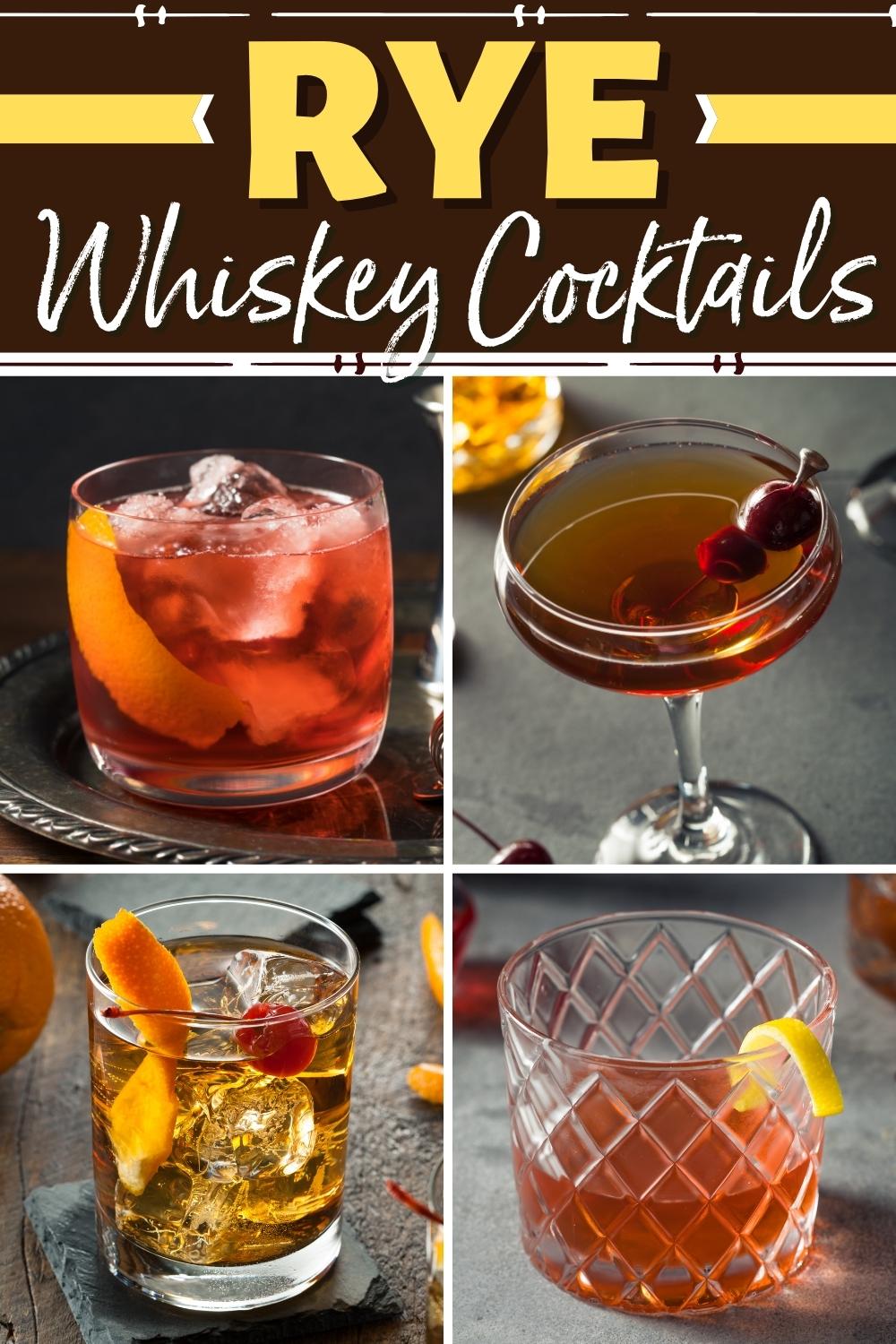
Rye must be at least 51% rye grain, which reads as pepper, dry spice, and a sharper finish. Rye is the classic Manhattan pour because sweet vermouth needs a dry counterweight; it's also non-negotiable in a Sazerac and welcome in any drink that already carries herbal or bitter modifiers (Vieux Carré, Brooklyn, Old Pal). If a stirred cocktail is tasting flabby, swap in rye and it will snap into focus.
Scotch is single or blended, and the smoky peated variants (Islay, Highland Park) live in a specific corner of the cocktail world. Blended Scotch drives the Rusty Nail, Blood and Sand, and the Rob Roy. Peated Scotch does its best work in tiny amounts — a 1/4-ounce float on a Penicillin or a rinse in a Bobby Burns. Save the 18-year bottles for neat pours; a $30 blend does everything you need behind a bar.
As of 2026, the best mixing whiskeys in the $25–$40 range are Buffalo Trace, Wild Turkey 101, Old Grand-Dad Bonded, Rittenhouse Rye Bottled-in-Bond, and Famous Grouse for blended Scotch. Bottled-in-Bond bourbons and ryes (100 proof, one distillery, one season) are the workhorse category — you get enough alcohol to survive dilution and enough character to carry a stirred drink. The label rule behind that pick is summarized in Wikipedia's bottled-in-bond entry: one distiller, one distilling season, at least four years in a bonded warehouse, bottled at 100 proof.
5 Foundational whiskey cocktails to learn first
If you can make five drinks well, you can make almost anything. These are the five. Learn the ratios cold, then everything else is a variation.
1. Old Fashioned. 2 oz bourbon or rye, 1 sugar cube (or 1 teaspoon rich syrup), 3 dashes Angostura bitters, orange peel expressed over the top. Stir with one large 2-inch cube. This is the drink that teaches you every fundamental — dilution, sweetener, bitters, expressed oil garnish — in about 40 seconds. If your Old Fashioned tastes hot or flat, you're stirring too briefly; the rule is roughly 30 seconds with cracked ice or 45 with a big cube.
2. Manhattan. 2 oz rye, 1 oz sweet vermouth, 2 dashes Angostura bitters, brandied cherry. Stir 30 seconds, strain into a chilled coupe. This is a cocktail where the vermouth quality matters more than the whiskey quality — a $9 bottle of Cinzano Rosso will out-perform a $50 vermouth left open on the counter for six months. Vermouth is a fortified wine; refrigerate after opening and it's done in 4–6 weeks. See our Storage & Containers picks for airtight vermouth bottles that actually work.
3. Whiskey Sour. 2 oz bourbon, 3/4 oz fresh lemon juice, 3/4 oz simple syrup, 1/2 oz egg white (optional), 2 dashes Angostura on the foam. Dry-shake, wet-shake, double-strain. Fresh lemon juice is non-negotiable — bottled lemon juice smells like cough syrup and tastes like it too. If you're squeezing three lemons for a round, use a proper hand press and strain out the pulp; the sour needs to be bright and clear, not cloudy.
4. Boulevardier. 1 1/2 oz bourbon, 1 oz Campari, 1 oz sweet vermouth, orange peel. Stir over one large cube in a rocks glass. Think of this as an Old Fashioned's grown-up cousin: bitter, softly sweet, and structured like a Negroni but with bourbon's roundness instead of gin's brightness. Rye is a legitimate swap if you want the Campari to sit even further forward.
5. Mint Julep. 2 1/2 oz bourbon, 1/2 oz rich simple syrup, 8–10 mint leaves, filled with crushed ice. Gently press the mint against the glass (do not pulverize it — you want the oil, not the chlorophyll), add ice in stages while stirring so the whole exterior of the metal cup frosts. Derby Day is peak season, but this is a great all-summer porch drink and a good introduction to crushed-ice technique. See Bon Appétit's whiskey cocktail gallery for their variations.
5 Modern whiskey cocktails from the current craft scene
The last 20 years produced a small but durable set of new whiskey classics. These aren't obscure — they show up on cocktail menus everywhere as of 2026 — but they extend the canon in real ways.
6. Penicillin. Sam Ross invented this at Milk & Honey in New York in 2005 and it is now on every serious cocktail menu. 2 oz blended Scotch, 3/4 oz lemon juice, 3/4 oz honey-ginger syrup, 1/4 oz peated Scotch floated on top. The peated float is the point — it puts smoke in your nose while the palate stays bright and warm. Ginger syrup is honey syrup infused with a knob of fresh ginger; make it hot and let it cool covered.
7. Sazerac. The New Orleans classic and the oldest continuously-mixed cocktail in the U.S. — served since 1838. Rinse a chilled rocks glass with absinthe (spray, swirl, dump), stir 2 oz rye, 1/4 oz rich simple syrup, 3 dashes Peychaud's, and 1 dash Angostura, strain in, express a lemon peel and drop it out. No garnish stays in the glass. See our Citrus-Spiced Creole Sazerac for the exact ratios we use.
8. Gold Rush. The Whiskey Sour with honey syrup instead of simple. 2 oz bourbon, 3/4 oz lemon juice, 3/4 oz honey syrup (2:1 honey to hot water). This drink is what taught a generation of bartenders that honey belongs in cocktails; it is unfussy, dead-easy, and disproportionately delicious.
9. Paper Plane. Sam Ross again, 2008. Equal parts (3/4 oz each) bourbon, Aperol, Amaro Nonino, and fresh lemon juice. Shake, strain up. Any equal-parts cocktail is a good first cocktail to memorize; the Paper Plane is the modern Last Word, and the mid-bitter Aperol/Nonino spine makes it read as balanced without being sweet.
10. New York Sour. A Whiskey Sour with a red-wine float. 2 oz bourbon, 3/4 oz lemon juice, 3/4 oz simple syrup, dry-shake with egg white, strain over ice, then gently pour 1/2 oz of dry red wine down the back of a bar spoon so it lays on top. The wine hits your palate first, then the whiskey underneath — it's a party trick that also tastes great.
5 Warm and stirred whiskey cocktails for winter
The best cold-weather cocktails read as small food: sweet, spiced, and warming, engineered for slow-sipping. These four hot drinks and one stirred stunner are the whole holiday-bar rotation.
11. Hot Toddy. 2 oz bourbon or rye, 3/4 oz honey, 3/4 oz lemon juice, hot water to fill, clove-studded lemon wheel. The mistake most people make is using boiling water — you want it at 175 °F so the whiskey's volatile aromas stay in the glass instead of evaporating in your face. This is the drink you make when someone has a cold; a real toddy actually helps.
12. Irish Coffee. 1 1/2 oz Irish whiskey, 1 teaspoon brown sugar, hot black coffee to fill, hand-whipped cream floated on top. This is not a Baileys drink. The cream must be whipped just to the point of soft peaks — thicker than pouring cream, thinner than dessert cream — so it slides off the back of a spoon in one soft mound. If your cream sinks, it's under-whipped; if it stands up, it's over-whipped.
13. Smoked Old Fashioned. Same build as a regular Old Fashioned — 2 oz bourbon, 1/4 oz maple syrup, 3 dashes Angostura, orange peel — but you pre-smoke the glass with hickory or cherry-wood chips using a $25 smoking gun, then pour. The smoke sits on the top note; it doesn't taste like ashtray, it tastes like the drink was made in front of a wood fire.
14. Vieux Carré. New Orleans, 1938, the drink Walter Bergeron designed for the Hotel Monteleone bar. 1 oz rye, 1 oz cognac, 1 oz sweet vermouth, 1 teaspoon Bénédictine, 2 dashes Peychaud's, 2 dashes Angostura. Stir, strain into a rocks glass over one cube. This is a genuinely great cocktail that most people never make because it looks like six bottles on the counter. It's worth every one.
15. Blood and Sand. Named after the 1922 Rudolph Valentino film. Equal parts (3/4 oz each) blended Scotch, cherry Heering, sweet vermouth, and fresh orange juice. Shake, strain up. This is one of the very few cocktails where a lot of orange juice actually works with Scotch — the sweet vermouth and cherry brandy build a bridge between them.
5 Long/tall whiskey drinks with soda, ginger, and citrus
Long drinks are what you make when you want a highball to last through a whole evening, or when someone at your bar doesn't want an aggressively boozy cocktail. These carry all the flavor of the whiskey but stretch it over 12 ounces.
16. Whiskey Highball. 2 oz Japanese whisky (or a mellow bourbon), 6 oz cold soda water, one big ice spear or several very cold cubes. The Japanese take highballs seriously; a Highball Bar in Tokyo uses purpose-frozen minus-20 °C ice and freshly-carbonated water so the drink stays crisp for 30 minutes. You don't need the theatrics — just make sure your soda is fresh and your ice is dry.
17. Whiskey Ginger. 2 oz bourbon, 4 oz cold ginger beer (not ginger ale — you want the heat), lime wedge squeezed and dropped in. This is the drink you serve when you don't have time to build cocktails one by one. Fever Tree or Cock 'n Bull make good bottled ginger beer; homemade ginger syrup topped with soda is even better.
18. Kentucky Mule. 2 oz bourbon, 1/2 oz fresh lime juice, 4 oz ginger beer, mint sprig, served in the copper mug. This is a Moscow Mule with bourbon — the copper is not decorative, it actually keeps the drink cold and reads bitter to the lip, which sharpens the ginger and lime. If you don't have copper mugs, a highball glass is fine; the drink is still great.
19. Bourbon Peach Smash. 2 oz bourbon, 1 ripe peach quarter, 1/2 oz simple syrup, 1/2 oz lemon juice, 5 mint leaves, muddled and shaken. Peaches and bourbon are the Kentucky-summer flavor combination. Use a good muddler — the wooden cocktail muddler options in Utensils & Tools get the fruit crushed without turning the mint bitter. Shake with plenty of ice, dump the whole thing into a rocks glass unstrained.
20. Whiskey & Soda with a citrus twist. 2 oz whiskey of choice, 4 oz club soda, a wide grapefruit peel expressed and dropped in. This is the drink you order at a hotel bar when everything on the menu is $22. Grapefruit and bourbon are quietly one of the best pairings in the whole spirits world.
Choosing an everyday bottle for mixing (not sipping)
Buy separate bottles for sipping and mixing. Neat pours reward age, single-barrel selection, and cask strength; cocktails reward proof and character in that order. Below is what to keep on the shelf as of 2026:
| Style | Everyday mixer ($25–40) | Upgrade ($45–65) | Notes |
|---|---|---|---|
| Bourbon | Buffalo Trace, Wild Turkey 101 | Four Roses Small Batch, Elijah Craig Small Batch | Bottled-in-Bond gives you body and proof |
| Rye | Old Overholt Bonded, Rittenhouse Bonded | Sazerac Rye, Michter's Rye | 100 proof rye is a stirred-drink cheat code |
| Blended Scotch | Famous Grouse, Monkey Shoulder | Compass Box Great King Street | Monkey Shoulder was built for cocktails |
| Peated Scotch (float only) | Laphroaig 10 | Ardbeg 10 | Use a 1/4 oz float, not a full pour |
| Japanese whisky | Suntory Toki | Nikka Coffey Grain | Toki is the highball benchmark |
| Irish | Jameson, Powers | Redbreast 12 | Powers is the pot-still choice for Irish Coffee |
Do not spend $60 on a single-barrel bourbon for cocktails. The ice, sugar, and bitters erase the exact nuance you paid for; a $28 Buffalo Trace makes an Old Fashioned that beats a $95 Blanton's every time. Save the good stuff for neat pours. Wikipedia's bourbon whiskey entry covers the legal definition, mash bills, and the major distilleries if you want to go deeper.
The bar tool checklist
You need eight tools to make every drink in this article, and every drink you'll ever want to make after. Buy them once and they last decades.
1. Jigger. A 1 oz / 2 oz Japanese-style jigger with 1/4 oz gradations. Free-pouring at home is fine for beer; for cocktails, measure. An OXO steel double jigger runs $10.
2. Boston shaker set. An 18 oz weighted tin and an 18 oz mixing tin — no glass. Glass shakers break; two-piece tins seal reliably and open with a slap.
3. Mixing glass. A pint glass works, but a real 500 ml crystal mixing glass with a spout is the biggest quality-of-life upgrade in the whole kit. $25.
4. Hawthorne strainer. Fits your shaking tin, has a coiled spring that catches ice chips. Get one with a tight spring — cheap ones let too much through.
5. Julep strainer. Fits your mixing glass, for stirred drinks. $8. Don't skip it and try to use the Hawthorne — it doesn't seat properly.
6. Long bar spoon. 12 inches, twisted handle. You stir cocktails, you don't shake stirred cocktails. Buy the cheap one.
7. Wooden muddler. For herbs and fruit. Do not buy a metal spiked muddler — those are for bar theatrics and they shred everything.
8. Fine-mesh strainer. Small kitchen strainer for double-straining shaken egg-white or fruit cocktails.
The full set is $80–$120 and it will outlast every other kitchen thing you own. Our full Bar & Coffee tools catalog has current picks with images and reviews. If you're expanding into knife work for garnishes — supremes, wide peels — the Knives & Cutting section has good paring-knife picks under $30.
Real-world numbers
Whiskey cocktail math is worth learning once. Below are the standard dilution curves and pour targets you'll want to internalize.
| Technique | Dilution added | Final volume | Final ABV | Serve temp |
|---|---|---|---|---|
| Stirred (2 oz whiskey, 40 s over big cube) | ~25% | ~2.5 oz | ~32% | 27–32 °F |
| Stirred (2 oz whiskey, 20 s over cracked) | ~30% | ~2.6 oz | ~30% | 25–30 °F |
| Shaken (2 oz + citrus, 12 s hard shake) | ~35% | ~3.4 oz | ~19% | 21–26 °F |
| Highball (2 oz + 6 oz soda) | soda drives | ~8 oz | ~10% | 32–35 °F |
| Hot toddy (2 oz + 4 oz water at 175 °F) | water drives | ~6 oz | ~13% | 155 °F sip |
If your stirred drinks come out weak or watery, either (a) your ice is too small, (b) your ice is too warm out of the freezer, or (c) you're stirring past the point of maximum dilution. The safe rule: stir until the outside of the mixing glass is frosted and cold to the fingertip, then strain.
Common pitfalls
Five specific mistakes home bartenders make and how to fix them:
- Wet, warm ice. Freezer-fresh ice has a layer of water on it that dilutes drinks faster than it should. Pour ice into a strainer, shake it dry, and let it sit 10 seconds before it hits the shaker.
- Bottled citrus. Bottled lemon and lime juice tastes stale, tinny, and often oxidized. Squeeze fresh, strain out the pulp, use it within 24 hours. If you're making cocktails for a party, juice the citrus that morning, not the night before.
- Wrong bitters ratio. Angostura is 45% ABV — three dashes is not decorative, it's a real ingredient. If you dash one drop, the drink will taste one-note; if you dash six drops, the drink will taste like a savory soup. Three is the number.
- Egg-white cocktails without a dry shake. For a sour with foam, shake once without ice for 15 seconds (dry shake), then again with ice for 12 seconds (wet shake). Skipping the dry shake gets you a thin, sad foam that dies in a minute.
- Over-diluted stirred drinks. If your Manhattan or Old Fashioned tastes watery, you stirred for too long. Practice hitting 30 seconds and 45 seconds by feel — buy a timer, do 10 practice stirs, and calibrate.
Sources & Last Verified
Last verified for 2026: bottle recommendations reviewed against current retail pricing and availability in May 2026; cocktail ratios follow published specs where available. Cross-reference reading:
- Wikipedia — Bottled in bond — the 1897 Bottled-in-Bond Act's rules for the 100-proof workhorse bottles recommended above.
- Bon Appétit — whiskey cocktail recipe gallery — good modern angles and seasonal builds.
- Wikipedia — Bourbon whiskey — legal definition, mash bills, and major producers.
For more whiskey specifically: 18 Whiskey Cocktails Beyond Bourbon goes deeper on rye, Scotch, and Irish builds, and 25 Fall Cocktails collects the maple and smoked Old Fashioneds, rye Manhattans, bourbon sours, hot toddies, and punches that make this the best whiskey season of the year.
For more cocktail territory: 18 Classic Cocktails Every Home Bartender Should Know covers the full canon beyond whiskey, and 20 Easy Mocktail Recipes has the zero-proof playbook for the same tool kit.