22 Greek Recipes: Moussaka, Souvlaki, Spanakopita & Classics
Four pantry items decide whether Greek food tastes Greek — here is the full repertoire built on them, from meze to baklava.
Authentic Greek cooking at home comes down to four ingredients used with confidence: good olive oil, lemons by the bag, dried Greek oregano, and full-fat sheep's-milk yogurt. Get those right and moussaka, souvlaki, spanakopita, and every meze on the table taste like Greece rather than like a generic Mediterranean approximation. Here are 22 recipes, organized the way a Greek table is actually built.
Get a free week of easy dinners
Seven weeknight dinners with the shopping list already totalled, sent Sunday. No account needed, unsubscribe in one click.
No spam, unsubscribe in one click. Recipes, shopping lists and Instacart carts all work without an account either way.
The flavor pillars: olive oil, lemon, herbs, yogurt
Greek food is not shy about fat or acid, and that's the whole point. A Greek cook uses olive oil as an ingredient, not a lubricant — half a cup in a pan of roast potatoes is normal, not excessive, because the oil emulsifies with lemon juice and starch into a sauce. Lemon goes in at the end, off heat, so the brightness survives.
The herb that separates Greek from Italian cooking is rigani — Greek oregano, dried on the stem, dramatically more pungent than the Italian variety in a supermarket jar. If your Greek food tastes flat, this is usually why. Buy it from a Greek or Middle Eastern grocer where it's sold in a bunch, not a shaker.
Yogurt is the fourth pillar. Strained sheep's or goat's-milk yogurt is thick enough to stand a spoon in, and that thickness is functional: it clings to meat in a marinade and it doesn't weep in tzatziki. The Mediterranean eating pattern that gets all the clinical attention is essentially this pantry, and Greek cooking is one of its oldest continuous expressions — the Oldways Mediterranean tradition documents the regional variations in detail.
The Greek pantry: what to stock, what to swap
| Item | What to buy | US price (2026) | Acceptable swap |
|---|---|---|---|
| Olive oil | Greek extra-virgin, tin not bottle | $18–28 / 1 L | Any single-origin EVOO |
| Oregano | Greek rigani on the stem | $4–7 / bunch | Turkish oregano; not Italian |
| Feta | Sheep's milk, packed in brine | $8–12 / lb | Bulgarian sirene; not pre-crumbled |
| Kalamata olives | Whole, in brine, pits in | $6–9 / lb | Any brined black olive |
| Phyllo | Frozen, #4 thickness | $5–7 / lb | None — don't substitute puff pastry |
| Greek yogurt | Full-fat, strained | $5–7 / 32 oz | Strain regular yogurt overnight |
| Orzo (kritharaki) | Any brand | $2–3 / lb | Small pasta shapes |
| Dried beans | Gigantes or cannellini | $3–5 / lb | Canned white beans |
Two swaps that are not acceptable: pre-crumbled feta (it's dried and salted to survive the package, and it will not melt or soften correctly), and puff pastry for phyllo (completely different structure — phyllo shatters, puff pastry inflates).
The iconic mains
These four are the dishes that define a Greek dinner table. Three of them are weekend projects; one is a Tuesday.
The Best Greek Moussaka is the flagship — layered eggplant, spiced lamb or beef, and a béchamel that sets into a custard. Budget 2.5 hours, most of it unattended. The single technique that separates good moussaka from soggy moussaka is salting the eggplant slices for 30 minutes and patting them completely dry before roasting.
Baked Pastitsio with Ground Beef and Béchamel is moussaka's pasta sibling — tubular pasta standing on end, cinnamon-scented meat sauce, the same béchamel cap. It's the more forgiving of the two because pasta doesn't release water the way eggplant does. Start here if you've never made either.
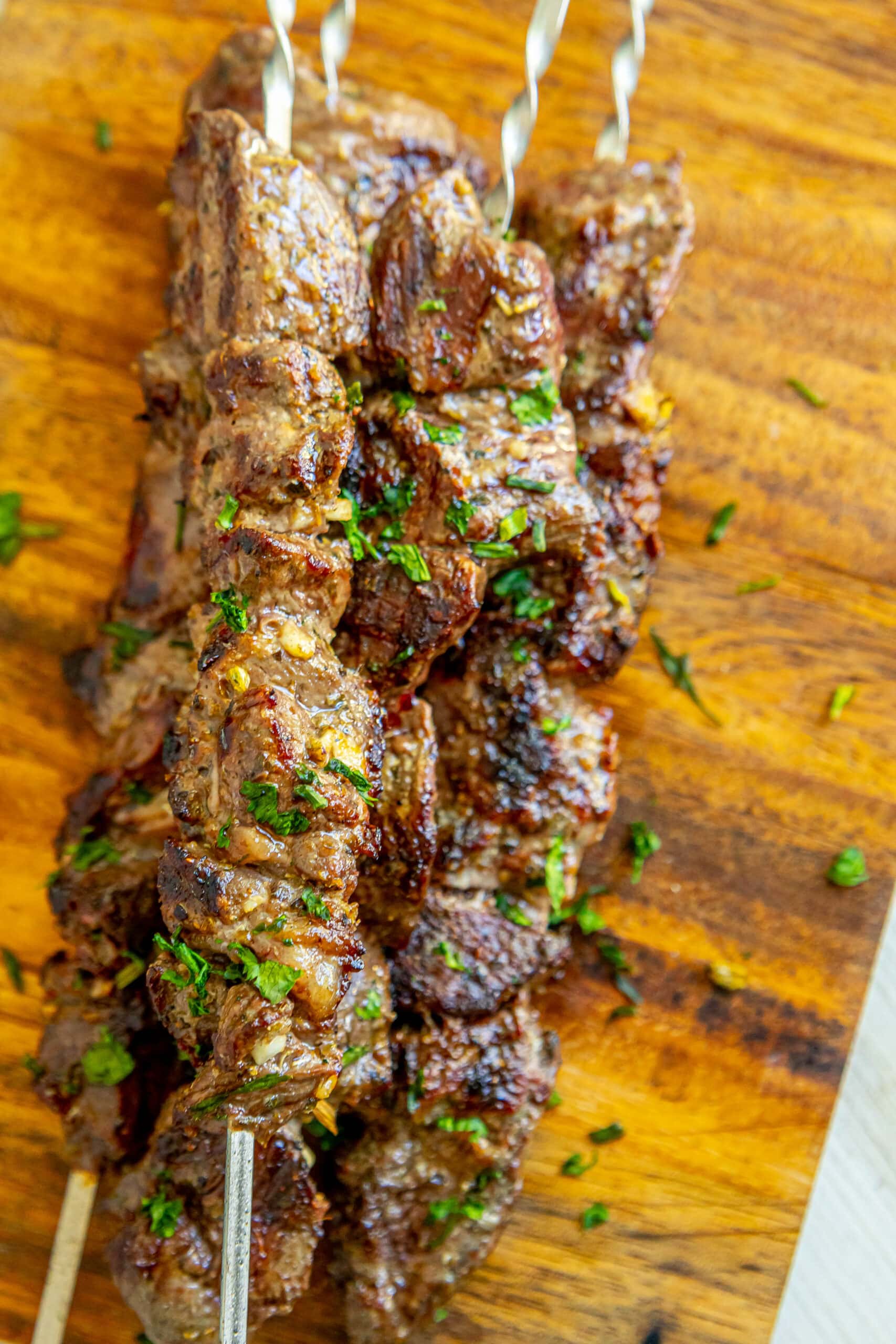
Grilled Lamb Souvlaki with Lemon and Oregano is the weeknight one. Cubed meat, lemon-oregano-oil marinade, 8 minutes over high heat. For a poultry version, Authentic Greek Lemon-Oregano Chicken Skewers uses the same marinade and cooks even faster. Vegetarians get Grilled Vegetable Souvlaki with Tzatziki Sauce, which is a real dish in Greece, not a concession.
Greek Lemon-Herb Roasted Chicken with Vegetables is the Sunday one-pan: chicken over potatoes, the whole thing swimming in lemon, oil, and oregano until the potatoes go creamy underneath and crisp on top.
For the wrap format, Chicken Gyro Wraps with Tzatziki and Pickled Onions gets you 90% of a street gyro without a vertical rotisserie.
Meze — the small plates
A Greek meal is often only meze: six or eight small plates, bread, and a couple of hours. This is the most transferable part of the cuisine for home cooks, because nothing needs to be hot at the same time.
- Authentic Yiayia's Cucumber & Herb Tzatziki Dip — grate the cucumber, salt it, and squeeze it dry in a towel. Skipping that step is why home tzatziki turns into a puddle in an hour.
- Authentic Greek Spanakopita with Phyllo — spinach and feta between shattering phyllo layers. Brush every sheet with oil or butter; a dry sheet won't separate.
- Authentic Mediterranean Spanakopita — a slightly simpler tray version if you're feeding a crowd.
- Mediterranean Dolmades with Lemon and Fresh Herbs — stuffed grape leaves, the meze that takes the longest and disappears the fastest.
- Vegetarian Greek Mezze Plate with Dolmades and Feta — the assembly shortcut when you want the format without four hours of cooking.
Meze math: plan 5–6 plates for four people, of which two should be no-cook (olives, feta with oil and oregano, bread). That ratio keeps the session under an hour of active work.
Grains, potatoes, and salads
Greek-Style Lemon Potatoes with Garlic and Oregano is the side that converts skeptics. Potatoes braise in a shallow bath of lemon juice, olive oil, and stock until the liquid reduces to a glaze. The ratio that matters: roughly 1/2 cup lemon juice and 1/2 cup oil per 2 lb of potatoes, cooked uncovered at 400°F for 60 minutes.
Chopped Mediterranean Greek Salad with Feta and Kalamata Olives — the horiatiki, or "village salad." Note what's not in it: lettuce. A real horiatiki is tomato, cucumber, onion, pepper, olives, and a slab of feta on top, dressed with oil and oregano only. No vinegar, no lettuce, no exceptions worth making.
One-Pot Lemon Herb Chicken & Orzo — orzo (kritharaki) cooked risotto-style in the chicken's own liquid. This is the highest-frequency weeknight dish in this whole roundup.
Soups and one-pots
Authentic Greek Avgolemono Soup with Lemon and Egg is the technique dish. Egg and lemon whisked into hot broth make a soup that's thick and glossy without a drop of cream — but add the hot broth to the eggs too fast and you get scrambled eggs in chicken stock. Temper slowly: a ladle at a time, whisking constantly, for the first three ladles.
Slow-Simmered Greek Fasolada Bean Soup with Carrots and Celery is often called the Greek national dish, and it costs about $4 to feed four. White beans, tomato, carrot, celery, and an aggressive amount of olive oil stirred in at the end.
If you want the fast end of the repertoire specifically, 22 Greek weeknight dinners covers the under-40-minute half in more depth, and 25 Mediterranean weeknight dinners widens it past Greece.
Sweets
Layered Walnut and Almond Baklava with Honey-Cinnamon Syrup — the rule that decides success: one temperature must be cold and the other hot. Either hot baklava gets cold syrup, or cold baklava gets hot syrup. Both hot means soggy; both cold means the syrup sits on top.
A weeknight Greek dinner in under 30 minutes
| Minute | Action |
|---|---|
| 0 | Chicken cubes into lemon-oregano-oil marinade; heat grill pan |
| 5 | Grate and salt cucumber for tzatziki; start orzo |
| 10 | Skewer and grill the chicken, 4 minutes per side |
| 15 | Squeeze cucumber dry; fold into yogurt with garlic, dill, lemon |
| 20 | Chop horiatiki: tomato, cucumber, onion, pepper, olives |
| 25 | Slab of feta on the salad, oil and oregano over everything |
| 30 | Serve |
Total cost for four: roughly $22 at August 2026 US prices, which is about $5.50 a plate.
Common pitfalls
- Italian oregano instead of Greek. The most common single cause of flat-tasting Greek food.
- Not salting the eggplant. Moussaka becomes a water dish.
- Vinegar in horiatiki. It's an oil-and-oregano salad. The tomato provides the acid.
- Boiling the avgolemono after the egg goes in. It curdles instantly. Take the pot off the heat before tempering and never return it to a boil.
- Pre-crumbled feta. Dry, over-salted, and it won't soften into the dish.
- Underdressing. Greek recipes are written with more olive oil than American recipes and cutting it by half changes the texture, not just the calories.
When Greek cooking isn't the right call
Skip moussaka, pastitsio, and phyllo work on a weeknight — all three want 2+ hours and a cooled resting period before they'll slice cleanly. And if you're cooking low-fat, Greek food is a poor fit: the oil is structural in the potatoes, the salads, and the bean soup, and reducing it produces a version that's not just less rich but genuinely worse-textured. Cook something else that night rather than a diminished version of this.
Kitchen tools that make Greek cooking easier
Three tools carry most of the load. A heavy roasting pan or braiser for lemon potatoes and moussaka — thin sheet pans warp and burn the glaze. A box grater for cucumber and kefalotyri. And a sharp chef's knife for the volume of tomato, cucumber, and onion a meze spread demands. If you're building phyllo dishes regularly, a 9x13 metal baking pan conducts better than glass and gives a crisper bottom layer.
Build a Greek dinner party for eight
The best argument for Greek cooking is that it scales without stress — almost everything is served warm or room-temperature, so nothing has to land at the same minute.
| Course | Dish | Make it | Cost for 8 |
|---|---|---|---|
| Meze | Tzatziki + bread | Day before | $6 |
| Meze | Spanakopita, cut small | Day before, reheat 10 min | $11 |
| Meze | Dolmades | Day before | $9 |
| Meze | Feta, olives, oil, oregano | 5 minutes, day of | $12 |
| Main | Moussaka or pastitsio | Day before, reheat 40 min | $24 |
| Main | Souvlaki skewers | Marinate overnight, grill 8 min | $26 |
| Side | Lemon potatoes | Day of, 60 min unattended | $7 |
| Side | Horiatiki | 15 minutes, day of | $10 |
| Sweet | Baklava | Two days ahead — it improves | $9 |
That's roughly $114 for eight people, or $14.25 a head, at August 2026 US grocery prices — less than a single entree at a Greek restaurant. The day-of active work is about 45 minutes because six of the nine dishes were finished earlier.
Two more dishes worth knowing that round the repertoire to a full 22: gigantes plaki (giant white beans baked in tomato and dill, essentially fasolada turned into a casserole), and saganaki — a slab of kefalograviera fried in a small pan until it blisters, finished with lemon at the table. Neither needs a recipe so much as a technique note: gigantes want a full hour uncovered so the tomato reduces onto the beans, and saganaki needs the pan smoking-hot or the cheese leaks oil instead of crusting.
FAQ
What's the difference between Greek and other Mediterranean cooking?
Greek cooking leans harder on lemon, dried oregano, dill, and full-fat sheep's-milk yogurt than Italian or Levantine traditions do. It also uses more open-flame grilling — souvlaki, gyros, whole fish — and more phyllo pastry than its neighbors. Where Italian cooking builds on tomato and cured pork, Greek cooking builds on olive oil and acid, which is why so many dishes finish with lemon off the heat rather than a long simmer.
What are the essential pantry items for Greek cooking?
Greek extra-virgin olive oil bought in a tin, dried Greek oregano on the stem (rigani — the flavor is much stronger than Italian oregano), lemons by the bag, feta packed in brine rather than pre-crumbled, Kalamata olives with pits in, frozen #4 phyllo, orzo, and dried white beans. That list covers roughly 80% of the recipes in this roundup, and every item keeps for months.
How do I make moussaka without it turning into a soggy mess?
Salt the sliced eggplant for 30 minutes and pat it completely dry before roasting — that pulls the bitter water out and lets the vegetable brown instead of steam. Cook each layer separately before assembly, reduce the meat sauce until a spoon leaves a clean track through it, and let the assembled dish rest 30 minutes out of the oven before cutting so the béchamel sets.
Is Greek yogurt the same as regular yogurt for cooking?
No. Greek yogurt is strained to remove whey, which makes it roughly three times thicker and considerably higher in protein per cup. That thickness is functional rather than cosmetic: thin yogurt weeps into a watery puddle in tzatziki within the hour, and it slides off chicken in a marinade instead of clinging. If you only have regular yogurt, strain it overnight in cheesecloth.
Can I cook Greek food on a weeknight, or is it all weekend projects?
About half of this roundup is under-30-minute weeknight material — souvlaki skewers, lemon-oregano chicken, horiatiki salad, tzatziki, and any of the orzo bowls. Moussaka, pastitsio, dolmades, and phyllo pastries are the weekend projects, and all four reheat well, so a Sunday moussaka covers Wednesday dinner too. Plan one weekend project per month and run the fast dishes the rest of the time.
Sources
- Harvard Health — The Mediterranean Diet
- Oldways — Traditional Mediterranean Diet
- Serious Eats — Mediterranean Recipes
Last verified: August 2026.
Frequently asked questions
What's the difference between Greek and other Mediterranean cooking?
What are the essential pantry items for Greek cooking?
How do I make moussaka without it turning into a soggy mess?
Is Greek yogurt the same as regular yogurt for cooking?
Can I cook Greek food on a weeknight, or is it all weekend projects?
Sources
Plan a week of meals in two minutes.
Tell our AI what you have and what you like — it builds your plan, shopping list, and Instacart cart. No account needed.
Try free →