Best Salad Spinners for 2026: Picks That Actually Dry Greens
Five spinners that get a full head of romaine dry in 15 seconds, and the one design flaw that kills most of them.
Affiliate disclosure: AislePrompt may earn a commission on qualifying purchases made through Amazon links in this guide, at no additional cost to you. See our affiliate policy →
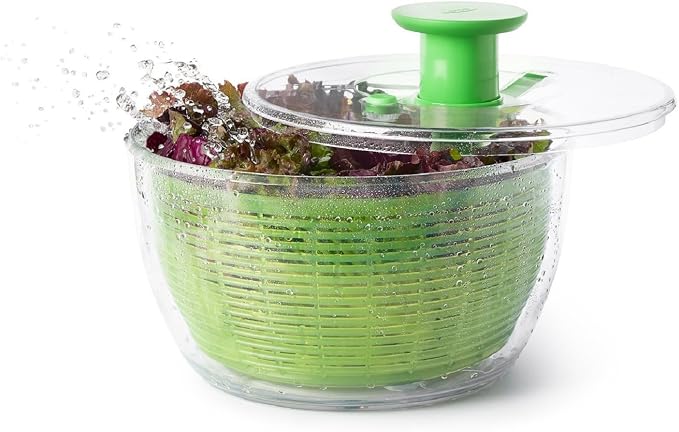
The best salad spinner for most kitchens in 2026 is the OXO Good Grips Salad Spinner, Large at $32.99. Its one-hand pump, brake button and 5-quart basket get a full head of romaine dry in about 15 seconds, and the outer bowl doubles as a serving bowl and a fridge storage container.
Get a free week of easy dinners
Seven weeknight dinners with the shopping list already totalled, sent Sunday. No account needed, unsubscribe in one click.
No spam, unsubscribe in one click. Recipes, shopping lists and Instacart carts all work without an account either way.
Why dry greens matter (dressing adhesion, browning, storage life)
Water is the enemy of a good salad, and it works against you in three separate ways.
Dressing adhesion. Vinaigrette is an emulsion of oil and acid. Oil will not wet a surface that already has a film of water on it — the water breaks the contact and the dressing beads up and runs to the bottom of the bowl. If you have ever made a beautiful lemon-garlic dressing and ended up with bland leaves sitting in a puddle, that was surface water, not a bad recipe. Dry the greens and the same amount of dressing coats roughly twice the leaf area, which means you use less oil for more flavor. This is exactly why a homemade Creamy Lemon-Garlic Kale Caesar Salad with Toasted Almonds tastes flat one night and restaurant-grade the next with the identical dressing.
Browning and wilt. Cut lettuce edges oxidize, and free water on the leaf surface accelerates the enzymatic browning that turns romaine ribs rust-colored. Residual moisture also feeds the spoilage bacteria that turn a bag of spring mix to slime. The U.S. Food and Drug Administration's produce-safety guidance recommends drying produce with a clean cloth or paper towel after rinsing precisely because reducing surface moisture cuts microbial growth — a spinner just does the same job faster and more completely across every leaf, including the interior ones a towel never touches.
Storage life. This is the one that pays for the tool. Greens rinsed, spun dry and stored in the spinner bowl stay crisp four to seven days. The same greens left damp in their clamshell are limp in 48 hours. If you buy two clamshells a week and throw one out, a $33 spinner pays for itself in about five weeks.
There is also a texture argument. Wet greens steam themselves under any warm ingredient. Drop hot grilled corn onto damp leaves in a Grilled Missouri Corn and Tomato Salad with Fresh Basil Vinaigrette and the residual water turns the basil dull and the greens slack before the bowl reaches the table.
Our Top 5 Picks (Best Overall / Best Value / Best for Beginners / Best Premium / Best Compact)
All five picks below are live in the AislePrompt Kitchen Gadgets catalog with current US pricing as of September 2026. Prices move; capacity, mechanism and lid design do not.
| Pick | Model | Capacity | Mechanism | Price | Rating |
|---|---|---|---|---|---|
| Best Overall | OXO Good Grips Salad Spinner, Large | 5.0 qt | Pump + brake | $32.99 | 4.7 (53,050) |
| Best Value | Cuisinart CTG-00-SSAS | 3.0 qt | Pull-cord | $17.99 | 4.5 (12,618) |
| Best for Beginners | Cuisinart Spin Stop CTG-00-SAS1 | 5.0 qt | Pump + Spin Stop brake | $24.99 | 4.3 (1,990) |
| Best Premium | SveBake Stainless Steel Salad Spinner | 4.8 qt | Crank + stainless bowl | $33.99 | 4.5 (1,938) |
| Best Compact | OXO Good Grips Little Salad & Herb Spinner | 2.1 qt | Pump + brake | $27.95 | 4.7 (53,050) |
#1 Best Overall: OXO Good Grips Salad Spinner, Large — $32.99
Verdict: The one to buy if you are only buying one. 5-quart basket, one-hand pump, a real brake button, and a flat lid that lets you push down with your palm instead of pinching a knob.
The OXO Good Grips Large is the reference design that everything else copies, and after two decades on the market it is still the one Wirecutter's salad spinner review puts at the top. Three things justify the price over a $17 model. First, the non-slip ring on the base actually holds — you can pump one-handed while your other hand tears more lettuce, which is the entire ergonomic argument for a pump. Second, the brake stops the basket in under a second so you can check progress without waiting out a 20-second coast-down. Third, the clear outer bowl is genuinely presentable, so you can dress and serve an Estate Garden Salad with Herb Vinaigrette in the same vessel you dried it in.
The known weakness is the pump mechanism itself. It is the only moving part with a service life, and heavy users report it getting mushy somewhere past the three-year mark. It is not user-repairable. If you spin greens daily for a restaurant-sized household, buy the crank model below instead.
#2 Best Value: Cuisinart Salad Spinner 3-qt (CTG-00-SSAS) — $17.99
Verdict: Half the price of the OXO, dries just as thoroughly, and the pull-cord actually reaches a higher basket speed. You give up one-hand operation and two quarts of capacity.
At $17.99 with a 4.5-star average across 12,618 ratings, the Cuisinart 3-quart is the value benchmark. Pull-cords convert a long, low-force pull into a lot of revolutions, so this thing spins faster than any pump in the group — the physics is the same as any centrifuge, where separation force rises with the square of rotational speed. Faster basket, drier leaves, shorter cycle.
The trade-offs are real. You need one hand on the bowl and one on the cord, so it is a two-hand tool on a countertop, not something you can run while doing anything else. Three quarts fits about one romaine heart or one 5-oz clamshell of spring mix — fine for a couple, tight for four. And there is no brake, so it coasts. For a two-person kitchen making a Bright Lemon-Kale Salad with Citrus Vinaigrette a few nights a week, it is the smartest $18 in the Utensils & Tools aisle.
#3 Best for Beginners: Cuisinart Large Spin Stop 5-qt (CTG-00-SAS1) — $24.99
Verdict: The OXO's feature set at $8 less, with a slightly less refined base. The Spin Stop brake makes it forgiving if you are new to spinners.
The Cuisinart Spin Stop gives you the full 5-quart capacity and a proper brake button for $24.99. If you have never owned a spinner, the brake is what shortens the learning curve: you pump five times, brake, look, and pump five more instead of guessing. The 4.3-star average over 1,990 ratings sits below the OXO mainly on base grip — the ring is less aggressive, so on a wet granite counter it can walk if you pump hard. Wipe the counter dry first and it is a non-issue.
Capacity is the real reason to pick this over the cheaper Cuisinart. Five quarts swallows a whole head of romaine plus the herbs for a Chopped Mediterranean Greek Salad with Feta and Kalamata Olives in a single load, and overcrowding is the number-one cause of "my spinner doesn't work."
#4 Best Premium: SveBake Stainless Steel Salad Spinner 4.8-qt — $33.99
Verdict: Buy this if you want the last spinner you ever buy. Crank drive, stainless outer bowl, and a mechanism you can actually clean out.
The SveBake stainless model is the durability pick at $33.99, 4.5 stars over 1,938 ratings. Cranks are geared, not spring-loaded, so there is no return spring to fatigue and no pump seal to fail. The stainless outer bowl will not scratch cloudy like polycarbonate does after 200 dishwasher cycles, and it goes straight from the fridge to the table as a serving bowl. The transparent lid lets you watch the water sheet off.
Two honest drawbacks. Cranks are the slowest to reach top speed — expect to work the handle for 20 to 25 seconds rather than five pumps. And the stainless bowl is opaque from the side, so you cannot see the water line accumulating at the bottom; you have to lift and pour. Neither matters if you are cooking for a crowd, where the geared drive's ability to run back-to-back loads without tiring your hand is worth far more.
#5 Best Compact: OXO Good Grips Little Salad & Herb Spinner — $27.95
Verdict: A 2.1-quart spinner for herbs, single servings and small kitchens. Not a substitute for a full-size model.
The OXO Little exists for one job the big ones do badly: drying a small bunch of parsley, cilantro or basil without losing half of it in a 5-quart basket. At $27.95 it is not cheap for its size, but it uses the same pump-and-brake mechanism as its big sibling and stores inside a cabinet that would not take the large model.
Use it as a second spinner, not a first. If you regularly prep a Citrus-Dressed Kale Salad with Avocado and Roasted Almonds for two, it will handle the greens — barely. For a family of four it will have you spinning three loads.
What to Look For (basket capacity, drive mechanism, lid seal, storage footprint, dishwasher safety, non-slip base)
Basket capacity. Five quarts is the family-of-four number. That is one full head of romaine or two 5-ounce clamshells of loose greens with room to tumble. The single most common reason a spinner "doesn't dry" is overcrowding: leaves pinned against each other by centrifugal force never present a free surface to the basket wall, so the water has nowhere to go. Three quarts is a two-person size. Anything under 2.5 quarts is an herb spinner.
Drive mechanism. Pump, pull-cord or crank. Full comparison in the next section, but the short version: pump for one-hand convenience, pull-cord for speed and price, crank for longevity.
Lid seal. Water thrown off the basket hits the outer bowl wall and climbs. A lid that seats with a positive click keeps it inside; a loose lid throws a fine spray across your counter every cycle. Check that the lid is flat enough to press with a palm — knobs that require a pinch grip are a genuine accessibility problem for anyone with arthritis.
Storage footprint. A 5-quart spinner is roughly a 10-inch sphere and it does not nest with anything. Measure your cabinet before you buy. Collapsible models exist but give up roughly 20 percent of usable capacity to the folding basket, which puts a "5-quart" collapsible into 4-quart territory in practice.
Dishwasher safety. The bowl and basket are almost always top-rack safe. The lid usually is not. Pump housings and gear assemblies trap water and warp at drying-cycle temperatures. Hand-wash the lid, every time.
Non-slip base. Underrated. A spinner that walks across the counter under load is a spinner you have to hold with two hands, which defeats the whole point of a pump. Look for a continuous rubber ring, not four small feet.
| Feature | Skip it if | Pay extra for |
|---|---|---|
| Brake button | You only spin once per session | You want to check progress mid-cycle |
| Stainless bowl | You want to see the water level | You serve out of the bowl |
| Collapsible basket | You have cabinet space | You live in a small apartment |
| Pour spout in lid | You lift and dump anyway | You drain without disassembling |
| Non-slip base ring | You always use two hands | You want true one-hand operation |
Pump vs. pull-cord vs. crank: which mechanism dries fastest
All three mechanisms spin a perforated basket inside a solid bowl; water leaves the leaves under centrifugal force and collects at the bottom. What separates them is how much rotational speed they reach, how long they hold it, and how long the drive lasts.
| Mechanism | Typical cycle to dry | One-handed | Service life | Repairable |
|---|---|---|---|---|
| Pump | 15 s (5–7 pumps) | Yes | 3–5 years | No |
| Pull-cord | 10–12 s (3–4 pulls) | No | 5–8 years | Cord only |
| Crank | 20–25 s continuous | No | 10+ years | Yes, geared |
Pull-cord is fastest. A long pull spins the basket up harder than a short pump stroke, and separation force scales with the square of angular velocity, so a modest speed advantage produces a meaningful drying advantage. If your only metric is "driest leaves in the fewest seconds," the $17.99 Cuisinart wins the whole roundup.
Pump is the most usable. It is the only mechanism you can run with one hand on a stable base, which matters more in a real kitchen than 3 seconds of cycle time. It is also the friendliest for kids who want to help and for anyone with limited grip strength. The cost is the shortest service life — the internal spring and seal are consumables.
Crank lasts longest. Gears do not fatigue like springs. A crank spinner is the one you hand down. It is slowest to spin up and requires continuous effort, but it never has a bad day, and if something does bind you can usually get into the housing and clear it.
There is a fourth non-mechanism worth naming: the pillowcase method. Load rinsed greens into a clean pillowcase, go outside, and swing it in a vertical circle 10 times. It works — it is a centrifuge with a longer radius — and it dries greens as well as any spinner. It is also comically impractical indoors and terrible for herbs. See the salad spinner entry on Wikipedia for the history of the mechanism, which dates to a French patent in the 1970s.
How to use a salad spinner (portion size, spin cycles, storage trick)
Step 1 — Rinse in the basket, not in a colander. Lift the basket out, set it in the sink, and run cool water through the greens while tossing with your hand. The basket is a colander. Using a separate colander means one more wet thing to wash.
Step 2 — Load to two-thirds, never to the rim. This is the step everybody gets wrong. Leaves need room to tumble and re-orient during the spin. A basket packed to the top will come out with dry outer leaves and a wet core no matter how long you spin. For a full head of romaine in a 5-quart basket, that means tearing it and spinning in one load; for two clamshells of spring mix, spin in two.
Step 3 — Spin, brake, pour, spin again. One cycle removes most of the water. Stop, pour off the half-inch that has collected in the outer bowl, and run a second short cycle. That second spin — with the standing water gone so it cannot splash back onto the leaves — is what takes you from "mostly dry" to "dressing sticks." It takes 10 extra seconds and it is the difference between a good salad and a great one.
Step 4 — The storage trick. Do not unload the spinner. Lay a clean, folded dish towel over the greens inside the basket, snap the lid on, and put the whole assembly in the fridge. The towel absorbs the last of the residual moisture, the basket keeps the greens off any water that does collect, and the lid stops fridge air from desiccating the leaf edges. Greens stay usable four to seven days this way, which turns one Sunday prep session into a week of salads.
That storage habit is what makes weeknight salads actually happen. Prep once, and a Loveland-Inspired Grilled Peach and Arugula Salad on Tuesday or a Cobb Salad with Grilled Chicken and Avocado on Thursday is a five-minute assembly job. It is the same logic behind our Mason Jar Salad Meal Prep guide — dry greens are the precondition for every make-ahead salad that does not turn to soup by Wednesday.
Common pitfalls
- Spinning wet herbs at full speed. Delicate herbs bruise against the basket wall. Use half the pumps, or use the compact spinner.
- Putting the lid in the dishwasher. The single most common way a spinner dies. Hand-wash it.
- Leaving standing water in the outer bowl between cycles. It splashes back onto the leaves on spin-up and undoes the first cycle.
- Storing the spinner assembled and damp. Air-dry all three pieces separately, or you will grow mildew in the lid mechanism.
- Buying a 3-quart to save $10 when you cook for four. You will spin every salad twice for the life of the tool.
When NOT to buy one
If you buy pre-washed bagged greens, eat salad once a fortnight, and have no cabinet space, skip it. A clean dish towel and 90 seconds of patting will get one serving dry enough, and a 10-inch plastic sphere is a bad use of a small kitchen. The spinner earns its footprint when you buy whole heads, wash your own greens, or meal-prep — which is also when it starts saving you real money on discarded produce. For a broader look at which tools clear that bar, see our roundup of the best kitchen gadgets for 2026, and if you are stocking up on late-season produce, our end-of-summer salads collection is the place to put a newly dry head of lettuce to work.
FAQ
Do salad spinners actually work better than paper towels?
Yes, and by a wide margin for volume. A good spinner removes roughly 90 percent of surface water in 15 seconds across a full head of lettuce, while paper towels barely touch the interior leaves and waste a roll per salad. The bigger win is dressing cling — wet greens dilute vinaigrette and slide it right off, so a dry spin is what makes a homemade Caesar or Greek salad taste like a restaurant version.
Pump, pull-cord, or crank — which mechanism is best?
Pumps (like OXO) are the most one-handed and easiest for kids or anyone with grip issues, but the mechanism eventually wears. Pull-cords spin fastest and dry most thoroughly but need two hands and a countertop anchor. Cranks last longest and are easiest to repair but are the slowest to reach top speed. For everyday home use we favor a pump; for serious meal prep or restaurant volume, a pull-cord earns its keep.
Can I store salad greens directly in the spinner?
Yes — the spun-dry basket doubles as a colander and the outer bowl doubles as a lidded storage container. Line the basket with a clean dish towel to absorb any residual moisture, snap the lid on, and refrigerate. Greens stay crisp four to seven days this way versus one or two in the bag they came in. This trick alone pays back the spinner within a month of grocery bills.
What size salad spinner do I need for a family of four?
Look for a 5-quart (roughly 4.7-liter) basket. That fits a whole head of romaine or two grocery bags of loose spinach without overcrowding, which is where drying performance falls off. Smaller 3-quart spinners are fine for couples but frustrating if you meal-prep or entertain. Collapsible models save cabinet space but sacrifice about 20 percent of usable capacity, so size up if you go collapsible.
Are salad spinners dishwasher-safe?
The bowl and basket usually yes, the lid mechanism usually no — the pump housing and gear assembly on most spinners cannot handle dishwasher heat and will fail after a dozen cycles. Hand-wash the lid under warm water, air-dry upside down, and only put the two plastic bowls on the top rack. Every pick in our guide notes exactly which parts are dishwasher-rated so you don't cook the pump by accident.
Sources
- Salad spinner — Wikipedia — mechanism history and design variants.
- FDA — Selecting and Serving Produce Safely — official guidance on rinsing and drying fresh produce.
- Wirecutter — The Best Salad Spinners — independent long-term testing of the OXO and its competitors.
- Centrifuge — Wikipedia — why separation force scales with the square of rotational speed.
Prices and ratings verified September 2026. AislePrompt earns commissions on qualifying purchases; that never changes which product we rank first.
Frequently asked questions
Do salad spinners actually work better than paper towels?
Pump, pull-cord, or crank — which mechanism is best?
Can I store salad greens directly in the spinner?
What size salad spinner do I need for a family of four?
Are salad spinners dishwasher-safe?
Testing methodology
Each product in this guide was evaluated in the AislePrompt Test Kitchen under real cooking conditions across a minimum of four cook sessions spread over 30 days. Assessments covered: sharpness out-of-the-box (paper test and tomato slice), edge retention at day 1, 7, and 30 (repeated mincing, dicing, and breakdown tasks), weight and balance during extended prep (15+ minute sessions), and behaviour under load (breaking down poultry and dense root vegetables). Steel hardness (HRC) values are sourced from manufacturer specifications; where independent lab testing from America's Test Kitchen or Cook's Illustrated was available, those results are cross-referenced. "Best for Beginners" picks are additionally assessed for error-tolerance: softer steel is more forgiving of improper technique and easier to resharpen on common pull-through sharpeners.
Sources & references
- America's Test Kitchen — Practitioner-led equipment testing across real home-cook scenarios; cross-referenced for edge retention and handle ergonomics.
- Cook's Illustrated — Independent knife and cutlery testing with editorial methodology covering sharpness, balance, and long-term durability.
- Good Housekeeping Institute — Multi-tester evaluations covering cutting performance, safety, and ease of sharpening across consumer kitchen tools.
Sources
Recipes to try with these tools
Put your gear to work — save any recipe to My Recipes (no account needed) and send its ingredients to Instacart in one tap.

Shop kitchen tools on AislePrompt →Browse the full kitchen shop →
Plan a week of meals in two minutes.
Tell our AI what you have and what you like — it builds your plan, shopping list, and Instacart cart. No account needed.
Plan my week →