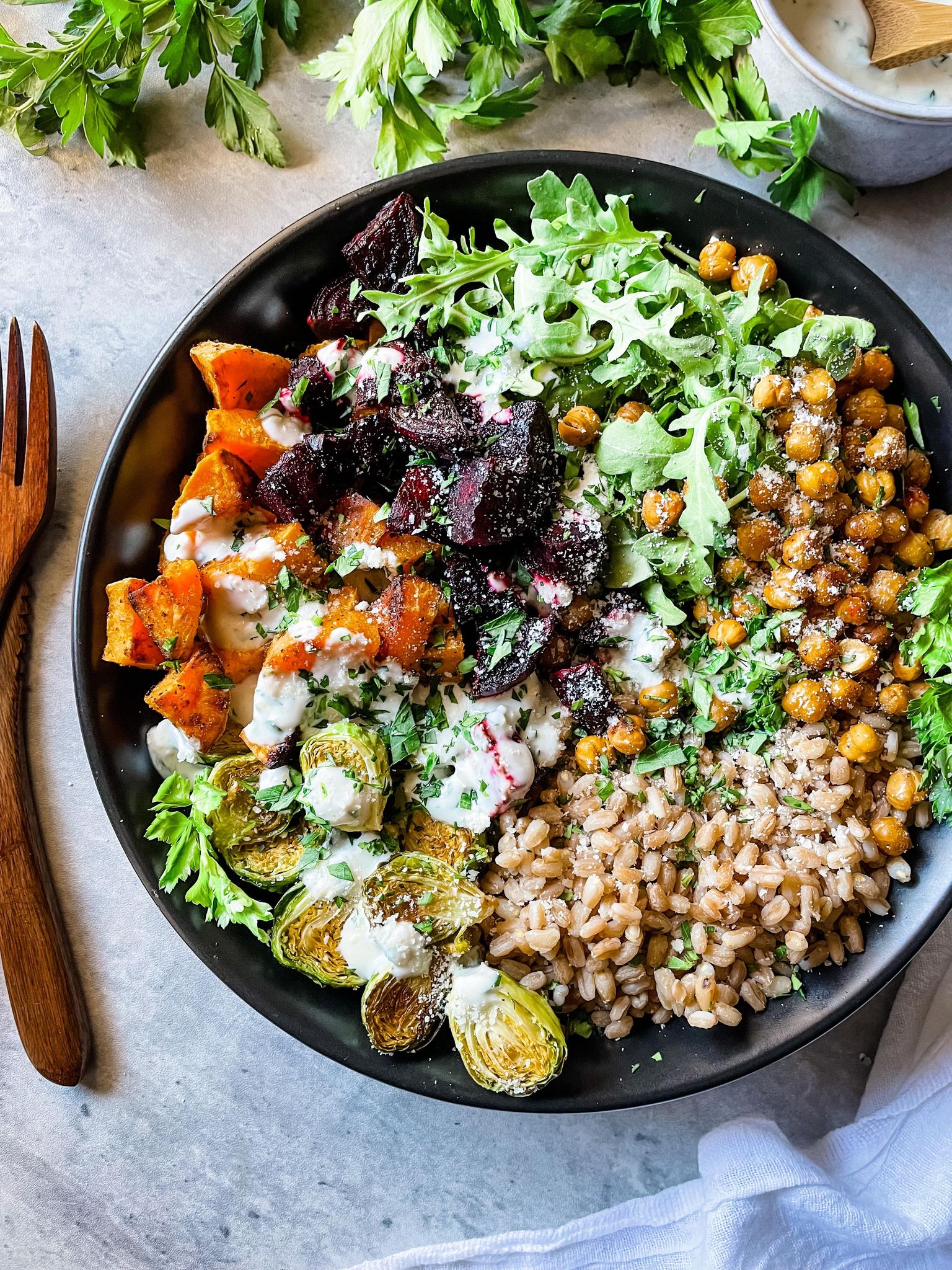
18 Ancient Grain Recipes: Farro, Barley & Freekeh Weeknight Bowls
What separates farro from freekeh, the ratios and times for each, and eighteen bowls that still eat like grain midweek.
Why Ancient Grains Beat White Rice for Weeknight Bowls
Get a free week of easy dinners
Seven weeknight dinners with the shopping list already totalled, sent Sunday. No account needed, unsubscribe in one click.
No spam, unsubscribe in one click. Recipes, shopping lists and Instacart carts all work without an account either way.
Farro, barley, freekeh, and bulgur all deliver 5 to 8 grams of fiber per cooked cup against white rice's 0.6, and they hold their structure in a fridge container for days instead of turning into a compacted brick. That texture difference is the practical argument: an ancient grain still eats like a grain on Wednesday, which is the whole point of cooking a batch on Sunday.
They also taste like something. White rice is a neutral platform. Farro is nutty and faintly sweet, barley is earthy and almost creamy at the edges, freekeh is smoky because the wheat is harvested green and fire-roasted, and bulgur carries a light toasted-wheat note. You need less sauce to make a bowl work, which usually means fewer calories and less sodium landing on top.
This guide is about the grains themselves — what each one is, how long it actually takes, what ratio of water it wants, and which recipes in the catalog show it off. If you want the bowl-assembly formula and protein math instead, that lives in 20 Grain Bowl Dinners: Meal-Prep-Friendly Buddha Bowls With 30g+ Protein.
The Ancient Grain Cheat Sheet
Six grains cover essentially every recipe you will meet. The single biggest variable is processing: pearled grains have the bran polished off and cook fast, whole or hulled grains keep the bran and take two to three times as long.
| Grain | Form to buy | Water ratio | Cook time | Texture | Fiber (per cooked cup) |
|---|---|---|---|---|---|
| Farro | Pearled (perlato) | 3:1, drain | 25-30 min | Chewy, nutty, distinct kernels | 5 g |
| Farro | Whole (integrale) | 3:1, drain | 45-60 min | Firmer, more mineral | 7 g |
| Barley | Pearled | 3:1, drain | 25-30 min | Creamy, plump | 6 g |
| Barley | Hulled | 3:1, drain | 50-60 min | Very chewy | 8 g |
| Freekeh | Cracked | 2.5:1, absorb | 20-25 min | Smoky, firm | 8 g |
| Freekeh | Whole | 3:1, drain | 40-45 min | Very smoky, coarse | 10 g |
| Bulgur | #1 fine | 1.5:1, soak only | 15 min off heat | Fluffy, light | 6 g |
| Bulgur | #3 coarse | 2:1, absorb | 15-20 min | Pilaf-like | 6 g |
| Spelt berries | Whole | 3:1, drain | 50-60 min | Dense, sweet | 7 g |
| Einkorn berries | Whole | 3:1, drain | 30-35 min | Soft, buttery | 6 g |
Farro is the catch-all Italian name for three hulled wheat species — einkorn, emmer, and spelt. Check the package for perlato (pearled) or semi-perlato: those have had some bran polished off and cook faster than whole (integrale) farro.
Barley is the one to reach for when you want creaminess: pearl barley sheds starch into its cooking liquid much the way arborio does, and it carries soluble beta-glucan fiber besides. That is why barley risotto turns creamy while farro keeps more bite.
Freekeh is green durum wheat, harvested young and roasted over open fire. It has the most assertive flavor of the group — smoke does most of the seasoning work for you.
Bulgur is parboiled, dried, and cracked wheat, sold in four grinds. Fine (#1) is tabbouleh; coarse (#3) is pilaf. Because it is precooked, it is the fastest ancient grain on the shelf.
Spelt and einkorn are worth knowing but harder to source. Both are hulled wheat species sold as farro in Italy, and both cook like whole farro in any bowl below.
6 Farro Bowls
Farro is the default weeknight grain: pearled farro is ready in 25 minutes, holds a distinct kernel under dressing, and never goes gluey.
Slow-Roasted Root Vegetable Farro Bowl with Maple-Dijon Glaze is the best cold-weather entry point — 50 minutes total, 450 calories, and the maple-Dijon does double duty as glaze and dressing.
Serious Farro & Roasted Vegetable Grain Bowl runs 45 minutes at 480 calories and is the most straightforward roasted-vegetable version.
Lemon-Dill Farro Salad with Roasted Chickpeas and Feta eats better cold on day two than warm on day one — the dill and lemon need time to move into the grain.
Quinoa and Farro Grain Salad with Lemon Vinaigrette mixes two grains, which is a trick worth stealing: quinoa's small round seeds fill the gaps between farro kernels and the bowl feels denser at 320 calories.
Cold-Pressed Farro and Chickpea Salad with Herb Dressing and Cold-Roasted Farro and Chickpea Grain Bowl with Lemon-Tahini Dressing are both make-ahead lunch builds — chickpeas and farro hold up equally well in the fridge, so both salads are still good on day three.
5 Barley Recipes
Barley's starch is the whole story. It thickens whatever liquid it cooks in, which makes it the best soup grain there is and a legitimate risotto substitute.
Barley and Roasted Mushroom Risotto with Thyme is the showpiece — 65 minutes, and the barley does the creaming without a cup of parmesan. Roast the mushrooms separately rather than sweating them in the pot; you want browning, not steam.
For soup, Quick Beef and Barley Soup with Root Vegetables delivers 32 grams of protein per serving in 75 minutes, while Rustic Slow-Simmered Beef and Barley Soup takes just over two hours and is meaningfully better for it — the extra time is collagen breaking down in the chuck.
Slow-Cooked Beef and Barley Stew with Root Vegetables is the stew-thick version at 450 calories and 30 grams of protein. For a meatless option with the same body, Northern-Style Spiced Lentil and Barley Stew leans on lentils for the protein and the barley for the texture.
One warning that applies to all four soups: barley keeps absorbing liquid in the fridge. A soup that was perfect at dinner will be a stew by lunch. Either cook the barley separately and add it per-bowl, or accept the transformation and thin with stock when you reheat.
7 Freekeh & Bulgur Bowls
These two are the fast lane. Cracked freekeh is done in 20 minutes and fine bulgur never sees direct heat at all.
Freekeh Salad with Roasted Eggplant and Sumac Dressing pairs the grain's smoke with charred eggplant — 45 minutes, 280 calories, and one of the better vegetarian mains in the catalog.
Herbed Freekeh Bowl with Roasted Sweet Potatoes leans sweet against the smoke at 410 calories, and Freekeh Pilaf with Caramelized Onions and Almonds is the side-dish version — 50 minutes, most of it unattended onion.
On the bulgur side, Herbed Tabbouleh Salad with Bulgur and Fresh Mint is the canonical use at 180 calories, and it is worth remembering that real tabbouleh is a parsley salad with bulgur in it, not the reverse — the grain should be a minority ingredient. Bulgur Wheat Salad with Sumac and Roasted Vegetables and Mediterranean Chickpea and Bulgur Salad invert that ratio for a fuller main-course bowl.
For a heartier turn, Pan-Fried Lamb and Bulgur Kibbeh with Fresh Mint uses bulgur as a binder rather than a base — 450 calories, 25 grams of protein.
3 Make-Ahead Grain Meal-Prep Ideas
One batch, three destinations. Cook 2 cups of dry pearled farro (yields about 5 cups) on Sunday. Monday and Tuesday it is a warm bowl with roasted vegetables; Wednesday it is a cold salad with vinaigrette and feta. Cooked grain keeps 3 to 4 days in the fridge, so freeze the last 2 cups on Sunday night and move them to the fridge the evening before you need them: Thursday's cold salad and Friday's soup. One 30-minute cook covers five lunches, and because farro does not compact, the thawed portions eat like day one.
Undersalt the batch, season the bowl. Salt the cooking water lightly — about half a teaspoon per quart — and do the real seasoning when you assemble. A single heavily seasoned batch locks you into one flavor direction for the week; a neutral batch can go Mediterranean on Monday and Middle Eastern on Wednesday.
Dress the grain warm, dress the bowl cold. Toss the grain with a spoonful of olive oil and a splash of vinegar while it is still hot — warm grains absorb dressing into the kernel instead of wearing it on the outside. Then keep the finishing dressing separate and add it at serving. Mixed-Grain Bowl with Harissa and Cilantro and Mediterranean Grain Salad both work well on this split-dressing schedule, as does Heirloom Wheat Berry Salad with Roasted Root Vegetables if you can find wheat berries.
Store cooked grains in a shallow, wide container rather than a deep one. Depth traps residual steam, and steam is what turns the bottom layer gummy by Wednesday.
How to Cook Ancient Grains: The Universal Method
Most ancient grains cook like pasta, not like rice. That single reframing solves nearly every texture complaint.
The pasta method (farro, barley, freekeh, spelt, einkorn, wheat berries): bring a large pot of water to a boil, salt it, add the grain, and boil uncovered until it is chewy-tender. Drain in a fine-mesh strainer. Because you are not trying to hit an exact absorption ratio, you can taste at 20 minutes, taste again at 25, and pull it exactly where you want it. Overcooking becomes much harder.
The absorption method (bulgur, cracked freekeh): combine grain and measured liquid, bring to a boil, cover, drop to the lowest heat, and cook until the liquid is gone. Then take it off the heat and let it stand covered for 10 minutes before fluffing. That rest is not optional — it is when the top layer finishes and the bottom layer stops steaming.
Three upgrades that cost nothing:
- Toast the dry grain in the empty pot with a teaspoon of oil for 2 to 3 minutes before adding liquid. It deepens the nutty flavor measurably, especially in farro and freekeh.
- Cook in stock, not water, when the grain is the center of the dish.
- Add a bay leaf and a smashed garlic clove to the boiling water and fish them out at the end.
Cooked grains freeze well. Spread them on a sheet pan to cool completely, then bag them flat — frozen flat, they thaw in a few minutes in a hot skillet.
Common Pitfalls
Buying whole farro and cooking it on the pearled timeline. This is the number one complaint behind "farro is too hard." Whole (integrale) farro needs 45 to 60 minutes and benefits from an overnight soak; pearled needs 25. The bags look nearly identical. If the package does not say, taste at 25 minutes rather than trusting the box, and keep going until the kernel is chewy-tender.
Treating barley like rice in a covered pot. Barley sheds starch, and in a sealed absorption pot that starch has nowhere to go but the bottom, where it scorches. Boil it in open water and drain unless you are deliberately making risotto or soup.
Cooking bulgur. Fine bulgur is already parboiled. Boiling it produces mush. Pour boiling water over it, cover, and walk away for 15 minutes.
Salting the water too aggressively. Grains keep absorbing seasoning long after they leave the pot, especially in a dressed salad. Water that tastes correctly seasoned yields a grain that tastes oversalted by Wednesday. Half a teaspoon per quart is enough.
Storing warm grains in a sealed deep container. Trapped steam condenses and the bottom third turns gummy. Cool on a sheet pan first, then store shallow.
Real-World Numbers
Every recipe linked above, with the per-serving numbers from its recipe page:
Four of them reach 25 g of protein or more, and all four are barley or bulgur dishes with meat: the Quick Beef and Barley Soup (32 g), Slow-Cooked Beef and Barley Stew (30 g), Rustic Slow-Simmered Beef and Barley Soup (28 g) and the Lamb and Bulgur Kibbeh (25 g). The fastest is the Mediterranean Chickpea and Bulgur Salad at 25 minutes, because bulgur only needs a soak.
On time: a 30-minute Sunday batch of 2 cups dry farro produces about 5 cups cooked, which covers five weekday lunches at 1 cup each. Amortized, that is 6 minutes of cooking per lunch.
When an Ancient Grain Is the Wrong Call
Most ancient grains are wheat, and barley is the other classic gluten grain. All six on this page contain gluten — the Celiac Disease Foundation's list of gluten sources names farro, spelt, einkorn, emmer and barley outright — so none of them is a celiac-safe substitute. Reach for quinoa, millet, buckwheat or sorghum labeled gluten-free instead.
They are also the wrong choice when you need a neutral background. A delicate steamed fish or a subtle Japanese preparation is served better by short-grain white rice; farro's nuttiness will fight it. And for a fast risotto where you want a specific creamy-but-distinct texture in 20 minutes, arborio still wins — barley risotto takes 50 to 60 minutes and lands somewhere different, though it lands somewhere very good.
Finally, skip them for anyone who genuinely dislikes chew. That is the defining characteristic of every grain here, and no cooking technique removes it.
Kitchen Tools
A 4- to 6-quart pot with a heavy base is the whole hardware requirement for the pasta method. Thin pots scorch the bottom layer during the toasting step. Our size-by-size breakdown is in Best Saucepans for 2026: 2-Quart to 4-Quart Picks, and the full Cookware category covers the larger stockpots.
A fine-mesh strainer matters more than it sounds. Bulgur and cracked freekeh slip straight through a standard colander's holes. You want a mesh strainer at least 8 inches across so a full pot drains in one pour — see Utensils & Tools.
Shallow glass storage containers finish the setup. Wide and flat beats tall and deep for cooked grains, and glass does not hold the smell of last week's harissa. Storage & Containers has the sets worth buying.
A rice cooker also handles bulgur and cracked freekeh on the white-rice setting if you already own one — Best Rice Cookers for 2026 covers which models have a dedicated grain program.
Sources & Related Reading
Nutritional and botanical references for this guide: Harvard's Nutrition Source on whole grains, the Whole Grains Council's whole vs refined grain definitions, and the species entries for farro, barley, freekeh, and bulgur.
Related reading on AislePrompt: 22 High-Fiber Healthy Dinners: Beans, Whole Grains & Vegetable Bowls and 20 Lebanese Recipes: Kibbeh, Tabbouleh & Mezze Weeknight Dinners.
Frequently asked questions
What's the difference between farro, barley, freekeh, and bulgur?
Are ancient grains gluten-free?
Can I meal-prep grain bowls without them going soggy?
Do I need to soak ancient grains before cooking?
What's the ratio of water to grain and can I use a rice cooker?
Sources
- nutritionsource.hsph.harvard.edu
- wholegrainscouncil.org
- en.wikipedia.org
- en.wikipedia.org
- en.wikipedia.org
- en.wikipedia.org
- celiac.org
Recipes to start your week with
Save any of these to My Recipes — no account needed — and send the ingredients to Instacart in one tap.


Plan a week of meals in two minutes.
Tell our AI what you have and what you like — it builds your plan, shopping list, and Instacart cart. No account needed.
Plan my week →