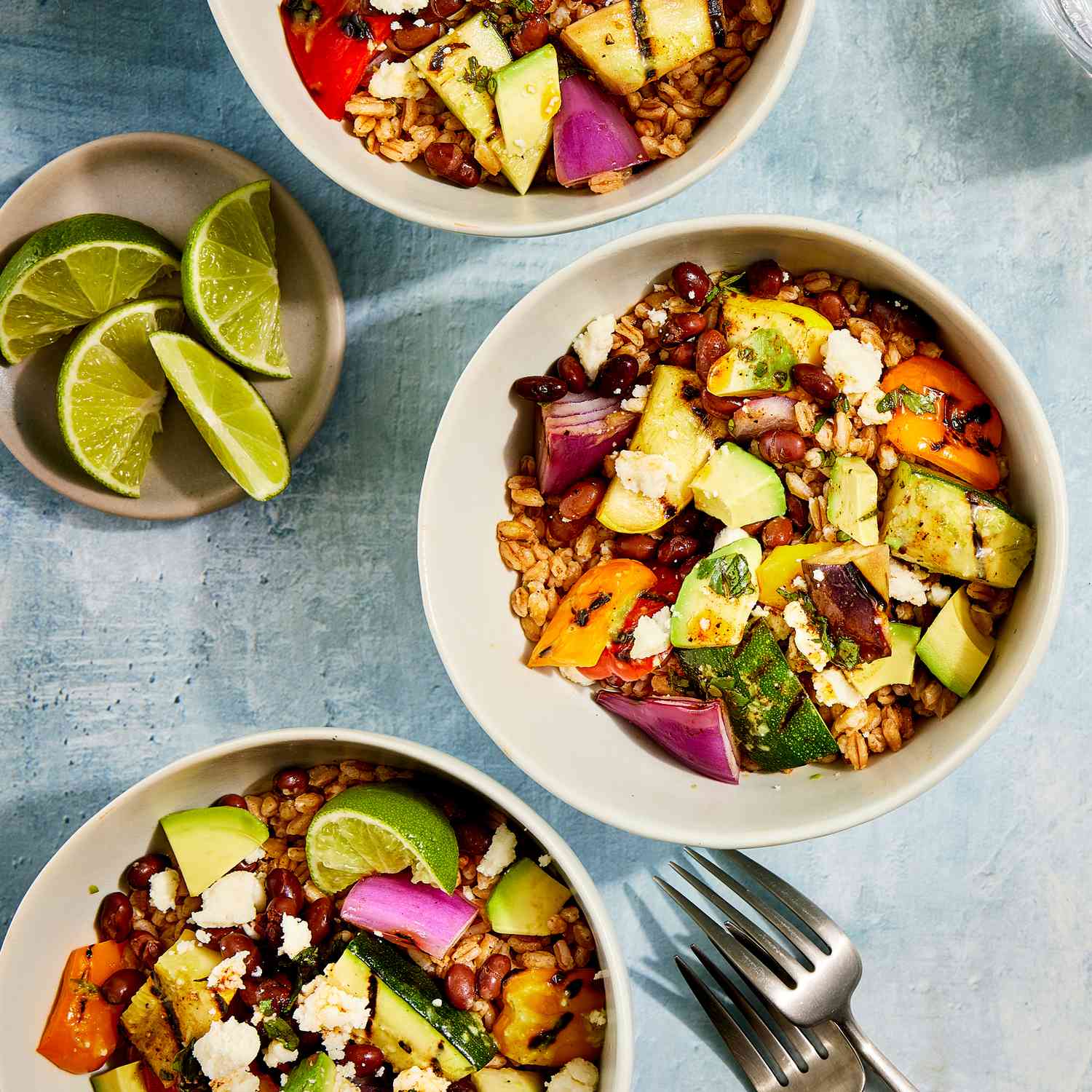
22 High-Fiber Healthy Dinners: Beans, Whole Grains & Vegetable Bowls
A legume, a whole grain and two cups of vegetables: the formula that takes a weeknight dinner from 5 grams of fiber to 15, with the measured numbers for all 22.
The best high-fiber dinner recipes follow one formula: a legume, a whole grain, and at least two cups of vegetables in the same bowl. Hit all three and dinner lands between 10 and 15 grams of fiber — close to half a day's target — with no supplement and no special shopping. Every recipe below carries a measured per-serving estimate so you can build a week that actually adds up.
Get a free week of easy dinners
Seven weeknight dinners with the shopping list already totalled, sent Sunday. No account needed, unsubscribe in one click.
No spam, unsubscribe in one click. Recipes, shopping lists and Instacart carts all work without an account either way.
Introduction — why fiber is the underrated dinner nutrient
Protein gets the marketing budget. Fiber gets the ad for the orange powder you stir into water.
That is backwards. Americans average roughly 15 grams of fiber a day against a target of 25 for women and 38 for men, which makes fiber the single most under-consumed nutrient in the standard American diet — a bigger real-world shortfall than protein, which most people already hit without trying. Dietary fiber is also the only macronutrient component you cannot fix with a shaker bottle: the health signal comes from fermentable fiber reaching your colon and feeding bacteria that produce short-chain fatty acids, and isolated fiber powders do a poor job of replicating that.
Dinner is the meal where the gap closes. Breakfast is usually a fixed habit and lunch is often eaten away from your own kitchen, but dinner is the meal you plan, shop for, and cook. A 12-gram dinner moves you from 15 grams a day to 27 in one decision, repeated five nights a week. That is the entire strategy in this guide.
The other reason to attack it at dinner: fiber-dense foods are the cheap ones. A pound of dried lentils costs less than a third of a pound of ground beef and yields six to seven servings. The Harvard T.H. Chan School of Public Health's fiber overview makes the same point from the clinical side — the observed benefits track whole-food fiber sources, not supplements, and whole-food fiber sources are beans, grains, and vegetables.
Every fiber number in this guide is an estimate calculated from each recipe's actual ingredient list using USDA FoodData Central values, divided by the recipe's stated yield. They are not lab assays. Treat them as accurate to within a gram or two, which is precise enough to plan a week.
How much fiber a single dinner should deliver (target: 12g+)
Twelve grams is the number to design around, and here is the arithmetic behind it.
If you eat a typical American breakfast and lunch, you arrive at dinner with about 9 to 11 grams already banked. A 12-gram dinner puts you at 21 to 23 — short of the 25/38 target but a near-doubling of the 15-gram baseline. Push dinner to 15 grams and add one high-fiber snack (an apple, 4.4 grams; a quarter cup of almonds, 4.5 grams) and you clear 25 without thinking about it again.
Twelve grams is also achievable in a single pot. It is roughly one cup of cooked black beans (15 grams) or one and a half cups of cooked lentils (23 grams) or two cups of cooked pearl barley plus a couple of carrots. You do not need an exotic ingredient. You need one legume, measured.
Here is the reference table worth memorizing. These are the staples that do the work:
| Staple (1 cup, cooked) | Fiber (g) | Calories | Protein (g) |
|---|---|---|---|
| Split peas | 16.3 | 231 | 16 |
| Lentils (brown or green) | 15.6 | 230 | 18 |
| Black beans | 15.0 | 227 | 15 |
| Chickpeas | 12.5 | 269 | 15 |
| Cannellini / white beans | 11.0 | 254 | 17 |
| Bulgur wheat | 8.2 | 151 | 6 |
| Pearl barley | 6.0 | 193 | 4 |
| Quinoa | 5.2 | 222 | 8 |
| Farro (pearled) | 5.0 | 200 | 7 |
| Brown rice | 3.5 | 218 | 5 |
| White rice | 0.6 | 205 | 4 |
Two things jump out. First, legumes deliver two to five times the fiber of any grain — the beans are doing the heavy lifting, and the grain is a supporting player. Second, the swap from white rice to brown rice buys you about 3 grams; the swap from white rice to a cup of black beans buys you 14. If you only change one thing, add the legume.
Vegetables matter but they are additive, not foundational. A medium sweet potato with skin is 4 grams. A cup of broccoli florets is 2.4. A whole medium avocado is 10, which is why avocado shows up so often in the highest-scoring bowls below. Three cups of mixed vegetables will typically contribute 5 to 7 grams — meaningful, but not enough on its own to carry a dinner past 12.
Of the 22 dinners in this guide, 17 clear 9 grams per serving on their own arithmetic and 12 clear 11 grams. The five vegetable-forward dinners in the sheet-pan and stir-fry section land between 3 and 8 grams, which is honest and expected — those are vegetable dishes, not legume dishes. Each one gets a specific booster line that takes it past 12.
6 bean and legume-based dinner recipes
Beans are the highest-leverage ingredient in this entire guide. One can, drained, is roughly 1.75 cups of cooked beans and 20 to 26 grams of fiber spread across the pot. Canned costs you about half a gram per serving versus dried and saves you two hours.
1. One-Pot Spicy Chipotle Black Bean Chili — 13.9 g fiber per serving. Three cups of black beans, a cup of corn, and chipotles in adobo, done in 40 minutes in one pot. The corn is not filler; it adds 4 grams of fiber to the pot on its own. This is the recipe to make on a Sunday and eat three times, and it is the single best fiber-per-minute-of-effort dish in the guide.
2. Cumin-Spiced Black Bean and Sweet Potato Tacos — 14.1 g fiber per serving. Two sweet potatoes with the skin on (8 grams between them), 1.75 cups of black beans (26 grams), and a whole avocado (10 grams) split four ways. Corn tortillas add another gram and a half per serving over flour. The avocado is doing real work here — leave it off and you drop to 11.6.
3. Slow-Simmered Greek Fasolada White Bean Soup with Tomato and Carrot — 13.0 g fiber per serving. The Greek national bean soup, and a two-hour simmer that requires almost no attention. Dried cannellini beans, not canned, plus carrots, celery, and tomato. Six servings from one pot, which is the best cost-per-serving in the guide at roughly a dollar a bowl.
4. Hidden-Spice Chickpea and Spinach Stew — 11.8 g fiber per serving. Chickpeas and four cups of spinach, twenty-five minutes of cooking. The spinach cooks down to almost nothing visually but still contributes about 3 grams to the pot. Smoked paprika and coriander do the flavor work so it doesn't taste like health food.
5. Lemon-Garlic Mediterranean Chickpea Stew — 11.1 g fiber per serving. The 30-minute version of the recipe above: chickpeas, tomato, lemon, oregano. Nothing to chop but an onion. This is the weeknight default when you get home at 6:45 and the alternative is takeout.
6. Crisp-Edged Sweet Potato and Black Bean Chili — 10.3 g fiber per serving. Sweet potato and black bean chili with crisped edges from roasting the potato first rather than boiling it in the pot. That single technique change is the difference between a chili and a mush.
Three more worth knowing: Coconut Turmeric Chickpea Curry lands at 10.0 grams and takes 40 minutes total; Yellow Split Pea Soup with Lemon Zest hits 13.6 grams on split peas alone, the highest-fiber legume in the table; and One-Pot Tomato White Bean Pasta is a 9.0-gram weeknight pasta that clears 12 if you use whole-wheat spaghetti instead of white — a two-second swap in the shopping list.
6 whole-grain bowl recipes (farro, quinoa, barley)
Grain bowls are where fiber math either works or quietly fails. A bowl of quinoa and roasted vegetables sounds virtuous and delivers about 7 grams. The same bowl with a cup of beans folded in delivers 12. The bowls below are ranked by whether they include a legume.
7. Core-Boosting Quinoa Power Bowl — 24.4 g fiber per serving. The highest-fiber dinner in this guide by a wide margin, and it is not close. Quinoa, a full cup of black beans, half a cup of chickpeas, two cups of kale, and a whole avocado, split two ways. One serving is roughly a full day's fiber target for a woman. It is also 450 calories, so this is a genuine dinner, not a side.
8. One-Pot Mexican Quinoa with Black Beans and Corn — 12.7 g fiber per serving. One pot, 35 minutes, quinoa cooked directly in the broth with black beans and corn. This is the recipe to teach someone who has never cooked quinoa — there is no separate pot and no draining step.
9. Crisp-Topped Farro & Roasted Root Vegetable Bowl — 10.0 g fiber per serving. Farro with carrots, parsnips, and sweet potato, finished with pumpkin seeds, sunflower seeds, and walnuts. The seeds add about 1.5 grams per serving and, more importantly, the textural contrast that keeps a grain bowl from being boring on day three.
10. Quinoa Stuffed Peppers — 9.8 g fiber per serving. Six stuffed peppers, quinoa and black beans inside, cheddar on top. The bell peppers themselves are 2 grams each. Good cold the next day, which is not true of most baked dishes.
11. Northward Roasted Root Vegetable and Barley Salad — 9.3 g fiber per serving. Pearl barley with roasted carrots, turnips, and parsnips in a Dijon-cider vinaigrette. Barley is the most underrated grain in the table: 6 grams per cup, more than quinoa or farro, at about a third of the price of quinoa. It is also rich in beta-glucan, the soluble fiber with the strongest cholesterol evidence behind it.
12. Roasted Eggplant and Bulgur Salad with Pomegranate Molasses — 6.8 g fiber per serving. Roasted eggplant and fine bulgur with pomegranate molasses. Bulgur is the highest-fiber grain on the table at 8.2 grams per cup and it cooks by soaking in boiling water for 15 minutes — no pot, no timer. Add a can of chickpeas and this goes to 11.5.
Also strong in this category: Sautéed Mushroom and Kale Farro Bowl with Lemon Garlic Dressing at 5.8 grams, Toasted Yungdrung Bon-Inspired Barley and Mushroom Pilaf at 6.2 grams, Sautéed Mushroom and Spinach Farro Risotto at 5.9 grams, and Kimchi Brown Rice Tempeh Bowl at 6.5 grams. All four are excellent dinners that need a legume added to clear the 12-gram bar — a drained can of chickpeas stirred into any of them adds 4.5 grams per serving. Hearty British Vegetable and Barley Soup is the exception in soup form at 5.7 grams, and it takes a cup of red lentils beautifully.
5 vegetable-forward sheet-pan and stir-fry dinners
These are the honest section. Vegetable dishes are 3 to 8 grams of fiber per serving, full stop — you cannot roast your way to 15 grams without a legume or a grain in the pan. What they offer instead is speed, and every one below has a booster line that gets it over 12.
13. Sheet Pan Tex-Mex Chicken and Black Bean Bake — 8.2 g fiber per serving. Chicken thighs, two bell peppers, red onion, and a can of black beans on one sheet pan at 425°F. The beans crisp slightly at the edges, which is the best argument for this recipe over a skillet version. Booster: serve over a cup of cooked bulgur (+8.2 g) → 16.4 g.
14. Vegetable Stir-Fry with Spicy Peanut Sauce over Brown Rice — 6.7 g fiber per serving. Broccoli, bell pepper, carrot, and snap peas over brown rice with a peanut sauce. The crushed peanuts are 3 grams for the whole batch. Booster: swap the brown rice for barley (+2.5 g) and add a cup of edamame (+8 g) → 17.2 g.
15. Authentic Tofu Buddha Bowl with Quinoa — 6.7 g fiber per serving. Crispy tofu, roasted vegetables, quinoa, tahini. Tofu is a low-fiber protein — soybeans lose most of their fiber in the curdling — so this bowl's fiber is almost entirely the quinoa and vegetables. Booster: add a cup of chickpeas roasted alongside the vegetables (+3.1 g per serving) → 9.8 g, or use tempeh instead of tofu (+1 g).
16. Garden-Fresh Tomato & Zucchini Minestrone Soup — 6.2 g fiber per serving. Minestrone with zucchini, tomato, carrot, celery, and white beans. Six servings, freezes well. Booster: double the white beans (+3 g) and add a half cup of small whole-wheat pasta (+2 g) → 11.2 g, or stir in a cup of cooked lentils (+3.9 g).
17. Ginger-Sesame Tofu Stir Fry with Rainbow Vegetables — 4.7 g fiber per serving. Fifteen minutes, one wok, broccoli and snap peas and rainbow peppers. The lowest-fiber dinner in the guide and the fastest. Booster: serve over a cup of cooked barley or bulgur (+6 to 8 g) and add a cup of edamame (+8 g) → 18 g. This is the template for "I have 20 minutes" — the wok is the fast part, the grain cooks unattended.
Honorable mention to Ethiopian-Inspired Spiced Vegetable Stir-Fry with Injera Croutons at 3.1 grams — genuinely delicious, genuinely not a high-fiber dinner unless you serve it with the lentil stew from the next section, which is exactly how it is eaten in Ethiopia.
5 lentil-based dinners for meatless nights
Lentils are the best fiber ingredient in a home kitchen and it is not particularly close. They need no soak, they cook in 20 to 35 minutes from dry, they cost roughly $1.50 to $2.00 a pound, and a cup cooked delivers 15.6 grams of fiber with 18 grams of protein alongside. Red lentils dissolve into a thick stew in 20 minutes; brown and green lentils hold their shape for 35.
18. Smoky Mushroom and Lentil Stew with Roasted Root Vegetables — 15.2 g fiber per serving. Brown lentils with mushrooms, carrots, and parsnips, smoked paprika doing a bacon impression. The highest-fiber lentil dish here and the most convincing meatless main in the guide for a meat eater — the mushrooms carry the umami that lentils alone lack.
19. Injera-Style Teff Flatbread with Berbere-Spiced Lentil Stew — 13.9 g fiber per serving. Berbere-spiced red lentil stew with a teff flatbread you make from scratch. Teff is a whole grain in the truest sense — the seed is too small to refine, so every gram of teff flour is whole-grain flour, contributing about 7 grams of fiber per cup. Budget an evening for this one; it is the weekend project of the group.
20. Cumin-Spiced Lentil Soup — 11.8 g fiber per serving. Red lentils, cumin seed, turmeric, and a swirl of coconut milk — dal in everything but name. Forty minutes, four servings, and it thickens further overnight into something you can eat with a fork.
21. Spiced Kenyan Lentil Stew with Coconut and Spinach — 11.5 g fiber per serving. Kenyan-style red lentil stew with coconut milk and four cups of spinach. Slightly sweeter than the dal above because of the coconut, and the spinach keeps it from feeling heavy.
22. Turmeric-Spiced Lentil Soup with Spinach and Lemon — 11.1 g fiber per serving. The lightest of the lentil group at 220 calories a serving: red lentils, turmeric, spinach, and enough lemon at the end to make it taste like a summer dish rather than a winter one. Thirty minutes total.
Two more if the five above go into rotation and you need variety: Lentil & Vegetable Soup at 11.8 grams is the plain French-style version with thyme, and Ethiopian-Inspired Lentil and Vegetable Salad with Spiced Dressing at 11.2 grams serves lentils cold in a berbere-dressed salad — a genuinely good hot-weather option, which lentils rarely get credit for.
Real numbers: what a fiber-first week actually costs
Fiber is the cheapest nutrient on the shelf, and this is the section that proves it.
| Ingredient | Typical US price | Servings per unit | Fiber per serving (g) | Cost per 10 g fiber |
|---|---|---|---|---|
| Dried lentils, 1 lb | ~$1.75 | 6 | 15.6 | ~$0.19 |
| Dried split peas, 1 lb | ~$1.60 | 6 | 16.3 | ~$0.16 |
| Canned black beans, 15 oz | ~$1.20 | 3.5 | 15.0 | ~$0.23 |
| Pearl barley, 1 lb | ~$2.00 | 6 | 6.0 | ~$0.56 |
| Bulgur, 1 lb | ~$2.50 | 6 | 8.2 | ~$0.51 |
| Quinoa, 1 lb | ~$4.50 | 6 | 5.2 | ~$1.44 |
| Fiber supplement powder, 30 doses | ~$25 | 30 | 3.0 | ~$2.78 |
Prices are approximate US supermarket averages as of September 2026 and will vary by region and store. The shape of the table is what matters: dried lentils deliver ten grams of fiber for about nineteen cents, and the powder in the orange tub costs roughly fifteen times more per gram while delivering a single isolated fiber type instead of the mixed soluble and insoluble fractions a bowl of lentils provides.
Time cost is similarly modest. Of the 22 dinners here, 14 are on the table in 45 minutes or less from a cold start, and the two-hour outlier (Slow-Simmered Greek Fasolada White Bean Soup with Tomato and Carrot) is unattended simmering. The bottleneck is not cooking time — it is having cooked grains and drained beans in the fridge on a Wednesday. Which is a batching problem, not a recipe problem.
Common pitfalls that wreck a high-fiber dinner
Counting the grain and forgetting the legume. This is the number-one failure. A quinoa bowl is a 5-gram base, not a 15-gram one. If your bowl has no bean, no lentil, and no pea in it, it is not a high-fiber dinner regardless of how healthy it photographs.
Peeling everything. A medium sweet potato with the skin is 4 grams of fiber; peeled, it is about 2.5. The same is true of potatoes, carrots, apples, and eggplant. Scrub, don't peel — you are throwing out a third of the fiber and all of the resistant starch concentrated near the surface.
Ramping from 15 grams to 35 in one day. The gut microbiota needs roughly two weeks to adjust its population to a new fiber load. Going from a low-fiber baseline to three bean dinners in a row is how people conclude they "can't tolerate fiber." Add about 5 grams per day per week and the adaptation is uneventful.
Not adding water. Insoluble fiber needs fluid to move. If you double your fiber and hold water intake constant, you get the exact discomfort you were trying to avoid. Add 16 to 20 ounces a day alongside a fiber increase.
Cooking beans in acid too early. Adding tomatoes, vinegar, or lemon to dried beans before they are tender will keep them firm essentially forever — the acid stabilizes the pectin in the cell walls. Simmer dried beans in plain salted water until they are soft, then add the acid. This is why Slow-Simmered Greek Fasolada White Bean Soup with Tomato and Carrot is written the way it is, and why a "quick" version of it fails.
Assuming "multigrain" means whole grain. Multigrain means more than one grain, and says nothing about whether any of them are whole. Look for "whole wheat" or "whole grain" as the first ingredient, or check the fiber line: 3 grams or more per 30-gram serving is a real whole-grain product.
When NOT to push fiber
This guide is wrong for some people, and it is worth being direct about who.
If you are in an active flare of Crohn's disease, ulcerative colitis, or diverticulitis, a low-residue diet is often the clinical recommendation and a bean-heavy dinner is the opposite of that. If you have IBS, the specific fibers matter more than the total — the galacto-oligosaccharides in beans and lentils are high-FODMAP and are among the most common triggers, while oats and psyllium usually are not. Canned lentils rinsed thoroughly are lower in FODMAPs than dried ones cooked in their own liquid, which is a useful workaround but not a substitute for a dietitian's guidance.
If you are eating a ketogenic or strictly low-carb diet, this guide does not apply. Beans and grains carry 15 to 40 grams of net carbohydrate per serving even after subtracting fiber, and there is no way to write a high-fiber, low-carb legume dinner. Our complete keto meal plan is the right document for that goal; avocado, chia, flax, and non-starchy vegetables are the levers there.
If you take levothyroxine, metformin, or certain seizure medications, high-fiber meals can affect absorption. The fix is spacing, not avoidance — take the medication two hours away from the fiber-dense meal.
And if you are feeding a toddler, scale down. The rough guideline is age plus 5 in grams per day, so a 4-year-old needs about 9 grams daily, not 25.
The equipment that makes high-fiber cooking painless
You need very little, but three things change the experience.
A 6- to 8-quart pot is the whole game for the bean and lentil sections — one vessel, six servings, no batch cooking. Almost every recipe in this guide labeled "one-pot" assumes one. Browse cookware for a heavy-bottomed Dutch oven or stockpot; the heavy base is what stops a lentil stew from scorching in the last ten minutes when it thickens.
An electric pressure cooker collapses the only real time cost here. Dried beans go from a two-hour simmer plus an overnight soak to 30 to 45 minutes unsoaked, which makes dried beans competitive with canned on a weeknight and cuts the cost per serving by about half. See small appliances for multi-cookers.
Deep storage containers are what make the batching work. A high-fiber week is really a Sunday where you cook one pot of grain and one pot of legume and portion them; if they end up in a shallow container in the back of the fridge, they get forgotten. Straight-sided, stackable, see-through — browse storage. A fine-mesh strainer for rinsing lentils and draining canned beans and a decent kitchen scale for portioning grain round it out.
Building a high-fiber week with the AislePrompt meal plan
Here is the structure that works, and it takes about 75 minutes on a Sunday.
Cook two bases. One pot of grain (three cups dry barley, bulgur, or farro — barley is the value pick) and one pot of legume (one pound of dried lentils or two pounds of dried beans). That is roughly six cups of cooked grain and eight cups of cooked legume, which covers five dinners with leftovers.
Assign the week. Two nights from the bean section, two from the lentil section, and one vegetable-forward night with its booster applied. A representative week:
| Night | Dinner | Fiber (g) |
|---|---|---|
| Monday | Chipotle black bean chili | 13.9 |
| Tuesday | Turmeric lentil soup with spinach | 11.1 |
| Wednesday | Ginger-sesame tofu stir fry over barley + edamame | 18.0 |
| Thursday | Black bean and sweet potato tacos | 14.1 |
| Friday | Quinoa power bowl | 24.4 |
| Weekly average | ||
| 16.3 |
That average, added to a typical 10-gram breakfast-and-lunch baseline, puts you at roughly 26 grams a day — over the female target, within reach of the male one with a single piece of fruit.
Let the plan do the sequencing. The AislePrompt meal plan builder handles the part people actually get wrong: rotating grains so you are not eating quinoa five nights running, and generating one consolidated shopping list so you buy a single pound of lentils instead of three cans on three trips. Start from any recipe above and it will fill the surrounding week.
If you want to go deeper on the adjacent patterns, our 22 chickpea recipes roundup covers the single most versatile legume in detail, the vegetarian meal prep guide handles the batching mechanics, and the 5-day Mediterranean meal prep plan is the closest cuisine-level match to a fiber-first diet — legumes, whole grains, and vegetables are its default, not its health variant. For cold weather, the 20 chili recipes collection is a bean-forward category by definition, and the high-protein meal plan pairs cleanly with this one — lentils and beans are the ingredients that satisfy both goals at once.
Frequently asked questions
How much fiber should I aim for in a single dinner?
Do I need to soak dry beans before cooking them?
Will high-fiber dinners cause bloating or discomfort?
Which whole grains have the most fiber per serving?
Are these dinners keto or low-carb friendly?
Sources
- en.wikipedia.org
- en.wikipedia.org
- en.wikipedia.org
- en.wikipedia.org
- en.wikipedia.org
- en.wikipedia.org
- en.wikipedia.org
- en.wikipedia.org
- fdc.nal.usda.gov
- nutritionsource.hsph.harvard.edu
A high-fiber week, planned for you.
Ask our AI for seven high-fiber dinners — it builds the shopping list and sends the cart to Instacart. No account needed.
Plan my high-fiber week →