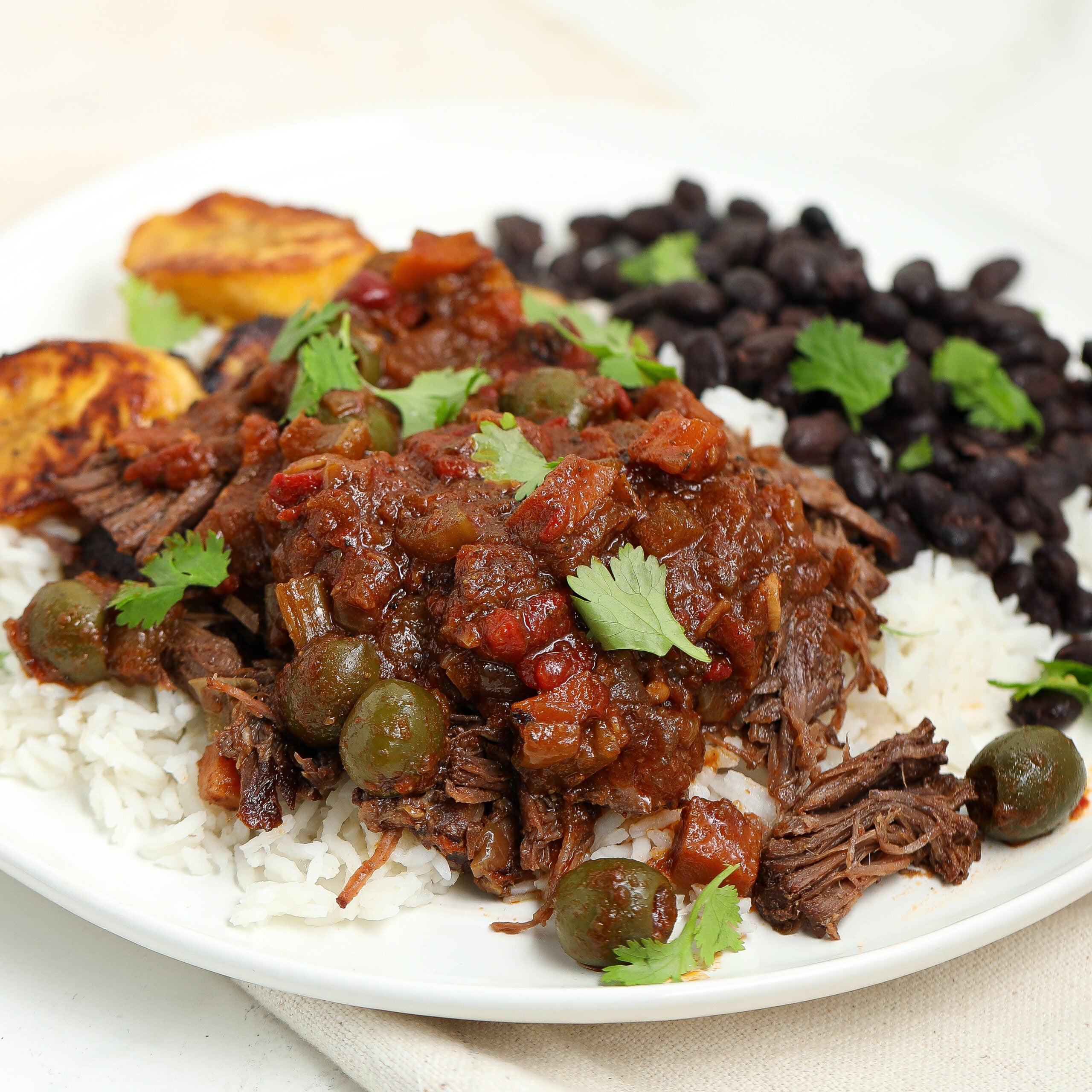
18 Cuban Recipes: Ropa Vieja, Mojo Pork & Arroz Con Pollo for Weeknight Dinners
Cuban home cooking runs on garlic, sour orange and a long braise — here's the whole repertoire, from Sunday ropa vieja to a pressed sandwich built from Tuesday's leftover pork.
Cuban home cooking is built from four cheap ingredients — onion, garlic, green bell pepper, cumin — plus time. Brown the meat hard, build a sofrito, add citrus and a bay leaf, and walk away. The 18 recipes below cover the whole repertoire, from a Sunday ropa vieja to a pressed sandwich you assemble out of Tuesday's leftover pork.
Get a free week of easy dinners
Seven weeknight dinners with the shopping list already totalled, sent Sunday. No account needed, unsubscribe in one click.
No spam, unsubscribe in one click. Recipes, shopping lists and Instacart carts all work without an account either way.
Introduction: Cuban Food Is Rice-and-Beans Comfort Cooking at Its Best
Cuban food has a reputation problem in American kitchens: people assume it's Mexican food with plantains, or that it's fiery. It is neither. There is essentially no chile heat in the classic Cuban repertoire. The flavor comes from garlic in quantities that look like a typo, sour citrus, cumin, oregano, and bay — and from browning, which is where most home cooks lose the dish before they've started.
That makes it unusually good weeknight material. A sofrito is 15 minutes of knife work and 10 minutes in the pan. After that, the technique is "cover it and leave it," which is a category of cooking that works around a job. Roughly two-thirds of the dinners below are one-pot, and four of them are genuinely under 45 minutes start to finish.
The other thing worth knowing before you shop: Cuban food is engineered around leftovers. Ropa vieja literally means "old clothes" — it was originally a way to use up boiled beef. A five-pound pork shoulder is Sunday's roast, Monday's rice bowl, and Wednesday's Cuban sandwich. Plan the week around one big braise and the rest of it costs you 20 minutes a night.
If you want the wider regional context, our Caribbean recipes by island guide puts Cuba next to Trinidad, Puerto Rico, the Dominican Republic and Haiti and shows where the techniques diverge.
The Cuban Sofrito Foundation (Onions, Garlic, Bell Peppers, Cumin)
Almost everything here starts the same way. Learn the base once and you've learned twelve dinners.
The ratio. For four servings: 1 large yellow onion, 1 green bell pepper, 6–8 cloves garlic, 2 tsp ground cumin, 1 tsp dried oregano, 2 bay leaves, and 2 tbsp olive oil. Cuban sofrito is green-pepper based and cumin-forward, which is what separates it from Puerto Rican sofrito (culantro, ají dulce, blended raw) and Spanish sofrito (tomato, no cumin).
Cut size matters more than you think. Dice the onion and pepper to about 1/4 inch. Larger and they won't collapse in the 10–12 minutes you're going to give them; smaller and they burn before the sugars develop. You want them soft and just starting to color at the edges, not browned.
Garlic goes in last, and it goes in mashed. Add it in the final 60 seconds. Garlic burns at around 300°F and turns acrid, and in a dish this garlic-dependent that failure is unrecoverable. For mojo specifically, mash the garlic with salt into a paste with the flat of a knife or a mortar — the salt acts as an abrasive and ruptures cells that chopping leaves intact, which is why paste-mojo tastes twice as strong as chopped-garlic mojo at the same clove count.
Then the sour orange. Mojo is garlic, cumin, oregano and naranja agria — bitter orange, which is tart like a lemon but with orange aromatics. Bottled Goya sour orange is in most US grocery Latin aisles and works fine. Without it, the standard substitution is 2 parts orange juice to 1 part lime juice plus a splash of grapefruit; that gets you about 90% of the way there.
Make a double batch of sofrito on Sunday. It refrigerates 5 days and freezes 3 months in a flat container — see storage for containers that stack without wasting freezer volume.
5 Slow-Braised Beef and Pork Classics (Ropa Vieja, Vaca Frita, Lechon)
This is the heart of it. Every one of these produces more than you'll eat in one sitting, and that's deliberate.
1. Authentic Cuban Ropa Vieja with Plantains — 15 min prep, 8 hours in the slow cooker, serves 4. Flank steak braised down until it shreds into strands in a sofrito-and-tomato sauce, served with sweet plantains. This is the flagship dish and the one to start with, because the slow cooker makes the 8-hour timeline free.
2. Cuban-Style Shredded Beef with Tomato and Bell Peppers — 20 min prep, 45 min cook, serves 4. The stovetop version, for when you didn't plan ahead at 7 a.m. It uses already-tender beef and reduces hard instead of braising long. Not as deep, but it's a Tuesday.
3. Slow Cooker Cuban-Style Mojo Pulled Pork — 20 min prep, 8 hours, serves 6. This is your lechón asado substitute and the single highest-leverage recipe on the list, because it feeds Sunday dinner and then becomes the filling for two of the three sandwiches below.
4. Citrus-Garlic Mojo Pork Roast — 30 min prep, 2 hours 15 min, serves 6. The oven version, with actual crackling skin. Marinate overnight if you can; 4 hours is the practical minimum for the citrus to penetrate past the surface.
5. Beef Picadillo with Sweet Plantains — 30 min prep, 1 hour, serves 4. Ground beef with olives, raisins and capers over rice. Picadillo is the cheapest dinner here per serving and the one kids reliably eat. If you want it faster, Picadillo with Ground Beef and Green Olives skips the plantains and lands in 45 minutes flat.
Two useful variations once you've made the base recipes: Citrus-Garlic Braised Pork Shoulder with Mojo Sauce (2h 35m, serves 6) is the Dutch-oven route with a better sauce than the slow cooker gives you, and Ropa Vieja Beef Tacos with Cabbage Slaw turns leftover braise into a second, structurally different dinner.
4 Cuban Chicken Dinners (Arroz con Pollo, Pollo Asado)
Chicken is where Cuban cooking gets fast. All four of these are weeknight-viable.
6. Brickell Street Cuban Mojo Chicken — 30 min prep, 35 min cook, serves 4. Bone-in chicken in a heavy mojo marinade, roasted until the skin crisps and the garlic goes sweet.
7. Sofrito-Infused Arroz con Pollo — 20 min prep, 35 min cook, serves 4, one pot. Chicken and rice cooked together so the rice absorbs the fat and the sofrito. The canonical Cuban weeknight dinner.
8. One-Pot Arroz con Pollo with Tomato and Bell Pepper — 20 min prep, 45 min cook, serves 4. A tomato-forward version with more vegetable bulk. Better for stretching to five people.
9. Cuban Mojo-Marinated Grilled Chicken with Citrus and Garlic — 15 min prep, 15 min cook, serves 6. Pollo asado over live fire. Fifteen minutes of actual cooking; the work is the marinade, done the night before.
For shredding into bowls and sandwiches, Cuban-Style Shredded Chicken with Mojo Sauce (25/45, serves 4) is the leaner alternative to pulled pork, and Citrus-Marinated Cuban Mojo Chicken Thighs hits the table in 35 minutes total.
4 Rice, Beans, and Plantain Sides
In a Cuban meal these aren't garnish — the rice and beans are half the plate by volume and most of the protein on a meatless night.
10. Authentic Cuban Black Bean Soup with Smoky Mojo Seasoning — 15 min prep, 2 hours 5 min, serves 6. Thick enough to eat over rice as a main. Freezes for three months.
11. Moros y Cristianos (Pigeon Peas and Rice) — 20 min prep, 40 min cook, serves 4, easy. Moros y cristianos — beans and rice cooked together so the grains take on the bean liquor and turn grey-brown. Cooking them separately and combining on the plate is a different, worse dish.
12. Tostones with Garlic-Lime Mojo Sauce — 15 min prep, 15 min cook, serves 4, easy. Twice-fried green plantains. Tostones live or die on the double fry: 325°F to cook through, smash, then 375°F to crisp. One fry gives you a limp disc.
13. Cinnamon-Sautéed Plantains — 10 min prep, 15 min cook, serves 4, easy. Maduros — the sweet, nearly-black ripe plantains. Buy them when the skin looks ruined. A yellow plantain is not ripe enough and will taste starchy.
Also worth knowing: Cuban-Style Black Bean Salad with Avocado and Lime (20 min, no cooking, serves 6, 250 cal) is the no-heat summer version, Cuban-Style Rum-Infused Black Bean Stew is a vegetarian main at 280 calories a serving, and Crispy Fried Plantains is the simplest possible entry point.
3 Cuban Sandwiches and Handhelds
14. Pressed Cuban Sandwich with Slow-Roasted Pork and Swiss — 10 min prep, 5 min press. Roast pork, ham, Swiss, yellow mustard, dill pickle, pressed on Cuban bread until the cheese fuses the layers. The Smithsonian's account of the sandwich's origins traces it to the cigar factories of Ybor City and Key West, where Cuban, Italian and German immigrant workers each contributed a layer — which is why Tampa's version has salami and Miami's doesn't. Serious Eats' technique breakdown for the Cuban sandwich is the best explanation of the press mechanics if you're doing it in a skillet.
15. Grilled Cuban-Style Pork Sandwiches with Mojo Sauce — 15 min prep, 15 min cook, serves 4. Faster, looser, grill-based. Skips the ham.
16. Cuban-Style Plantain and Black Bean Sliders — 15 min prep, 20 min cook, serves 8, easy, vegetarian. Mashed plantain and black bean patties. This is the one that works for a party where a third of the guests don't eat pork.
No sandwich press? A heavy skillet on top of the sandwich in a second skillet, weighted with a filled kettle, gets you to the same place. What matters is sustained pressure plus about 5 minutes of heat, not the specific tool.
2 Sweet Endings: Flan and Tres Leches
17. Slow-Cooked Rice Pudding with Sweetened Condensed Milk — 15 min prep, 45 min cook, serves 6, easy. Arroz con leche — cinnamon, lime zest, condensed milk. The default Cuban household dessert, and the cheapest thing in this article to make.
18. Three-Milk Soaked Tres Leches Cake with Cinnamon Whipped Cream — 20 min prep, 30 min bake, serves 12. Tres leches is claimed by half of Latin America and is firmly on the Cuban-American dessert table. Soak it a minimum of 4 hours; overnight is better, and it will not get soggy — a properly dry sponge absorbs about 1.5 times its own weight in the milk mixture.
On flan: the catalog's Leche Flan Baked Caramel Custard is the Filipino version of the same Spanish colonial custard, and the method is identical — the Filipino recipe just runs richer on egg yolks. Bake it in a water bath at 325°F and pull it when the center still wobbles as a single mass; carryover heat finishes it. Overbaked flan curdles into something grainy and there is no recovering it.
For the after-dinner coffee, Spiced Cuban Coffee Old Fashioned is a 7-minute adult version of the cafecito that ends every Cuban meal.
Building a Cuban Sunday Dinner Menu
The classic Sunday plate is one braise, one starch, one plantain, and salad. Here's a version for 8 people that costs about 90 minutes of active work:
| Course | Recipe | Active time | Start when |
|---|---|---|---|
| Main | Slow Cooker Cuban-Style Mojo Pulled Pork | 20 min | 7:00 a.m. |
| Rice | Moros y Cristianos | 20 min | 4:20 p.m. |
| Plantain | Cinnamon-Sautéed Plantains | 10 min | 4:45 p.m. |
| Salad | Cuban-Style Black Bean Salad with Avocado | 20 min | 3:30 p.m. |
| Dessert | Tres Leches Cake | 20 min | Saturday night |
Double the pork. Eight people will eat about 4 pounds of cooked shoulder; buy 7 pounds raw, because pork shoulder loses roughly 40% of its weight to rendered fat and moisture over an 8-hour braise. The surplus is Monday's rice bowl and Wednesday's sandwiches.
The AislePrompt shopping list merges duplicated ingredients across all five recipes, so the six onions and three heads of garlic show up as one line each instead of five — you buy the garlic once instead of finding it in five different places in the cart.
What You'll Need in the Kitchen
Cuban cooking is not equipment-hungry. Four things do almost all of it.
A 5- to 7-quart Dutch oven. Enameled cast iron holds a low simmer without scorching the bottom of a tomato-based braise, which a thin stainless pot will not. This is the single purchase that improves ropa vieja most — browse cookware for options that handle a 300°F oven for four hours.
A heavy skillet. Cast iron or carbon steel for tostones and vaca frita. You need a pan that holds its temperature when you drop cold plantain into hot oil; a thin nonstick pan drops 60–80°F on contact and the tostones absorb oil instead of crisping.
A real chef's knife. You will mince eight cloves of garlic, dice two onions and a pepper before every single dinner in this article. A dull knife turns a 15-minute prep into 30 and bruises the onion into bitterness. See knives for picks that hold an edge through daily use.
A citrus juicer and a mortar. Mojo runs on volume — a single pork roast wants a cup of juice, which is 6–8 limes hand-squeezed. A $15 press does it in two minutes. Check gadgets for presses and utensils for a mortar and pestle, which makes garlic paste properly.
Optional but useful: a slow cooker or multicooker from small-appliances makes the 8-hour braises a set-and-forget morning task instead of an all-day kitchen commitment.
Real-world numbers: time, cost, and calories per dinner
Rough figures as of 2026, using US supermarket prices and the nutrition data attached to each recipe:
| Dish | Active time | Total time | Calories/serving | Protein (g) |
|---|---|---|---|---|
| Beef Picadillo with Green Olives | 15 min | 45 min | 380 | 25 |
| Cuban-Style Shredded Chicken with Mojo | 25 min | 70 min | 520 | 38 |
| Citrus-Garlic Braised Pork Shoulder | 15 min | 2h 35m | 420 | 32 |
| Ropa Vieja Beef Tacos | 20 min | 2h 45m | 420 | 32 |
| Rum-Infused Black Bean Stew | 10 min | 1h 55m | 280 | 18 |
| Cuban-Style Black Bean Salad | 20 min | 20 min | 250 | 8 |
The pattern to notice: active time barely moves between the 45-minute dinner and the 2h 45m one. Cuban braises are cheap in attention and expensive in clock. Start them before you need them and the weeknight cost is 15–20 minutes.
Common pitfalls
Not browning the meat hard enough. The most common failure by a wide margin. Pale meat gives you a grey, thin braise. Get the pan properly hot, dry the meat with paper towels, work in two batches, and accept 4–5 minutes per side. Crowding the pan drops the temperature below the browning threshold and the meat steams in its own liquid.
Burning the garlic. Add it in the last minute of the sofrito, never at the start with the onion. Burnt garlic is bitter and it perfumes the entire pot.
Using sweet oranges instead of sour. Regular orange juice makes mojo taste like a marinade from a supermarket bottle. If you can't find naranja agria, use 2 parts orange to 1 part lime — the acidity is what cuts the pork fat, and sweet orange alone doesn't have it.
Under-ripe plantains for maduros. Yellow plantains are still starchy. For sweet plantains you want the skin mostly black. Green plantains are a different ingredient entirely and only work for tostones.
Cooking rice and beans separately for moros. They have to cook together in the bean liquid. Combining them at the end gives you white rice next to beans, which is a fine dinner but is not moros y cristianos.
Pulling pork too early. Shoulder is done at shreddable, not at a temperature. Foodsafety.gov's minimum internal temperature chart puts pork's safe minimum at 145°F, but a shoulder is still tough there — collagen doesn't break down into gelatin until roughly 195–205°F. Safe and done are 50 degrees apart on this cut.
When NOT to cook Cuban on a weeknight
Skip the braises entirely if you're starting dinner after 6 p.m. and haven't prepped. Ropa vieja and mojo pork are not compressible — there's no 30-minute version that tastes like the real thing, and the ones that claim to be are just stewed beef. On those nights, cook arroz con pollo (35 minutes, one pot) or picadillo (45 minutes) and save the braise for a day when the slow cooker can run while you're out.
Also skip it if you're cooking for someone avoiding pork and you haven't planned around it. Pork is load-bearing in this cuisine — it's in the sandwiches, the roast, and often the beans. The plantain-and-black-bean sliders and the rum black bean stew are the two genuinely pork-free mains here, and you'd want to build the whole menu around them rather than substituting at the last minute.
Related guides
- Caribbean Recipes by Island: Trinidad, Cuba, Puerto Rico & Dominican — where Cuban technique diverges from its neighbors
- 20 Dutch Oven Dinners: One-Pot Braises, Stews & Weeknight Roasts — the pot that runs this whole article
- Back-to-School Slow Cooker Dinners: 4-Week Meal Plan — how to fit an 8-hour braise around a school week
FAQ
See the frequently-asked questions below for sour orange substitutions, oven-versus-slow-cooker timing, equipment, authenticity, and which of these dishes freeze well.
Sources
- Ropa vieja — Wikipedia
- Cuban sandwich — Wikipedia
- Mojo (sauce) — Wikipedia
- The Cuban Sandwich: A History — Smithsonian Magazine
- Cuban Sandwich technique — Serious Eats
- Safe Minimum Internal Temperatures — Foodsafety.gov
Frequently asked questions
What is mojo and can I buy it at the grocery store?
Can I use a regular oven if I don't have a slow cooker for ropa vieja?
What kitchen equipment do I need for Cuban cooking?
How authentic is 'Cuban-American' cooking versus food actually made in Cuba?
Which of these dishes work for meal prep and freezing?
Sources
Plan a week of meals in two minutes.
Tell our AI what you have and what you like — it builds your plan, shopping list, and Instacart cart. No account needed.
Try free →