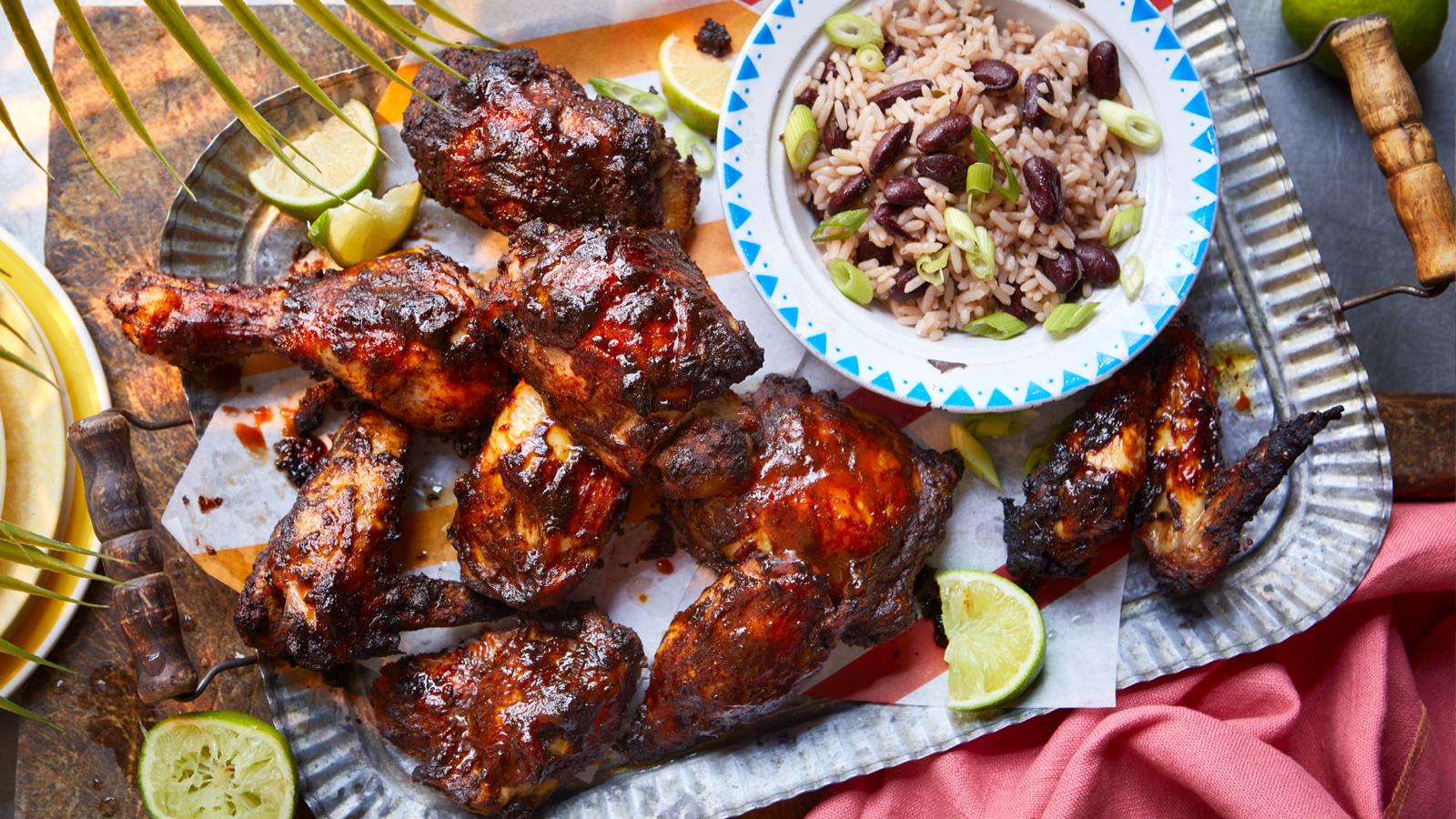
18 Jamaican Recipes: Jerk Chicken, Curry Goat, Ackee & Rice-and-Peas Dinners
Four techniques — jerk, curry, brown stew, one-pot coconut rice — carry the whole Jamaican canon, and eighteen recipes fall out of them.
Authentic Jamaican home cooking runs on four techniques: jerk (a scotch-bonnet-and-pimento marinade, grilled or roasted), curry (Jamaican curry powder bloomed in oil and finished long and slow), brown stew (browning plus a covered simmer), and one-pot coconut rice. Learn those four and the eighteen recipes below stop being eighteen projects and start being variations.
Get a free week of easy dinners
Seven weeknight dinners with the shopping list already totalled, sent Sunday. No account needed, unsubscribe in one click.
No spam, unsubscribe in one click. Recipes, shopping lists and Instacart carts all work without an account either way.
Jamaica punches far above its size in the world's kitchens, and the reason is compression. Taíno barbacoa smoking met West African one-pot stewing, met Indian and Chinese indenture-era curry and stir-fry, met Spanish and British colonial pantries, all on an island 146 miles long. That is why a single Jamaican plate can carry allspice-smoked pork, a curry that traces to Madras, coconut rice with Ghanaian roots, and a British-derived meat patty with a turmeric crust. Nothing on the island stayed in its lane.
The practical upside for a home cook in 2026 is that Jamaican food is unusually forgiving. Most of the canon is braised, stewed, or marinated — techniques that reward walking away, not hovering. There is exactly one specialty ingredient you genuinely cannot fake (scotch bonnet), one you should not substitute (whole pimento berries), and one you can buy already made (browning). Everything else is chicken, rice, beans, and time.
The four pillars of Jamaican cooking
Almost every savory dish on the island is a variation on one of four methods. Sorting them this way is what turns a long recipe list into a repertoire.
Jerk is a marinade and a fire, not a sauce. Scotch bonnet, scallion, thyme, ground pimento, and a hit of sweetness go into a paste that sits on the protein for anywhere from four hours to overnight. The traditional cook is over green pimento wood; a home cook gets 85 percent of the way there with a covered charcoal grill and a handful of soaked wood chips, or a 425°F oven with a final broil. See the Jerk (cooking) history for how the technique traveled from Maroon communities in the Blue Mountains to the roadside pans of Boston Bay.
Curry in Jamaica is not Indian curry with a Caribbean accent — it is its own line. Jamaican curry powder leans hard on turmeric and allspice, so it tastes earthier and more golden than a Madras blend. The non-negotiable step is blooming: the powder goes into hot oil for 60 to 90 seconds before any liquid, which cooks off the raw dustiness. Skip it and the dish tastes chalky no matter how long you simmer.
Brown stew is the technique most cooks outside the island have never met. Protein gets seared in caramelized sugar or bottled browning, then simmered covered with thyme, allspice, scotch bonnet, and aromatics until the sauce reduces to a glossy mahogany. It is closer to a French braise than to anything spicy, and it is the single best entry point if you are cooking for people who do not want heat.
One-pot rice covers rice and peas, cook-up rice, and pelau. Coconut milk, a whole scotch bonnet dropped in unbroken, thyme, and pigeon peas or kidney beans go in with long-grain rice, and the pot does the rest. This is the dish that turns two proteins into a meal for six.
The Jamaican pantry: five things worth buying properly
You can cook this entire list with a standard supermarket pantry plus five additions. None cost more than $8 as of 2026.
| Ingredient | What it does | Cost | Substitute? |
|---|---|---|---|
| Scotch bonnet peppers | Fruity heat, 100k–350k SHU | $4–6/lb fresh | Habanero (closest); jalapeño is not a substitute |
| Whole pimento (allspice) berries | The defining jerk aroma | $4/2oz jar | Ground allspice at half volume, in a pinch |
| Fresh thyme (on the stem) | Goes in whole, comes out whole | $2/bunch | Dried thyme at one-third volume |
| Browning sauce | Mahogany color for brown stew | $4/5oz bottle | Burnt sugar you make yourself (see below) |
| Full-fat coconut milk | Rice, curries, rundown | $2/can | None — light coconut milk breaks the dish |
Two notes that matter more than they look. First, scotch bonnets carry a distinct apricot-and-tomato fruitiness that habaneros only approximate and that jalapeños do not have at all; a dish built on jalapeño heat tastes like a different cuisine. Second, pimento — the allspice berry — is native to Jamaica and is genuinely the flavor most people identify as "jerk." Buy whole berries and crack them yourself; pre-ground allspice loses its volatile oils within about six months of opening.
If you cannot find browning sauce, make it: melt 1/2 cup sugar in a dry pan over medium heat until it goes past amber to near-black and starts to smoke faintly, then kill the heat and carefully add 1/2 cup hot water. It will spit. It keeps in a jar for months.
Five jerk recipes, from chicken to tofu
Jerk is where most people start, and chicken is where most people should start. Thighs beat breasts by a wide margin here — the marinade is aggressive and lean white meat dries out before the crust develops.
Native Caribbean Jerk Chicken is the baseline: 10 minutes of prep, 20 minutes of cook, 320 calories and 28g protein per serving across four servings. Marinate overnight if you can; four hours is the practical floor for the pimento to penetrate past the surface.
Jerk Chicken with Mango Salsa is the version to make when you are cooking for people who are nervous about heat. The salsa is not a garnish — the acid and sugar in ripe mango genuinely blunt capsaicin on the palate, and it drops the perceived heat of a full scotch bonnet by roughly half. 400 calories, 35g protein, 45 minutes total.
Jamaican Jerk Grilled Shrimp Skewers is the fastest jerk on this page: 15 minutes of prep and 8 minutes over the fire. Shrimp only need 20 to 30 minutes in the marinade — any longer and the salt and acid start to cure the flesh into rubber. This is the weeknight jerk.
Instant Pot Caribbean Jerk Pork Shoulder solves the problem that jerk pork is a five-hour dish. Eighty minutes under pressure gets you shreddable shoulder; finish it under the broiler for six minutes to rebuild the bark you lost. Six servings at 480 calories and 45g protein — this is the single most cost-efficient recipe here at roughly $2.20 a serving.
Jerk Tofu with Mango Salsa is the vegetarian entry that actually works, because tofu is a sponge and jerk marinade is exactly the kind of aggressive, high-salt, high-acid liquid a sponge wants. Press the tofu for 30 minutes first — undrained tofu dilutes the marinade and never crusts.
Two more worth knowing: Jerk Salmon with Pineapple Salsa at 25 minutes total, and Jerk Vegetable Stir-Fry for using up the last third of a jar of marinade on a Tuesday.
Three Jamaican curries
Curry goat is the Sunday dish, the wedding dish, and the dish most likely to be judged. It is also almost impossible to ruin, because the fix for every problem is more time.
Slow-Cooked Kid Goat Curry with Coconut and Spices runs 15 minutes of prep and 150 minutes of cook for six servings at 450 calories and 40g protein. Goat shoulder is the cut; ask a halal or Caribbean butcher for bone-in pieces, which run $6–9/lb as of 2026 and contribute the collagen that makes the sauce cling. If goat is genuinely unavailable, lamb shoulder is the substitute and it needs about 30 minutes less.
The technique that separates good curry goat from great is the two-stage bloom. Green-seasoning the meat overnight (scallion, thyme, garlic, scotch bonnet, allspice, a splash of vinegar) is stage one. Blooming the curry powder in hot oil until it darkens and smells nutty, then adding the drained meat to that oil, is stage two. Most home versions skip stage two and dump powder into liquid; that is the single most common failure mode in this dish.
For a lighter, weeknight-scale curry, Jamaican Spiced Chicken and Coconut Rice with Black Beans puts protein and starch in one pot in 50 minutes, four servings at 520 calories and 32g protein. It is not strictly a curry goat substitute, but it hits the same coconut-and-allspice register on a Wednesday.
Brown stew and the one-pot classics
Brown Stew Chicken with Caribbean Thyme and Scotch Bonnet is the dish to make first if you are cooking Jamaican food for skeptics. Sixty-five minutes total, four servings, 450 calories and 40g protein, and the heat is entirely controllable because the scotch bonnet goes in whole and comes out whole. Puncture it and you have a different, much hotter dish; leave it intact and you get the fruit without the burn.
Oxtail Stew with Scotch Bonnet and Allspice is the long game: 20 minutes of prep, 180 minutes of cook, 550 calories and 40g protein across four servings. Oxtail has gone from a cheap cut to a $9–13/lb cut over the last decade, which makes this the most expensive dish on the page at roughly $6.50 a serving. It is also the one people remember. Butter beans go in during the last 30 minutes, never at the start — they disintegrate.
A pressure cooker cuts oxtail to about 55 minutes at high pressure, but you lose some of the reduction. If you go that route, strain the liquid and reduce it hard on the stovetop for 10 minutes before serving.
Coconut Fish Stew with Callaloo is the rundown-adjacent dish on this list — 50 minutes, 350 calories, 30g protein — and it is the fastest way to get the coconut-and-thyme flavor without a three-hour braise.
The sides that make it a plate
A Jamaican plate is not a protein with a garnish. The starch carries equal weight, and rice and peas is the non-negotiable one.
Jamaican Rice and Peas with Scotch Bonnet and Coconut Milk takes 35 minutes for four servings at 350 calories. Despite the name, rice and peas contains no peas — "peas" means kidney beans or, traditionally, gungo (pigeon) peas. If you use dried beans, their cooking liquid is the ingredient: it is what turns the rice pink-brown and gives it depth. Canned beans work but rinse them and add a tablespoon of tomato paste to replace the missing body.
Crispy Fried Plantains at 45 minutes for four servings and 220 calories. The variable nobody tells you about is ripeness. Yellow-with-black-spots plantains fry sweet and soft; fully yellow plantains fry starchy and bland; fully black plantains are for baking, not frying. Buy them green four days ahead and let them turn on the counter.
Stewed Callaloo with Coconut Milk is the green on the plate — 30 minutes, 150 calories, and the closest analogue to collards in the Jamaican canon. Canned callaloo is genuinely fine here and is what most Kingston households use midweek; drain and rinse it or the dish goes salty.
Breakfast and street food
Ackee and saltfish is Jamaica's national dish and the thing most visitors remember. It is also the one recipe on this page with a real safety rule attached.
Saltfish and Ackee Breakfast Fry-Up runs 30 minutes for three servings at 350 calories and 30g protein. Use canned ackee, full stop. Unripe ackee contains hypoglycin A, which causes Jamaican vomiting sickness; the FDA maintains an active import restriction on the fruit and only permits canned product from approved processors, documented in FDA Import Alert 21-11. Canned ackee has already been harvested at the right stage and processed. Do not buy fresh ackee from an informal source, and do not forage it.
The other rule: ackee has the structural integrity of soft scrambled egg. Fold it in at the very end and stir maybe three times. Anything more and you have yellow mush.
Spiced Jamaican Beef Patties with Turmeric Dough is an 80-minute project for eight patties at 320 calories each — about $1.05 a patty against $3.50 to $4.50 at a bakery. They freeze raw beautifully. Assemble a double batch, freeze on a sheet tray, bag them, and bake from frozen at 400°F for 28 minutes.
Pan-Fried Saltfish and Callaloo Fritters with Scotch Bonnet Aioli covers the fritter tradition in 35 minutes. Soak the saltfish overnight in three changes of water; a single soak leaves it aggressively salty and there is no fixing it downstream.
Real-world numbers: what these dinners actually cost
Rough US grocery pricing as of mid-2026, calculated for four servings including the starch side. Times are total, not active.
| Dish | Total time | Cost/serving | Calories | Protein |
|---|---|---|---|---|
| Jerk shrimp skewers | 23 min | $4.10 | 350 | 32g |
| Brown stew chicken | 65 min | $2.85 | 450 | 40g |
| Jerk chicken (thighs) | 30 min + marinade | $2.40 | 320 | 28g |
| Instant Pot jerk pork | 100 min | $2.20 | 480 | 45g |
| Curry goat | 165 min | $5.60 | 450 | 40g |
| Oxtail stew | 200 min | $6.50 | 550 | 40g |
| Beef patties (8) | 80 min | $1.05 | 320 | 18g |
| Rice and peas (side) | 35 min | $0.65 | 350 | 8g |
Two takeaways. Jerk pork shoulder is the value play: 45g of protein for $2.20 a serving, and it produces enough leftovers for a second dinner. Oxtail is the splurge and always will be — the price has roughly tripled since 2015 as the cut moved from offcut to trend.
Common pitfalls
Marinating jerk protein for too short a time. Four hours is the floor for chicken, overnight is right, and 24 hours is not too long. Thirty minutes produces jerk-seasoned chicken, not jerk chicken — the pimento and thyme never get past the surface.
Puncturing the scotch bonnet in a stew. Whole and intact, it perfumes the pot. Split, it dominates it. If you want real heat, mince a quarter of one and leave the rest whole so you keep control.
Adding curry powder to liquid. Bloom it in oil for 60 to 90 seconds first, until it darkens a shade and smells nutty rather than dusty. This is the highest-leverage 90 seconds in Jamaican cooking.
Using light coconut milk. It is water with a coconut memory. Rice and peas made with light coconut milk comes out dry and pale; curries made with it break and go grainy. Full-fat or nothing.
Not soaking saltfish enough. Overnight, three water changes, taste before you commit. Once salted cod goes into a dish over-salted, no amount of potato or cream will pull it back.
Crowding the pan on brown stew. The sear is the entire color story. Two batches with room around each piece beats one crowded batch every time, and it costs you five extra minutes.
When not to cook Jamaican on a weeknight
Curry goat and oxtail are Sunday food, and pretending otherwise leads to a 9:30 p.m. dinner. Both need 2.5 to 3 hours of unattended braising, and while a pressure cooker compresses that, it also flattens the sauce reduction that makes them worth the effort.
Skip jerk entirely on a weeknight unless you marinated the night before. The marinade time is not optional and there is no shortcut — a heavier hand with the paste does not compensate for missing hours.
Patties are a weekend project too. The dough needs two rests, and rushing them gives you tough, gray-crusted turnovers.
What does work on a Tuesday: jerk shrimp (23 minutes), brown stew chicken (65 minutes, mostly hands-off), the coconut-rice chicken one-pot (50 minutes), or reheated anything from Sunday. Jamaican braises reheat better than almost any other cuisine — the stews are measurably better on day two as the allspice and thyme keep extracting.
How to build a Sunday Jamaican dinner
The classic plate is jerk chicken, rice and peas, fried plantain, and a green. Here is the timeline for six people, working backward from a 6:00 p.m. dinner.
Saturday, 8:00 p.m. — Blend the jerk marinade, coat the chicken thighs, refrigerate. Soak dried kidney beans if you are using them. Total active time: 20 minutes.
Sunday, 3:30 p.m. — Start the beans in coconut milk with thyme and a whole scotch bonnet. They need about 75 minutes before the rice goes in.
Sunday, 4:45 p.m. — Rice into the bean pot, lid on, heat low. Do not lift the lid. Meanwhile slice plantains and set up the fry pan.
Sunday, 5:10 p.m. — Chicken onto the grill or into a 425°F oven. Thirty to thirty-five minutes; finish with three minutes under the broiler for the char.
Sunday, 5:35 p.m. — Fry the plantains. They take about 12 minutes total and go from perfect to burnt in roughly 45 seconds, so this is the one step where you stand there.
Sunday, 5:50 p.m. — Callaloo into a pan with coconut milk, 8 minutes. Rest the chicken while it cooks.
Total active time across two days: about 70 minutes. Cost for six: roughly $27, or $4.50 a head.
What to buy
You do not need specialty gear for any of this, but four things earn their space.
A heavy Dutch oven, 5.5 quarts or larger, is the single most-used tool here — it does brown stew, curry goat, oxtail, and rice and peas. Enameled cast iron is ideal because the acid in the browning and tomato will strip a bare cast-iron seasoning over time. Browse cookware for the size that fits your burner.
A sharp 8-inch chef's knife matters more than usual because you are breaking down bone-in chicken, cubing goat shoulder, and slicing plantains thin enough to crisp. Dull knives crush plantain rather than cutting it. See knives.
A blender or small food processor for the jerk paste. A mortar and pestle is traditional and produces a better texture, but a blender is what most people will actually use twice a month. The small appliances category covers both immersion and countertop options.
Long-handled tongs and a sturdy spider for grilling and frying — plantains in 350°F oil are not a job for a fork. Utensils has the basics.
For ingredients, grocery covers the shelf-stable half of the pantry list: coconut milk, canned ackee, canned callaloo, browning, whole pimento, and Jamaican curry powder. Scotch bonnets and fresh thyme come from a Caribbean or Latin market, or online — scotch bonnets freeze whole with no meaningful loss, so buy a pound and freeze what you don't use.
Nutrition figures on this page come from the recipe catalog and cross-check against USDA FoodData Central for the base ingredients.
FAQ
What's the difference between jerk seasoning and jerk marinade, and can I make jerk without a grill?
Jerk seasoning is the dry spice blend (pimento, thyme, scotch bonnet flakes, scallion powder); jerk marinade is that blend wet-blended with fresh scotch bonnet, scallion, garlic, soy, vinegar, and oil into a paste. The marinade is what you want for chicken and pork. Yes, you can make excellent jerk without a grill: roast at 425°F on a rack for 35 minutes, then broil 3-4 minutes for char. A stovetop smoker or a handful of soaked pimento wood chips in a foil packet under the broiler gets you most of the smoke.
How hot is a scotch bonnet, and what can I use instead?
Scotch bonnets run 100,000-350,000 Scoville units, roughly 12-40x a jalapeño, but they carry a distinct fruity apricot-tomato note that habaneros only approximate and jalapeños don't have at all. Habanero is the only true substitute. To dial back heat without losing flavor, drop the pepper into stews whole and unbroken, then remove it before serving — you get the aroma and about 20% of the capsaicin. Removing seeds and white pith cuts heat by roughly half.
Is ackee safe to eat, and where do I buy it?
Canned ackee from an FDA-approved processor is entirely safe and is what every Jamaican household outside the island uses. Unripe fresh ackee contains hypoglycin A, a toxin that causes Jamaican vomiting sickness, which is why the FDA maintains an import restriction permitting only canned product from vetted facilities. Buy canned, drain gently, and fold it in during the last two minutes of cooking. Never buy fresh ackee from an informal seller and never forage it in Florida or Hawaii where the tree grows.
What's the fastest Jamaican weeknight dinner I can actually make?
Jerk shrimp skewers, about 23 minutes start to finish. Toss a pound of peeled shrimp with 3 tablespoons jerk marinade for 20 minutes maximum (longer turns the texture rubbery), thread onto skewers, and grill or broil 3-4 minutes a side. Serve over leftover rice with lime and a fried plantain. Cost lands around $4.10 per serving, and it delivers 32g of protein. Brown stew chicken is the next-fastest at 65 minutes, most of it unattended simmering.
Do I need Jamaican curry powder, or will Indian curry powder work?
They're different products and the swap is noticeable. Jamaican curry powder is turmeric-forward with allspice and less cumin, giving it a golden, earthy profile; Madras and other Indian blends lean on cumin, coriander, and chili, which reads spicier and more aromatic. If Jamaican powder is unavailable, use a mild Madras blend plus a quarter teaspoon of ground allspice per tablespoon and an extra pinch of turmeric. Either way, bloom it in hot oil for 60-90 seconds before adding liquid.
Related guides
If you want the wider region, start with 20 Caribbean Dinner Recipes for the four-technique overview across the islands, then Caribbean Recipes by Island for how Trinidad, Cuba, Puerto Rico, and Haiti diverge from Jamaica. For neighboring cuisines that share the coconut-and-chili register, see 18 Cuban Recipes and 18 West African Recipes, which is where rice and peas and callaloo trace back to.
Frequently asked questions
What's the difference between jerk seasoning and jerk marinade, and can I make jerk without a grill?
How hot is a scotch bonnet, and what can I use instead?
Is ackee safe to eat, and where do I buy it?
What's the fastest Jamaican weeknight dinner I can actually make?
Do I need Jamaican curry powder, or will Indian curry powder work?
Sources
- en.wikipedia.org
- en.wikipedia.org
- en.wikipedia.org
- en.wikipedia.org
- en.wikipedia.org
- fdc.nal.usda.gov
- accessdata.fda.gov
Plan a week of meals in two minutes.
Tell our AI what you have and what you like — it builds your plan, shopping list, and Instacart cart. No account needed.
Try free →