18 Portuguese Recipes: Bacalhau, Piri Piri & Caldo Verde Weeknight Dinners
Shred the kale to a millimeter, marinate the chicken overnight, and soak the salt cod for two days — everything else in Portuguese cooking is easy.
Portuguese recipes at home come down to four pantry items — good olive oil, smoked paprika, chouriço, and piri piri — plus salt cod when you want to cook the national dish properly. Most of the weeknight repertoire is one pan and under 40 minutes; the projects are salt cod and slow pork, and both are mostly waiting.
Get a free week of easy dinners
Seven weeknight dinners with the shopping list already totalled, sent Sunday. No account needed, unsubscribe in one click.
No spam, unsubscribe in one click. Recipes, shopping lists and Instacart carts all work without an account either way.
Introduction: Portugal's cooking sits between Mediterranean and Atlantic
Portugal is technically a Mediterranean country that does almost none of its cooking on the Mediterranean. Its entire 1,100-mile coastline faces the Atlantic, and that geographic accident shapes the food more than anything else. Where Spain, Italy, and Greece lean on tomato, olive, and sun, Portugal leans on cold-water fish, cabbage, potato, pork, and a genuinely fierce love of salt cod.
Portugal also spent 400 years running the first global trade network, and it brought the ingredients home. Piri piri chilies came from Mozambique and Angola. Cinnamon and black pepper came from Goa. Cilantro — which most of Southern Europe treats with suspicion — is a core Portuguese herb, a leftover of Moorish and African contact. That is why Portuguese food does not taste like Spanish food despite sharing a peninsula: it is Iberian technique carrying spices nobody else in Europe was using in 1600.
For a home cook the practical draw is that Portuguese cooking is cheap. The canonical dishes are built on the least expensive proteins available — salt cod, sardines, pork shoulder, chicken, chouriço — stretched with potato, kale, and beans. A caldo verde for six costs about $8. As of 2026, salt cod runs $14–20 per pound at Portuguese and Italian markets, which sounds high until you remember it triples in weight when rehydrated.
The Portuguese pantry: piri piri, smoked paprika, chouriço, salt cod
Piri piri (also spelled peri peri) is the small, extremely hot African bird's-eye chili — 50,000–175,000 Scoville — that Portuguese traders brought back from Mozambique. In practice you will buy it as a sauce: chilies, garlic, lemon, vinegar, oil, and sometimes whisky, blended and rested. Homemade is better and takes ten minutes; store-bought Nando's-style is fine.
Chouriço is the paprika-and-garlic cured pork sausage that flavors half the soups and stews in the country. It is not Spanish chorizo, though Spanish chorizo substitutes acceptably — Portuguese chouriço is generally wine-forward and less intensely smoked. Linguiça is its milder cousin. Either works.
Smoked paprika (pimentão doce) does the heavy lifting in marinades and rubs. Buy Spanish or Portuguese sweet smoked paprika, not Hungarian — the smoke matters.
Salt cod (bacalhau) is the national obsession. Portugal claims 365 bacalhau recipes, one per day. It arrives stiff as plywood, packed in salt, and requires 24–48 hours of soaking in the refrigerator with the water changed every 8 hours. Buy a thick center-cut lombo if you can — the tail sections are thin, bony, and cook unevenly.
Also worth stocking: good Portuguese olive oil (fruitier and more peppery than most Spanish), bay leaves, dried red beans, and a bottle of dry white wine you would actually drink.
| Ingredient | Cost | Where to buy | Substitutes |
|---|---|---|---|
| Salt cod, center-cut lombo | $14–20/lb | Portuguese, Italian, Caribbean markets | Fresh cod, salted 24h at home |
| Chouriço | $6–9/lb | Most supermarkets, Portuguese delis | Spanish chorizo, linguiça, andouille |
| Piri piri sauce | $5–8 | Supermarket hot-sauce aisle | Homemade: bird's eye + garlic + lemon |
| Smoked sweet paprika | $4–7 | Spice aisle | Regular paprika + ¼ tsp smoked salt |
| Portuguese olive oil | $10–18/L | Specialty grocers | Any good Spanish or Greek EVOO |
Bacalhau 101: which cut to buy, how to soak it, and 3 easy prep angles
Salt cod is the single technique that separates people who cook Portuguese food from people who read about it. It is not hard; it just requires planning two days ahead.
Buying. Look for thick, white, flexible-when-pressed pieces from the loin. Yellowed, brittle, or paper-thin pieces are old or from the tail. A 1-pound piece of dried salt cod yields roughly 2 pounds rehydrated and feeds four.
Soaking — the actual protocol:
1. Rinse off the surface salt under cold running water, hard, for 60 seconds.
2. Submerge in cold water in a non-reactive container, cover, refrigerate.
3. Change the water every 8 hours. Thin pieces need 24 hours; thick loin needs 36–48.
4. Test by tasting a small raw flake at the 24-hour mark. It should taste seasoned, not salty. Under-soaked cod ruins the dish; over-soaked cod goes bland and mushy.
5. Drain, pat dry, and either poach gently for 8 minutes or flake it raw into the recipe depending on the preparation.
Three preparations to start with:
- Bacalhau à Brás — flaked cod, matchstick potatoes fried crisp, onion, and eggs folded together off the heat until just barely set. The eggs must not scramble; they are a binder, not a component.
- Bacalhau com Natas — flaked cod layered with potato and onion under cream and béchamel, baked until browned. This is the gateway version; nobody dislikes it.
- Bacalhau à Gomes de Sá — cod, potato, onion, olives, and hard-boiled egg baked with generous olive oil. The most restrained of the three and the easiest to get right.
If you are not ready to commit two days, spiced Portuguese-style cod with tomato and olive ragout gets you the flavor profile with fresh cod in 35 minutes, and it is the honest weeknight substitute.
Piri piri chicken done right on a sheet pan or grill
Frango piri piri is Portugal's most exported dish, and almost every version served outside Portugal is wrong in the same way: not spatchcocked, and marinated for 30 minutes instead of overnight.
The method:
1. Spatchcock the bird. Cut out the backbone with shears, press flat. This drops roast time from 70 minutes to about 40 and makes the thigh and breast finish together.
2. Marinate 8–24 hours in piri piri sauce, crushed garlic, smoked paprika, lemon juice, olive oil, and salt. Under four hours and the flavor sits on the surface only.
3. Reserve half the marinade un-touched by raw chicken. That is your basting sauce and table sauce.
4. Cook hot. 425°F oven on a rack over a sheet pan, or a two-zone grill: indirect for 25 minutes, then skin-side down over direct heat for 6–8 to blister.
5. Baste in the last 10 minutes only. The sugar and lemon in the marinade scorch if applied early.
6. Pull at 165°F in the thigh, rest 10 minutes.
Sheet-pan versions get you 90% of the result with zero fire management: sheet pan Portuguese-style roasted chicken with piri-piri sauce and sheet pan Portuguese-inspired chicken with piri piri marinade are both weeknight-viable. For the grill, grilled piri-piri chicken with Alfama citrus marinade leans harder on lemon, and grilled peri-peri chicken with spicy paprika marinade is the smokier variant.
Slower and hands-off: slow cooker Portuguese-style chicken with piri piri sauce. Faster: pan-seared chicken with Portuguese piri-piri sauce in about 25 minutes, or one-pan piri piri chicken with roasted vegetables for a complete plate. Piri-piri chicken with lemon and olives adds a briny counterweight that works well against the heat.
Caldo verde, açorda, and other weeknight Portuguese soups
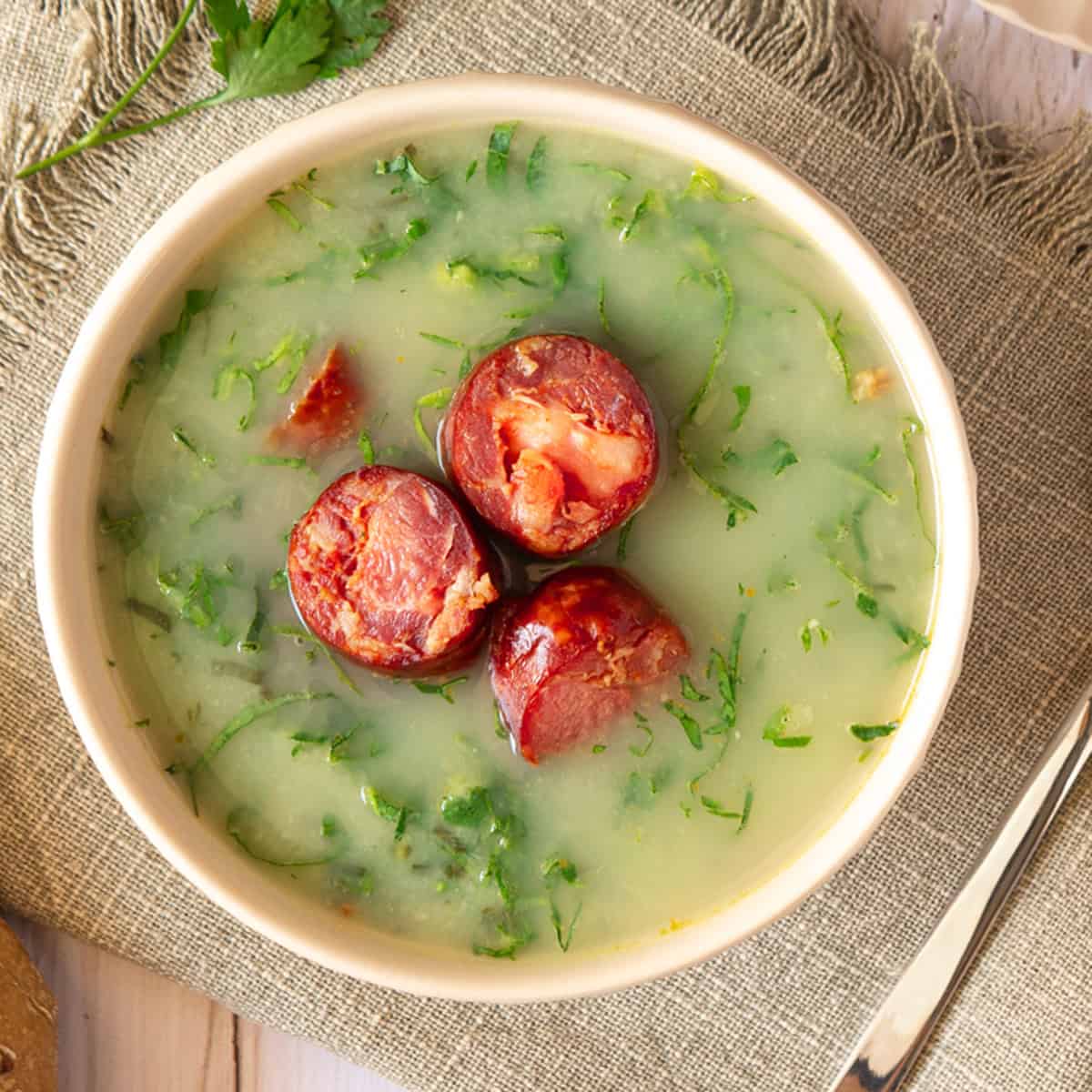
Caldo verde is the one everybody knows: potato-and-onion purée thinned to a broth, with chouriço and hair-thin ribbons of collard or kale dropped in at the end. It is served at every wedding and every festival in the north, and it is a four-ingredient soup that lives or dies on two details.
Detail one: the greens must be shredded to 1–2 millimeters. Traditionally couve galega, which nothing in an American supermarket exactly matches; collards are closer than kale in texture, kale is closer in flavor. Stack the leaves, roll them into a tight cigar, and slice as thin as your knife allows. Thick ribbons make it a kale-and-potato soup instead of caldo verde.
Detail two: the greens go in for 3–5 minutes, no more. They should stay emerald and have bite. Overcooked greens turn the whole pot olive-drab and sulfurous.
Cook the chouriço separately, slice it into coins, and float it on top so the soup base stays clean and the sausage stays firm. Try spiced Portuguese-style caldo verde soup with kale and chorizo or smoky chouriço potato kale soup.
Açorda is the other Portuguese soup idea worth stealing: day-old bread torn into a garlic-and-cilantro broth, sometimes with a poached egg, sometimes with shrimp. It exists to use stale bread and it is genuinely excellent. The closest thing in most kitchens is a garlic bread soup — the technique transfers exactly.
Sopa da pedra ("stone soup") is the hearty one: red beans, pork, chouriço, potato, and whatever else is around. Portuguese-style feijoada with mixed pork cuts and chorizo covers the same territory — note that Portuguese feijoada uses white or red beans and is a different animal from the Brazilian black-bean version.
Seafood beyond bacalhau: octopus, sardines, clams
Portugal eats more fish per capita than any other country in Europe — roughly 125 pounds per person per year — and most of it is not cod.
Sardines are the summer icon. Whole, gutted, heavily salted, grilled over charcoal until the skin blisters, eaten off a slab of bread that catches the fat. The technique is trivially simple and the only rule is heat: a screaming grill and 3 minutes per side. Do not oil the fish; oil the grate.
Octopus (polvo) is the celebration dish, usually polvo à lagareiro — boiled until tender, then roasted with smashed potatoes under a flood of olive oil and garlic. The trick is a long, gentle boil (45–70 minutes depending on size) followed by high-heat roasting. Pan-seared octopus with lemon and smoked paprika is the streamlined version, and pan-seared octopus with olive oil and citrus dressing is the cold-plate take.
Clams — amêijoas à Bulhão Pato — steamed with garlic, cilantro, white wine, and olive oil, nothing else. It takes six minutes and it is one of the best things in the Portuguese repertoire.
Shrimp shows up everywhere: sautéed Portuguese shrimp with garlic and white wine is the restrained version, spiced Portuguese-style shrimp with garlic and piri piri brings the heat, and grilled peri-peri shrimp with lemon and garlic works on skewers. For a full one-pot, Bom Jesus-inspired Portuguese shrimp rice pilaf approximates arroz de marisco, which in Portugal is served deliberately soupy — not a paella, closer to a risotto that never got stirred.
18 Portuguese recipes to cook this month
Weeknight, under 40 minutes
1. Pan-seared chicken with Portuguese piri-piri sauce
2. Sautéed Portuguese shrimp with garlic and white wine
3. Spiced Portuguese-style shrimp with garlic and piri piri
4. Spiced Portuguese-style shrimp with garlic and chili
5. Portuguese-style chorizo and potato skillet
6. Spiced Portuguese-style cod with tomato and olive ragout
7. Spiced Portuguese-style pork tenderloin with garlic and paprika
Sheet pan and one pan
8. Sheet pan Portuguese-style roasted chicken with piri-piri sauce
9. Sheet pan Portuguese-inspired chicken with piri piri marinade
10. Sheet pan Portuguese-spiced chicken with roasted potatoes
11. One-pan piri piri chicken with roasted vegetables
12. Piri-piri chicken with lemon and olives
Soups and stews
13. Spiced Portuguese-style caldo verde soup with kale and chorizo
14. Smoky chouriço potato kale soup
15. Portuguese-style feijoada with mixed pork cuts and chorizo
16. Baked Portuguese palm fruit and chickpea stew
Slow pork and Sunday cooking
17. Slow-roasted pork shoulder with Portuguese piri-piri sauce
18. Slow cooker Portuguese-style pork with orange and bay leaves
Also worth a weekend: Portuguese-inspired braised pork with white wine and bay leaves, grilled piri-piri chicken with Alfama citrus marinade, and for dessert, Bom Jesus-inspired Portuguese almond and orange cake.
Building a Portuguese Sunday lunch: sardines, chicken, arroz doce
Sunday lunch is the meal that matters in Portugal, and it runs long — two to three hours at the table, four or five courses, wine throughout.
| Course | Dish | Timing | Notes |
|---|---|---|---|
| Petiscos | Olives, bread, cheese, chouriço coins | Set out at start | No cooking |
| Soup | Caldo verde | Base made ahead, greens at the last minute | Serve small |
| Fish | Grilled sardines or shrimp | 10 min, cooked to order | Outside if possible |
| Main | Piri piri chicken or roast pork | 40–90 min, mostly unattended | Start first |
| Sides | Roast potatoes, rice, simple salad | Alongside main | Vinegar-only dressing |
| Dessert | Arroz doce or almond cake | Make the day before | Serve cold |
Timing backwards from a 1:00 p.m. sit-down: dessert made Saturday. 10:45 — chicken into the oven. 11:30 — caldo verde base simmering, potatoes in. 12:15 — grill lit. 12:40 — sardines on. 12:50 — greens into the soup. 1:00 — sit.
Arroz doce is the dessert to know: short-grain rice cooked in milk with lemon peel and a cinnamon stick, enriched with egg yolks off the heat, poured into a shallow dish, and dusted with cinnamon in a lattice pattern. Serve at room temperature or cold, never warm. It is better on day two.
Wine. Vinho verde with the seafood — it is low-alcohol, slightly spritzy, and cuts fried food. A Douro red with the pork or chicken. Both are among the best value in the wine world; you can drink genuinely good Portuguese wine for $12 a bottle.
Kitchen equipment: a good sheet pan, a heavy pot, and a fish spatula
A heavy half-sheet pan (18 × 13 inches). Piri piri chicken, sheet-pan pork, and roasted potatoes all want a pan that will not warp at 425°F. Thin aluminum pans buckle audibly and dump rendered fat into one corner, which then smokes. An 18-gauge aluminum sheet pan costs about $18 and lasts a decade — see bakeware. Get two; you will use both on Sundays.
A 6–8 quart heavy pot. Caldo verde starts with about 3 pounds of potato and 8 cups of liquid, and feijoada needs room for beans plus four cuts of pork. An enameled Dutch oven is ideal for the browning step; a heavy stockpot works if you brown the chouriço separately. Look through cookware.
A fish spatula. Cod, sardines, and octopus all want a thin, flexible, slotted, offset blade — the difference between an intact fillet and a broken one is entirely the tool. A good one costs $15–25 in utensils and is the most under-owned useful thing in an American kitchen.
Also worth having: a sharp knife for shredding greens to 1 mm (a dull knife bruises them; browse knives), a non-reactive container large enough to soak a pound of salt cod submerged for two days, and an immersion blender for the caldo verde base.
Common pitfalls
- Under-soaking the bacalhau. Taste a raw flake before you commit. If it is aggressively salty, give it another 8 hours. There is no fixing an over-salted finished dish.
- Shredding the kale too thick. Caldo verde with ¼-inch ribbons is a different, worse soup.
- Marinating piri piri chicken for 30 minutes. It reads as a sauce sitting on top instead of seasoning going through. Overnight, always.
- Scrambling the eggs in bacalhau à Brás. Off the heat, folded, 20 seconds. They should coat, not curdle.
- Treating chouriço like an ingredient to render out. Cook it separately and add it back. Rendering it into the pot muddies the color of everything.
- Buying Hungarian paprika. Sweet, not smoked, and the smoke is half the flavor of the marinade.
FAQ
How long does salt cod really need to soak, and can I skip it?
Thin pieces need 24 hours; thick center-cut loin needs 36-48 hours, refrigerated, with the water changed every 8 hours. You cannot skip it — unsoaked salt cod is inedibly salty, and a quick 2-hour soak leaves the interior briny while the exterior goes soft. If you do not want to plan ahead, use fresh cod and add a teaspoon of anchovy paste or a splash of fish sauce to recover some of the cured depth; it is not the same dish but it is a good one.
What is the difference between piri piri and peri peri?
Nothing but spelling and geography. Both refer to the African bird's eye chili (Capsicum frutescens) that Portuguese traders carried between Mozambique, Angola, and Portugal. Portuguese spelling tends toward piri piri, South African and British usage toward peri peri, and the commercial sauces are essentially interchangeable. Heat ranges from 50,000 to 175,000 Scoville depending on the chilies, so taste before you commit a whole marinade.
Can I substitute Spanish chorizo for Portuguese chouriço?
Yes, and it is the substitution most American cooks will make. Portuguese chouriço is typically cured with wine and garlic and is a little less aggressively smoked than Spanish chorizo, which leans harder on pimentón. Use the cured, ready-to-eat kind, not fresh Mexican chorizo, which is raw ground pork and will fall apart into the pot. Linguiça is milder and closer still if your market carries it.
Is Portuguese food spicy?
Mostly no, with one loud exception. The everyday repertoire — caldo verde, bacalhau, roast pork, arroz de marisco — is garlicky and herb-forward but not hot at all. Piri piri dishes are the exception, and even those are usually served with the hot sauce alongside so each person controls the heat. If you are cooking for a mixed table, make the chicken mild and put the piri piri on the table in a bowl.
What wine should I serve with Portuguese food?
Vinho verde for anything from the sea: it is light, 9-11% alcohol, faintly spritzy, and costs $8-12 a bottle. For pork, chicken, and feijoada, a Douro red made from Touriga Nacional gives you structure and dark fruit for around $15. Portuguese wine is systematically underpriced relative to quality because the grape names are unfamiliar, which makes it the best value on most restaurant lists.
Sources
- Serious Eats — Piri Piri Chicken on spatchcocking, marinade timing, and reserving basting sauce.
- Saveur — Bacalhau à Brás on salt-cod soaking protocol and the off-heat egg fold.
- Bon Appétit — Caldo Verde on green-shredding thickness and the late add.
Related reading: 25 regional Spanish recipes, 18 Turkish recipes, and 20 French bistro dinners.
Frequently asked questions
How long does salt cod really need to soak, and can I skip it?
What is the difference between piri piri and peri peri?
Can I substitute Spanish chorizo for Portuguese chourico?
Is Portuguese food spicy?
What wine should I serve with Portuguese food?
Sources
Recipes to start your week with
Save any of these to My Recipes — no account needed — and send the ingredients to Instacart in one tap.



Cook Portuguese at home this week.
Ask our AI for a week of Portuguese dinners — it writes the recipes, builds the shopping list, and sends the cart to Instacart. No account needed.
Plan my Portuguese week →