20 Easy Air Fryer Dinner Recipes Ready in 30 Minutes
Twenty tested weeknight air fryer dinners across chicken, fish, pork, beef, and vegetarian, plus the buying + technique guide that stops the five most common mistakes.
Affiliate disclosure: AislePrompt may earn a commission on qualifying purchases made through Amazon and Instacart links in this article, at no additional cost to you. See our affiliate policy →
The fastest weeknight dinners in this list use one appliance, take under 30 minutes from cold start to plate, and use 70–80% less oil than deep-frying — that's the air fryer's whole pitch. Below are 20 real recipes from our catalog organized by protein (chicken, fish, pork, beef and lamb, vegetarian) plus a working guide to the appliance itself — how it differs from an oven, which style to buy, and the mistakes that quietly ruin most first batches.
Why the air fryer is the weeknight MVP
An air fryer preheats in 3–5 minutes and cooks most single-serving proteins in 8–15 minutes at 375–400°F. A conventional oven takes 8–12 minutes to reach the same temperature and then 20–30 minutes to cook the same protein — that's a 15–25 minute swing on a Tuesday night. It also uses 1,400–1,750 watts for a short window instead of running a 3,000-watt oven for 40 minutes, so the summer-kitchen-heat penalty is roughly zero.
The trade-off is capacity. A basket-style air fryer holds enough for two adults comfortably or a family of four with two staggered rounds. Anything bigger than a 4-pound chicken or a full sheet-pan dinner needs an oven-style unit or an actual oven. If you cook for five or more every night, a basket-style air fryer is a supplement, not a replacement.
Every recipe below assumes the same appliance baseline: a 6-quart basket-style unit at 375–400°F, shaken or flipped once at the midpoint, with 1–2 tsp of oil sprayed or brushed onto the food (never poured in the basket). Times will run 1–2 minutes shorter on a smaller 4-quart basket and 1–2 minutes longer on an oven-style unit.
How the air fryer differs from a conventional oven (and why times are shorter)
An air fryer is a countertop convection oven with an aggressive fan and a small, insulated cavity. Three physical effects compress cook times:
1. The fan drives ~5x more airflow per cubic inch of cavity than a standard convection oven. That thin, fast layer of hot air is what browns and crisps food; more of it hitting the surface per second means a faster crust.
2. The cavity is tiny, so it hits temperature almost instantly and recovers heat within seconds when you open it to shake the basket. A full-size oven loses 50–75°F when you crack the door; an air fryer loses maybe 15°F and is back to target before the food notices.
3. The heating element is a few inches from the food instead of a foot below it. Radiant heat drops off with the square of the distance, so a close element cooks the surface aggressively — which is exactly what you want for crispy skin and browned edges.
Practical implications: use the same temperature you'd use in the oven, but cut cook time by 20–30%. Check doneness 3–5 minutes before you think it'll be done, especially the first time you cook something new — an instant-read thermometer is the single best tool you can buy to stop over- or undercooking. Chicken thighs are done at 175°F (bone-in) or 165°F (boneless); salmon at 125–130°F (medium); pork chops at 145°F; steak wherever you like it.
Baseline temperature/time chart (starting point for a 6-quart basket-style unit; adjust from doneness, not the clock):
| Protein | Temp | Time | Doneness (internal) |
|---|---|---|---|
| Bone-in chicken thighs | 400°F | 22–25 min | 175°F |
| Boneless chicken breast | 380°F | 12–15 min | 165°F |
| Chicken tenders | 400°F | 8–10 min | 165°F |
| Salmon fillet (1 in) | 400°F | 8–10 min | 125–130°F |
| Shrimp (16/20 ct) | 400°F | 5–7 min | opaque, curled |
| Pork chops (1 in) | 400°F | 10–12 min | 145°F |
| Ribeye steak (1 in) | 400°F | 8–12 min | 130°F (medium-rare) |
| Meatballs (1.5 in) | 380°F | 10–12 min | 160°F |
| Whole vegetables | 400°F | 12–18 min | fork-tender + browned |
20 curated air fryer dinners, by protein
Chicken (5)
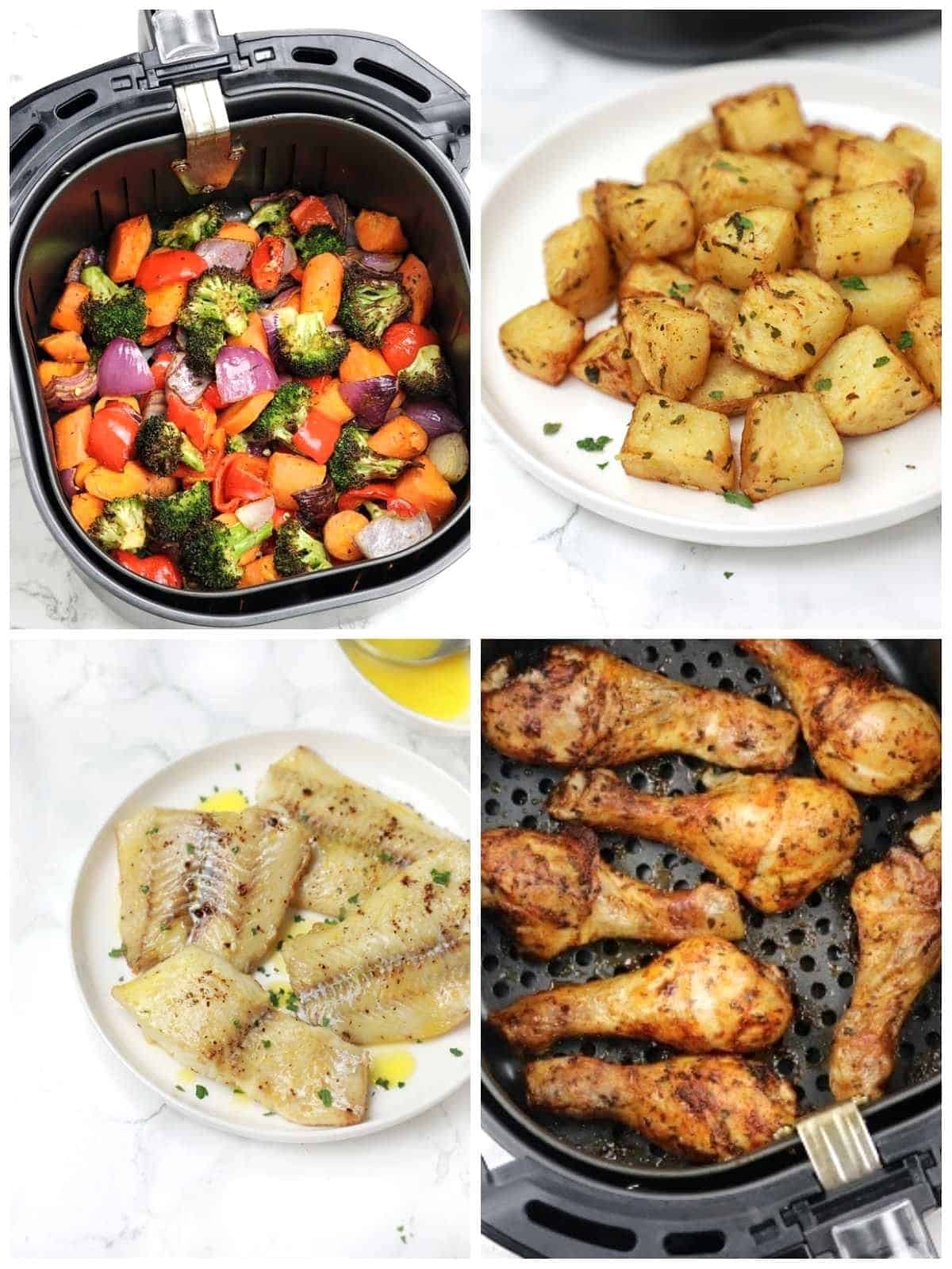
1. Air Fryer Garlic-Pepper Chicken Thighs — The default answer to "what's for dinner." Bone-in, skin-on thighs get a coarse black pepper and garlic rub, then 22–25 minutes at 400°F. Skin renders glass-crisp because the fan is inches away. Pair with a lemony arugula salad and rice cooked while the thighs are in.
2. Air Fryer Parmesan-Crusted Chicken Tenders — Dredge tenders in beaten egg, then panko + finely grated parmesan, then straight into a preheated basket. Nine minutes at 400°F with a flip at four. The parmesan browns and shatters like a pork rind — kids don't notice they're eating protein, not fast food.
3. Air Fryer Chicken Tenders with Dijon and Thyme — The grown-up version. Dijon binds the panko without the egg wash, and the thyme reads herbal without being fussy. Same 9-minute cook. This is the recipe that converts adults who "don't get" chicken tenders as a dinner.
4. Best Air Fryer Chicken Wings with Honey Mustard Glaze — A dredge of cornstarch is the trick — it draws moisture out of the skin so the fan can crisp it. Two-stage cook: 12 minutes at 380°F to render the fat, then 8 minutes at 400°F to brown, then tossed in the honey mustard while hot so the glaze grips. Better than most bar wings and far lighter.
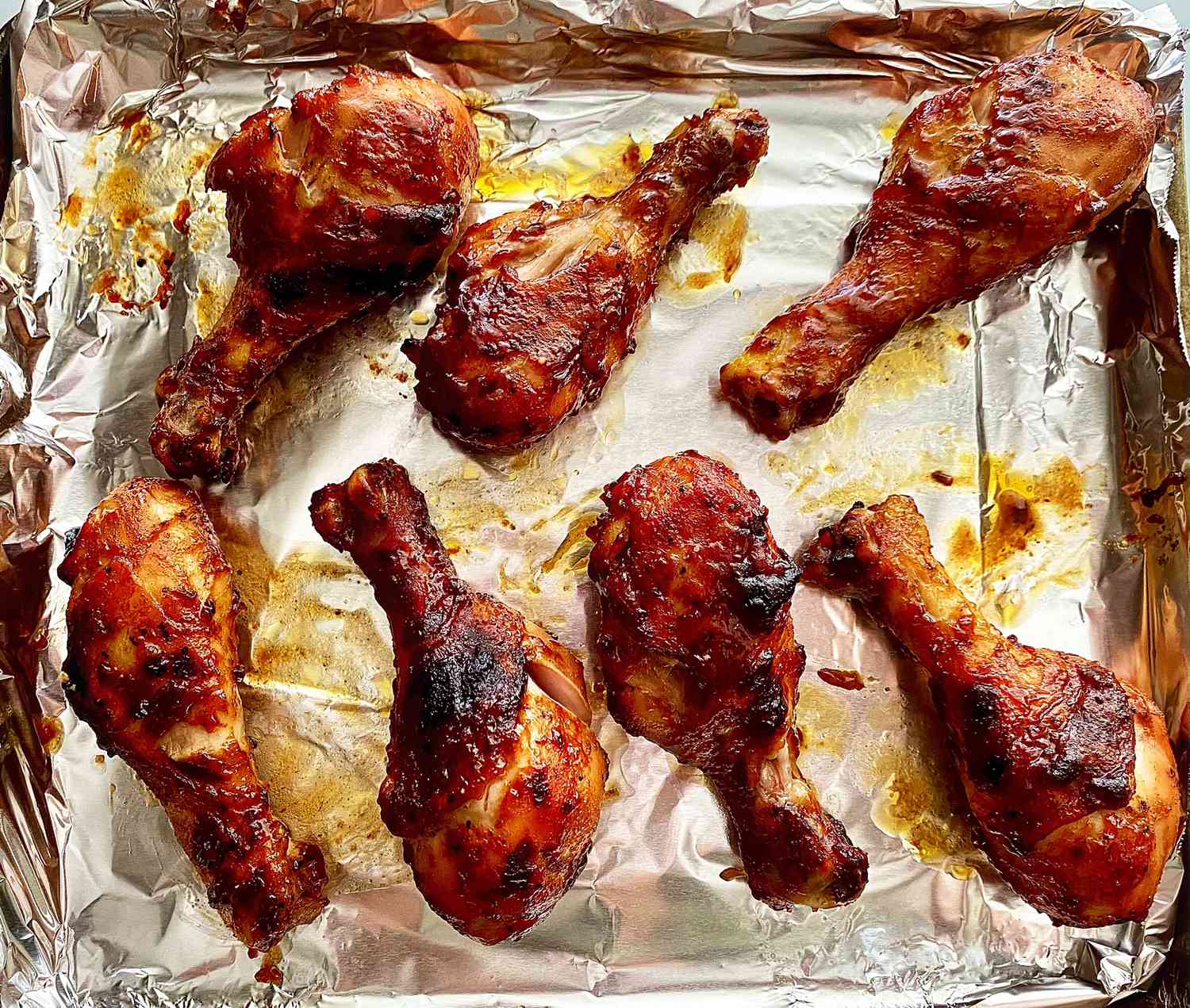
5. Air Fryer Rosemary Garlic Chicken Drumsticks — Drumsticks stay juicier than breasts because dark meat holds moisture through overcooking. Twenty minutes at 400°F, flip at ten. Cheap protein, kid-friendly, no dredge — the rub is oil, rosemary, garlic, salt.
Fish and seafood (4)
6. Air Fryer Crispy Lemon-Garlic Salmon Fillets — Skin-on fillets, brushed with olive oil and a garlic-lemon rub, 8 minutes at 400°F. Pull at 125°F internal for medium — the fillet keeps cooking 5–7°F after you take it out. Skin releases from the basket cleanly if you preheat and don't move it early.
7. Air Fryer Spanish-Style Garlic Shrimp with Smoked Paprika — Peeled 16/20 shrimp tossed with smoked paprika, sliced garlic, and olive oil; 6 minutes at 400°F, shaken once. Serve over crusty bread with the pan drippings — the whole thing is 12 minutes of active work.
8. Air Fryer Fish Sticks with Lemon-Dill Yogurt Dip — Fresh cod cut into fingers, panko-crusted, 9 minutes at 400°F. The yogurt-dill dip takes 90 seconds. Kids call these "the good fish sticks" — no freezer aftertaste, no soggy middle.
9. Air Fryer Shrimp Skewers with Mango Salsa — Two-plate dinner in 20 minutes: shrimp skewers 6 minutes at 400°F, salsa built cold from mango + red onion + lime + jalapeño while the basket runs. This is the shoulder-season recipe that carries you from July through September.
Pork (3)
10. Air Fryer Pork Chops with Garlic-Thyme Butter — Bone-in 1-inch chops, 12 minutes at 400°F, flipped once. Compound butter (garlic + thyme + softened butter, formed into a log and chilled) melts over the hot chops in the last 60 seconds. This looks like an $18 restaurant plate and takes under 20 minutes total.
11. Honey Mustard Air Fryer Pork Belly Bites — Cubed pork belly, tossed with honey + Dijon + a pinch of cayenne, 18 minutes at 380°F with a shake at nine. The fat renders into the basket and the sugars caramelize on the outside — dangerous snack, brilliant weeknight protein over rice.
12. Air Fryer Sausage and Caramelized Onion Hot Dogs with Chipotle Mayo — Better than any ballpark hot dog, done at home in 12 minutes. Slice good-quality bratwurst or Italian sausage, add sliced onions, air-fry together at 380°F for 10 minutes shaking twice. The onions caramelize in the residual sausage fat.
Beef and lamb (3)
13. Serious Herb-Crusted Air Fryer Steak — Yes, the air fryer sears steak — not identical to a cast-iron pan, but very close and half the smoke. Twelve-ounce ribeye, 400°F, 5 minutes per side for medium-rare, rested 5 minutes. The herb crust (rosemary + thyme + coarse salt) forms on contact with the hot basket floor.
14. Air Fryer Korean BBQ Beef Lettuce Wraps with Gochujang Sauce — Thin-sliced sirloin marinated in soy + gochujang + sesame oil + brown sugar for 20 minutes, then 6 minutes at 400°F. Serve on butter lettuce leaves with rice, quick pickles, and extra gochujang. Fast, light, and dinner-party-good.
15. Air Fryer Middle Eastern Lamb Kebabs with Yogurt Sauce — Ground lamb mixed with grated onion, cumin, coriander, and mint, formed around skewers, 10 minutes at 400°F. The yogurt-tahini-lemon sauce takes 3 minutes in a bowl. Serve with warm pita and cucumber salad — restaurant-quality kebabs without the grill.
Vegetarian and sides (5)
16. Air Fryer Crispy Tofu and Sweet Potato Fries — Press tofu 20 minutes, cube it, toss in cornstarch + soy + sesame oil, then air-fry 15 minutes at 400°F shaking every 5. Sweet potato fries run in parallel in a second basket (or a second round). Complete meal, 30 minutes, no meat.
17. Air Fryer Vegetable Medley with Rosemary — The universal side. Any hard vegetable (broccoli, cauliflower, carrots, brussels sprouts, sweet potato, delicata squash), cubed uniform, tossed with olive oil + rosemary + salt, 15 minutes at 400°F shaking twice. Roast-vegetable results in a third of the time.
18. Air Fryer Za'atar Spiced Cauliflower Bites — Small cauliflower florets tossed with olive oil + za'atar + a pinch of sumac, 14 minutes at 400°F shaken at 7. The edges char, the interior stays tender. Serve with lemon wedges and yogurt as a starter or a whole meal over grains.
19. Air Fryer Crispy Zucchini Fries with Herb Dip — Panko-crusted zucchini spears, 10 minutes at 400°F. The herb dip is sour cream + Dijon + parsley + chives. This is the recipe that gets kids to eat zucchini in July when the garden is drowning in it.
20. Air Fryer Baked Potato with Cheesy Topping — Full-size baked potato in 40 minutes instead of 90, with skin that shatters like a good chip. Split, top with sharp cheddar + scallions + sour cream. Under $2 per plate; almost embarrassingly good.
5 sheet-pan-style meals that convert perfectly to air fryer
Most sheet-pan recipes translate directly to the air fryer with two adjustments: cook proteins and vegetables in separate rounds (or halves of a dual-basket unit) because they finish at different times, and drop the temperature 10–15°F because the fan runs so much harder.
1. Chicken thighs + broccoli. Thighs 22 minutes at 400°F; broccoli 8 minutes at 400°F in the same basket after the thighs come out and rest. Broccoli benefits from the residual fat.
2. Salmon + asparagus. Both at 400°F for 8 minutes; salmon on one side, asparagus on the other. If they don't fit together, salmon first (rest under foil), asparagus second.
3. Sausage + peppers + onions. Everything at 380°F for 15 minutes, shaken once. Sausage renders into the vegetables — no oil needed.
4. Chicken shawarma + cauliflower. Chicken thighs marinated in yogurt + shawarma spice, air-fried 22 minutes at 400°F; cauliflower florets tossed with the same spice, 12 minutes at 400°F. Serve on pita with tahini.
5. Meatballs + zucchini. Beef-pork meatballs 12 minutes at 380°F, zucchini rounds 6 minutes at 400°F. The meatballs finish first — hold them under foil while the zucchini cooks.
Basket vs oven-style air fryer: which to buy for your kitchen
Two form factors, real differences:
| Feature | Basket-style | Oven-style |
|---|---|---|
| Preheat time | 3–5 min | 5–8 min |
| Air-frying performance | Excellent (fan closer to food) | Very good (larger cavity, fan farther) |
| Capacity | 4–8 qt (2-basket units 8–10 qt) | 15–30 qt (fits whole chicken, 12-in pizza) |
| Versatility | Air fry, roast, reheat, dehydrate | Adds rotisserie, toast, bake, sometimes proof |
| Cleanup | Removable non-stick basket → dishwasher | Racks + drip tray, more surfaces |
| Countertop footprint | Small, tall | Wide, oven-shaped |
| Typical price | $80–$180 | $180–$300 |
| Best for | Weeknight proteins, small households | Whole-chicken cooks, entertaining, kitchen replacement |
For most families, a 6–8 quart basket-style unit is the right first buy. It's fastest, cleans easiest, and crisps most aggressively because the fan is inches from the food. The Ninja AF101 Air Fryer 4 Qt is a popular, compact entry-level starting point, and it's usually under $100. If you want the extra basket for two-protein weeknight dinners (chicken and vegetables cooking on independent timers), step up to the 8-quart DualZone.
Oven-style makes sense if you already skip your full-size oven for most cooks, entertain often enough to need whole-chicken capacity, or want an appliance that does rotisserie. Buy basket first, add oven-style later if you actually run into capacity limits. The reverse order is a common expensive mistake — big oven-style units are slower to preheat, harder to clean, and don't crisp as aggressively for the single-serving cooks that made you buy the appliance in the first place.
Browse the wider selection in our small-appliances shop for current pricing, and grab a good instant-read thermometer alongside — measuring internal temperature is the single fastest way to stop over- and undercooking. A pair of long, silicone-tipped OXO tongs round out the accessory kit.
Air fryer mistakes: overcrowding, skipping preheat, using the wrong oil
Almost every "my air fryer doesn't work" complaint traces to one of five things.
1. Overcrowding the basket. The fan needs airflow between pieces to crisp them. If food is stacked or touching wall-to-wall, the appliance becomes a slow convection oven — you'll get soft, pale, sad results. Rule of thumb: single layer, roughly 25% of the basket floor visible. Cook in two rounds instead of cramming.
2. Skipping preheat. Three to five minutes at target temperature is not optional. Cold-start air-frying gives you soggy exteriors because the crust has to form while the interior is also coming up to temperature. The exception: slow-roast style cooks (whole chicken, big root vegetables) where you actually want a slower ramp.
3. Using the wrong oil. Extra-virgin olive oil starts smoking around 375°F, and most air fryer cooks run at 380–400°F. That's why your kitchen smells like burnt oil after wing night. Use avocado oil (smoke point 520°F), refined peanut oil (450°F), or refined sunflower oil (440°F) instead. Aerosol cooking sprays with propellants can also degrade the basket's non-stick coating — a refillable oil sprayer is a better tool.
4. Not shaking or flipping. Whatever surface touches the basket doesn't see moving air, so it doesn't crisp. Set a timer for the midpoint and shake small items (fries, wings, cubed vegetables) or flip large items (chops, chicken breasts). Miss the shake and you'll get one crispy side and one soft side.
5. Ignoring internal temperature. Air fryer times vary by 10–20% between units, and even by 10% between "the same" unit at different ambient temperatures. Guessing cook time is how chicken ends up dry or salmon ends up gray. A $30 instant-read thermometer pays for itself in the first month.
Two smaller mistakes worth naming: dumping oil into the basket instead of spraying or brushing the food (creates smoke and mess), and putting bare parchment or foil in the basket without weighting it down with food (the airflow lifts it into the heating element — one of the top three ways people damage their appliance).
Real-world numbers: what an air fryer actually costs to run
A typical 6-quart basket-style unit at 1,750 watts running for 15 minutes uses 0.44 kWh. At the U.S. average residential rate of about $0.17 per kWh, that's 7.5 cents per cook — call it a nickel and a couple of pennies. A full-size electric oven at 3,000 watts running 40 minutes (10 to preheat + 30 to cook the same food) uses 2.0 kWh, or roughly 34 cents per cook. Over a year of five weeknight dinners a week, the difference is about $70 in electricity plus real air-conditioning savings in summer months.
You'll also save on oil. A deep fry that would use 2 cups of oil ($5–$8 depending on quality) turns into 1–2 teaspoons ($0.05) in an air fryer. That's not the reason to buy one, but it's a real ongoing cost difference nobody talks about.
Common pitfalls (from readers) and how to fix them
- "My food is dry on the outside but not crisp." You're not using enough oil — the surface needs a fat film to conduct heat and brown. A light spray or brush of oil across the top surface is the fix, not more time.
- "Everything I make tastes the same." You're leaning too hard on garlic + salt + oil as a rub. Vary the acid (lemon zest, vinegar, mustard) and the finishing herb (parsley, cilantro, dill, mint, tarragon). A finishing sauce takes 60 seconds and changes the whole plate.
- "The basket is impossible to clean after chicken." Line it with pre-cut perforated parchment rounds for high-fat cooks like wings and thighs. Weight the parchment down with the food. Do not use foil — it corrodes with acidic marinades.
- "My air fryer smokes on high-fat foods." Add 1 tablespoon of water to the drip tray under the basket before cooking bacon, wings, or pork belly. The water absorbs the rendered fat and steam prevents flare-up smoke.
- "The exterior burns before the interior cooks through." Drop the temperature 25°F and add 3–5 minutes. Small dense proteins (thick chops, whole chicken pieces, meatballs) do better with a slightly gentler ramp.
When NOT to reach for the air fryer
The air fryer is not the answer for everything.
- Braises and stews. Anything that needs to sit in liquid for 45+ minutes belongs in a Dutch oven or slow cooker. The air fryer is a dry-heat appliance.
- Batter-dipped foods (tempura, beer batter). Wet batter drips off before it sets. You need submerged oil for that texture. Use a Dutch oven with 2 inches of neutral oil instead.
- Anything for 8+ people. You'll be cooking in three rounds and the first two will be cold by the time round three is done. Sheet pans in a full-size oven scale better.
- Delicate fish (cod, sole, tilapia in thin fillets). They cook so fast the basket structure ends up marking or breaking them. A quick sear in a nonstick pan is easier.
- Foods you want soft, not crisp. Roasted tomatoes, poached eggs, custards — wrong appliance. Use the oven or stovetop.
Knowing the appliance's limits is what keeps it in weekly rotation instead of the pile with the bread machine and juicer. Every appliance is a specialized tool; the air fryer is very good at one specific job (dry-heat, high-airflow, small-portion cooking) and mediocre at everything else. Buy it for the job it does well.
Sources + Last verified
The times, temperatures, and technique advice above are consistent with these three authoritative sources — worth bookmarking if you want to go deeper on any single point:
- Serious Eats — Best Air Fryers — J. Kenji López-Alt's comparative test of the major basket-style units, with side-by-side crisp performance and load-recovery data.
- America's Test Kitchen — Air Fryer Equipment Reviews — the ATK review lab's ranked buying guide with control-panel usability + longevity notes from multi-year testing.
- USDA — Food and Nutrition — canonical source for safe internal-temperature standards and cross-contamination guidance for the poultry, pork, and beef cooks above.
Last verified: 2026-07-17. Ninja, Cosori, and Instant Vortex model lineups + Amazon pricing were current at time of writing; check the Ninja AF101 product page for live inventory. Recipe pages linked above use our full ingredient + step-by-step format with printable cards and integrated shopping lists.
Frequently asked questions
How much less oil does an air fryer actually use?
Do I need to preheat the air fryer?
Basket-style vs oven-style air fryer: which should I buy?
Can I use aluminum foil or parchment in an air fryer?
Why does everyone say to shake the basket halfway through?
Recipes to start your week with
Save any of these to My Recipes — no account needed — and send the ingredients to Instacart in one tap.