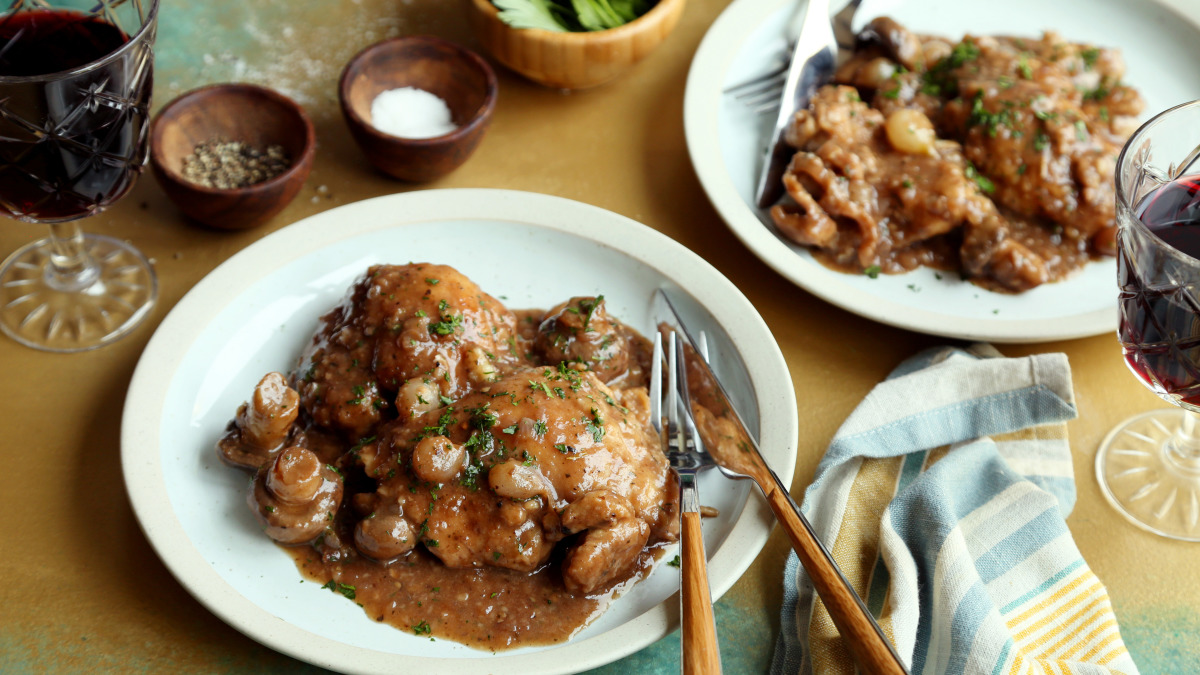
20 French Bistro Dinners: Coq au Vin, Boeuf Bourguignon & Cafe Classics at Home
One heavy pot, a bottle of cheap Burgundy, and twenty dishes that made French neighborhood restaurants famous.
Classic French bistro dinners are a short list of well-drilled dishes: a red-wine braise like coq au vin or boeuf bourguignon, a seared cut with a pan sauce, a gratin or ratatouille alongside, and bread. Nothing is plated with tweezers. Everything is cooked in one heavy pan, and most of it tastes better the next day.
Get a free week of easy dinners
Seven weeknight dinners with the shopping list already totalled, sent Sunday. No account needed, unsubscribe in one click.
No spam, unsubscribe in one click. Recipes, shopping lists and Instacart carts all work without an account either way.
What defines a bistro dinner (versus haute cuisine)
A bistro is a small neighborhood restaurant with a chalkboard menu, a house wine, and a kitchen the size of your kitchen. Haute cuisine is the opposite discipline: brigade staffing, multi-stage sauces, garnishes assembled at the pass. Bistro cooking survives translation to a home kitchen because it was never built on staffing in the first place.
Three practical differences matter when you cook this food at home:
One pan, one sauce. A bistro braise builds its sauce in the same pot that seared the meat. There is no separate stock reduction started at 6 a.m. You brown, you deglaze, you add liquid, you walk away. The Maillard reaction on the sear and the fond you scrape off the bottom are the sauce base.
Time replaces technique. Coq au vin does not ask you to do anything difficult; it asks you to give it 45 to 120 minutes. In our catalog, Authentic Coq au Vin runs 20 minutes hands-on plus 45 minutes braising, while Slow-Cooked Coq au Vin stretches to 120 minutes for six servings. Same skills, different clock.
Cuts, not center-cuts. Chuck, shoulder, shank, thighs, duck legs, pork rind. The dish was designed around tough connective tissue that needs a low, wet, three-hour conversion into gelatin. That is also why it is cheap: the standard bourguignon cut is beef chuck, not tenderloin.
The historical version of coq au vin literally used a mature rooster — a bird too tough to roast, with enough collagen to reward a long braise. Modern recipes use chicken thighs for the same reason, and the wine is usually red Burgundy, though regional variants swap in Riesling (coq au riesling, Alsace), vin jaune (Jura), or Champagne.
The bistro pantry: butter, shallots, wine, dijon, herbs de provence
You can cook every dish on this page out of eight ingredients plus a protein. This is the shopping list that makes the rest of the article possible:
| Pantry item | What it does | Typical cost (2026) | Don't substitute with |
|---|---|---|---|
| Unsalted butter | Mounts pan sauces, fries the fish, finishes the gratin | $4–6/lb | Margarine — it breaks in a beurre blanc |
| Shallots | Sweeter, faster-melting aromatic base than onion | $3–4/lb | Yellow onion in a beurre blanc (too harsh) |
| Dry red wine (Burgundy/Pinot Noir) | Braising liquid + acid for bourguignon, daube, coq au vin | $10–15/bottle | "Cooking wine" — it is salted and flat |
| Dry white wine | Fricassée, beurre blanc, mussels, pan sauces | $10–14/bottle | Vinegar alone (no body) |
| Dijon mustard | Emulsifier for vinaigrette, backbone of chicken pan sauces | $4/jar | Yellow mustard (sugar + turmeric) |
| Herbes de Provence | Thyme/rosemary/savory blend for ratatouille and daube | $5/jar | Italian seasoning (oregano-forward) |
| Gruyère | Melts without greasing out in gratins and onion soup | $16–20/lb | Pre-shredded "Swiss" (anti-caking starch) |
| Bacon or lardons | Renders the fat you brown everything else in | $6–8/lb | Turkey bacon (no fat to render) |
Two rules that save the most dinners:
1. Cook with a wine you would drink, but not an expensive one. A $12 Pinot Noir or Côtes du Rhône reduces cleanly. A $40 bottle contributes nothing extra after 90 minutes of simmering, and cooking wine is pre-salted, which wrecks a reduction that is going to lose half its volume.
2. Buy the whole shallot, not the jarred mince. Shallots go into almost every dish here, and jarred shallot in oil tastes fermented in a pan sauce that has nowhere to hide.
Braises and stews: coq au vin, boeuf bourguignon, blanquette de veau
This is the heart of the bistro repertoire. Every dish in this section follows the same five moves: dry the meat, brown it hard in rendered fat, sweat aromatics, deglaze with wine, then braise covered until a fork twists out with no resistance.
1. Authentic Coq au Vin — 20 min prep, 45 min cook, 4 servings, 380 calories and 28 g protein per serving. The fastest honest coq au vin here, because it uses thighs rather than a whole bird. Start it at 6:15 and you eat at 7:20.
2. Coq au Vin with Mushrooms and Pearl Onions — 20 min prep, 65 min cook, 4 servings, 490 calories. The garnish version: button mushrooms and pearl onions cooked separately and folded in at the end so they keep their shape instead of dissolving into the sauce. If you are cooking for guests, cook this one.
3. Classic Beef Bourguignon — 40 min prep, 170 min cook, 6 servings, 620 calories and 42 g protein. Nearly four hours door to door, and 90% of that is unattended oven time. For a lighter, longer, hands-off version, Slow-Simmered Beef Bourguignon runs 180 minutes at 480 calories a serving.
4. Chicken Fricassée with Mushrooms and Tarragon — 15 min prep, 40 min cook, 4 servings, 480 calories and 40 g protein. This is the white-braise slot on a bistro menu — the same idea as blanquette de veau, which is genuinely hard to shop for in most American markets because veal breast is a special order. A fricassée gets you the identical cream-and-white-wine profile from supermarket chicken. The variant Chicken Fricassee with Mushrooms and Creamy White Wine Sauce trims it to 30 minutes of cooking.
5. Beef Daube Provençale — 20 min prep, 150 min cook, 6 servings, 480 calories. The southern cousin of bourguignon: same braise, but orange zest, olives, and herbes de Provence instead of pearl onions and lardons. Beef Daube with Red Wine and Orange is the 10-minute-prep version if you want the shortest possible hands-on time.
6. Cassoulet with Pork Rind and Herb Bouquet — 15 min prep, 180 min cook, 6 servings, 520 calories and 40 g protein. Real cassoulet is a bean-and-meat casserole from Languedoc, built over days in its traditional form. This one is a three-hour weekend project and still produces the crust you break with a spoon.
Braise timing at a glance
| Dish | Hands-on | Total | Servings | Cal/serving | Best day to eat it |
|---|---|---|---|---|---|
| Authentic Coq au Vin | 20 min | 65 min | 4 | 380 | Day 2 |
| Coq au Vin w/ Pearl Onions | 20 min | 85 min | 4 | 490 | Day 1 (garnish texture) |
| Classic Beef Bourguignon | 40 min | 210 min | 6 | 620 | Day 2 |
| Chicken Fricassée | 15 min | 55 min | 4 | 480 | Day 1 (cream splits) |
| Beef Daube Provençale | 20 min | 170 min | 6 | 480 | Day 2 or 3 |
| Cassoulet | 15 min | 195 min | 6 | 520 | Day 2 |
The "best day" column is the part most recipes skip. Wine braises genuinely improve overnight because the gelatin sets and the tannins round off; cream braises do not, because reheating a cream sauce past a simmer breaks it. Keep your refrigerator at 40 °F or below — the FDA's refrigerator guidance — and a wine braise holds three days safely.
One-pan classics: steak au poivre, sole meuniere, chicken paillard
The other half of a bistro menu never sees the oven. These are 10-to-30-minute dishes where the sauce is built in the pan in the 90 seconds after the protein comes out.
7. Classic Steak au Poivre with Crispy Homemade French Fries — 30 min prep, 30 min cook, 2 servings, 850 calories and 55 g protein. The full steak au poivre experience including the fries, which is where most of those calories live. Crack the peppercorns coarsely in a mortar; pre-ground pepper burns and turns acrid in the crust.
8. Pan-Seared Sole with Lemon-Dill Beurre Blanc — 15 min prep, 12 min cook, 2 servings, 420 calories. Sole meunière in everything but name. The one technical dish on this list: a beurre blanc is a butter emulsion held together by a wine-and-shallot reduction, and it breaks if the pan goes over about 130 °F. Add cold butter one cube at a time off the heat, swirling.
9. Pan-Seared Chicken Breast with Dijon and Tarragon — 10 min prep, 12 min cook, 4 servings, 450 calories and 40 g protein. The chicken-paillard slot: pound the breast to an even half-inch, sear it fast, then build a mustard pan sauce off the fond. Pan-Seared Chicken Breasts with Dijon and Lemon Pan Sauce is the two-serving version at 320 calories.
10. Citrus-Scented Seared Scallops with Beurre Blanc — 10 min prep, 10 min cook, 2 servings, 380 calories. Twenty minutes total, and the most restaurant-looking plate in this article. Dry the scallops on paper towels for 10 minutes first or they steam instead of searing.
11. Bistro-Style Beef Tenderloin with Herb Butter — 20 min prep, 20 min cook, 4 servings, 450 calories and 40 g protein. When you want steak-frites energy without deep-frying. Pan-Seared Ribeye with French Onion Butter is the single-serving indulgence at 700 calories.
Two numbers make or break every dish in this section. First, the pan needs to be at 400–450 °F before the protein touches it — a drop of water should skitter, not sit and sizzle. Second, fish and scallops want a dry surface; blot them and leave them uncovered in the fridge for 20 minutes if you have the time.
Soul food of the bistro: gratin dauphinois, ratatouille, cassoulet
The vegetable side of a bistro menu is not an afterthought — half these dishes are the whole dinner if you add bread and a salad.
12. Herb-Roasted Potato Gratin with Gruyère — 20 min prep, 65 min cook, 6 servings, 350 calories. Our closest take on gratin dauphinois: sliced potatoes, cream, garlic, and a Gruyère top. Slice the potatoes to an even 1/8 inch or the top layer burns before the bottom cooks — this is the one place a mandoline is worth owning.
13. Authentic Provençal Ratatouille — 20 min prep, 40 min cook, 4 servings, 180 calories. The cheapest dinner in this article and the only one under 200 calories a serving. Cook each vegetable separately before combining if you want distinct textures; dump everything in at once and you get a good stew instead, which is also fine on a Tuesday.
14. Duck Confit and Pork Cassoulet with Garlic-Infused Beans — 30 min prep, 165 min cook, 4 servings, 620 calories and 35 g protein. The full-dress cassoulet with confit duck legs. Budget a Saturday.
15. Crispy Duck Confit with Garlic and Thyme — 15 min prep, 190 min cook, 4 servings, 700 calories and 45 g protein. Confit on its own, without the bean casserole around it. Fifteen minutes of actual work; the other 190 are the oven doing a slow poach in fat.
For a second gratin in the rotation, Baked Potato Gratin with Garlic and Thyme is the no-cheese version at 320 calories, and Savory Vegetable Gratin with Nutmeg swaps most of the starch for vegetables at 320 calories for six.
Weeknight-friendly bistro meals under an hour
Everything above assumes you have a weekend. These five do not.
16. Bistro Omelette with Gruyère and Herbs — 5 min prep, 5 min cook, 1 serving, 320 calories and 21 g protein. Ten minutes, one pan, and the single most French thing you can cook. Three eggs, low heat, constant small movements, pulled off the burner while the center is still glossy. French-Style Herb Omelette with Gruyère Cheese is the same idea at 300 calories.
17. Salade Niçoise with Tuna and Hard-Boiled Eggs — 20 min prep, 10 min cook, 2 servings, 450 calories and 40 g protein. Forty grams of protein for 450 calories makes this the best macro ratio on the page. Salade niçoise is also the one dish here that is better cold, so it doubles as next-day lunch.
18. Weeknight Beef Bourguignon with Pearl Onions — 25 min prep, 55 min cook, 6 servings, 380 calories. Eighty minutes total for six servings by using a quicker-cooking cut and a hotter braise. Not as silky as the 210-minute version, but on a Wednesday it wins.
19. Pan-Seared Dijon Beef with Mushrooms and Garlic — 10 min prep, 15 min cook, 4 servings, 420 calories and 38 g protein. Twenty-five minutes, four servings, one skillet. This is the dish to learn first if you have never built a pan sauce.
20. Roasted Asparagus and Herb Quiche — 25 min prep, 40 min cook, 6 servings, 280 calories. A quiche feeds six for about $9 in ingredients and reheats better than almost anything else here. Use a store-bought crust on a weeknight; nobody at your table is grading the pastry.
Under-an-hour scoreboard
| Dish | Total time | Servings | Cal/serving | Protein/serving |
|---|---|---|---|---|
| Bistro Omelette with Gruyère | 10 min | 1 | 320 | 21 g |
| Citrus-Scented Seared Scallops | 20 min | 2 | 380 | 32 g |
| Pan-Seared Chicken, Dijon + Tarragon | 22 min | 4 | 450 | 40 g |
| Pan-Seared Dijon Beef | 25 min | 4 | 420 | 38 g |
| Pan-Seared Sole, Beurre Blanc | 27 min | 2 | 420 | 34 g |
| Salade Niçoise | 30 min | 2 | 450 | 40 g |
| Chicken Fricassée | 55 min | 4 | 480 | 40 g |
| Roasted Asparagus Quiche | 65 min | 6 | 280 | 15 g |
If you cook only one thing from this article on a weeknight, make it the fricassée. Fifty-five minutes gets you four servings of a genuine French braise, and the leftovers reheat gently in a covered pan with a splash of stock.
What to drink and what to serve on the side
Wine. Match the braising wine to the glass. If you cooked with Burgundy or another Pinot Noir, pour the same; if you built a daube on Côtes du Rhône, drink Rhône. For the white-wine dishes — fricassée, beurre blanc, mussels — a dry unoaked Chardonnay or a Muscadet does double duty. Budget $12–18 a bottle in 2026 and buy two: one to cook, one to drink.
Bread. A braise without bread is an unfinished plate. A supermarket baguette is $3 and stales in six hours, which is the correct behavior — day-old baguette is what you want for croutons and for the French onion soup top.
A first course, if you want the full menu. Parisian Bistro-Style Onion Soup with Crispy Baguette Topping runs 25 minutes prep and 65 minutes of caramelizing for 4 servings at 420 calories. The lower-effort route is Slow-Caramelized French Onion Soup with Crispy Baguette at 20 minutes hands-on. In summer, Chilled Sweet Potato and Leek Vichyssoise at 190 calories is the coldest, lightest starter on the site, and Chicken and Leek Velouté with Croutons is the winter equivalent at 280. If you want the charcuterie-board opener, Herb-Infused Beef Liver Pâté is 25 minutes of work, 160 calories a serving, and about $4 of chicken or beef liver.
Sides. Green salad with a Dijon vinaigrette (one part mustard, one part vinegar, three parts oil, salt), buttered green beans, or the potato gratin above. That is the entire list. A bistro plate is a braise, a starch, and something green with acid on it.
Dessert. One dish, made ahead: French-Style Apple Tarte Tatin with Caramel Glaze, 20 minutes prep and 40 minutes baking for 6 servings at 380 calories.
The Sunday-roast option. If you want a bistro-adjacent centerpiece instead of a braise, Herb-Rubbed Roast Chicken with White Wine Pan Sauce feeds six in 95 minutes at 450 calories and 45 g protein, and Herb-Crusted Roast Chicken with Garlic Mashed Potatoes brings its own starch.
Equipment that earns its keep for French cooking
You need four things. Everything else on this list is optional.
| Tool | Why French cooking specifically needs it | Price (2026) | Our pick |
|---|---|---|---|
| 5–7 qt enameled Dutch oven | Stovetop sear → oven braise in one vessel; enamel won't react with wine | $42 | Amazon Basics 6-quart enameled Dutch oven |
| Heirloom-grade version of the same | Thinner enamel, better lid seal, 40-year service life | $290 | Le Creuset Signature 6.5 qt Deep Round Oven |
| 12-inch tri-ply stainless skillet | Fond. Nonstick makes no fond, so it makes no pan sauce | $63 | Cuisinart Professional Stainless 12-inch skillet |
| 8-inch chef's knife | Two pounds of mirepoix per braise | $129 | WÜSTHOF Classic White 8" |
| Fish spatula | Thin enough to get under sole without tearing it | $28 | MIU flexible stainless fish spatula |
| Handheld mandoline | 1/8-inch potato slices for gratin, in 4 minutes not 20 | $35 | OXO Good Grips Precision Handheld Mandoline |
| Instant-read thermometer | 165 °F poultry, 130 °F for a beurre blanc that won't break | $125 | ThermoWorks Thermapen ONE |
| French whisk | Narrow head fits a saucepan; mounts butter without aerating | $7 | 11-inch slim French whisk |
| Fine-mesh strainer | Straining a sauce is the difference between home and bistro | $16 | Cuisinart 3-count mesh strainer set |
The honest version of this table: a $42 Dutch oven and a $63 stainless skillet cook every recipe on this page. The $290 Le Creuset is a nicer object with a better lid seal, not a better braise. Browse the full cookware, knives, and utensils categories if you are building a kit from scratch — prices above were current as of 2026 and move around.
One thing to skip: a nonstick skillet. Nonstick is engineered to prevent food from sticking, and the stuck bits are the sauce. Every pan-sauce dish in this article fails in nonstick.
Common bistro-cooking pitfalls
Crowding the pan on the sear. Two pounds of beef chuck dropped into one skillet at once drops the surface temperature below the browning threshold, and the meat steams grey in its own juice. Brown in three batches, 6–8 minutes each. This is the single most common reason a home bourguignon tastes flat — you skipped 20 minutes of browning and lost the entire fond.
Boiling instead of simmering. A braise should show one lazy bubble every couple of seconds, around 190 °F. A rolling boil at 212 °F squeezes the muscle fibers tight and the meat comes out stringy after three hours instead of tender. If your stovetop's lowest setting still boils, move the covered pot to a 300 °F oven.
Adding the wine and immediately covering it. Raw wine tastes sharp and thin. Let it reduce uncovered by about half — three to five minutes of hard bubbling — before the stock goes in.
Breaking the beurre blanc. Butter emulsions split above roughly 130–140 °F. Pull the pan off the heat, add cold cubed butter one at a time, and swirl rather than whisk hard. If it breaks anyway, take it off the burner, add a tablespoon of cold cream, and whisk it back together.
Salting a reduction early. A pan sauce that loses half its volume doubles its salt concentration. Season at the end, after the sauce has reduced to where you want it.
Using pre-shredded cheese in a gratin. The anti-caking starch on pre-shredded Gruyère keeps it from melting smoothly, and the top layer goes grainy and oily. Grate from a block; it takes 90 seconds.
When a French braise is the wrong call
Skip this whole genre when:
- You have under 30 minutes and no leftovers. A braise's minimum honest runtime is about 55 minutes. Under that, cook the omelette or the Dijon beef instead, or go look at a weeknight pasta roundup.
- You are cooking for someone avoiding alcohol entirely. You can build a credible braise without wine, but it is a different dish. See the FAQ below for the substitution ratio that actually works.
- You need low-fat. Bistro food is butter-and-lardon food. The two low-calorie exits on this page are the ratatouille (180) and the vichyssoise (190); most everything else lands between 380 and 700 calories a serving.
- You want it on the table hot at an exact minute. Braises are forgiving about when you eat, which is why they suit dinner parties, but they will not be rushed to hit 7:00 p.m. sharp. Cook it the day before and reheat.
- It is 95 °F out. These are cold-weather dishes. In August, the salade niçoise and the chilled vichyssoise are the bistro menu.
FAQ
Do I need a Dutch oven for bistro cooking?
A five- to seven-quart enameled Dutch oven is the single most useful pan for French cooking, because coq au vin, boeuf bourguignon, cassoulet, and ratatouille all move from stovetop sear to oven braise in one pot. A heavy stainless pan handles most of the sautés but loses to the Dutch oven on any low-and-slow dish. The $42 Amazon Basics 6-quart and the $290 Le Creuset cook the same braise; see the cookware category for vetted picks.
What wine should I use for braising if I don't drink?
Non-alcoholic red wine works better than cooking wine, which is salted and flat. If you are skipping wine entirely, use one and a half cups of beef stock plus two tablespoons of red wine vinegar and one tablespoon of tomato paste to mimic the acidity and body. Never substitute grape juice — it turns the braise cloying, and there is no later step that removes the sugar.
Can bistro classics work on a weeknight?
Yes, if you separate the day-of assembly from the slow simmer. Coq au vin holds in a 40 °F refrigerator for three days and genuinely improves on day two, so a Sunday braise becomes a Wednesday dinner that reheats in twenty minutes. Weeknight-native dishes like the Dijon beef at 25 minutes and the bistro omelette at 10 are on the table faster than delivery.
What's the difference between a bistro and a brasserie?
A bistro is a small neighborhood restaurant with a short handwritten menu of daily specials, home-style braises, and a chalkboard wine list. A brasserie is larger, serves all day, and leans on Alsatian classics like choucroute garnie, oysters, and steak frites. This roundup covers bistro cooking because it maps cleanly onto home kitchens with one heavy pot; brasserie fare needs a fryer and a raw bar.
What sides make a bistro dinner feel complete?
A green salad with Dijon vinaigrette, a hunk of good baguette to mop the braise, and roasted or gratinéed potatoes cover most of the menu. Buttered haricots verts or leeks vinaigrette add a second vegetable for company dinners. Skip elaborate starches — the braise is the centerpiece, and the plate should feel confident but simple rather than crowded.
Why does my pan sauce taste harsh instead of round?
Almost always under-reduced wine. Raw alcohol and raw tannin both read as sharpness, and both cook off — but only with the lid off. After you deglaze, let the wine bubble hard and lose about half its volume before any stock goes in, then season at the very end. A sauce that reduces by half also doubles its salt concentration, so early salting is the second most common cause.
Where to go next
If braising is the part you liked, our 22 Dutch oven dinners roundup covers the same technique across other cuisines. For neighboring European comfort food, try the 22 German recipes and 22 Polish recipes collections, or head south to the 22 Greek recipes guide.
Frequently asked questions
Do I need a Dutch oven for bistro cooking?
What wine should I use for braising if I don't drink?
Can bistro classics work on a weeknight?
What's the difference between a bistro and a brasserie?
What sides make a bistro dinner feel complete?
Why does my pan sauce taste harsh instead of round?
Sources
Plan a week of meals in two minutes.
Tell our AI what you have and what you like — it builds your plan, shopping list, and Instacart cart. No account needed.
Try free →