22 Weeknight Pasta Dinners: 30-Minute Recipes Beyond Spaghetti Bolognese
Bolognese needs an hour you do not have on a Tuesday. Every sauce here finishes in the time the water takes to boil.
Affiliate disclosure: AislePrompt may earn a commission on qualifying purchases made through Amazon and Instacart links in this article, at no additional cost to you. See our affiliate policy →
Quick weeknight pasta comes down to one rule: the sauce has to finish in the time the water takes to boil and the pasta takes to cook — about 20 minutes total. That rules out long braises and rules in garlic-and-oil, cheese-and-pepper, cherry-tomato, and pan-sauce pastas. Below are 22 recipes that fit, sorted by what's in your fridge.
Classic Spaghetti Bolognese is a Sunday sauce wearing a Tuesday costume. It needs 40 to 70 minutes of simmering to taste like anything, which is why the jar of pre-made version exists and why weeknight pasta gets a bad reputation. Every recipe on this list works on a different principle: the sauce is built in the pan while the pasta boils, and the two are married with a ladle of starchy water at the end.
The 30-minute weeknight pasta framework
Every fast pasta dinner is the same four moves in the same order. Learn the sequence once and you can improvise the rest of your life.
Water on first. Four quarts in a tall pot, lid on, high heat. Six to eight minutes to boil, and that clock is your whole prep window. Nothing else starts until the pot is on the burner.
Build the sauce base while it heats. Garlic, chili, anchovy, pancetta, or shallot in fat over medium heat. Two to four minutes. This is the flavor floor of the dish and it cannot be rushed past golden into brown-bitter.
Cook the pasta one minute short. Box time minus 60 seconds. It finishes in the sauce, which is where it should absorb its last bit of liquid.
Emulsify in the pan. Tongs the pasta straight into the sauce pan with a half-cup of the cooking water. Toss hard over medium heat for 30 to 60 seconds. The starch in the water binds the fat and the water into a glossy sauce that clings — this is the emulsion that separates restaurant pasta from sad pasta with sauce sitting on top.
Total active time: 22 to 28 minutes for nearly everything below.
Pantry pastas: dinners from things you already have
These five need nothing fresher than a garlic clove. They're the reason to keep the pantry stocked — no shopping trip, no thawing, no plan.
Roman-Style Cacio e Pepe with Pecorino Romano is three ingredients and the hardest technique on this list. Cacio e pepe is pasta, Pecorino Romano, and black pepper, emulsified into a cream that contains no cream. It fails when the pan is too hot and the cheese seizes into strings. Pull the pan off the heat before the cheese goes in, and use pasta water that's cooled for 20 seconds.
Classic Spaghetti Aglio e Olio is 15 minutes and about $2.40 a serving. Aglio e olio is garlic sliced thin, warmed slowly in olive oil until barely gold, chili flakes, parsley, pasta water. If you want a slightly richer version with more body, Authentic Italian Aglio e Olio Pasta runs the garlic longer and finishes with more cheese.
Spaghetti alla Puttanesca with Authentic Italian Flair is the highest flavor-per-effort dish in the entire pasta canon. Puttanesca is anchovy, garlic, olives, capers, canned tomato — all shelf-stable, all intensely savory. Twenty-five minutes, roughly 320 calories a serving, and it tastes like it took an hour.
No-Cook Tuna Pasta Salad with Olives is the August answer: boil pasta, dress it cold, done in 15 minutes with zero stovetop time beyond the pot. Canned tuna, olives, lemon, olive oil.
Creamy Fettuccine Alfredo rounds out the pantry five. Butter, parmesan, pasta water, and nothing else if you make it the Roman way; the American version adds cream for insurance. Twenty minutes, and the one dish on this list that children reliably eat without negotiation.
Creamy without cream
Four dishes that read rich and contain no heavy cream. The fat comes from egg yolk, cheese, ricotta, or browned butter, and the body comes from starch.
Authentic Spaghetti alla Carbonara is egg yolk, pecorino, guanciale or pancetta, and black pepper. Carbonara contains no cream in any Roman version — the sauce is a custard tempered by pasta water off the heat. If the eggs scramble, the pan was still on the burner. Spaghetti Carbonara with Pancetta is the more forgiving variant, with pancetta rendering slower than guanciale and a little more fat to buffer the yolks.
Lemon-Herb Lemon Ricotta Pasta whisks whole-milk ricotta with lemon zest and pasta water into a sauce that takes about as long as the pasta does. It's the fastest genuinely creamy pasta you can make — no reduction step at all.
Crispy Sage Butter Pasta with Parmesan Crisps browns butter until the milk solids go nutty, crisps sage leaves in it, and finishes with parmesan. This is where the Maillard reaction does the work a long simmer would otherwise do — 20 minutes total. For a weekend version worth the extra 45 minutes of rolling, Authentic Hand-Rolled Tagliatelle with Brown Butter Sage uses fresh egg pasta, which suits butter sauces far better than dried.
Creamy Garlic Mushroom Pasta leans on mushroom liquid and starch rather than dairy for its body. Twenty-five minutes, about 420 calories, and the best vegetarian entry in the creamy category.
Protein-forward pasta
When pasta is the whole dinner and not a side, you want 25 to 40 grams of protein on the plate. These five do it without a second pan of chicken.
Shrimp Scampi Linguine is 30 minutes and 34 grams of protein a serving. Shrimp go in for the last 3 minutes only — the difference between sweet and rubbery is about 90 seconds. Lemon-Garlic Butter Shrimp Scampi is the brighter, more acidic take with a shorter cook.
Real Deal Chicken Piccata isn't a pasta recipe on paper, but the lemon-caper pan sauce was designed to be spooned over noodles and it's the single best use of a chicken cutlet on a weeknight. Thirty-five minutes, 30 grams of protein.
Italian-Style Sausage and Peppers One-Pot Pasta cooks the pasta directly in the sauce. Sausage renders, peppers soften, pasta absorbs the fat and the tomato — one pot, 45 minutes, 22 grams of protein and one thing to wash.
One-Pot Pasta with Shrimp and Spinach does the same trick in 40 minutes with a lighter profile — 450 calories, 20 grams of protein, and a full serving of greens wilted in at the end.
One-Pot Chicken and Cherry Tomato Pasta is the version to make when you want dinner and a single pot: 25 minutes of cook time, 400 calories, 25 grams of protein.
Vegetable-driven pasta
Five dishes where the vegetable is the point, not a garnish. All are meat-free; three are vegan as written.
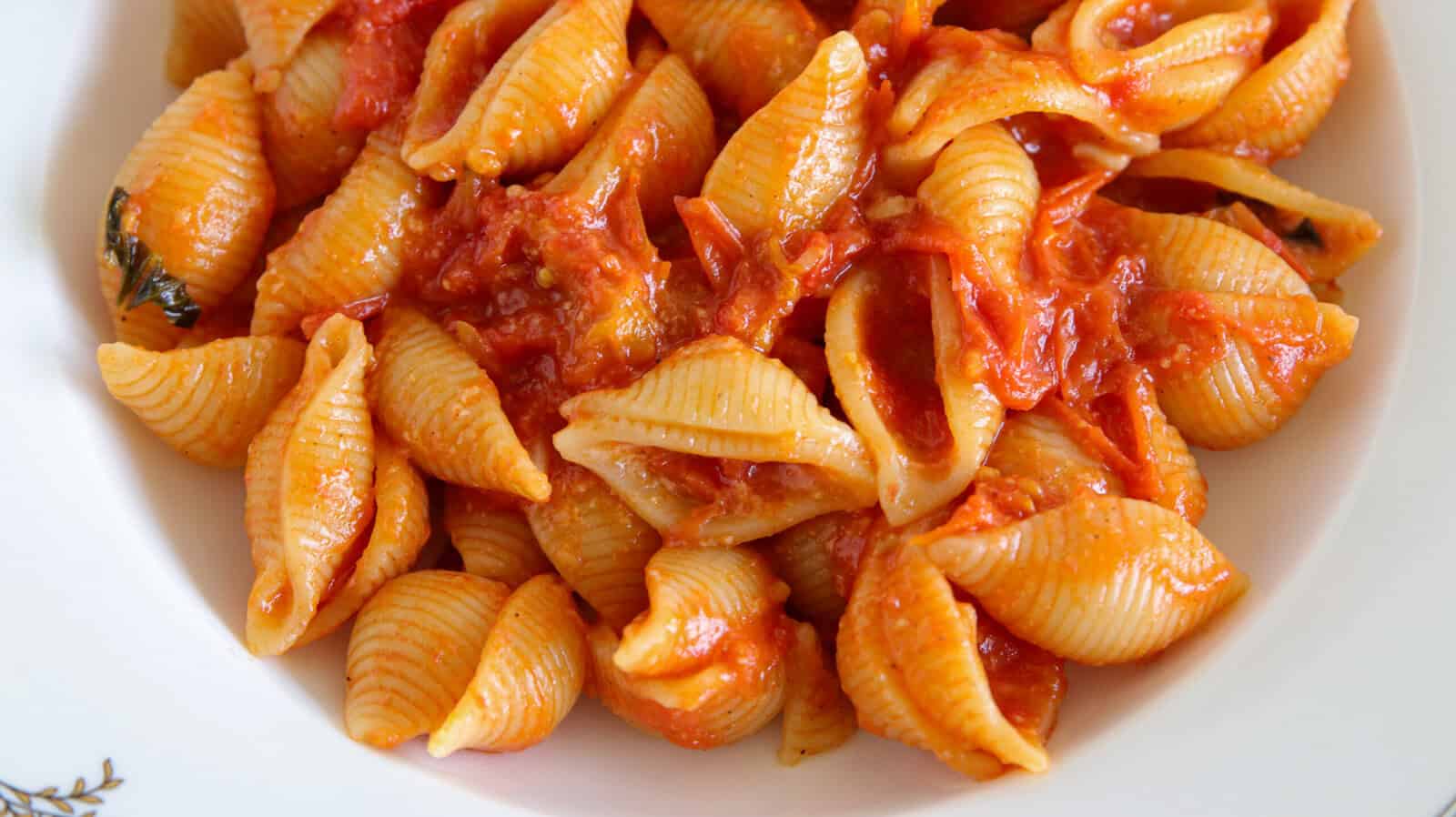
Spinach and Cherry Tomato Pasta bursts cherry tomatoes in hot oil until they collapse into a fresh sauce — no canned tomato, no simmering. Twenty minutes total, 420 calories.
Lemon Herb Shrimp Pasta with Pesto and Chickpea and Spinach Pasta with Pesto both run on pesto, which is the single best thing to keep in the freezer in ice-cube portions. Two cubes plus pasta water is a sauce in 90 seconds.
Grilled Eggplant and Zucchini Pasta with Pesto and Chickpeas is the late-summer version — 35 minutes if you're grilling the vegetables, 20 if you broil them instead.
Baked Feta & Tomato Pasta with Basil is the internet-famous one and it earns the attention. A block of feta and two pints of cherry tomatoes roast together at 400°F for 20 minutes, then get mashed into a sauce with hot pasta. Active time is under 10 minutes.
One-pot pasta dinners
One-pot pasta breaks the framework above on purpose: the pasta cooks in exactly enough liquid to be absorbed, so the starch never leaves the pan and there's no draining step. It works when the sauce is liquid enough to start (tomato, broth, wine) and fails with oil-based sauces.
The three above — Italian-Style Sausage and Peppers One-Pot Pasta, One-Pot Pasta with Shrimp and Spinach, and One-Pot Chicken and Cherry Tomato Pasta — are the reliable ones. Stir every three minutes or the bottom layer will catch, and add liquid a quarter-cup at a time if the pasta is still firm and the pan is going dry.
The 5-shape pasta pantry
You do not need eleven boxes. You need five shapes that cover every sauce type, and about $14 keeps you stocked for a month of dinners.
| Shape | Best with | Why | Box cost |
|---|---|---|---|
| Spaghetti | Oil and cheese sauces | Long strands carry a thin coating without pooling | $1.80 |
| Linguine | Seafood, clam, scampi | Flat face grips butter-wine sauces | $2.20 |
| Rigatoni | Chunky meat and vegetable | Ridges and tube trap solids | $2.40 |
| Orecchiette | Sausage, broccoli, greens | Cups catch crumbled meat and small florets | $3.20 |
| Fettuccine | Cream, butter, brown butter | Wide surface for heavy sauces | $2.60 |
Buy bronze-die durum semolina pasta if you can find it under $3 a box. The rough, chalky surface holds roughly twice as much sauce as slick Teflon-extruded pasta, and it's the cheapest single upgrade available to a home cook. Store it in the original box in a dry cupboard — pasta keeps two years unopened and doesn't need a fancy canister.
How to salt pasta water (and why it matters)
One tablespoon of kosher salt per four quarts of water, added after the water reaches a full boil. That's roughly 1% salinity — noticeably salty when you taste it, less salty than seawater despite what every cookbook says.
This is the only moment you can season the pasta itself. Sauce sits on the outside of the noodle; salt in the boiling water penetrates the whole strand as it hydrates. Under-salted pasta tastes flat no matter how good the sauce is, and no amount of finishing salt fixes it, because you'd be seasoning the surface twice instead of the interior once.
Do not add oil. Oil floats, coats the noodles as you drain, and actively prevents sauce from sticking. If your pasta clumps, the problem is water volume (use four quarts per pound) or the first 90 seconds of not stirring.
Pull the pasta one minute before the box time. Al dente means a firm white core still visible when you bite a strand in half; that core disappears during the 60 seconds it finishes in the sauce. And reserve a full cup of water before draining — you will use half of it, and you will be glad you have the rest.
Real-world numbers: cost and time
Approximate US supermarket costs as of August 2026, for four servings, and active time at the stove.
| Recipe | Active time | Cost / serving | Protein |
|---|---|---|---|
| Spaghetti aglio e olio | 15 min | $2.40 | 18 g |
| Cacio e pepe | 15 min | $3.10 | 24 g |
| Puttanesca | 25 min | $3.30 | 10 g |
| Carbonara | 25 min | $3.90 | 18 g |
| Baked feta pasta | 10 min active | $4.20 | 22 g |
| Shrimp scampi linguine | 30 min | $6.80 | 34 g |
| Sausage and peppers one-pot | 30 min active | $4.10 | 22 g |
| Creamy garlic mushroom | 25 min | $3.60 | 10 g |
Every one of these lands under the roughly $12 to $18 a head that a mid-week takeout order costs, and six of the eight are faster than delivery.
These are approximate US supermarket prices and home-kitchen timings as of August 2026 — plan against them rather than treat them as measured laboratory results. Per-serving nutrition comes from each linked recipe's own listing, and cost per serving assumes you already own oil, salt, and dried chili.
Common pitfalls
Draining in the sink and walking away. The pasta keeps cooking on residual heat and dries out. Move it straight into the sauce pan with tongs or a spider.
Not enough water. Two quarts for a pound of pasta drops the water temperature so far when the pasta goes in that the surface starch gels before the pasta is submerged, and everything sticks. Four quarts, minimum.
Adding cheese over direct heat. Pecorino and parmesan break into strings above roughly 180°F. Off the heat, always, then toss.
Cooking the garlic to brown. Golden is sweet; brown is bitter, and there is about 40 seconds between the two. Slice rather than mince for a wider margin.
Rinsing the pasta. You are washing off the exact starch you need to make the sauce cling. Only rinse for cold pasta salad.
When pasta isn't the right weeknight call
Pasta is a poor choice when you need dinner to hold. It's at its best within four minutes of leaving the pan and it degrades fast — the sauce absorbs, the noodles bloat, and reheated pasta is a different, worse dish. If people are eating at three different times because of practice schedules, cook something braised instead.
It's also the wrong call if you're feeding a crowd larger than six on one burner. You can't fit more than a pound and a half of pasta in a standard 8-quart pot without wrecking the water-to-pasta ratio, and cooking in batches means the first batch is cold. For eight or more, roast a tray of something instead.
A five-night pasta rotation
Pasta every night gets boring fast if all five dinners are the same sauce in a
different shape. The rotation below moves across a different axis each night —
seafood, vegetable, meat, mushroom, cream — so no two dinners taste related, and
the whole week shops from one trip.
| Night | Recipe | Shape | Active time | Why it lands here |
|---|---|---|---|---|
| Monday | 15-Minute Shrimp and Garlic Lemon Orzo | Orzo | 20 min | Shrimp thaws in cold water in the time the orzo cooks; 35 g protein on the worst night of the week |
| Tuesday | Half-And-Half Pasta Primavera | Penne | 35 min | Clears whatever vegetables survived the weekend before they turn |
| Wednesday | Spaghetti with Ground Beef and Tomato Basil Sauce | Spaghetti | 40 min | The honest weeknight answer to bolognese — browned beef and tomato in 25 minutes instead of 70 |
| Thursday | Pasta with Sautéed Mushrooms and Fresh Thyme | Rigatoni | 35 min | Meatless without announcing it; mushrooms carry the same savory weight |
| Friday | Penne alla Vodka with Roasted Cherry Tomatoes | Penne | 35 min | The one worth an extra ten minutes, because nobody is in a hurry on Friday |
Three shapes cover all five nights — orzo, penne, spaghetti — plus one box of
rigatoni if you want Thursday to look different from Tuesday. Buy two pounds of
each; dried pasta keeps for years and the per-box price drops sharply above the
single-box quantity.
The shared shopping list is short because four of the five nights lean on the same
base: garlic, shallot, canned or cherry tomatoes, parmesan, parsley, olive oil,
and one protein each for Monday and Wednesday. Everything else is already in the
pantry if you stocked the five shapes above. Building the same rotation around
what's actually on sale is what the meal-prep planner is
for — set the cook-time ceiling to 40 minutes and it will only return dinners
that fit this window.
Where to go next
If you want the one-pot method exclusively, the one-pot pasta dinner collection goes deeper on liquid ratios and which shapes survive the absorption method. New to Italian cooking generally, start with the beginner Italian pasta guide. And for the nights when pasta isn't the answer, the sheet-pan dinner collection covers the same 30-minute window with a tray instead of a pot.
Stocking the drawer: a 12-inch skillet wide enough to toss a pound of pasta and a pair of long tongs do 90% of this work — both live in cookware and utensils. A box grater or rotary grater matters more than it sounds, because pre-grated parmesan is coated in cellulose that refuses to emulsify. And a single sharp chef's knife handles every garlic clove, shallot, and parsley bunch on this page.
Browse the full recipe catalog to filter these by cook time, or build a week around them with the meal-prep planner.
Frequently asked questions
How salty should pasta water be?
Should I add oil to pasta water?
Why do professional cooks reserve pasta water?
What's the difference between fresh and dried pasta?
How do I keep pasta from clumping after draining?
Sources
- en.wikipedia.org: Pasta
- en.wikipedia.org: Durum
- en.wikipedia.org: Al dente
- en.wikipedia.org: Cacio e pepe
- en.wikipedia.org: Carbonara
- en.wikipedia.org: Spaghetti aglio e olio
- en.wikipedia.org: Spaghetti alla puttanesca
- en.wikipedia.org: Pecorino Romano
- en.wikipedia.org: Pesto
- en.wikipedia.org: Emulsion
- en.wikipedia.org: Maillard reaction
Recipes to start your week with
Save any of these to My Recipes — no account needed — and send the ingredients to Instacart in one tap.