20 Persian Recipes: Kebabs, Tahdig & Herbed Stews for Home Cooks
Rice is the main event, the stews are the side, and seven pantry items unlock the whole cuisine.
Persian cooking at home comes down to three moves: steam long-grain basmati until it forms a crackling golden crust, simmer a herb-heavy stew for two to three hours, and grill marinated meat fast over high heat. Master those and 90% of the Iranian table is yours. Everything else — the saffron, the dried limes, the barberries — is seasoning around that spine.
Get a free week of easy dinners
Seven weeknight dinners with the shopping list already totalled, sent Sunday. No account needed, unsubscribe in one click.
No spam, unsubscribe in one click. Recipes, shopping lists and Instacart carts all work without an account either way.
That framing matters because Persian food has a reputation for being fussy, and it isn't. It's slow, which is a different thing. A pot of ghormeh sabzi takes three hours but needs about twelve minutes of your attention. Rice takes 75 minutes but the technique is a fixed sequence you'll have memorized after two tries. This guide walks through the pantry, the rice, the kebabs, the stews, and the sweets, with 22 recipes from our catalog mapped to each section so you can go from reading to cooking in one click.
The rhythm of a Persian meal
A Persian dinner is not built around a single hero protein the way an American one is. Rice is the center of the plate — usually more than half of it — and everything else orbits it. A typical weeknight spread is a mound of saffron-streaked rice, one stew ladled beside it (never on top, until you're eating), a plate of raw herbs, a bowl of yogurt, and flatbread. Weekend and guest meals add kebabs, a second stew, and pickles.
The practical upshot for a home cook: cook the rice well and you can serve almost anything with it. A single pot of The Best Ever Saffron Rice with Lemon and Herbs turns a Tuesday-night stew into a real dinner. Start there before you worry about authenticity anywhere else.
The second structural rule is sourness. Persian cooking uses acid the way French cooking uses butter — as a base note in nearly everything. Dried lime, pomegranate molasses, verjuice, tamarind, and fresh lemon all show up in savory dishes, and the balance of sour against sweet (fesenjan is the extreme case) is the flavor signature that distinguishes Iranian food from Turkish or Levantine cooking. See Wikipedia — Iranian cuisine for the historical and regional background.
The Persian pantry: what to buy first
You can cook everything in this guide with seven ingredients beyond a normal Western pantry. Buy them once and they last a year or more.
| Ingredient | What it does | Typical cost | Shelf life |
|---|---|---|---|
| Saffron (Iranian sargol) | Color + floral aroma in rice, stews, desserts | $12–20 per gram | 2 years, airtight, dark |
| Dried limes (limoo omani) | Fermented sour-bitter depth in stews | $6 per 10–12 limes | 2+ years |
| Dried fenugreek leaf | The "green" backbone of ghormeh sabzi | $4 per 2 oz | 1 year |
| Barberries (zereshk) | Tart red jewels for rice | $8 per 8 oz | 6 months, refrigerated |
| Pomegranate molasses | Sour-sweet reduction for fesenjan | $6 per bottle | 1 year, refrigerated after opening |
| Rose water | Floral lift in desserts and drinks | $5 per bottle | 2 years |
| Sumac | Table acid for kebabs and rice | $5 per 3 oz | 1 year |
On saffron. Buy threads, never powder — powdered saffron is the single most commonly adulterated spice in the world, cut with safflower or turmeric. Iranian sargol (all-red stigma tips, no yellow style attached) is the potent grade. You need far less than most Western recipes call for: about 20 threads, ground with a pinch of sugar in a mortar and bloomed in two tablespoons of hot water, is enough to color and perfume rice for four to six people. Wikipedia — Saffron covers grading and adulteration in detail if you want the full picture before spending $18 a gram.
On dried limes. Pierce them twice with a knife tip before they go into the pot, or they float and never release. Two limes per stew is standard; three if you like the bitter edge. Remove them before serving — biting into one is an experience nobody enjoys twice. If you can't find them, a strip of lemon zest plus a tablespoon of lemon juice at the end approximates the sourness but not the fermented, almost-smoky bitterness.
For grinding saffron, blooming spices, and portioning dried herbs you want a small mortar, a fine strainer, and an accurate scale — the Kitchen Gadgets and Utensils & Tools categories cover the whole kit for under $60 combined.
Rice as art: tahdig and three polow variations
Tahdig — literally "bottom of the pot" — is the crisp golden layer that forms under the steamed rice. It's the most fought-over item on any Persian table, and it is the technique worth learning first. Our Herbed Rice with Crispy Tahdig walks the full method, and Wikipedia — Tahdig documents the regional crust variations; here is the mental model behind it.
The five-step sequence, with the numbers that matter:
1. Rinse and soak. Rinse basmati until the water runs clear (usually 5 changes), then soak 1–2 hours in salted water. Soaking hydrates the grain so it elongates instead of breaking.
2. Parboil, 6–7 minutes. Drop the drained rice into a big pot of aggressively salted boiling water. Start tasting at 5 minutes. You want the grain soft at the ends and still chalky at the core. Drain the second it hits that stage — 60 seconds too long and the tahdig will be mush.
3. Build the crust. Wipe the pot dry, add 3 tablespoons of oil plus 2 of butter over medium heat, and lay in your crust layer: plain parboiled rice, thin potato rounds, or lavash bread. Yogurt whisked into a cup of the rice makes the richest, most reliably golden version.
4. Mound and vent. Pile the remaining rice loosely into a pyramid — never pack it — and poke 5 or 6 holes to the bottom with a wooden spoon handle so steam can escape.
5. Steam, 45–50 minutes. Wrap the lid in a clean tea towel to catch condensation, clamp it on, and go low. 10 minutes on medium to set the crust, then the lowest flame your stove makes for the rest.
The failure mode is almost always heat, not timing. If your tahdig burns at 40 minutes, your "low" is too high — use a heat diffuser or move to a smaller burner.
Three polow variations to build from the same base:
- Loobia polow (green bean and beef rice) — the layered one-pot version in One-Pot Persian Beef and Green Bean Rice, which cooks the meat and rice together and still produces a crust.
- Adas polow (lentil rice) — Turmeric-Saffron Rice with Lentils and Peas is the weeknight-friendly take, ready in about 40 minutes and genuinely good cold the next day.
- Lamb pilaf with dried lime — Saffron-Scented Lamb and Rice Pilaf with Dried Lime collapses a stew and a rice course into one pot for nights you don't want to run two burners.
You need a wide, heavy pot with a tight lid — nonstick makes tahdig release trivially, enameled cast iron gives a deeper crust but demands more attention. Both live in Cookware.
Kebabs: five that work on a home grill
Persian kebab is a marinade problem, not a grill problem. The meat is thin, the cook is fast (4–6 minutes total), and everything that makes it taste like a kebab house happened 8 hours earlier in a bowl. Two marinade families cover the whole category: grated onion + saffron for chicken and beef, and onion + salt only, worked hard for ground-meat koobideh.
1. Koobideh-style ground meat skewers — Herb-Infused Lamb Kebabs. The trick with any ground-meat kebab is a 20% fat ratio and kneading the mix for a full 8 minutes until it turns tacky. Under-kneaded meat slides off the skewer into the fire; this is the number-one koobideh failure.
2. Joojeh-style saffron chicken — Grilled Lemon-Turmeric Chicken Skewers with Yogurt Marinade. Yogurt-and-acid marinade, 4–12 hours. Past 24 hours the acid turns the surface mealy.
3. Barg-style beef — Seared Beef Kebabs with Sumac and Fresh Herb Marinade. Slice against the grain at roughly ¼ inch, pound lightly, and cook hot and brief.
4. Kofta skewers — Lamb Kofta Skewers with Sumac Yogurt Sauce, the closest thing to koobideh you can make without flat metal skewers.
5. Indoor version — Air Fryer Middle Eastern Lamb Kebabs with Yogurt Sauce at 390°F for 10–12 minutes. Not identical to charcoal, but it's the version you'll actually make in February.
Serve every one of them with grilled tomatoes, sumac at the table, and rice — not bread, unless you're building a sandwich.
Herbed stews (khoresht): five to know
Khoresht is where Persian cooking earns its reputation. These are long, low simmers where the fat separates and pools on top — that slick of oil is the traditional doneness signal, not a mistake.
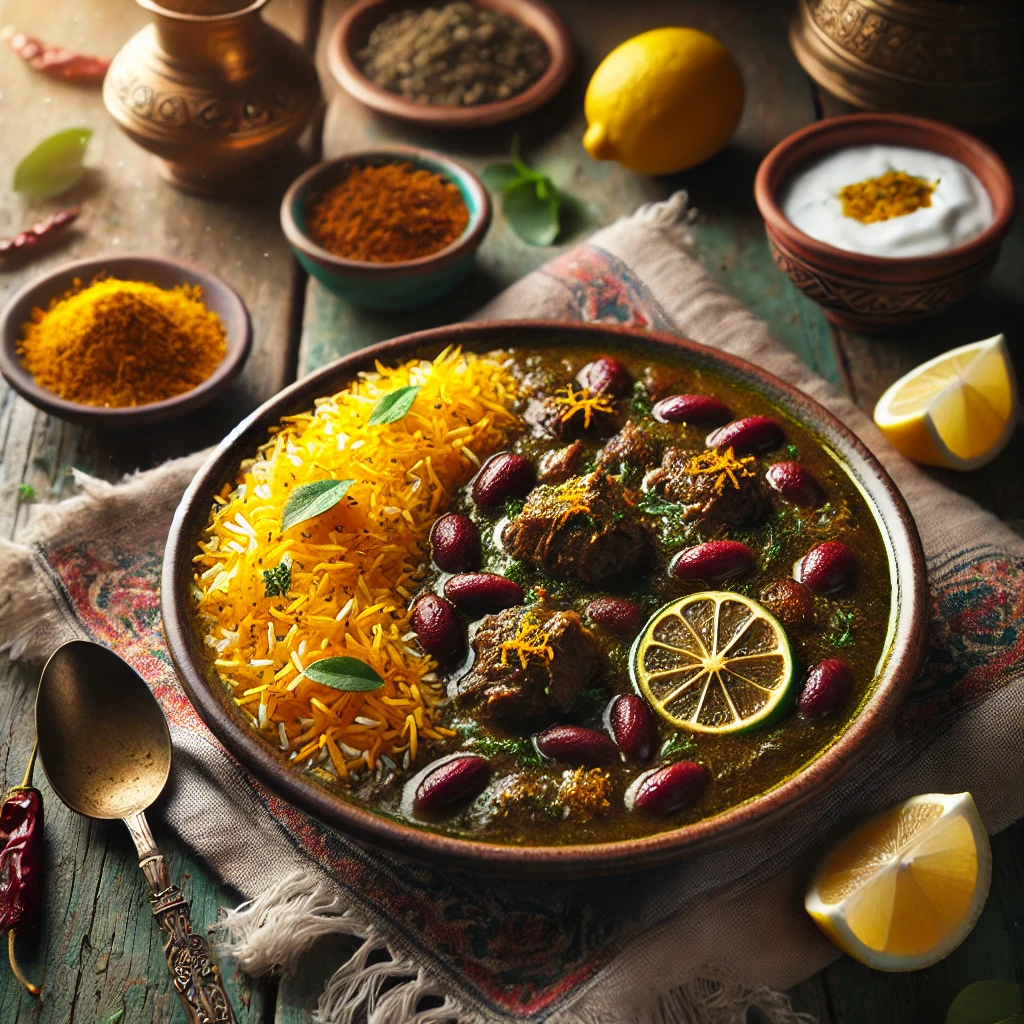
1. Ghormeh sabzi — the national dish. Slow-Braised Ghormeh Sabzi with Dried Lime and Fresh Herbs. Parsley, cilantro, chives, and fenugreek, fried down until the green turns nearly black — that 20-minute herb fry is not optional and is the step most Western adaptations skip. Kidney beans, lamb or beef, two dried limes, three hours. Wikipedia — Ghormeh sabzi has the regional variations.
2. Fesenjan — pomegranate and walnut, the sweet-sour showpiece. Herbed Chicken Fesenjan with Pomegranate Reduction is the classic; Slow-Cooked Chicken Stew with Pomegranate and Walnut Sauce is the hands-off version. Toast and grind the walnuts finely; the sauce should go from beige to deep brown over 90 minutes as the oil renders out.
3. Khoresht-e bademjan — eggplant and tomato. Persian Roasted Eggplant and Tomato Stew with Turmeric and Garlic. Salt the eggplant 30 minutes and roast rather than fry — same result, a third of the oil.
4. Herb and lamb stew with limes — Slow-Cooked Herb and Lamb Stew with Dried Limes, a gentler entry point than full ghormeh sabzi.
5. Saffron lamb shanks — Saffron-Infused Lamb Shanks with Herb-Infused Broth, the celebration dish. Three hours at 300°F, covered, and the meat gives up at the bone.
Timing note for weeknights: every stew here is better on day two and freezes for three months. Make a double batch on Sunday and the Wednesday version costs you 10 minutes of rice.
Aash, appetizers, and the herb plate
Four dishes round out the table, and three of them are cold, which makes them ideal make-ahead.
- Aash-style herb and legume soup — Persian Herb and Lentil Soup with Lemon and Turmeric. Thick enough to stand a spoon in; the traditional version tops it with fried mint and kashk (fermented whey), for which sour cream thinned with lemon is a fine substitute.
- Kashk-e bademjan analog — Charred Eggplant and Yogurt Dip with Garlic and Sumac. Char the eggplant directly over a gas flame for 12 minutes until the skin collapses.
- Salad shirazi — Shirazi Salad with Cucumber and Tomato. Dice everything to a uniform ¼ inch and dress immediately before serving; it weeps within 20 minutes.
- Grilled fish, Gulf style — Persian Gulf-Style Grilled Fish with Lemon and Herbs, for the southern coastal end of the cuisine that most roundups ignore.
The uncooked herb plate — sabzi khordan — is not a garnish. Put out whole mint, tarragon, basil, radishes, scallions, walnuts, and feta, and let people build bites between courses. It costs $6 and does more for the meal's authenticity than any single technique in this guide. A sharp knife makes prep quick; see Knives & Cutting.
Sweets and tea
Persian desserts are floral and restrained — rose water, cardamom, saffron, pistachio, and much less sugar than a Western dessert course.
- Saffron and Cardamom Infused Rice Pudding with Rose Water — the sholeh zard family. Serve cold, dusted with cinnamon in a pattern.
- Saffron-Infused Rosewater Ice Cream with Pistachio Crunch — bastani, essentially. The pistachio shards are structural, not decorative.
- Honey-Rose Water Poached Pears with Pistachios — a 25-minute dessert when guests are already at the table.
- For a savory-sweet crossover, Pan-Seared Chicken with Dill and Rose Water Sauce shows how floral notes work outside the dessert course.
Tea is black, brewed strong in a two-tier pot, and drunk through a sugar cube held in the teeth. Never with milk.
How to build a Persian sofreh
The sofreh is the spread itself — traditionally a cloth on the floor or table where every dish arrives at once. A working template for six people:
| Element | Count | Example | Make-ahead |
|---|---|---|---|
| Rice | 1 large platter | Tahdig-topped chelo | Day-of, 75 min |
| Stew | 1–2 | Ghormeh sabzi + fesenjan | 2 days ahead |
| Kebab | 1 | Joojeh or koobideh | Marinate overnight |
| Herb plate | 1 | Mint, tarragon, radish, feta | 2 hours ahead |
| Salad | 1 | Shirazi | 10 min before serving |
| Yogurt | 1 | Mast-o-khiar | Day before |
| Bread | 1 basket | Lavash or barbari | Store-bought is fine |
| Dessert | 1 | Sholeh zard or bastani | Day before |
Sunday-cook, Thursday-eat schedule: stews on Sunday (they improve), yogurt and dessert Monday, marinade Wednesday night, rice and salad the hour before you eat. Everything on that table except the rice and salad holds 3–4 days refrigerated. If you'd rather not plan it by hand, our AI meal planner will build the shopping list and the day-by-day order around whichever dishes you pick.
Common pitfalls
Five failure modes account for most disappointing first attempts:
1. Over-parboiling the rice. 7 minutes is the ceiling, not the target. Rice that's fully soft going into the steam turns to paste and refuses to form a crust.
2. Under-frying the herbs in ghormeh sabzi. Bright green herbs at the end of cooking mean a grassy, thin stew. They should fry down to a dark, almost khaki mass over 15–20 minutes before the meat and water go in.
3. Too much saffron. Past about 30 threads per pot the flavor turns medicinal and slightly bitter. More is not better and it's expensive to learn that lesson.
4. Whole dried limes left in. Pierce them, use two, and fish them out before serving.
5. Rushing the kebab marinade. Under 4 hours, chicken kebab tastes like grilled chicken. The onion enzymes need the time.
When Persian cooking is the wrong call
If you have 30 minutes and one burner, this is not your cuisine tonight — the rice alone takes 75 minutes. Skip to a sheet-pan dinner and come back on the weekend. It's also a difficult fit for very low-carb eating: rice is not a side dish here, it's the plate, and the stews on their own read as under-seasoned without it. And if you can't source dried limes, fenugreek, and real saffron, cook something else rather than substituting your way to a dish that isn't recognizably Persian — the pantry genuinely is the cuisine.
Keep going
If you liked this, the neighboring cuisines share a pantry and a lot of technique: 20 Lebanese Recipes, 20 Israeli & Levantine Recipes, and 20 Moroccan Recipes. For the equipment side — the wide pot, the skewers, the mortar — start with Cookware and Small Appliances.
Frequently asked questions
What is tahdig and how do I get the crispy crust right?
Where do I buy dried limes and saffron for Persian cooking?
How different is Persian cuisine from other Middle Eastern cooking?
Are Persian recipes healthy?
Can I make Persian food without a rice cooker?
Sources
Plan a week of meals in two minutes.
Tell our AI what you have and what you like — it builds your plan, shopping list, and Instacart cart. No account needed.
Try free →