20 Peak-Season Sweet Corn Recipes: Elote, Chowders & Grilled Ideas
Local ears beat frozen for about three more weeks — here's how to pick them, char them six ways, and cook a dozen before they turn starchy.
Peak US sweet corn runs from late August through mid-September, and right now is the last stretch where local ears beat anything frozen. Buy corn picked the same day, cook it within 48 hours, and lean on high-heat methods — grilling, charring, skillet-searing — that concentrate the sugars instead of leaching them into boiling water.
Get a free cookout plan for a crowd
Mains, sides and quantities scaled to your headcount, with one Instacart cart instead of a spreadsheet.
No spam, unsubscribe in one click. Recipes, shopping lists and Instacart carts all work without an account either way.
Why local ears eclipse frozen right now
Sweet corn is one of the few crops where the calendar genuinely decides the outcome. A freshly picked ear is roughly 4-6% sugar by weight. From the moment it leaves the stalk, enzymes start converting that sugar to starch: modern supersweet (sh2) varieties hold their sugar far better than the heirloom su types, but even those lose measurable sweetness within a day at room temperature. The University of Minnesota Extension puts the harvest window for a given planting at about four to six days — which is why a farm stand that picks each morning tastes categorically different from a supermarket pallet that shipped three states.
That window is closing. Most of the US crop north of the Mason-Dixon line finishes by the third week of September. After that, the frozen bag is genuinely the better buy — it's blanched and frozen within hours of harvest, so it holds more sugar than a two-week-old fresh ear. But between now and mid-September, fresh wins on every axis that matters: sweetness, kernel pop, and the milky liquid that makes chowders and creamed corn taste like something.
The USDA notes in its corn primer that sweet corn accounts for barely 1% of total US corn acreage — the rest is field corn for feed, ethanol, and processing. That scarcity is exactly why the fresh season feels short: you are competing for a tiny slice of a very large crop, and the growers who serve it fresh are almost all regional.
Practical consequence: buy more than you think you need this week, strip the extras off the cob, and freeze the kernels flat in a zip bag. Two ears yield roughly 1½ cups of kernels — enough for a chowder base in November when you'll wish you'd bought twelve.
How to pick, husk, and store fresh corn
The four-signal check at the stand
| Signal | Good ear | Walk away |
|---|---|---|
| Husk | Bright green, tight to the cob, slightly damp | Yellowed, dry, loose, peeling |
| Silk | Gold to light brown, moist, slightly sticky | Black, brittle, dry to the touch |
| Stem end | Pale and freshly cut, still moist | White, dried, or shriveled |
| Weight | Heavy for its size, kernels fill to the tip | Light, gaps or dents along the rows |
The milk test
Peel back a two-inch window at the top of the ear and press a kernel with your thumbnail. A fresh ear squirts a thin milky liquid. A starchy one dents and stays dry — that ear has been off the stalk for days and belongs in a chowder, not on the grill. Serious Eats' corn buying guide makes the same call and adds the useful corollary: never buy corn that has already been husked at the store. Husks are the corn's own packaging, and stripping them accelerates moisture loss dramatically.
Storage that actually works
Husks on. Loosely wrapped in a damp paper towel. Crisper drawer. Two days maximum. Do not store corn in a sealed plastic bag — trapped ethylene and condensation turn the kernels mealy. If you can't cook it within two days, blanch the ears three minutes, cut the kernels off, and freeze.
Three mistakes that cost you sweetness
1. Salting the boiling water. Salt toughens the kernel pericarp. Boil in plain water, or add a tablespoon of sugar and a splash of milk if you want the old-school Midwestern treatment.
2. Boiling too long. Fresh corn needs three to five minutes, not fifteen. Overcooked corn tastes like the water it was cooked in.
3. Husking hours ahead. Husk immediately before cooking. Every minute a naked ear sits, it dries.
Grilling corn six ways
Grilling is where peak-season corn earns its keep. Direct heat drives the Maillard reaction on the kernel surface while the interior stays juicy — you can't get that from a stockpot. Six methods, ranked by how much char you want.
1. Husk-on soak (juiciest, least char). Soak whole ears in cold water 15 minutes. Grill over medium, turning every 4 minutes, for 15-20 minutes total. The wet husk steams the kernels. Peel and butter. This is the method for people who want plump, tender corn and don't care about grill marks.
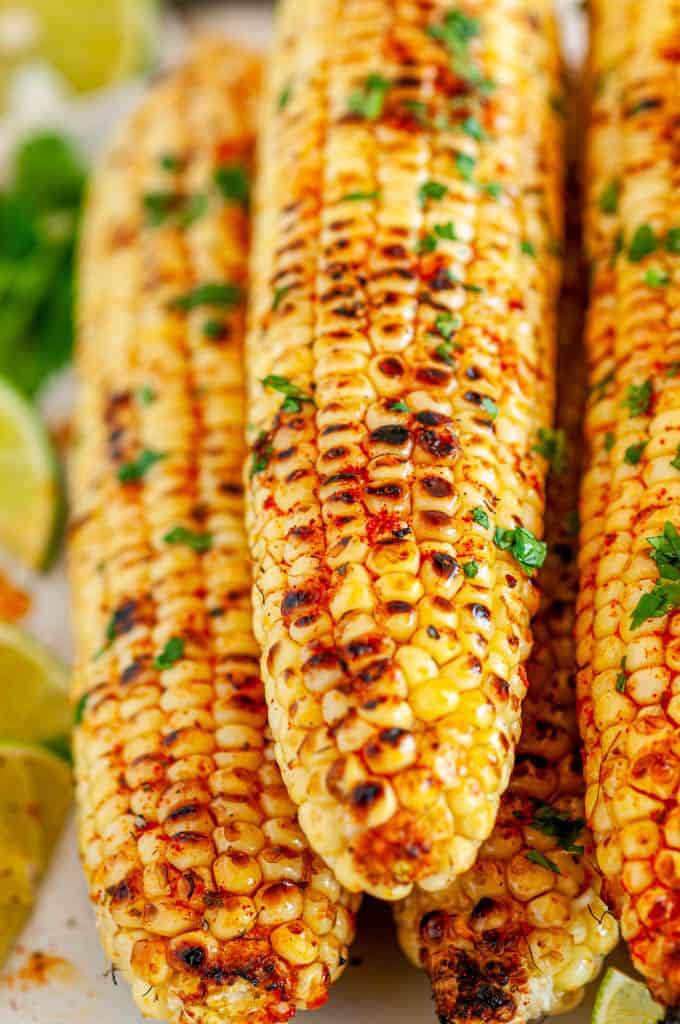
2. Direct char (most flavor). Husk completely, brush with oil, grill over high heat 8-10 minutes, turning every 2 minutes until roughly a third of the kernels have blackened spots. This is the base for Honey-Lime Grilled Corn on the Cob with Chili Butter and for anything where you want smoke in the finished dish.
3. Foil pack (hands-off, crowd-friendly). Husk, butter, season, wrap tightly in foil, grill 20 minutes over medium, turning twice. No flare-ups, no attention required, and the butter stays on the corn instead of dripping into the fire.
4. Elote (the one everyone asks for). Direct-char first, then coat hot: mayo or crema, cotija, chili powder, lime. Charred Street-Style Mexican Corn with Chipotle-Lime Mayo and Grilled Elote-Style Mexican Street Corn with Cotija and Chili are the two versions worth learning. For a dairy-free take, Grilled Detroit-Style Street Corn with Vegan Parmesan and Lime hits the same salty-tangy note.
5. Plancha / griddle (best for off-cob). Strip kernels raw, then dry-sear them in a single layer on a flat top until they blister. Two minutes, no stirring, then toss. This is how you get char into a salad or salsa without wrestling whole ears.
6. Cast iron (indoor char). No grill? Get a dry skillet screaming hot, add kernels in one layer, leave them alone for 90 seconds, then toss. A Lodge seasoned cast iron skillet holds enough thermal mass that the kernels char instead of steaming — a thin nonstick pan will not do this.
20 curated sweet corn recipes
Grilled sides and elote
1. Honey-Lime Grilled Corn on the Cob with Chili Butter — 20 minutes, the default cookout side.
2. Charred Street-Style Mexican Corn with Chipotle-Lime Mayo — full elote treatment, on the cob.
3. Grilled Elote-Style Mexican Street Corn with Cotija and Chili — the simpler cotija-forward version.
4. Grilled Detroit-Style Street Corn with Vegan Parmesan and Lime — dairy-free, same salt-acid balance.
Salads
5. Elote-Inspired Mexican Street Corn Salad with Cotija and Cilantro — elote off the cob, easier to serve for a crowd.
6. Sautéed Omaha Corn and Tomato Salad with Basil Vinaigrette — peak corn plus peak tomato, one bowl.
7. Omaha-Inspired Sweet Corn and Black Bean Salad — travels well, better on day two.
8. Grilled Corn and Peach Salad with Honey Thyme Dressing — the late-August overlap dish, corn and stone fruit together.
9. Rustic Tex-Mex Black Bean and Corn Salad — 15 minutes, no cooking beyond charring the kernels.
Chowders and soups
10. Roasted Hatch Green Chili and Sweet Corn Chowder — Hatch season and corn season overlap by about three weeks. Use it.
11. Charred Corn and Andouille Soup with Creole Spices — smoky, brothy, freezes well.
12. Fire-Roasted Poblano and Corn Soup — vegetarian, blended, deep green heat.
13. Garden-Style Tomato & Corn Soup — the two peak-season crops in one pot.
Salsas, tacos, and handhelds
14. Pan-Fried Mexican Street Corn Tacos with Cotija and Lime Crema — vegetarian taco night, 25 minutes.
15. Chili-Spiced Black Bean and Corn Tacos — pantry beans plus fresh kernels.
16. Smoky Southwest Grilled Chicken Tacos with Corn Salsa — corn salsa as a condiment, not a side.
Fritters, cornbread, and baked
17. Sweet Corn and Zucchini Mini Fritters — the best use for the two vegetables you have too many of right now.
18. Show-Me Regional Cornbread Salad with Black Beans — layered, potluck-scale.
Off-cob mains
19. Pan-Seared Chicken with Summer Corn and Tomato Succotash — one skillet, 30 minutes.
20. Shrimp and Corn Pasta Salad with Citrus Vinaigrette — cold, packable, good for the last picnic of the year.
Also worth a look: Three Sisters Succotash with Roasted Corn and Beans, Vegetarian Pasta Salad with Roasted Sweet Corn and Black Beans, Pan-Seared Catfish with Cajun Spice and Creamed Corn, and Dominican-Style Sweet Corn Pudding for dessert.
Real-world numbers: yield, time, and cost
| Task | Input | Output / time |
|---|---|---|
| Kernels off the cob | 1 medium ear | ~¾ cup kernels |
| Chowder for 4 | 4 ears | ~3 cups kernels + cobs for stock |
| Boil | Fresh ear, plain water | 3-5 min |
| Direct-char grill | Husked ear, high heat | 8-10 min, turn every 2 |
| Husk-on grill | Soaked ear, medium heat | 15-20 min |
| Blanch for freezing | Whole ear | 3 min, then ice bath |
| Farm-stand price, peak | Per ear | $0.50-$1.00 |
| Supermarket, off-season | Per ear | $1.25-$2.00 |
Don't throw the stripped cobs away. Simmer them in the chowder liquid for 20 minutes and pull them before adding cream — they carry a surprising amount of starch and corn flavor, and it costs you nothing.
Common pitfalls
- Cutting kernels off in a bowl. They fly. Stand the ear in the center of a wide sheet pan or use a dedicated stripper.
- Charring on a dirty grate. Sugar plus residue equals bitter carbon, not sweet char. Scrape hot, oil the grate.
- Dressing elote cold. The mayo-crema base needs a hot ear to cling. Assemble within a minute of pulling it off the grill.
- Freezing kernels in a clump. Spread flat, freeze, then break apart. A frozen brick thaws unevenly and waters down whatever you add it to.
- Buying husked ears "for convenience." You lose a day of shelf life and you can't run the milk test.
Late-summer sweet corn dinner plan
Monday — grill night. Honey-Lime Grilled Corn on the Cob with Chili Butter alongside grilled chicken thighs. Grill four extra ears while the fire is hot; strip them for the rest of the week.
Wednesday — skillet main. Pan-Seared Chicken with Summer Corn and Tomato Succotash, using Monday's stripped kernels. 30 minutes start to finish.
Friday — soup + salad. Roasted Hatch Green Chili and Sweet Corn Chowder with Rustic Tex-Mex Black Bean and Corn Salad on the side.
The side, any night: Elote-Inspired Mexican Street Corn Salad with Cotija and Cilantro keeps three days in the fridge and gets better.
Dessert: Dominican-Style Sweet Corn Pudding — corn as a sweet, which surprises people who have only had it buttered.
Total corn required: about 14 ears. Buy 16 — you'll eat two standing at the counter.
When NOT to use fresh corn
Skip fresh and reach for frozen when the recipe cooks the corn hard and long: chowders that simmer 40 minutes, cornbread batter, fritters, casseroles, and anything pureed. In those dishes the pop and sweetness you paid a premium for get cooked away anyway, and frozen kernels are cheaper, pre-stripped, and perfectly good. Fresh is worth it for raw and lightly cooked applications — salads, salsas, grilled sides, and the last-minute stir into a soup off the heat.
Also skip fresh in February. A "fresh" ear in the off-season has traveled from Florida or Mexico and has been off the stalk for a week. Frozen, blanched at harvest, will taste sweeter.
What to buy
You do not need much specialized equipment for corn, but three things earn their storage space during a six-week season.
Long grill tongs. Turning eight ears over high heat every two minutes is the whole job. A pair of locking silicone-tipped kitchen tongs with a 12-inch reach keeps your knuckles off the grate. Browse the rest of the utensils and tools range if you want a matched set.
A corn stripper. If you're going through a dozen ears a week, a dedicated corn cob stripper cuts stripping time roughly in half versus a chef's knife and keeps the kernels contained. A sharp knife and a sheet pan works fine too — see the cutting boards selection if your board is too small to catch the spray.
A cast iron skillet. For indoor charring, thermal mass is the whole game. The Lodge 10.25-inch seasoned skillet is the cheap, correct answer; the broader cookware category has larger options if you're charring for six.
Plan your week around the haul with the AislePrompt meal planner, and if you're stocking up for a cookout, the Labor Day weekend cookout guide pairs directly with everything above. For the other half of the late-summer harvest, see our late summer tomato recipes.
Worked example: one dozen ears, one week
Say you come home from the stand on Saturday with twelve ears at $0.75 each — $9.00 total. Here is how that haul actually gets used without a single ear going starchy in the drawer.
Saturday, within an hour. Husk four ears and grill them husk-off over high heat while the coals are at their hottest. Two get eaten standing up. Two get stripped into a container — that is roughly 1½ cups of charred kernels banked for later.
Saturday night. Husk and soak the remaining eight, grill them husk-on at medium while dinner cooks, then strip six and refrigerate the kernels. Grilled-then-stripped kernels keep four days and taste like something; raw stripped kernels keep two and taste like nothing after day one. This single habit — cook first, strip second, store third — is the difference between a productive corn week and a compost bin.
Sunday. The 1½ cups of charred kernels become Elote-Inspired Mexican Street Corn Salad with Cotija and Cilantro. Ten minutes, no cooking, and it improves through Tuesday.
Tuesday. Two cups of the grilled kernels plus the reserved cobs go into Roasted Hatch Green Chili and Sweet Corn Chowder. Simmer the naked cobs in the stock for 20 minutes before you add dairy; pull them, then finish. The difference is not subtle.
Thursday. The last cup goes into Pan-Seared Chicken with Summer Corn and Tomato Succotash — a 30-minute weeknight skillet that reads as a much bigger effort than it is.
Total: twelve ears, five dishes, roughly $9 of corn spread across a week of meals, and zero waste. Scale it up and freeze the surplus flat; two extra bags of stripped kernels in the freezer will carry a chowder in November.
Scaling for a crowd
Cooking corn for twenty is a logistics problem, not a technique problem. The math: plan 1½ ears per adult if corn is the featured side, 1 ear if it is one of three sides. A standard 22-inch kettle grill holds about twelve ears in a single layer over direct heat, and each batch takes ten minutes plus turning.
The fix is to stagger. Soak everything, run husk-on batches at medium heat — they tolerate sitting in a warm oven or a cooler lined with towels for 30 minutes without degrading, which direct-charred ears do not. Char only the last batch, the one that goes out immediately.
If you are serving elote, do not build it on the cob for a crowd. Strip everything and make the salad version; it holds temperature, serves with a spoon, and nobody is standing over a plate wearing mayonnaise. Same flavors, a fifth of the mess.
FAQ
How can I tell if corn is really fresh at the store? Bright green husks clinging tightly to the ear, moist gold-thread silks that are never dry or brown, and a stem end that looks freshly cut rather than white and dried out. Peel back a small window at the top and press a kernel with your thumbnail: it should squirt milky liquid. Corn loses roughly a quarter of its sugar within 24 hours of picking, so buy from a stand or store that turns stock daily.
Should I husk corn before or after cooking? It depends on the method. For grilling, leave husks on and soak the ears for 15 minutes so the husks steam the kernels for plumper, more tender corn. For boiling, husk first and cook 3-5 minutes in unsalted water — salt toughens the kernels. For roasting or elote-style char, husk and rub with oil so the sugars caramelize directly on the flame instead of steaming under the leaves.
Can I substitute frozen corn in these recipes? Yes for chowders, fritters, cornbread, and anything where the corn cooks further — thaw and drain first. Skip the substitution for salads, salsas, and grilled sides that showcase raw or lightly cooked kernels; frozen loses the pop and sweetness that make peak-season recipes worth the effort. If you must use frozen off-season, char it hard in a dry skillet to concentrate the sugars before adding to the dish.
How long does fresh corn keep in the fridge? Two days at most, husks on, wrapped loosely in a damp paper towel and stored in the crisper drawer. After that, sugars convert to starch and the flavor flattens noticeably. If you have bought more than you can cook, blanch the ears three minutes, shock them in ice water, strip the kernels, and freeze them flat — that stops the conversion and buys you six months.
What is the fastest way to get kernels off the cob? Stand the shucked ear upright in the center of a wide, rimmed sheet pan and run a sharp knife down the sides in four passes, rotating a quarter turn each time. The pan catches everything, unlike a cutting board. After cutting, run the back of the knife down the stripped cob to scrape out the milky residue — that liquid is pure corn flavor and belongs in whatever you are making.
Sources
- University of Minnesota Extension — Growing sweet corn
- USDA — Corn: many uses, many ways to eat
- Serious Eats — How to buy and store fresh corn
Frequently asked questions
How can I tell if corn is really fresh at the store?
Should I husk corn before or after cooking?
Can I substitute frozen corn in these recipes?
How long does fresh corn keep in the fridge?
What kitchen tools make working with corn easier?
Sources
Plan the whole cookout in one go.
Ask our AI for mains, sides and quantities for your headcount — one Instacart cart, no spreadsheet.
Plan my cookout →