22 Indian Weeknight Dinners: Tikka Masala, Butter Chicken & Curries
Six spice jars, one high-sided skillet, and 22 catalog recipes that hit the table in 45 minutes or less.
Yes — you can put real Indian food on a weeknight table in under 45 minutes. Restaurant Indian is slow because it holds pre-cooked gravies for hundreds of covers; home Indian is fast because a single onion-tomato-spice base takes about 12 minutes and then carries almost any protein. Six spice jars, one skillet, and a pot of basmati is the whole system.
Get a free week of easy dinners
Seven weeknight dinners with the shopping list already totalled, sent Sunday. No account needed, unsubscribe in one click.
No spam, unsubscribe in one click. Recipes, shopping lists and Instacart carts all work without an account either way.
Below are 22 Indian dinners from the AislePrompt catalog that clock in at 45 minutes or less from cutting board to plate, grouped so you can pick by protein, by heat level, or by how tired you are. Every one links straight to the full recipe with a shoppable ingredient list.
Introduction: Why Indian home cooking is faster than you think
The slowness people associate with Indian food comes from three specific things, and none of them belong on a Tuesday: overnight marinades, whole-spice tempering done as theater rather than function, and slow-braised cuts like lamb shank or goat shoulder. Strip those out and what remains is a technique stack that is genuinely faster than most American weeknight cooking.
Here is the actual clock. Dice one large onion: 3 minutes. Sweat it in ghee until the edges go translucent-gold: 7 minutes. Add ginger-garlic paste, then ground spices, then canned tomato or tomato paste: 4 minutes. You now have a base that will accept chicken thighs, paneer, chickpeas, lentils, shrimp, or cauliflower. Add the protein and simmer 15 to 20 minutes. Total: 30 to 34 minutes, most of it unattended.
Compare that to a "quick" American sheet-pan dinner — 15 minutes of prep and a 25-minute bake with a 10-minute oven preheat you can't skip. The curry wins on wall-clock time and wins on leftovers, because a curry improves overnight while roasted vegetables turn to mush.
The second reason it's faster than you expect: Indian cooking is unusually forgiving about ingredient substitution. Out of paneer? Firm tofu or halloumi behaves nearly identically in Kadai Paneer Simmered in Spiced Tomato Gravy. Out of heavy cream? Full-fat coconut milk or a spoonful of cashew paste finishes a gravy the same way. That flexibility means you cook what's in the house instead of making a store run, which is where most weeknight dinner plans actually die.
The third reason is batching. A doubled onion-tomato base freezes in flat quart bags and thaws in 8 minutes of simmering. Two Sundays a year of base-making buys you a season of 20-minute dinners. We'll lay that rotation out in a section below.
One honest caveat, as of 2026: the fastest dishes here are the skillet curries and tandoori-style broiled proteins. Biryani, dal makhani, and slow-braised vindaloo are weekend projects — they're in the catalog, but they aren't on this list, and any site telling you a proper dal makhani is a 30-minute dish is lying to you about the black-lentil cook time.
The 6-jar Indian pantry that unlocks a hundred dinners
You do not need a 30-jar masala dabba. Six ground spices plus one whole seed cover the overwhelming majority of North and South Indian weeknight cooking. Buy them once — a $25 to $35 outlay at an Indian grocery, or roughly $45 at a supermarket for smaller jars — and they last about six months before the volatile oils fade.
| Spice | What it does | Typical dose (4 servings) | Don't skip it in |
|---|---|---|---|
| Garam masala | Warm finishing blend — cardamom, cinnamon, clove | 1 tsp, added at the END | Butter chicken, korma, keema |
| Ground cumin | Earthy backbone, the "Indian smell" | 1.5 tsp, bloomed in fat | Chana masala, aloo gobi, dal |
| Ground coriander | Citrusy body, thickens gravy slightly | 2 tsp, bloomed in fat | Tikka masala, kadai paneer |
| Turmeric | Color plus bitter-earthy base note | 0.5 tsp — more turns it medicinal | Dal, egg curry, khichdi |
| Kashmiri chili powder | Deep red color, mild heat (1,000–2,000 SHU) | 1–2 tsp | Tandoori marinades, rogan josh |
| Brown mustard seeds | Popping tempering seed, South Indian sharpness | 1 tsp in hot oil until they crackle | Dal tadka, Goan fish curry |
Add four fresh items — yellow onions, garlic, a knob of ginger, and a bunch of cilantro — plus three shelf-stable ones: canned crushed tomatoes or tomato paste, full-fat coconut milk, and ghee. That's the whole kit.
Two rules about spice handling that matter more than the brand you buy. First, ground spices go into hot fat, not into liquid. Blooming cumin and coriander in ghee for 30 to 45 seconds before the tomatoes go in is the single biggest quality delta between a flat curry and a fragrant one. Second, garam masala goes in at the end, off heat or in the last two minutes. It's a finishing blend; boiling it for 20 minutes cooks off exactly the aromatics you paid for.
Kashmiri chili powder deserves a specific callout because it's the ingredient most home cooks get wrong. It is not cayenne. It's a mild, intensely red chili that gives tandoori chicken and butter chicken their signature color without scorching heat. If your grocery only stocks generic "chili powder" — which in the US is usually a Tex-Mex blend with cumin and oregano already in it — buy Kashmiri online or substitute sweet paprika plus a pinch of cayenne.
Turmeric is the other one worth understanding. It's the pigment behind the color of dal and khichdi, and it's the compound behind most of the "golden milk" health marketing you've seen. Harvard Health's review of the turmeric evidence is the sober read here: curcumin shows real anti-inflammatory activity in lab settings, but absorption from food quantities is low, and the culinary case for turmeric is color and flavor first. Use half a teaspoon and move on.
Stock the pantry from the shelf-stable aisle in one trip — AislePrompt's Grocery & Pantry category carries the ghee, coconut milk, and whole-spice basics, and everything in it ships to a shoppable list.
22 weeknight Indian dinners under 45 minutes (curated recipe cards)
Every recipe below is 45 minutes or less, total, including prep. Times are from the recipe card, not from a wishful headline. Sorted fastest first.
A few structural notes on that list. Nine of the 22 are vegetarian and four more are vegetable-forward with a small amount of protein, which is why Indian is the single best cuisine to lean on if you're trying to cut meat two nights a week without eating another sad grain bowl. The tandoori-style dishes (#2, #3, #4, #9) are the fastest because they're broiler or grill-pan cooking — a yogurt-and-spice coating, 8 to 12 minutes of high heat, done. If you need dinner in half an hour flat and you're only going to memorize one technique from this article, memorize that one.
Calorie counts sit between 220 and 450 per serving for everything except the biryani, which is a full rice-and-protein plate at 650. Protein runs 30 to 40 grams for the meat dishes and 12 to 18 grams for the paneer and lentil dishes — respectable, but if you're chasing a protein target, pair the vegetarian ones with a cup of yogurt.
Chicken curries: tikka masala, butter chicken, chicken korma
Chicken is where most people start, and the three canonical dishes are close cousins that differ mainly in what enriches the gravy.
Chicken tikka masala is tomato-forward with a smoky note from the pre-charred chicken. Maharaj Indian Grill-Style Chicken Tikka Masala is the 40-minute weeknight version: skip the overnight marinade, toss cubed thighs in yogurt and tandoori spice for the 15 minutes it takes to build the gravy, then broil them on a sheet pan while the sauce reduces. You get about 80% of the char you'd get from a proper marinade for 5% of the planning. The catalog also carries a longer, more traditional Chicken Tikka Masala at 100 minutes if you want the full weekend treatment — the difference is a real marinade and a slower onion caramelization, and it is noticeably better.
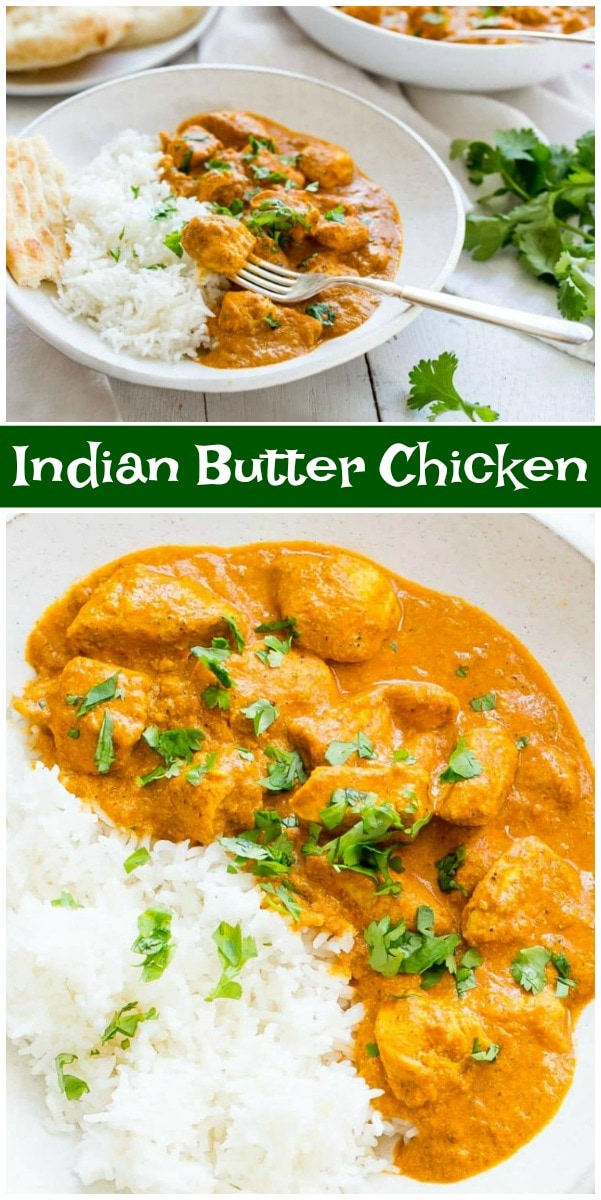
Butter chicken (murgh makhani) trades some of the tomato acidity for butter and cream, and it's the mildest of the three — the one to make when you're feeding kids or heat-averse guests. The Best Ever Indian Butter Chicken lands at 45 minutes and 450 calories a serving. If you want naan handled in the same recipe rather than as a separate errand, Creamy Homemade Butter Chicken with Warm Naan bundles both at the same 45-minute mark.
Korma is the nut-thickened one — cashew or almond paste plus cream, barely any chili, deeply aromatic from cardamom and mace. Chicken Korma with Spinach runs 50 minutes, which pushes it just past our weeknight line, so treat it as a Thursday-when-you-got-home-early dish. The vegetarian sibling, Vegetable Korma with Cashews, does fit at 45 minutes and is the better weeknight pick.
Two more chicken curries worth knowing that don't fit the famous-three framing. Saffron and Cardamom Indian Chicken Curry is lighter — 320 calories, no cream, the aromatics doing the work — and Indian-Spiced Chicken Curry with Coconut and Tomatoes is the dairy-free option at 45 minutes, using coconut milk where the others use cream.
Use thighs, not breasts. This is the highest-leverage swap in the entire article. Boneless skinless thighs hold up to a 20-minute simmer without going stringy, they're cheaper per pound, and they carry spice better because of the fat. Breast meat in a curry is dry by minute 14. If you only have breasts, cut them larger, add them in the last 8 minutes, and pull the pan the moment they hit 160°F.
For the fried and broiled end of the chicken spectrum, Spicy Sri Lankan Chicken 65 with Curry Leaf and Green Chili at 35 minutes is a genuinely great weeknight dish that nobody makes at home, and Crispy Chickpea Flour Chicken Pakoras turn a pound of chicken into an appetizer-plus-dinner for two in 40 minutes. Serious Eats' Indian recipe archive is a good cross-reference if you want to see the technique variations side by side.
Vegetarian mains: chana masala, palak paneer, dal tadka
The vegetarian half of Indian cooking isn't a compromise track — it's the larger and older half of the cuisine, and it's where the cost-per-serving math gets absurd. A pot of dal feeding four costs about $3 in ingredients.
Dal is the fastest entry point. Steamed Gujarati Dal Tadka with Mustard Seeds is 40 minutes, 220 calories, and 14 grams of protein per serving using split red lentils (masoor dal), which cook in 18 to 20 minutes without soaking. The tadka — hot ghee with popped mustard seeds and cumin poured over the finished lentils — is the entire flavor event, and it takes 90 seconds. Do not skip it and do not do it early; it goes on at the table.
If you want a creamier, richer lentil dish, Creamy Turmeric Lentil Curry with Coconut Milk hits 35 minutes and 410 calories, and it's fully vegan.
Paneer dishes are the protein anchor. The catalog carries four weeknight-viable versions and they're genuinely different dishes, not reskins:
- Spiced Palak Paneer with Roasted Spinach and Indian Cheese — 40 min, spinach-based, mild, the kid-friendly one
- Creamy Saag Paneer with Regional Spice Mix — 35 min, mixed greens instead of pure spinach, slightly bitter edge
- Tandoori-Spiced Kadai Paneer with Bell Peppers — 40 min, dry-ish and peppery, no cream
- Kadai Paneer with Bell Peppers and Fresh Tomato Gravy — 45 min, saucier version of the same
Buy paneer rather than making it — a 12-ounce block runs $5 to $7 and takes zero minutes. Sear the cubes in ghee for two minutes a side before they go into the gravy; unseared paneer has the texture of a wet eraser.
Chana masala is the pantry dish — canned chickpeas, canned tomatoes, spices, done. Classic Chana Masala with Cumin is listed at 60 minutes because it's built for dried chickpeas; swap in two drained cans and you're at 30 minutes with a nearly identical result.
Rounding out the vegetable side: Spiced Aloo Gobi (Indian Cauliflower Curry) is the fastest dish in this entire article at 25 minutes, and Goan Egg Curry in Spiced Coconut Gravy at 40 minutes is the cheapest protein-forward dinner here — six eggs, one can of coconut milk, done. Gujarati Sweet Rice Khichdi is the Indian equivalent of chicken soup: rice and lentils cooked together into something soft and restorative, 45 minutes, and the dish every Indian household makes when someone is sick.
Two seafood options that belong in the vegetarian-adjacent conversation because they're just as fast: Steamed Goan Fish Curry with Coconut and Kokum at 35 minutes and 250 calories is the lightest main on this list.
Rice and bread on autopilot: 20-minute basmati and store-bought naan tricks
The starch is where weeknight Indian dinners usually go wrong, because people either over-invest (making naan from scratch on a Wednesday) or under-invest (microwave rice that tastes like the pouch).
Basmati, the 20-minute method that actually works:
1. Rinse 1.5 cups basmati in a bowl of cold water, swirl, drain, repeat until the water runs mostly clear. Three rinses. This takes 90 seconds and it's the difference between separate grains and glue.
2. Soak 15 minutes if you have it — not required, but soaked grains elongate rather than break.
3. Combine with 2.25 cups water (a 1:1.5 ratio, not the 1:2 you'd use for long-grain white), a teaspoon of salt, and a tablespoon of ghee.
4. Boil uncovered, then cover and drop to the lowest heat for 10 minutes.
5. Kill the heat and do not lift the lid for 10 more minutes. The residual steam finishes the grains. Fluff with a fork, never a spoon.
That's 20 minutes of clock time and about 3 minutes of attention, and it runs entirely in parallel with the curry.
When you want the rice to be the event rather than the accompaniment, Saffron-Infused Basmati Rice Pilaf with Toasted Nuts and Raisins is 45 minutes and serves six — it turns a simple dal into a dinner-party plate. And Saffron-Infused Chicken Biryani with Cucumber Raita is the rare biryani that genuinely fits in 45 minutes because it's a layered pilaf rather than a sealed-pot dum biryani.
Naan: buy it. Frozen or refrigerated naan from the grocery is genuinely good in 2026, and the reheating technique matters more than the brand. Dry cast-iron skillet over medium-high, 45 to 60 seconds per side, until it puffs and shows a few black blisters. Then brush with melted ghee and a pinch of flaky salt. That 90 seconds takes supermarket naan from "fine" to "why does this taste like the restaurant." Microwaving it, by contrast, produces a warm, damp frisbee.
If you want naan made properly as part of the dish, Tandoori-Spiced Chicken with Fresh Naan Bread handles it in the 45-minute window.
Raita in 4 minutes: one cup of full-fat plain yogurt, half a grated cucumber squeezed dry, a quarter teaspoon of toasted cumin, salt, and chopped cilantro. It's a cooling counterweight for anything spicy and it's the reason Tandoori-Spiced Chicken with Creamy Cucumber Raita reads as a complete meal at 30 minutes.
A 5-night weeknight rotation with make-ahead components
Here's an actual week, built so that Sunday's work compounds across five dinners. Total active cooking on Sunday: about 50 minutes.
Sunday prep (50 minutes):
- Double batch of onion-tomato base: 4 large onions, 6 cloves garlic, 2-inch ginger, 2 cans crushed tomatoes, cumin/coriander/turmeric/Kashmiri chili. Cook down 25 minutes, cool, freeze flat in four quart bags.
- Marinate 2 lbs chicken thighs in yogurt + tandoori spice. Freeze half.
- Cook 3 cups dry basmati (yields ~9 cups), portion flat into freezer bags.
| Night | Dish | Active time | What Sunday did for you |
|---|---|---|---|
| Monday | Tandoori-Spiced Grilled Chicken Thighs with Mint Yogurt Sauce | 15 min | Chicken already marinated |
| Tuesday | Steamed Gujarati Dal Tadka with Mustard Seeds | 20 min | Rice pre-cooked |
| Wednesday | Maharaj Indian Grill-Style Chicken Tikka Masala | 18 min | Base thawed, chicken marinated |
| Thursday | Spiced Palak Paneer with Roasted Spinach and Indian Cheese | 22 min | Base thawed |
| Friday | Spiced Lamb Keema with Peas and Basmati Rice | 25 min | Base thawed, rice pre-cooked |
Average weeknight active time: 20 minutes. That's faster than delivery.
What freezes well, what doesn't. Tomato-based gravies (tikka masala, chana masala, kadai paneer) freeze for three months with no quality loss and arguably improve — the spices continue to bloom. Lentil dishes freeze well but thicken; add a splash of water on reheat. Dairy-heavy gravies (butter chicken, korma) will break if you freeze them with the cream in; freeze the base, stir in cream on reheat. Paneer goes rubbery after freezing — freeze the gravy, add fresh paneer.
Rice freezes better than anyone expects. Cool it fast, portion it flat, and reheat from frozen with a tablespoon of water under a damp paper towel for 2 minutes. Do not leave cooked rice at room temperature for hours before refrigerating — Bacillus cereus is the one real food-safety concern in this entire article, and it's entirely avoidable by cooling rice within an hour.
Shopping it in one pass. AislePrompt's shopping list groups every ingredient across all five nights by aisle, so the spices, produce, dairy, and proteins come off the shelf in a single loop instead of five separate trips. Tap the Instacart button at the top of the list to send the whole week to your local store. Most of what's above is standard-supermarket stuff — chicken thighs, yellow onions, canned tomatoes, spinach, yogurt, basmati. Only the Kashmiri chili powder and paneer might need the international aisle.
If a five-night rotation is more commitment than you want, the 30-Minute Weeknight Dinner Plan is a lower-effort framework, and the Fall Family Dinner Rotation folds a couple of these curries into a broader four-week plan.
Kitchen equipment that pays for itself in Indian cooking
Short list. Indian home cooking is famously equipment-light, and the tandoor obsession is a red herring — nobody in an Indian home kitchen has one either.
| Tool | Why it matters here | Rough cost | Skip if |
|---|---|---|---|
| 12-inch skillet, high-sided | Handles ~80% of curries; the walls prevent splatter during tempering | $40–$120 | You have a 5-qt sauté pan |
| Heavy 5–6 qt Dutch oven | Biryani, big-batch dal, korma for a crowd | $60–$350 | You cook for 1–2 |
| Cast-iron skillet or grill pan | Tandoori char and naan reheating on the stovetop | $25–$50 | You have a working broiler |
| Spice grinder (blade coffee grinder) | Whole spices ground fresh beat pre-ground by a wide margin | $20–$40 | You're happy with jarred ground |
| Microplane | Ginger and garlic in 20 seconds, no board, no mincing | $15–$20 | Never — buy this one |
| Immersion blender | Smooths tomato-cashew gravies without a blender transfer | $35–$60 | You like texture in your gravy |
The high-sided skillet is the one purchase that changes your week. Tempering mustard seeds in a shallow pan sends them across your stovetop; high walls contain it. Browse Cookware for skillet and Dutch oven options, and Utensils & Tools for the microplane and a decent wooden spatula — a metal spoon will scrape the fond you spent seven minutes building.
For the appliance-assisted path, a 6-quart electric pressure cooker collapses the two dishes that don't fit the weeknight window: dried chickpeas for chana masala go from 8 hours of soaking plus an hour of simmering to 35 minutes total, and black lentils for dal makhani go from overnight to 45 minutes. Small Appliances covers the pressure cookers and rice cookers; if you cook rice more than twice a week, a $60 rice cooker removes the one variable in this whole system that requires timing.
A note on knives, since almost every dish here starts with an onion: you need one sharp 8-inch chef's knife, not a block. A dull knife is why onion prep feels like a chore. Knives & Cutting has the picks, and our Best Kitchen Knife Sets in 2026 guide breaks down what's actually worth paying for.
What you can skip, definitively: a masala dabba (a plate and six jars work identically), a tandoor or tandoor attachment, a dedicated kadai if you own a wok or high-sided skillet, and a mortar and pestle unless you enjoy the process. Bon Appétit's Indian recipe collection is a good sanity check on this — read a dozen of their recipes and note how few call for anything beyond a skillet and a pot.
Common pitfalls
Five specific failure modes, in the order home cooks hit them.
1. Under-cooking the onions. This is the big one. "Translucent" is not the target — you want the edges going golden-brown, which takes 8 to 10 minutes on medium, not 3 on high. Rushing this is why a curry tastes thin and sharp instead of sweet and deep.
2. Adding ground spices to liquid. Spices dumped into simmering tomatoes taste raw and dusty. They need 30 to 45 seconds in hot fat first. If your pan is too dry, add another tablespoon of ghee — this is not the place to cut fat.
3. Boiling garam masala. It's a finishing blend. Twenty minutes of simmering destroys the cardamom and clove aromatics you're paying a premium for. Last two minutes, off heat if possible.
4. Using chicken breast. Covered above, but it bears repeating because it's the most common single mistake. Thighs.
5. Skipping the acid or the fresh finish. A curry that tastes "flat but I don't know why" is almost always missing a squeeze of lemon, a spoonful of yogurt, or a handful of fresh cilantro at the end. All three are 15-second fixes. Taste before you plate, and if it's dull, reach for acid before you reach for more salt.
When Indian isn't the right call
Honest limits. Indian cooking is not the answer when you have fewer than 20 minutes total — the onion base alone eats half of that, and the tandoori dishes still need broiler preheat time. Reach for a stir-fry or a sheet-pan dinner instead.
It's also not ideal if you're cooking for someone with a dairy allergy and you're new to the cuisine. Yogurt, ghee, cream, and paneer run through most of the North Indian canon. It's absolutely doable — Goan, South Indian, and most Gujarati cooking is coconut-based rather than dairy-based, and Indian-Spiced Chicken Curry with Coconut and Tomatoes and Steamed Goan Fish Curry with Coconut and Kokum are both fully dairy-free — but you have to pick deliberately rather than grabbing the first curry recipe you find.
Finally, if your household genuinely can't handle any heat, know that "mild Indian" is a real category rather than a compromise: butter chicken, korma, and palak paneer are all mild by design. But if even black pepper is too much, this cuisine will be a fight. Try the 25 Easy Japanese Dinners rotation instead — same weeknight speed, almost no chili.
FAQ
The questions below cover pantry setup, heat management, freezing, shopping, and equipment. If you want to go deeper on a neighboring cuisine that shares most of this spice pantry, the 18 Sri Lankan Recipes and 22 Malaysian & Indonesian Recipes collections reuse the same six jars.
Frequently asked questions
What Indian pantry staples do I need to cook 90% of these recipes?
How can I make these curries family-friendly for kids who don't love heat?
Can I make Indian food ahead and freeze it?
What's the fastest way to shop for a week of Indian dinners?
Do I need a specific pan or pot to cook Indian food well?
Sources
Plan a week of meals in two minutes.
Tell our AI what you have and what you like — it builds your plan, shopping list, and Instacart cart. No account needed.
Try free →