22 Malaysian & Indonesian Recipes: Nasi Goreng, Rendang, Laksa & Satay
Three techniques — the pounded spice paste, the dry-braise and the jar of sambal — unlock this entire cuisine at home.
Affiliate disclosure: AislePrompt may earn a commission on qualifying purchases made through Amazon and Instacart links in this article, at no additional cost to you. See our affiliate policy →
Start with three techniques, not twenty-two recipes. Learn to build a rempah (the pounded spice paste), learn the dry-braise that turns beef and coconut milk into rendang, and learn to keep a jar of sambal on the table. Everything else in Malaysian and Indonesian cooking is a variation on those three moves, and all three work fine on a home stove.
The crossroads cuisine of the Malay archipelago
The Malay archipelago is the reason your spice cabinet exists. Nutmeg and cloves grew nowhere else on earth but the Maluku Islands, and for four centuries the ships that came for them left behind Indian curry technique, Chinese wok technique, Arab braising, Portuguese chilies and Dutch bureaucracy. What came out the other side is Malaysian and Indonesian cooking: a cuisine of layered pastes, coconut fat, sour fruit and deliberate heat that is genuinely distinct from the Thai food most American home cooks already know.
This guide covers the four dishes in the title plus eighteen more, all linked to recipes you can cook tonight. Where our catalog is thin — and it is thin in a few specific places — I say so and give you the ratios instead of sending you to a recipe that isn't the dish.
If you already cook Thai food or Vietnamese food, you have most of the pantry. The differences are candlenuts, shrimp paste, palm sugar and a much heavier hand with coconut milk.
Rempah and bumbu: the spice paste that runs everything
Almost every savoury dish in this guide starts the same way: you grind a wet paste, then you fry it. Malaysians call it rempah; Indonesians call it bumbu. It is not a dry spice blend and it is not curry powder. It is a wet purée of aromatics that you cook in oil until the water drives off and the oil separates back out.
A workhorse rempah for four servings:
| Component | Amount | Role |
|---|---|---|
| Shallots | 8–10 small (about 150 g) | body, sweetness, bulk |
| Garlic | 5–6 cloves | savoury base |
| Dried red chilies | 8–12, soaked 20 min | color and slow heat |
| Fresh bird's eye chilies | 2–6, to taste | sharp front heat |
| Lemongrass | 2 stalks, bottom 10 cm only | citrus-pine top note |
| Galangal | 3 cm piece | pine and camphor, not ginger |
| Turmeric | 3 cm fresh, or 1 tsp ground | color, earthiness |
| Candlenuts | 4–5 (macadamias substitute) | fat, thickening |
| Belacan / terasi | 1 tsp, toasted | glutamate, funk, depth |
Grind that to a paste, then fry it in 3–4 tablespoons of neutral oil over medium heat. The clock matters more than the recipe does: 8 to 12 minutes, stirring, until the raw shallot smell is gone, the paste darkens by two or three shades and you can see oil pooling at the edges of the pan. That oil break — Indonesians call the state pecah minyak, "broken oil" — is the signal. Stop early and every dish downstream tastes raw and slightly bitter, no matter how long you simmer it afterward.
Toast the belacan before it goes in. Wrap the teaspoon in foil, dry-toast it in a skillet for 2 minutes a side, and open a window. It smells alarming and tastes like nothing else; skipping it is the single most common reason a home-cooked laksa tastes flat.
You can see the finished paste doing its work in Kuala Lumpur Spiced Coconut Chicken Curry and Coconut Tamarind Chicken Curry, both of which are essentially rempah plus coconut milk plus protein.
Rendang: a dry-braise, not a curry
Rendang comes from the Minangkabau highlands of West Sumatra, and it is the dish most often gotten wrong in American kitchens — usually by stopping three-quarters of the way through.
Here is the actual arc. You brown beef chuck, add rempah and a full litre of coconut milk per kilo of meat, and simmer uncovered. For the first 90 minutes it looks like a wet curry. Around the two-hour mark the liquid drops below the meat and the sauce goes from soup to gravy to paste. In the last 30 to 45 minutes the coconut milk breaks: the water is gone, the coconut oil renders out, and the meat finishes by frying in its own oil and caramelized paste. That last stage is where the color goes from orange-brown to near-black and where all the flavor comes from.
Total: 2.5 to 3 hours of mostly-unattended stovetop time, and it cannot be shortened. A 45-minute "rendang" is a wet Padang-style curry — good food, wrong dish. If you want the real thing on a weeknight, Slow Cooker Malaysian Beef Rendang with Coconut Milk runs 8 hours unattended, then finishes in a skillet for the oil break.
Four versions worth your time, in ascending order of commitment:
- Spiced Beef Rendang with Toasted Coconut and Kaffir Lime Leaves — 2 h 10 min, the shortest honest one.
- Lowyat-Style Spiced Beef Rendang with Toasted Coconut — 2 h 10 min, serves 6, the Malaysian-leaning version.
- Braised Beef Rendang with Toasted Coconut — 2 h 30 min.
- Minangkabau-Inspired Beef Rendang with Coconut and Aromatics and Slow-Cooked Lemongrass Beef Rendang — 3 hours, the reference builds.
Two details separate a good rendang from a great one. First, kerisik — coconut that you dry-toast to a dark brown and then grind to a paste. It goes in during the last hour and it is what gives the finished dish its slightly gritty, nutty body; skip it and the texture is thinner. Second, torn kaffir lime leaves (makrut) go in late, not early, or the perfume boils off.
Cut beef into 4 cm cubes, not 2 cm. Three hours will reduce them; small cubes shred into mush.
Nasi goreng and mie goreng: rice and noodles at speed
If rendang is the weekend, nasi goreng is the Tuesday. Indonesian fried rice is not Chinese fried rice with a different name — the defining ingredient is kecap manis, a thick palm-sugar-sweetened soy sauce that caramelizes on the rice and turns it mahogany. Add a spoonful of sambal, a fried egg on top, and prawn crackers (krupuk) on the side, and that is the dish.
Be aware of a gap: we do not currently have a recipe titled nasi goreng in the catalog. Rather than link you to a generic fried rice and call it Indonesian, here is the ratio, which is all you actually need:
For 3 cups of day-old cold jasmine rice: fry 2 tbsp sambal oelek and 3 minced garlic cloves in 2 tbsp oil for 1 minute; add the rice and break it up; add 3 tbsp kecap manis and 1 tbsp regular soy; toss over the highest heat your burner makes for 3–4 minutes until the grains are separate and glossy. Top with a fried egg cooked in hot oil until the edges are lacy. Fresh rice steams instead of frying and gives you paste — this is the one non-negotiable.
The noodle side is better covered. Mie goreng is the same seasoning logic on yellow egg noodles, and the Malaysian mamak-stall version, mee goreng, adds tomato and potato:
- Stir-Fried Mee Goreng with Spicy Sambal Sauce — 25 minutes, the closest thing here to a stall plate.
- Quick Indonesian-Inspired Noodle Stir Fry with Garlic and Chili — 20 minutes total, the weeknight version.
- Stir-Fried Singapore Noodles with Shrimp and Curry Powder — the curry-powder vermicelli that is, famously, not from Singapore.
Then there is char kway teow, the flat-rice-noodle dish that lives or dies on wok hei — the scorched, faintly smoky aroma you only get when the wok is hot enough to vaporize the sauce on contact. Try Spicy Malaysian Char Kway Teow Stir-Fried Rice Noodles or Stir-Fried Char Kway Teow with Prawns and Chinese Sausage. If you want the flavor without the noodle-handling, Egg Noodles Tossed in Char Kway Teow Sauce gets you 80% there in 18 minutes.
The single most useful home-cook adjustment: cook noodle dishes in two batches. A home burner puts out 12,000–18,000 BTU against a hawker wok range's 100,000+. Four servings at once drops the pan below searing temperature and you steam instead of fry. Two batches of two, four minutes each, beats one batch of four every time.
Laksa: the coconut curry noodle soup
Laksa is the archipelago's great argument. There are two families and people are not casual about the distinction:
| Style | Base | Sour from | Noodle | Typical toppings |
|---|---|---|---|---|
| Curry laksa (curry mee) | Coconut milk + rempah | Lime, mild | Yellow egg noodles + rice vermicelli | Tofu puffs, fish cake, cockles, egg |
| Asam laksa (Penang) | Fish stock, no coconut | Tamarind, aggressive | Thick rice noodles | Mint, pineapple, cucumber, torch ginger |
Curry laksa is the one most people mean and the one that travels best to a home kitchen. The broth is rempah fried to the oil break, then coconut milk, then stock, held below a boil — hard boiling splits coconut milk into grease and grit.
- Coconut Curry Laksa — 30 minutes, serves 4, the straightforward build.
- Kopitiam-Style Curry Mee with Tofu Puffs and Egg — 25 minutes, closer to a coffee-shop bowl. Related: curry mee.
- Vegetarian Laksa with Tamarind Broth and Tofu — 80 minutes, and the tamarind gives you a hint of the asam side.
- One-Pot Coconut Curry Noodles with Silken Tofu — 25 minutes when you want the idea and not the project.
Tofu puffs are worth a special trip. Those hollow deep-fried cubes soak up broth like sponges and are the textural signature of a curry laksa bowl. They are in the refrigerated section of any Asian market, they freeze indefinitely, and nothing substitutes for them.
Assemble in the bowl, never in the pot: noodles first, then toppings, then ladle broth over. Noodles left sitting in hot broth turn to porridge in about ten minutes, which is why every stall in Kuala Lumpur builds bowls to order.
Satay and peanut sauce
Satay is Indonesian in origin, adopted everywhere, and simpler than it looks. Skewered meat, a turmeric-and-lemongrass marinade, a hard sear, and a peanut sauce that is not the sweet stuff from a jar.
The marinade is where the flavor lives, not the sauce. Ground coriander, turmeric, lemongrass, garlic, shallot, palm sugar and a little oil, at least 2 hours and ideally overnight. Thread the meat along the skewer in a flat ribbon rather than bunched in cubes — more surface area against the grate means more char per bite.
- Grilled Chicken Satay with Peanut and Coconut Sauce — 50 minutes, serves 4, the reference version.
- Wok-Seared Chicken Satay with Spicy Peanut Sauce — indoor method, no grill needed.
- One-Pan Satay Chicken with Peanut Sauce and Green Beans — 32 minutes, skewers skipped entirely, weeknight-shaped.
- Crispy Tofu Satay with Mango-Peanut Sauce and Tamarind-Infused Vegetable Satay with Mango-Lime Sauce — the vegetarian routes, and the tofu one genuinely works.
For the sauce: toast raw peanuts and grind them coarse rather than using peanut butter. You want visible texture. Fry a spoonful of rempah, add the ground peanuts, coconut milk, tamarind water, palm sugar and salt, and simmer to a loose, pourable consistency — it thickens as it cools, so pull it thinner than you think. Balance is roughly 2 parts savoury : 1 part sweet : 1 part sour; taste and adjust the tamarind last.
Serve with ketupat or lontong — compressed rice cakes — plus raw shallot and cucumber. The raw allium against the sweet sauce is the whole point.
Sambal: the condiment that is not optional
Sambal is where this cuisine parts ways with the western idea of "hot sauce." There are hundreds of named varieties; a jar on the table is assumed, the way salt is assumed.
The three you should know:
| Sambal | Build | Use it on |
|---|---|---|
| Sambal oelek | Fresh red chilies + salt, ground coarse, barely cooked | Anything; it is a base ingredient as much as a condiment |
| Sambal belacan | Chilies + toasted shrimp paste + lime | Rice, grilled fish, cucumber |
| Sambal goreng | Chilies fried in oil with shallot, garlic, palm sugar | Tempeh, eggs, potato, as a stir-fry base |
Sambal is also a cooking method. Fry a couple of spoonfuls in oil, add protein and vegetables, and dinner takes fifteen minutes:
- Sambal Goreng Tempeh with Crispy Shallots and Palm Sugar — 30 minutes, and the best introduction to tempeh I can point you to.
- Stir-Fried Tofu with Spicy Sambal and Crispy Shallots — 35 minutes, vegan.
- Spicy Indonesian Sambal Stir-Fried Chicken — 30 minutes.
- Stir-Fried Malaysian Sambal Prawns with Tamarind — 22 minutes, and the sweet-sour-hot triangle in its clearest form.
- Sambal Stir-Fried Aubergine and Okra — 140 calories a serving, a side that outshines most mains.
- Stir-Fried Water Spinach with Sambal and Garlic — this is kangkung belacan, one of the great vegetable dishes on earth, and it takes 17 minutes. Water spinach is at most Asian markets; substitute spinach only under protest, since it lacks the hollow crunchy stem that makes the dish.
Rice dishes worth building a meal around
Rice is not a side here — several of the region's signature dishes are the rice.
Nasi lemak is Malaysia's national dish and an ideal introduction: rice steamed in coconut milk with a pandan leaf, served with sambal ikan bilis (anchovy sambal), fried peanuts, cucumber and a boiled or fried egg. It is breakfast food there and a complete dinner here.
- Malaysian-style Nasi Lemak with Spiced Anchovy Sambal — 45 minutes, serves 4.
- Surface-Inspired Layered Nasi Lemak with Spicy Sambal and Crispy Anchovies — same dish, plated as layers.
Hainanese chicken rice is the Singaporean icon, and the technique that matters is invisible on the plate: the chicken poaches gently, then the rice cooks in the poaching stock with rendered chicken fat, ginger and garlic. Two dishes, one pot of liquid.
- Hainanese Chicken Rice with Ginger-Soy Dipping Sauce — 70 minutes, the full build.
- Wok-Fried Kopitiam-Style Hainanese Chicken Rice and Stir-Fried Malaysian Kopitiam Hainanese Chicken Rice — faster stir-fried takes at 45–75 minutes.
- Chili-Lime Soy Dipping Sauce for Kopitiam Chicken Rice — 5 minutes, and the plate is incomplete without it.
Two more rice plates worth knowing: nasi campur, the Indonesian "mixed rice" plate where a scoop of rice is ringed with four or five small portions — see Candi Temple-Inspired Nasi Campur with Sambal — and nasi kerabu, the east-coast Malaysian herb-rice salad dyed blue with butterfly pea flowers, as in Kelantan-Style Nasi Kerabu with Blue Butterfly Pea Rice. The blue is real, it is not food coloring, and it is the most striking thing you can put on a dinner table this month.
Also here: Nasi Kebuli with Crispy Fried Chicken, the Arab-influenced Indonesian spiced rice (nasi kebuli), and simpler coconut rice in Bekasi-Style Coconut Rice with Grilled Chicken, Kuantan-Style Spiced Coconut Rice with Turmeric and Pandan and Simmered Lemongrass Chicken with Coconut Rice.
The sweet-soy braises: semur
Semur is the archipelago's answer to pot roast — a Dutch-Indonesian hybrid braise built on kecap manis, nutmeg, clove and star anise. It is mild, sweet, deeply savoury, and the single best dish in this guide for feeding people who say they don't like spicy food.
- One-Pot Semur Chicken with Star Anise and Cloves — 65 minutes.
- Semur Chicken Braised in Indonesian-Spiced Sauce — 65 minutes.
- Slow-Cooked Lamb Semur with Star Anise and Cloves — 3 hours 20, serves 6, and the best of the three.
A note on our catalog: several semur recipes are filed under an Australian cuisine tag. The dish is Indonesian; the filing is a metadata artifact, not a claim about origin.
Sweets, kuih and the coffee-shop breakfast
The dessert tradition here is kuih — dozens of small steamed, layered or fried snacks built from rice flour, glutinous rice, coconut and palm sugar rather than wheat and butter. Klepon (glutinous rice balls filled with molten palm sugar and rolled in coconut) and nine-layer steamed kuih lapis are the famous ones.
Be aware of a second gap: we have no kuih, no cendol and no es campur in the catalog today. Cendol in particular is worth describing since it is unlike anything in a western dessert repertoire: green pandan-flavored rice-flour worms in coconut milk over shaved ice, with a shot of dark palm sugar syrup poured over at the table. If you want to approximate the flavor, the syrup is the essential half — dissolve 100 g of gula melaka in 60 ml of water with one pandan leaf, simmer 5 minutes, and pour it over anything cold.
What we do have is the kopitiam breakfast, which is the more useful thing anyway. Kaya is a coconut-and-egg jam, spread thick on toasted white bread with a cold slab of butter, eaten with soft-boiled eggs and dark soy:
- Kopitiam-Style Kaya Toast with Soft-Boiled Eggs — 20 minutes.
- Quick Kopitiam-Style Kaya Toast with Soft-Boiled Eggs — 15 minutes.
- Malaysian Kopitiam Toast with Kaya and Butter and Kopitiam-Style Toasted Butter Kaya and Coconut Jam Sandwich.
And the drink: teh tarik, "pulled tea," strong black tea and condensed milk poured between two vessels from arm's length until it foams. Malaysian Kopitiam-Style Teh Tarik (Pulled Milk Tea) and Malaysian-Style Teh Tarik with Frothy Condensed Milk both take about 10 minutes. Do the pulling over the sink the first three times.
For the adults' table, Pandan-Infused Malaysian Gula Melaka Cocktail and Iced Cempedak Coffee with Palm Sugar Syrup both lean on pandan and palm sugar, which is the flavor axis this whole section runs on.
22 Malaysian and Indonesian recipes to cook this month
Ordered roughly from weeknight to weekend. Every link goes to a full recipe with ingredients and steps.
1. Stir-Fried Malaysian Sambal Prawns with Tamarind — 22 min · 280 cal · the fastest real dish here
2. Stir-Fried Mee Goreng with Spicy Sambal Sauce — 25 min · mamak-stall noodles
3. Quick Indonesian-Inspired Noodle Stir Fry with Garlic and Chili — 20 min · serves 3
4. Stir-Fried Water Spinach with Sambal and Garlic — 17 min · 70 cal · kangkung belacan
5. Sambal Stir-Fried Aubergine and Okra — 25 min · 140 cal · vegetarian
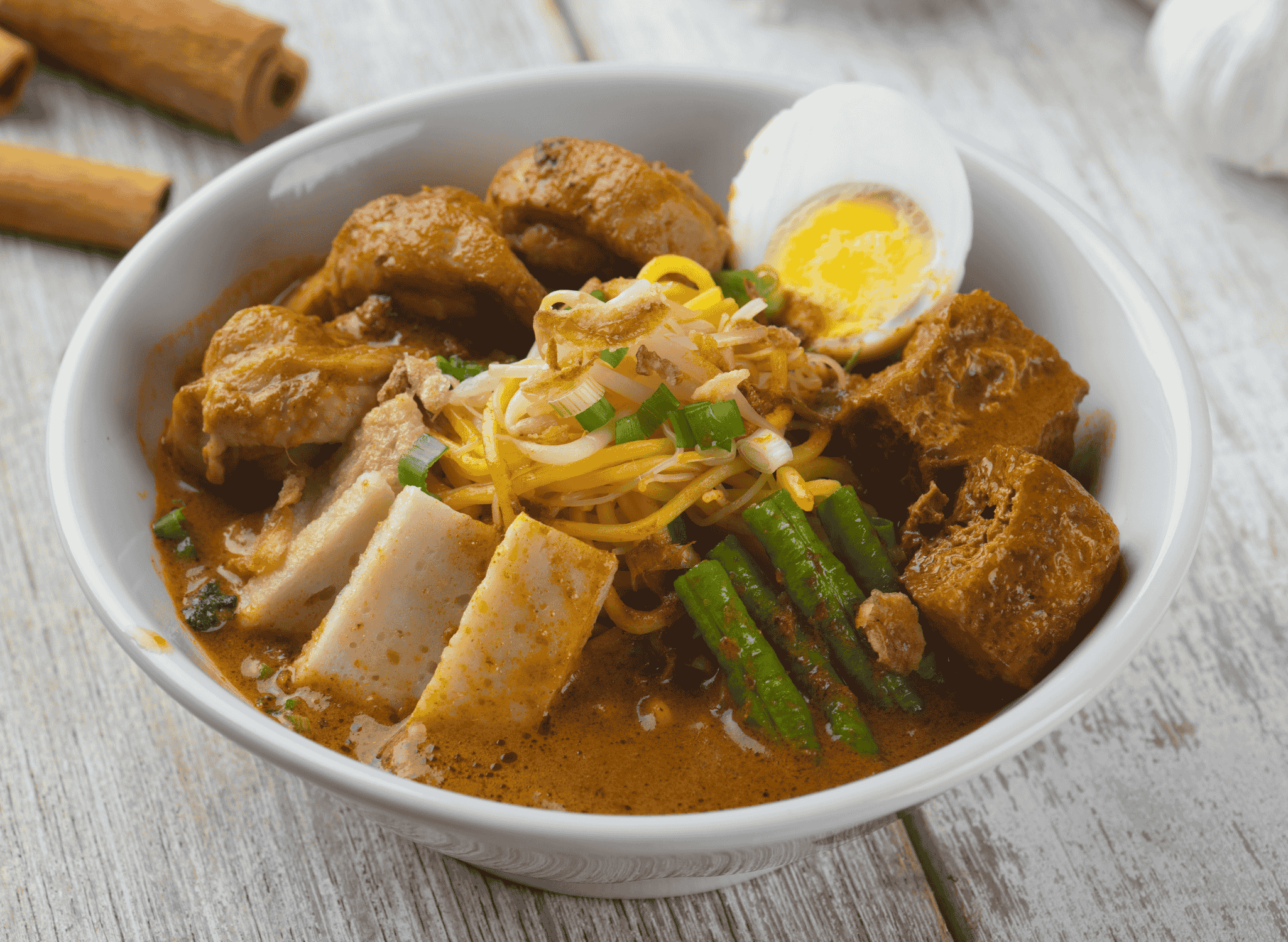
6. Coconut Curry Laksa — 30 min · serves 4 · the bowl in the photo above
7. Kopitiam-Style Curry Mee with Tofu Puffs and Egg — 25 min · coffee-shop style
8. Spicy Malaysian Char Kway Teow Stir-Fried Rice Noodles — 25 min · wok hei practice
9. Stir-Fried Char Kway Teow with Prawns and Chinese Sausage — 35 min
10. Spicy Indonesian Sambal Stir-Fried Chicken — 30 min · serves 4
11. Sambal Goreng Tempeh with Crispy Shallots and Palm Sugar — 30 min · vegetarian
12. Stir-Fried Tofu with Spicy Sambal and Crispy Shallots — 35 min · vegan
13. Sautéed Tempeh with Spiced Tamarind Glaze — 25 min · vegetarian
14. Malaysian-Style Coconut Curry with Tempeh and Vegetables — 40 min · vegan
15. Grilled Chicken Satay with Peanut and Coconut Sauce — 50 min · serves 4
16. Crispy Tofu Satay with Mango-Peanut Sauce — 30 min · vegetarian
17. Kuala Lumpur Spiced Coconut Chicken Curry — 50 min · rempah practice
18. Malaysian-style Nasi Lemak with Spiced Anchovy Sambal — 45 min · the national dish
19. Kelantan-Style Nasi Kerabu with Blue Butterfly Pea Rice — 50 min · the showpiece
20. Hainanese Chicken Rice with Ginger-Soy Dipping Sauce — 70 min · serves 4
21. Spiced Beef Rendang with Toasted Coconut and Kaffir Lime Leaves — 2 h 30 · the weekend project
22. Slow-Cooked Lamb Semur with Star Anise and Cloves — 3 h 20 · serves 6 · no chili heat
Four more if you're building a spread: Grilled Sambal Eggplant with Tamarind Glaze, Tamarind-Glazed Malaysian Prawns with Garlic, Spicy Crab and Tomato Curry with Coconut Milk — the closest thing here to Singapore chili crab — and Stir-fried Lemongrass Tofu with Mixed Vegetables.
Push any of them into a week's plan with the meal plan tool, or send the ingredients straight to a shopping list.
Real-world numbers: time, cost and heat
Two things trip up people cooking this cuisine for the first time: assuming everything is a three-hour project, and assuming everything is punishing. Neither is true.
Active versus total time, measured on a standard 15,000-BTU gas range:
| Dish | Active time | Total time | Serves |
|---|---|---|---|
| Sambal prawns | 12 min | 22 min | 3 |
| Mee goreng | 12 min | 25 min | 2 |
| Curry laksa | 15 min | 30 min | 4 |
| Char kway teow | 15 min | 25 min | 3 |
| Chicken satay | 20 min | 50 min (+ marinade) | 4 |
| Nasi lemak | 20 min | 45 min | 4 |
| Hainanese chicken rice | 25 min | 70 min | 4 |
| Beef rendang | 30 min | 2 h 30 – 3 h | 4–6 |
| Lamb semur | 20 min | 3 h 20 | 6 |
Nine of the twenty-two recipes above finish in 30 minutes or less. The three-hour dishes are three-hour dishes because of unattended simmering, not because of work.
Pantry cost. These are approximate US supermarket and Asian-market prices as of August 2026, and the point is that the specialty half of this list is a one-time purchase that lasts a year or more:
| Ingredient | Typical price | Shelf life | Used in |
|---|---|---|---|
| Coconut milk, 400 ml can | $1.80–$2.50 | 2 years | almost everything |
| Kecap manis, 600 ml | $5–$7 | 1 year opened | nasi goreng, mie goreng, semur |
| Sambal oelek, 8 oz | $3–$4 | 1 year refrigerated | everything |
| Belacan / terasi block | $4–$6 | 2+ years | laksa, sambal belacan |
| Tamarind pulp block | $3–$5 | 2 years | rendang, satay sauce, asam dishes |
| Palm sugar / gula melaka | $5–$8 | indefinite | satay sauce, cendol syrup, kuih |
| Galangal, fresh | $2–$3 | 3 months frozen | every rempah |
| Lemongrass, 4 stalks | $2–$3 | 6 months frozen | every rempah |
| Kaffir lime leaves | $3–$4 | 1 year frozen | rendang, laksa |
| Candlenuts, 200 g | $5–$7 | 6 months | rempah thickening |
Roughly $35–$50 for the full specialty pantry, and it covers dozens of meals. Per-portion cost on the weeknight dishes lands around $2.50–$4.00; the rendang, on chuck at $6–$7 a pound, comes in near $3.50 a serving at six servings.
Heat calibration, because "spicy" is doing too much work as a word:
| Level | Fresh bird's eye chilies (4 servings) | Reads as |
|---|---|---|
| Mild | 0, dried chilies only | Warm, no burn — kids fine |
| Medium | 2–3 | Noticeable, sustained, pleasant |
| Stall-standard | 6–8 | Sweating; this is the default in KL |
| Enthusiast | 12+ | The chili is the dish |
Build the base at mild-to-medium and put sambal on the table. That is how it is actually served, and it means one pot feeds a table with different tolerances.
Common pitfalls
Boiling the coconut milk. Above a bare simmer, coconut milk splits into oil and grainy solids and the sauce never comes back together. Curries and laksa broths want lazy bubbles at the edge of the pot, not a rolling boil. The lone exception is rendang, where you want the split — but only at the end, after two hours, and by then the water is gone.
Under-frying the rempah. This is the big one. Eight to twelve minutes, until the oil separates. Four minutes gets you a dish that tastes raw and vaguely metallic, and no amount of downstream simmering fixes it, because the fix is a chemical change that only happens in hot oil.
Fresh rice in nasi goreng. Day-old, cold, uncovered-in-the-fridge rice has lost enough surface moisture to fry. Fresh rice steams, clumps and goes gluey. If you must use same-day rice, spread it on a sheet pan and freeze it for 30 minutes first.
Skipping the shrimp paste because it smells bad. It does smell bad. Toasted and cooked into a paste, it reads as savoury depth, not fish — the same trick as anchovies in a Caesar. It is the difference between "nice coconut soup" and "laksa."
Crowding the wok. A home burner cannot recover from four servings hitting a pan at once. You get grey, steamed noodles. Two batches, always.
Using ginger for galangal. They are different rhizomes and they taste nothing alike — galangal is piney and medicinal where ginger is hot and sweet. Frozen galangal is at every Asian market. If you genuinely cannot get it, leave it out rather than doubling the ginger. If you are left with a surplus knob after a rendang, 20 fresh ginger recipes is where to spend it.
Treating peanut sauce as a dip you buy. Jarred satay sauce is candy. Ground toasted peanuts, rempah, tamarind and palm sugar takes twelve minutes and is a different food.
When this cuisine is the wrong call
Skip the archipelago tonight if any of these are true.
You have 20 minutes and no pantry. The weeknight dishes above are genuinely fast, but they assume kecap manis, sambal and coconut milk are already in the cupboard. Starting from zero, the first meal is a shopping trip plus an hour. Cook something from the 30-minute weeknight side of the site tonight and buy the pantry this weekend.
You are cooking for someone with a peanut allergy and satay is the plan. Peanut is structural in satay sauce, gado-gado dressing and several rojak variants. Toasted sunflower seed makes a passable substitute in the sauce, but do not improvise around this one — pick a rendang, a semur or a chicken rice instead, none of which use peanuts.
Shellfish is off the table and you want the "real" flavor. Belacan is shrimp. Miso plus a little soy gets you a plausible umami substitute in laksa and sambal, and it is a good dish — but it is not the same dish, and it is more honest to say so than to pretend the swap is invisible.
Nobody at the table eats above mild. You can dial every recipe here down, but a nasi lemak with no sambal or a laksa built at zero heat is a shadow of itself. The semur braises and Hainanese chicken rice are the two dishes that are genuinely great with no chili at all — start there.
What to buy
You need less equipment than you think. In priority order:
1. A carbon-steel wok, 14-inch, flat-bottomed ($35–$50). The single highest-return purchase for this cuisine. Sloped sides let you toss instead of stir, and carbon steel recovers heat far faster than stainless. Flat-bottomed if you have an electric or induction range; round-bottomed only works over a gas ring or a wok burner. Season it, never soap it. Browse cookware.
2. A granite mortar and pestle, 6–8 inch ($30–$60), or a mini food processor ($30–$45). The mortar makes a genuinely better rempah — pounding ruptures cell walls and releases oils that a blade just chops around — but a food processor with a teaspoon of oil to keep things moving gets you 85% of the result in a fifth of the time. Nobody will know. Both live in kitchen gadgets and small appliances.
3. A heavy cleaver or a 8-inch chef's knife ($25–$60). You will spend real time on shallots, lemongrass and galangal — galangal in particular is woody and unpleasant to cut with a dull blade. See knives and cutting boards.
4. A wok spatula (chuan) ($12–$20). The curved edge matches the wok's curve; a flat western turner leaves food behind. Cheap and disproportionately useful. In utensils and tools.
5. A 5–6 quart Dutch oven ($60–$120) for rendang and semur. Heavy base, tight lid, oven-safe. Any enameled cast iron works.
6. Small lidded jars ($10–$15 for a set) for sambal, kerisik and rempah — all three keep a week refrigerated and freeze well in tablespoon portions. Storage containers.
For the ingredients themselves, the pantry tracker will remember what you've already bought, and shelf-stable staples like coconut milk, kecap manis and tamarind are in grocery and pantry.
Freeze aggressively. Lemongrass, galangal, kaffir lime leaves, turmeric and pandan all freeze whole with essentially no loss. Buy them when you see them, not when you need them — that is the actual difference between cooking this food occasionally and cooking it regularly.
Not sure what to make with what's already in your kitchen? Ask the AislePrompt assistant — it will build a rempah around what you have and tell you what to substitute, or scale any recipe here to your table.
Where to go next
The archipelago sits at a crossroads, so its neighbours are the natural follow-ons: Thai recipes share the coconut-and-chili palette, Vietnamese cooking offers the herb-forward counterweight, Chinese weeknight dinners share the wok technique that built char kway teow, and Indian curries are where the spice paste itself came from. Browse the full recipe catalog for more.
Sources
- Malaysian cuisine — Wikipedia
- Indonesian cuisine — Wikipedia
- Singaporean cuisine — Wikipedia
- Peranakan cuisine and the Peranakan Chinese — Wikipedia
- Rendang and Padang cuisine — Wikipedia
- Laksa — Wikipedia
- Satay — Wikipedia
- Nasi goreng — Wikipedia
- Nasi lemak — Wikipedia
- Char kway teow — Wikipedia
- Hainanese chicken rice — Wikipedia
- Sambal — Wikipedia
- Bumbu (seasoning) — Wikipedia
- Shrimp paste (belacan / terasi) — Wikipedia
- Gado-gado — Wikipedia
- Roti canai — Wikipedia
- Cendol — Wikipedia
- Kuih and klepon — Wikipedia
- Es campur — Wikipedia
- Semur — Wikipedia
- Tempeh — Wikipedia
- Coconut jam (kaya) — Wikipedia
- Teh tarik and the kopitiam — Wikipedia
- Sweet soy sauce (kecap manis) — Wikipedia
- Galangal, Cymbopogon (lemongrass), turmeric and Pandanus amaryllifolius — Wikipedia
- Tamarind, palm sugar and candlenut — Wikipedia
- Coconut milk — Wikipedia
- Krupuk, ketupat and lontong — Wikipedia
- Mie goreng, mee goreng and curry mee — Wikipedia
- Nasi campur, nasi kerabu and nasi kebuli — Wikipedia
- Wok — Wikipedia
- Ipomoea aquatica (water spinach) — Wikipedia
- Bird's eye chili and shallot — Wikipedia
- Kaffir lime — Wikipedia
- Minangkabau people — Wikipedia
- Spice trade and the Maluku Islands — Wikipedia
- Rijsttafel — Wikipedia