22 Quick Weeknight Meals Under 20 Minutes: Fast Dinners
Twenty-two recipes timed fridge-to-plate, grouped by protein path, with the pantry list and prep order that keep them honest.
Yes — you can put a real dinner on the table in under 20 minutes, and this guide has 22 of them, every one timed from fridge door to plate. The trick is not "cooking faster." It is picking recipes whose cooking method finishes in the time it takes a pot of water to boil: thin proteins over high heat, eggs, or a one-pot pasta that cooks in its own sauce. Everything below runs 10 to 20 minutes total, averaging 19 minutes and 387 calories per serving.
Get a free week of easy dinners
Seven weeknight dinners with the shopping list already totalled, sent Sunday. No account needed, unsubscribe in one click.
No spam, unsubscribe in one click. Recipes, shopping lists and Instacart carts all work without an account either way.
The 20-minute rule and why most "quick" recipes lie about time
Most "20-minute dinner" recipes on the internet start their clock after the onion is diced, the chicken is pounded, and the pasta water is already boiling. That is how a 20-minute recipe becomes a 45-minute Tuesday.
We time differently. Every recipe in this roundup counts total time as prep plus cook — the numbers you see are the numbers stored on the recipe page, not a marketing headline. Across the 22 recipes here:
| Metric | Value |
|---|---|
| Fastest | 10 minutes |
| Slowest | 20 minutes |
| Average total time | 19 minutes |
| Recipes at 15 minutes or less | 3 |
| Average calories per serving | 387 kcal |
| Average protein per serving | 25.6 g |
| Recipes with 30 g+ protein | 10 of 22 |
| Recipes needing 5 minutes prep or less | 11 of 22 |
There are only three honest ways to get under 20 minutes, and every recipe below uses one of them:
1. Thin protein, high heat. A boneless chicken breast pounded to half an inch, a flank steak sliced against the grain, a shrimp, a salmon fillet. Thickness — not weight — decides cook time.
2. Eggs. An omelette is done in three minutes. Eggs are the fastest complete protein in your kitchen.
3. One-pot starch. Pasta that cooks in the sauce skips the separate boil, the colander, and the second pan to wash.
What does not fit in 20 minutes: braises, bone-in roasts, dried beans from scratch, anything you have to bake. Be honest about that up front and you stop being disappointed at 7 p.m.
This matters beyond convenience. A population-based cohort of 11,396 UK adults found that people eating home-cooked meals more than five times a week — versus fewer than three — ate 62.3 g more fruit and 97.8 g more vegetables daily, and were 28% less likely to have an overweight BMI (Mills et al., International Journal of Behavioral Nutrition and Physical Activity, 2017). The barrier to cooking at home five nights a week is almost never skill. It is time. That is the problem this list solves.
The 22-recipe roundup, grouped by protein path
Pick your path by what is already in your fridge, not by what sounds good. Each entry lists real total time, calories, and protein per serving straight from the recipe page.
Pasta & Grains — average 20 minutes, 478 kcal, 18 g protein
The one-pot method is the whole game here. Starch releases into the cooking liquid and thickens it into a sauce, so you skip draining entirely.
1. One-Pot Spaghetti with Garlic and Cherry Tomatoes — 20 min · 420 kcal · 15 g protein · serves 4. Spaghetti simmers directly in vegetable broth with garlic and cherry tomatoes until the liquid becomes the sauce. Five minutes of prep, one pot to wash.
2. Spaghetti with Garlic-Chili Olive Oil and Crispy Breadcrumbs — 20 min · 480 kcal · 15 g protein · serves 4. Aglio e olio with a toasted breadcrumb top. Pantry-only: no fresh produce required beyond garlic and parsley.
3. One-Pot Spaghetti alla Carbonara with Pancetta — 20 min · 560 kcal · 28 g protein · serves 4. The highest-protein pasta on this list. Eggs and Parmesan emulsify off-heat into a sauce; the residual pan heat cooks them without scrambling.
4. One-Pot Creamy Tomato Basil Tortellini — 20 min · 480 kcal · 22 g protein · serves 4. Fresh cheese tortellini cooks in three minutes, so the sauce is the slow part. The single best "I forgot to plan dinner" recipe here.
5. Pan-Roasted Gnocchi with Sage Brown Butter and Parmesan — 20 min · 450 kcal · 12 g protein · serves 4. Shelf-stable gnocchi goes straight into the pan — no boiling — and crisps like a tiny potato. Four ingredients do all the work.
Eggs — average 15 minutes, 312 kcal, 17 g protein
The fastest group on the list, and the cheapest. Three of the five are single-serving, which makes them the right answer when you are cooking only for yourself.
6. Bistro Omelette with Gruyère and Herbs — 10 min · 320 kcal · 21 g protein · serves 1. The fastest recipe in this guide. Seven ingredients, five minutes of cooking, French technique: low heat, constant motion, pull it while the center is still glossy.
7. Pan-Seared Mushroom and Spinach Omelette with Parmesan — 15 min · 350 kcal · 25 g protein · serves 1. Sauté the mushrooms first to drive off water, or you get a soggy omelette. That step is the entire difference.
8. Spinach and Salsa Breakfast Burrito with Scrambled Eggs — 15 min · 350 kcal · 22 g protein · serves 1. Breakfast-for-dinner that travels. Wrap it in foil and it survives a commute.
9. Sautéed Spinach and Cilantro Shakshuka with Feta Crumbles — 17 min · 220 kcal · 9 g protein · serves 2. A green, low-carb take on shakshuka at only 220 kcal — the lightest dinner here. Serve with bread if you want it to be filling.
10. Wok-Fried Egg Rice with Scallions and Soy — 20 min · 320 kcal · 9 g protein · serves 4. Requires cold cooked rice — day-old is genuinely better, because fresh rice steams instead of frying. The one recipe here that rewards leftovers.
Chicken — average 20 minutes, 384 kcal, 34 g protein
The highest-protein group. Every recipe clears 30 g per serving.
11. Pan-Seared Chicken with Garlic Butter and Lemon Sauce — 20 min · 360 kcal · 42 g protein · serves 2. The most protein-dense recipe in this roundup at 42 g. Pound the breast even before it hits the pan; that is the only reason this works in 20 minutes.
12. Pan-Seared Chicken Thighs with Garlic and Spinach — 20 min · 340 kcal · 30 g protein · serves 4. Thighs are more forgiving than breast — they stay juicy even if you overshoot the temperature. Start skin-side down in a cold pan to render the fat.
13. Quick Chicken Tacos with Avocado Cilantro Sauce — 20 min · 350 kcal · 30 g protein · serves 4. Sliced chicken strips cook in half the time a whole breast does. The avocado sauce is blender-only, no cooking.
14. Chicken and Veggie Quesadilla with Mild Salsa — 20 min · 450 kcal · 35 g protein · serves 2. Built on already-cooked shredded chicken, so this is the rotisserie-chicken riff: buy the bird, use it three ways.
15. Hawaiian-Style Teriyaki Glazed Chicken Skewers — 20 min · 420 kcal · 35 g protein · serves 4. The teriyaki is a quick toss, not an overnight soak — glaze during cooking rather than marinating ahead, and the clock still holds.
One-Skillet — average 20 minutes, 350 kcal, 32 g protein
Stir-frying is the original 20-minute technique. High heat, small pieces, keep it moving.
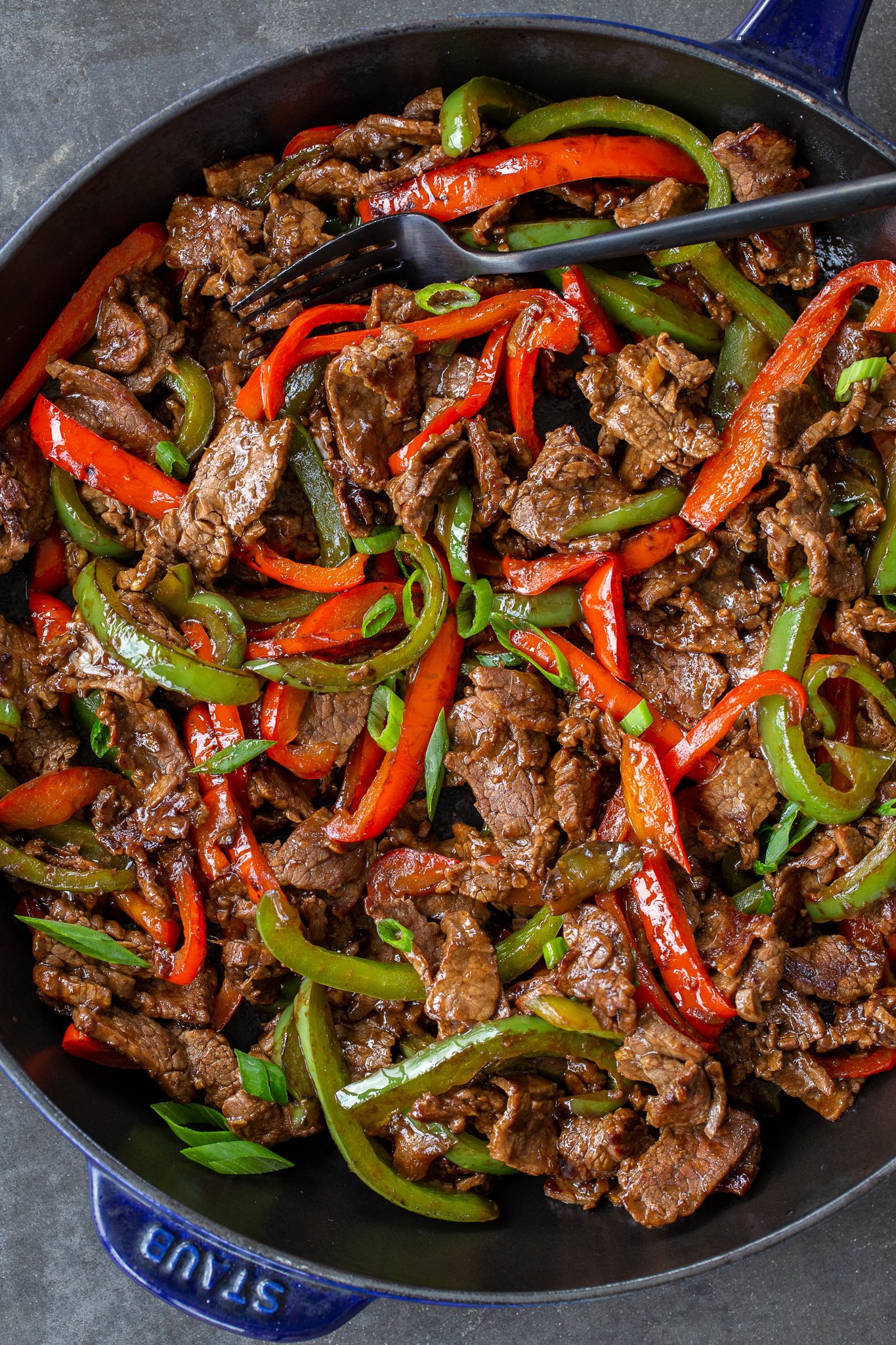
16. Sautéed Garlic Beef Stir Fry with Bell Peppers — 20 min · 350 kcal · 30 g protein · serves 3. Flank steak sliced thin against the grain, cornstarch for velvet texture, garlic-soy to finish. The template every other beef stir-fry copies.
17. Stir-Fried Shrimp Lo Mein with Garlic and Scallions — 20 min · 420 kcal · 35 g protein · serves 3. Egg noodles and shrimp both cook in under four minutes, so nearly all the time here is prep.
18. Lemon-Garlic Shrimp Stir-Fry with Broccoli and Snap Peas — 20 min · 280 kcal · 30 g protein · serves 4. Lowest-calorie high-protein entry: 30 g of protein for 280 kcal. Frozen shrimp thaws under cold running water in five minutes.
Seafood & Handhelds — average 20 minutes, 400 kcal, 30 g protein
Fish is the most under-used weeknight protein precisely because it cooks so fast that people overcook it.
19. Lemon-Garlic Shrimp Scampi with Angel Hair Pasta — 20 min · 380 kcal · 28 g protein · serves 4. Angel hair cooks in three minutes — the fastest pasta shape sold. Time it so the pasta lands in the pan the moment the shrimp turn opaque.
20. Pan-Seared Salmon with Dill Sauce — 20 min · 420 kcal · 38 g protein · serves 4. Dry the skin thoroughly, hot pan, do not move it for four minutes. The sauce is stirred together cold while the fish cooks.
21. Pan-Seared Salmon with Charred Lemon and Herb Salsa Verde — 20 min · 350 kcal · 34 g protein · serves 4. Char the lemon halves cut-side down in the same pan; it takes 90 seconds and completely changes the acid.
22. Veggie-Packed Quesadilla with Black Beans and Corn — 20 min · 450 kcal · 18 g protein · serves 2. The only fully vegetarian pantry recipe here — canned black beans and frozen corn mean you can make it with an empty produce drawer.
Real-world numbers: what 20 minutes actually buys you
Time is not the only axis. Here is how the five paths compare on the things that decide what you cook on a given night.
| Path | Avg time | Avg kcal | Avg protein | Pans to wash | Best for |
|---|---|---|---|---|---|
| Pasta & Grains | 20 min | 478 | 18 g | 1 | Feeding 4 cheaply |
| Eggs | 15 min | 312 | 17 g | 1 | Cooking for one |
| Chicken | 20 min | 384 | 34 g | 1–2 | Protein targets |
| One-Skillet | 20 min | 350 | 32 g | 1 | Using up vegetables |
| Seafood & Handhelds | 20 min | 400 | 30 g | 1–2 | Feeling like you tried |
Two things fall out of that table. First, the egg path is the only one that is meaningfully faster — five minutes, on average, which over five weeknights is nearly half an hour. Second, if you are chasing protein, chicken and stir-fry beat pasta by roughly 15 g per serving for the same 20 minutes and the same single pan.
The 6 pantry staples that unlock every 20-minute dinner
Stock these six and you can cook most of this list without a grocery run:
1. Dried pasta and rice. Angel hair (3 min) and fresh tortellini (3 min) are the fastest; jasmine rice cooked ahead becomes fried rice later.
2. Garlic. In 17 of the 22 recipes above. Buy whole heads, not jarred — the pre-minced kind tastes of the preservative.
3. Canned tomatoes and tomato paste. A tablespoon of paste, bloomed in oil for 60 seconds, gives a 20-minute sauce the depth of a long-simmered one.
4. Lemons. Acid at the end is what makes fast food taste finished. Nine recipes here end with lemon.
5. Eggs. The whole egg path, plus the carbonara emulsion, plus fried rice.
6. Frozen shrimp. Thaws in five minutes under cold water, cooks in three, and carries 30 g of protein per serving.
Add olive oil, soy sauce, and Parmesan and you have covered the seasoning backbone of every recipe on this list. For the shopping side of that, the Grocery & Pantry shelves collect the shelf-stable staples, and Storage & Containers covers the airtight jars that keep breadcrumbs and rice usable for months.
Speed technique: what to do before you turn on the burner
The single highest-leverage habit is mise en place — French kitchen practice for setting out every prepped ingredient before cooking starts (Mise en place, Wikipedia). Restaurants run on it because you cannot chop an onion while a pan is at 400°F without burning something.
Concretely, in the five minutes before you light a burner:
- Read the recipe to the end. The most common cause of a blown 20-minute clock is discovering step 6 needs an ingredient at room temperature.
- Fill and start the kettle if anything needs boiling water. An electric kettle beats a pot on the stove by four to six minutes.
- Chop everything. All of it. Into separate piles or bowls.
- Open the cans and measure the sauces. Sauce ingredients — soy, sesame oil, lemon juice, cornstarch — should be pre-mixed in one small bowl so they hit the pan as a single pour.
- Pat proteins dry and season them. Wet chicken steams instead of searing; that alone can add five minutes.
- Get the pan heating while you finish. A properly preheated skillet is the difference between a sear and a simmer.
A sharp knife is not a luxury here — it is the difference between two minutes and six minutes of prep. If your knife crushes a tomato instead of slicing it, that is the bottleneck, and the Knives & Cutting selection is where to fix it. The pan matters almost as much: 18 of these 22 recipes are cooked in a single skillet, so one heavy 12-inch pan from Cookware covers nearly the whole list. A kitchen scale and prep tools shave another minute or two off measuring.
Common pitfalls that turn a 20-minute dinner into 45
These are the five failure modes we see most often:
1. Crowding the pan. Too much food in one skillet drops the surface temperature and the food releases water and steams. Grey chicken instead of golden chicken. Cook in two batches — it is faster than waiting for a crowded pan to recover.
2. Cold protein straight from the fridge. A fridge-cold breast takes noticeably longer to reach a safe internal temperature and cooks unevenly. Take it out when you start prepping.
3. Skipping the pound. An un-pounded chicken breast is 1.5 inches thick at one end and half an inch at the other. By the time the thick end is safe, the thin end is dry. Two minutes with a heavy pan fixes it.
4. Starting the pasta water too late. Water takes 8 to 10 minutes to boil — often the longest single step. Start it before anything else, or use a one-pot recipe that skips it.
5. Under-seasoning, then over-correcting. Salt the pasta water, salt the protein before it hits the pan, and taste before the final plate. Fast food that tastes flat is almost always an under-salting problem, not a technique problem.
One more, specific to fish and chicken: cook to temperature, not to time. The FDA's safe minimum internal temperatures are 165°F for all poultry, 145°F with a three-minute rest for beef, pork, veal, and lamb chops or steaks, 160°F for ground meat and egg dishes, and 145°F for fin fish — or until the flesh is opaque and separates easily with a fork. Shrimp, lobster, and crab are done when the flesh is pearly and opaque (FDA — Safe Food Handling). A $12 instant-read thermometer removes all the guesswork and, in practice, makes you faster, because you stop cooking things "a bit longer just to be sure."
When NOT to do this
A 20-minute dinner is a tool, not a religion. Skip this list when:
- You are cooking for more than six people. Searing in batches destroys the time advantage. Cook something that scales in an oven instead.
- You want leftovers for the week. These recipes serve 1 to 4. Batch cooking is a different discipline with different economics — a braise that takes two hours but feeds you four times costs less time per meal than four 20-minute dinners.
- The cut is wrong. Bone-in, skin-on, and tough cuts (chuck, brisket, shanks) are not going to work, and forcing them produces something tough. Save them for the weekend.
- You are genuinely too tired to stand up. Making a hard promise to yourself about a 20-minute recipe you will not cook is worse than a sandwich you will. A breakfast burrito at 15 minutes is a legitimate dinner.
Grocery strategy: shopping a "quick-week" cart
The reason quick dinners fail is rarely the cooking. It is discovering at 6:45 that you have no garlic. Shop the week as a system:
Buy one protein per path, not one per recipe. A pound of shrimp covers recipes 17, 18, and 19. One package of chicken breast covers 11, 13, and 15. That is six dinners from two proteins.
Buy one rotisserie chicken. It slots directly into the chicken and veggie quesadilla, which is written for already-cooked shredded chicken, and it eliminates the cooking step entirely on your worst night.
Buy vegetables that survive. Bell peppers, broccoli, and snap peas last 7 to 10 days refrigerated. Spinach and fresh herbs do not — use those in the first three days (recipes 7, 9, 12 are the spinach ones).
Front-load the perishables. Cook fish and fresh herbs Monday and Tuesday. Push the pantry recipes — aglio e olio, gnocchi, black bean quesadillas — to Thursday and Friday when the fridge is bare.
Here is a five-night sequence built on exactly that logic:
| Night | Recipe | Time | Why this night |
|---|---|---|---|
| Monday | Pan-Seared Salmon with Dill Sauce | 20 min | Fish first — it has the shortest fridge life |
| Tuesday | Sautéed Garlic Beef Stir Fry | 20 min | Fresh peppers still crisp |
| Wednesday | Quick Chicken Tacos | 20 min | Avocado has ripened by midweek |
| Thursday | One-Pot Creamy Tomato Basil Tortellini | 20 min | Pantry night, one pot, low effort |
| Friday | Bistro Omelette with Gruyère and Herbs | 10 min | Ten minutes, whatever is left |
You can build this automatically: the meal plan builder filters by total time so you can cap the whole week at 20 minutes, then rolls every ingredient into one shopping list. If you would rather describe the constraint in words — "nothing over 20 minutes, no fish, feeding three" — the AI chat planner will assemble the week and the cart for you.
If 20 minutes turns out to be tighter than you need, we also keep a 30-minute weeknight dinner guide with more forgiving recipes, and a 15-minute dinner list for nights that are worse than this one. The one-pan stir fry collection goes deeper on the skillet path specifically.
FAQ
Does "under 20 minutes" include prep time or just cook time?
Both. Every total time in this guide is the recipe's stored prep time plus its cook time — chopping included, measured fridge-to-plate. What it assumes is that you already own the six pantry staples listed above: oil, garlic, salt, canned tomatoes, pasta or rice, and eggs. Passive time is called out separately and does not count against the clock, because you are not standing at the stove during it. Where a recipe would normally want a long marinade, like the teriyaki skewers, we glaze during cooking instead so the 20-minute number stays honest.
What are the pantry staples I should always have for 20-minute dinners?
Six ingredients unlock most of this roundup: dried pasta or rice, canned tomatoes, garlic, lemons, eggs, and frozen shrimp. Add olive oil, soy sauce, and Parmesan and you have the seasoning backbone of all 22 recipes. Keep a tube of tomato paste in the fridge — one tablespoon bloomed in hot oil for 60 seconds adds the savory depth that normally takes an hour of simmering. With those on hand, roughly half this list is cookable with no grocery trip at all.
Can I really cook chicken breast in under 20 minutes safely?
Yes, if you make it thin first. Pound a boneless breast to an even half-inch — about two minutes of work — then sear over medium-high for roughly four minutes per side. The FDA's safe minimum internal temperature for all poultry is 165°F, and an even half-inch breast reaches it well inside ten minutes of cooking. Thickness, not weight, is what determines cook time. If you would rather skip the pounding, use thighs or tenders: both cook faster than an intact breast and stay juicy even if you overshoot slightly.
How do I speed up prep on a weeknight?
Do all of it before you turn on a single burner — the mise en place principle. Chop every vegetable, pre-mix the sauce ingredients in one small bowl, open the cans, and pat the protein dry and season it while the pan preheats. Start an electric kettle if anything needs boiling water; it beats a stovetop pot by four to six minutes. Then sharpen your knife, because a dull blade genuinely doubles chopping time and is the most common hidden reason a "quick" dinner runs to 45 minutes.
Which of these recipes have the most protein?
Ten of the 22 clear 30 g of protein per serving. The leader is the pan-seared chicken with garlic butter and lemon at 42 g, followed by pan-seared salmon with dill sauce at 38 g and shrimp lo mein at 35 g. If you are optimizing protein per calorie rather than per serving, the lemon-garlic shrimp stir-fry is the standout: 30 g of protein for 280 calories. As a group, the chicken and stir-fry paths average about 15 g more protein per serving than the pasta path for the same 20 minutes.
Is cooking at home this quickly actually better for me than takeout?
The evidence points that way. In a cohort of 11,396 UK adults, those eating home-cooked meals more than five times a week consumed 62.3 g more fruit and 97.8 g more vegetables per day than those eating them fewer than three times, scored higher on both the Mediterranean and DASH diet measures, and were 28% less likely to have an overweight BMI. The study is cross-sectional, so it shows association rather than proof of cause — but the practical takeaway is that frequency matters more than sophistication. Five simple 20-minute dinners beat one elaborate Sunday project.
Sources
- FDA — Safe Food Handling: Safe Minimum Internal Temperatures — the 165°F / 160°F / 145°F figures used throughout.
- Mills et al., "Frequency of eating home cooked meals and potential benefits for diet and health," International Journal of Behavioral Nutrition and Physical Activity (2017) — the 11,396-adult cohort and the fruit, vegetable, and BMI figures.
- UK Food Standards Agency — Cooking your food — doneness guidance for poultry and fish.
- USDA FoodData Central — reference database for the nutrition values behind the per-serving figures.
- Mise en place — Wikipedia — origin and definition of the prep-first method in the speed-technique section.
Frequently asked questions
Does "under 20 minutes" include prep time or just cook time?
What are the pantry staples I should always have for 20-minute dinners?
Can I really cook chicken breast in under 20 minutes safely?
How do I speed up prep on a weeknight?
Which of these recipes have the most protein?
Is cooking at home this quickly actually better for me than takeout?
Sources
Recipes to start your week with
Save any of these to My Recipes — no account needed — and send the ingredients to Instacart in one tap.

Plan a week of meals in two minutes.
Tell our AI what you have and what you like — it builds your plan, shopping list, and Instacart cart. No account needed.
Plan my week →