22 South Indian Recipes: Dosa, Sambar & Chettinad Weeknight Dinners
South Indian cooking isn't naan and cream — it's rice, tamarind, coconut and a mustard-seed tadka. Here's the eight-item pantry and the 22 dishes that use it.
South Indian cooking is rice, lentils, coconut, tamarind and curry leaves — not the wheat-and-cream template most American "Indian food" menus run on. If you want easy South Indian recipes for dinner, start with a chettinad or Kerala coconut curry (35-45 minutes, one pan), add sambar or rasam from a pot of toor dal, and skip fermented dosa batter until a weekend. That order gets you eating South Indian on a Tuesday instead of admiring it on a Saturday.
Get a free week of easy dinners
Seven weeknight dinners with the shopping list already totalled, sent Sunday. No account needed, unsubscribe in one click.
No spam, unsubscribe in one click. Recipes, shopping lists and Instacart carts all work without an account either way.
Introduction: South Indian vs North Indian — Why the Distinction Matters
Almost every Indian restaurant in the United States serves a Punjabi menu: naan, butter chicken, tikka masala, paneer, garam masala, cream. That is North Indian food, and it is roughly one-fifth of the country's cooking. The four southern states — Tamil Nadu, Kerala, Karnataka and Andhra Pradesh/Telangana — feed about 250 million people on a completely different pantry.
The practical differences matter in your kitchen, not just on a map:
| Dimension | North Indian | South Indian |
|---|---|---|
| Staple starch | Wheat — naan, roti, paratha | Rice, rice batter, rice flour |
| Primary fat | Ghee, butter, cream | Coconut oil, sesame oil, ghee |
| Souring agent | Yogurt, tomato, amchur | Tamarind, kokum, lime, buttermilk |
| Signature start | Onion-ginger-garlic masala base | Tadka: mustard seed, curry leaf, dried chili |
| Finishing spice | Garam masala (added late) | Freshly ground coconut-coriander pastes |
| Typical protein | Chicken, lamb, paneer | Fish, chicken, lentils, chickpeas |
| Dairy load | High | Low outside curd rice and buttermilk |
If you already cook North Indian at home — and the site has plenty of that in 22 Indian Weeknight Dinners — you own maybe 40% of the pantry you need here. The other 60% is cheap: a pound of toor dal runs $2-4, tamarind concentrate $4 a jar, and both last a year.
The technique gap is smaller than it looks. Most South Indian dishes follow one of three shapes: tadka-then-simmer (sambar, rasam, dals), dry-roast-and-grind-then-braise (chettinad, Andhra), or coconut-milk-poach (Kerala moilee, avial). Learn those three and 22 recipes collapse into three muscle memories.
The Four Regional Kitchens: Tamil Nadu, Kerala, Karnataka, Andhra
Calling it "South Indian" flattens four kitchens that argue with each other. According to the overview in Wikipedia — South Indian cuisine, each state's staples diverge on fat, heat and starch.
Tamil Nadu is the tiffin state: dosa, idli, vada, upma, sambar, rasam. Sesame oil, tamarind, and asafoetida define it. Within Tamil Nadu, the Chettinad region of Karaikudi is the outlier — a merchant community whose cooking uses more whole spice (star anise, kalpasi/black stone flower, fennel) and more meat than the vegetarian mainstream around it. Wikipedia — Chettinad cuisine documents the dry-roast-and-grind masala that makes it taste nothing like a restaurant curry.
Kerala cooks in coconut oil and coconut milk, with a heavy hand on black pepper (this was the Malabar pepper coast Europeans sailed for) and a Christian, Muslim and Hindu culinary triple-braid. Fish curry here is soured with kokum or fish tamarind (kudampuli) rather than tomato. The regional profile at Wikipedia — Kerala cuisine is a good primer before you shop.
Karnataka sits in the middle: Udupi vegetarian temple cooking (the source of most "South Indian restaurant" menus worldwide), Mysore-style sweeter sambars, and generous ghee.
Andhra Pradesh and Telangana are the heat. Guntur chilies push Andhra food to genuine 4/5 spice — often several times hotter than a British curry-house vindaloo — and Hyderabad contributes the Mughlai overlay that gives you dum biryani.
Pick a state to cook from on any given night rather than "South Indian" generally. The shopping list gets shorter and the flavors get sharper.
The South Indian Pantry (Curry Leaves, Tamarind, Toor Dal, Coconut)
Eight items cover almost every recipe below. Buy them once.
| Ingredient | Typical US price | Where | Substitute if desperate |
|---|---|---|---|
| Toor dal (split pigeon pea) | $2-4 / lb | Patel Brothers, Indian grocer | Yellow split peas (longer cook) |
| Urad dal (split black gram) | $3-5 / lb | Indian grocer | None for dosa batter |
| Tamarind concentrate | $4-6 / 16oz | Indian/SE Asian aisle | Lime + a pinch of brown sugar |
| Fresh curry leaves | $2-3 / bunch | Produce cold case | Nothing tastes close — freeze extras |
| Black mustard seed | $3 / jar | Any Indian grocer | Yellow mustard seed (milder) |
| Coconut oil (unrefined) | $8-12 / jar | Any grocery | Neutral oil, minus the aroma |
| Full-fat coconut milk | $2-3 / can | Any grocery | Light coconut milk (thinner sauce) |
| Asafoetida (hing) | $5 / tin | Indian grocer | Omit; do not use garlic powder |
Two notes that save a first attempt:
- Curry leaves are not bay leaves and not cilantro. They are a citrus-family leaf that must hit hot fat to release aroma. Buy fresh, strip from the stem, and freeze the rest in a zip bag for up to six months. Dried curry leaves are close to inert.
- Tamarind concentrate strengths vary wildly. A thick Indian-brand paste needs about a teaspoon per four servings; a thin Thai-style one needs a tablespoon. Taste your dal before committing.
You will also want somewhere to keep all this. A set of airtight jars from /k/storage beats leaving dal in torn plastic bags — humidity turns urad dal rancid fast.
Everything in this guide can be pushed straight into a shopping list with AislePrompt's meal plan builder, which will consolidate overlapping dal and coconut quantities across whichever recipes you pick.
Dosa, Uttapam & Rice-Batter Breakfasts (5 recipes)
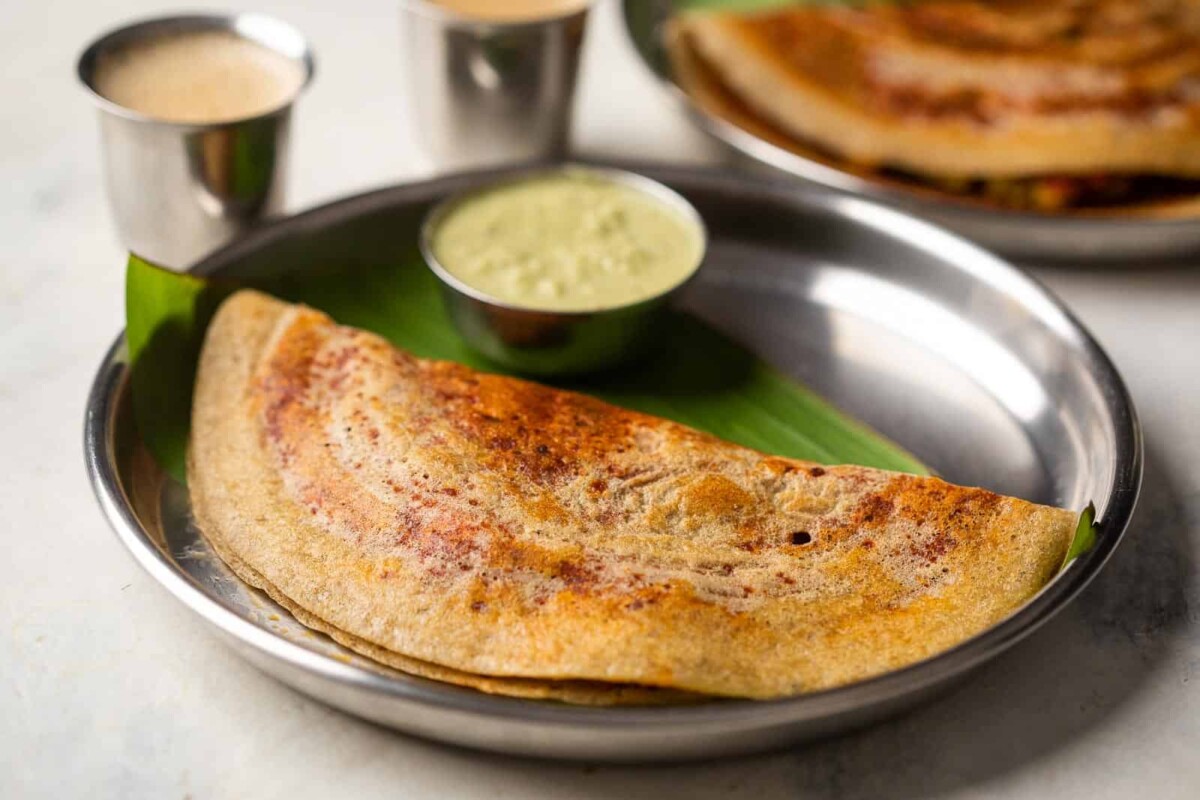
Dosa is a fermented rice-and-urad-dal crepe. Batter is a project — soak 4-6 hours, grind, ferment 8-12 hours at 80-85°F — but it makes a week's breakfasts and it freezes.
1. Homemade Masala Dosa with Potato Filling — the canonical version. 120 minutes prep (mostly unattended soaking), 30 minutes cook, 4 servings, ~320 calories each. Make this first; the potato masala also works as a filling for anything else.
2. Masala Dosa with Tamarind Chutney — 180 calories a serving, faster batter turnaround, and a tamarind chutney that doubles as a dip for vada.
3. Fermented Millet Mysore Masala Dosa — Mysore-style means a red chili-garlic paste smeared inside the crepe before the potato goes in. The millet swap raises fiber and holds crisp better than an all-rice batter.
4. Pan-Fried Thattil Kutti Dosa with Urad Dal and Rice Batter — small, thick, griddle-stacked dosas from Kerala street carts. 6 servings at 150 calories; the easiest entry point because you are not chasing a paper-thin spread.
5. Fermented Millet Dosa with Spiced Coconut Chutney — 12-hour ferment, includes the coconut chutney recipe you will want next to everything else on this page.
If you have 20 minutes instead of 12 hours, upma is the answer: Tempered Semolina Upma with Mustard Seeds and Curry Leaves is 10 minutes prep and 15 minutes cook with no fermentation at all, and Spiced South Indian Millet Upma swaps in millet for a lower-glycemic bowl. For something sweeter, Steamed Idiyappam with Coconut Milk and Jaggery Syrup — rice string hoppers — is a Kerala breakfast that reads like dessert.
Batter troubleshooting
| Symptom | Cause | Fix |
|---|---|---|
| Batter never rises | Kitchen below 75°F | Oven with light on, or Instant Pot yogurt mode 10-12h |
| Dosa sticks to the pan | Pan not hot enough, or too clean | 400-450°F surface; rub with a halved onion dipped in oil |
| Dosa tears when spreading | Batter too thick | Thin with water to heavy-cream consistency |
| Sour, ammonia smell | Over-fermented past ~16h | Refrigerate at the 10-hour mark next time |
| No crisp edge | Too much batter per dosa | 1/3 cup max, spread outward in one spiral |
Cast iron is the traditional surface and still the best one; a well-seasoned skillet from /k/cookware outperforms nonstick because you can run it hotter without degrading a coating.
Sambar, Rasam & Lentil Stews (4 recipes)
Sambar is a tamarind-soured toor dal stew with vegetables. Rasam is its thinner, peppery, tomato-tamarind cousin — closer to a broth you drink. Between them they cover about half of everyday South Indian eating. The history and regional variants are catalogued at Wikipedia — Sambar).
6. Authentic Tamil-Style Sambar with Tamarind — 15 minutes prep, 45 minutes cook, 4 servings, 220 calories and 12g protein each. The reference recipe.
7. Vegetable Sambar with Lentils and Drumstick — 30-minute cook, same nutrition profile, and it uses drumstick (moringa pods) if your grocer stocks them frozen. Substitute okra or eggplant one-for-one.
8. Spiced Red Lentil Sambar with Tamarind — masoor dal instead of toor. It breaks down faster and forgives an unattended pot; 250 calories, 12g protein.
9. Chennai Style Tamarind and Mustard Seed Rasam Soup — 70 calories a bowl, 20 minutes on the stove. This is the one to make when someone in the house is sick.
For a richer variation, Coconut Milk and Mustard Seed Rasam rounds off the acid with coconut milk — 150 calories, 8g protein, and it holds better as leftovers than a classic rasam, which thins out overnight. The general nutritional profile of these lentil-forward dishes is easy to verify against USDA FoodData Central if you are tracking macros; toor dal runs roughly 22g protein per 100g dry.
Real-world numbers on batch cooking. One pot of sambar from 1 cup of dry toor dal yields about 8 cups of finished stew, costs roughly $3.50 in ingredients, and refrigerates for 4 days or freezes for 3 months. That is under $0.45 per serving for a 12g-protein bowl — the cheapest high-protein meal in this entire guide.
Chettinad, Kerala & Andhra Curries (5 recipes)
This is the weeknight-dinner core. All five below are one-pan, 40-65 minutes total, and none require fermented anything.
10. Spiced Chicken Chettinad with Coconut Curry — 20 minutes prep, 40 minutes cook, 4 servings, 320 calories and 28g protein. The dry-roasted whole-spice masala is what separates this from a generic curry; do not skip the toasting step, it takes four minutes.
11. Authentic Kerala Fish Curry — 380 calories, 25g protein, 20 minutes of actual cooking. Use any firm white fish; kingfish, snapper and even frozen cod all work.
12. Spiced Andhra Tamarind Chicken Curry — the heat entry. 15 minutes prep, 40 minutes cook, 320 calories, 28g protein. Start at half the chili if you have not cooked Andhra before; you can always add.
13. Authentic Madras-Style Chicken Curry with Coconut Milk — the fastest of the group at 20 prep / 30 cook. 420 calories, 28g protein. This is the Tuesday one.
14. Kerala-Style Fish Curry: Coastal Authentic — 12 minutes of cooking, 310 calories, 28g protein, serves 2. If you have fish in the freezer and 25 minutes, this is dinner.
Three more worth bookmarking: Chettinad Coconut Chicken with Tamarind for a sourer, slower 45-minute braise; South Indian Fish Curry with Tamarind and Coconut at 35g protein a serving; and Authentic Kerala Coconut Curry, a vegetarian version at 400 calories that takes 20 minutes of cook time.
Curry comparison at a glance
| Recipe | Total time | Calories | Protein | Heat (1-5) |
|---|---|---|---|---|
| Madras chicken, coconut milk | 50 min | 420 | 28 g | 2 |
| Chicken chettinad | 60 min | 320 | 28 g | 3 |
| Andhra tamarind chicken | 55 min | 320 | 28 g | 4 |
| Kerala fish curry | 50 min | 380 | 25 g | 2 |
| Kerala coastal fish curry | 37 min | 310 | 28 g | 2 |
| Kerala coconut curry (veg) | 45 min | 400 | 10 g | 1 |
Vegetable Stir-Fries (Poriyal, Thoran) (3 recipes)
Poriyal (Tamil) and thoran (Kerala) are the same idea: a vegetable cooked dry with a mustard-seed tadka and finished with grated coconut. They take 15-25 minutes and turn one curry into a full plate.
15. Vegetable Avial with Coconut and Yogurt — the Kerala mixed-vegetable classic, 15 prep / 20 cook, 150 calories. Coconut-and-yogurt bound rather than dry-fried, and documented at Wikipedia — Avial if you want the Onam-sadya context.
16. Tamari-Glazed Eggplant with Curry Leaf and Mustard Seed Drizzle — 25 minutes, 180 calories. A modern crossover, but the curry-leaf-and-mustard finish is textbook South Indian technique.
17. Stir-Fried Tofu with Curry Leaves and Garlic — 15 minutes cook, 220 calories, 21g protein. The highest-protein vegetarian dish here and the one to pair with plain rasam and rice.
Also useful in this slot: Pan-Seared South Indian Spiced Chickpea Curry, 10 minutes prep and 280 calories with 12g protein, which straddles curry and side.
A wide pan matters more than you think — poriyal wants surface area so the vegetable browns instead of steaming. A 12-inch skillet or a carbon steel wok from /k/cookware works; a 2-quart saucier does not. Keep a slotted spatula from /k/utensils nearby, because you will be tossing constantly for the last three minutes.
Rice Dishes: Biryani, Coconut Rice, Curd Rice (3 recipes)
18. Hyderabadi Lamb Biryani with Saffron and Yogurt Marinade — the weekend project: 60 minutes prep, 50 minutes cook, 550 calories, 35g protein per serving. Hyderabadi dum biryani layers marinated raw meat under par-cooked rice and seals the pot, so the meat steams in its own marinade.
19. Basmati Vegetable Biryani — 40 prep / 30 cook, 380 calories. The vegetarian version, and the safer first biryani because there is no undercooked-meat failure mode.
20. Pan-Seared Chicken 65 with Spiced Biryani Rice — 420 calories, 35g protein, and it delivers biryani-adjacent flavor in 70 total minutes without the layering ritual. Chicken 65 is a Chennai hotel invention from the 1960s and belongs on any South Indian table.
Curd rice is the one thing worth making without a recipe: cook 1 cup rice soft, cool it, stir in 1.5 cups plain yogurt and 1/4 cup milk, salt, and finish with a tadka of mustard seed, curry leaf, dried chili and a pinch of asafoetida in 2 tsp coconut oil. Ten minutes, and it is the standard closer to a Tamil meal.
A rice cooker or multicooker from /k/small-appliances removes the only real variable here. Biryani in particular punishes a 10% water error; a machine does not make 10% errors.
Chutneys & Podis (2 recipes)
Chutney is not optional at a South Indian breakfast — it is the sauce that makes a plain dosa a meal.
21. Chennai Street-Style Masala Vada with Coconut Chutney — 20 prep / 15 cook, 6 servings, 210 calories and 9g protein each. Chana-dal fritters plus the coconut chutney recipe.
22. Besan Crepes with Spiced Tomato Chutney — a chickpea-flour crepe with a tomato chutney that keeps a week in the fridge and goes on everything.
Podi ("gunpowder") is the dry one: dry-roast 1/2 cup urad dal, 1/4 cup chana dal, 8-10 dried red chilies and 1 tsp sesame seeds separately until each smells nutty, cool completely, then grind with salt and a pinch of asafoetida to a coarse sand. Mix a spoonful with sesame oil and eat with idli or dosa. It keeps three months in a sealed jar and costs about $2 to make.
Kitchen Tools: Wet Grinder vs Blender
The one piece of gear that South Indian cooking traditionally requires — a stone wet grinder — is also the one you can most likely skip.
| Tool | Price (2026) | Batter quality | Verdict |
|---|---|---|---|
| Stone wet grinder (1.5-2L) | $180-300 | Best — no heat, maximum aeration | Only if you make dosa weekly |
| High-power blender (Vitamix class) | $350-550 | Very good with ice water, 2-3 batches | Buy for general use, not for dosa |
| Standard blender | $60-120 | Acceptable — thicker, less airy | Fine for a first attempt |
| Food processor | $100-200 | Poor for dosa, good for coconut chutney | Keep for chutneys |
| Cast iron dosa tawa | $25-40 | N/A | Actually worth it |
The real answer for most people: use whatever blender you already own, blend in 2-3 small batches with ice water so the motor does not heat the batter above 100°F (heat kills the wild fermentation), and spend the money on a flat cast-iron tawa instead. Browse /k/small-appliances for the blender side and /k/cookware for the tawa. A microplane and a box grater from /k/gadgets handle fresh coconut and ginger without any of this.
Common pitfalls
1. Adding tamarind at the start of a sambar. Acid stops lentils from softening. Cook the dal fully first, then add tamarind and simmer 10 more minutes.
2. Tadka in cold oil. Mustard seeds must pop. If they are not popping within 20-30 seconds, the oil was not hot enough and you have just made oily seeds.
3. Powdered coconut in a Kerala curry. Desiccated coconut has no fat left in it. Use canned full-fat coconut milk or fresh-frozen grated coconut.
4. Boiling coconut milk hard. It splits. Add it in the last 5 minutes and hold the pan at a bare simmer.
5. Salting fish curry early. Salt draws moisture out of fish and turns it chalky. Salt the gravy, add the fish for the last 6-8 minutes.
When NOT to cook South Indian
If you have 25 minutes and no pantry, this is not the cuisine to start tonight. The curries are fast, but they assume tamarind, curry leaves, mustard seed and coconut milk are already in the house. Do one $25 shopping trip first, then everything in the curry section above becomes a genuine weeknight option. Fermented dosa batter is never a weeknight thing — plan it Friday for Sunday.
Likewise, if you are cooking for someone who genuinely cannot handle heat, skip Andhra entirely and cook Kerala. The coconut-forward Kerala dishes here run 1-2 on a 5-point chili scale; Andhra runs 4.
FAQ
See the structured FAQ below for buying, fermentation, spice-level and vegetarian questions.
Sources
- Wikipedia — South Indian cuisine — regional overview and staple comparison
- Wikipedia — Chettinad cuisine — the Karaikudi spice tradition
- Wikipedia — Kerala cuisine — coconut-oil and Malabar pepper context
- Wikipedia — Sambar) — history and regional variants
- Wikipedia — Dosa) — fermentation and batter ratios
- Wikipedia — Avial — Onam sadya context
- USDA FoodData Central — nutrition figures for dals, coconut milk and rice
Recipe times, calories and protein figures above are from each linked recipe page as of August 2026.
Frequently asked questions
What's the difference between North Indian and South Indian cooking?
Can I make dosa without a wet grinder?
Where can I buy toor dal, urad dal, and curry leaves?
Is South Indian food mostly vegetarian?
How spicy is South Indian food really?
Sources
- en.wikipedia.org
- en.wikipedia.org
- en.wikipedia.org
- en.wikipedia.org
- en.wikipedia.org
- en.wikipedia.org
- fdc.nal.usda.gov
Plan a week of meals in two minutes.
Tell our AI what you have and what you like — it builds your plan, shopping list, and Instacart cart. No account needed.
Try free →