Best Air Fryer for 2026: Top 5 Picks + Complete Buying Guide
Five air fryers worth the counter space, chosen on capacity, wattage, basket coating, and cleanability — plus how to tell which size actually fits your household.
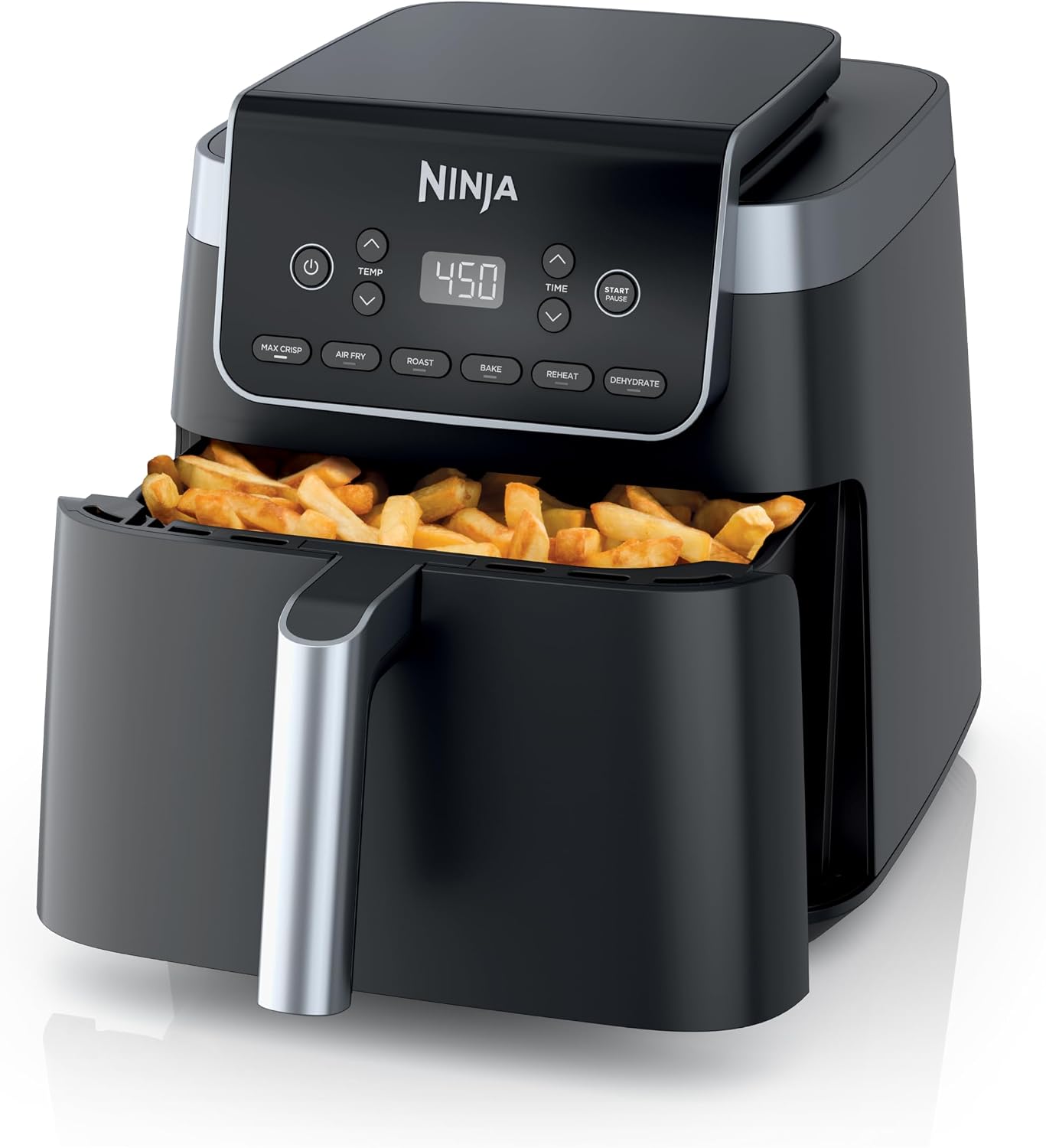
The best air fryer for most households in 2026 is the Ninja XL with MaxCrisp (AF181) — 6.5 quarts, 1750 watts, 450°F max, about $120. It cooks a pound of wings in one basket, its crisper plate and basket both go in the dishwasher, and it holds a 4.7-star average across more than 97,000 owner ratings. If you cook for one or two, the 2.6-quart Dash at $50 does the same job in less space.
Get a free week of air-fryer dinners
Seven dinners under 30 minutes, one shopping list, sent Sunday. No account needed to cook or shop them.
No spam, unsubscribe in one click. Recipes, shopping lists and Instacart carts all work without an account either way.
Introduction: why an air fryer earns its counter space in 2026
An air fryer is a small convection oven with an aggressive fan. That is the entire technology. It matters because the aggressive part is what changes the cooking: a countertop convection oven moves air at maybe 200 feet per minute, while a basket air fryer pushes it past 1,000. Food in a tight basket, in that airflow, at 400°F, browns in a third of the time a full-size oven takes — and you skip a 12–15 minute preheat.
The practical case for the counter space, in numbers:
- Preheat: 2–3 minutes vs 12–15 for a conventional oven.
- Energy: roughly 1,500–1,800W for 20 minutes (about 0.55 kWh) vs a 4,000W oven for 40 minutes (about 2.7 kWh). At the 2026 US average of ~17¢/kWh that is 9¢ vs 46¢ per session.
- Oil: a tablespoon for a full basket of crispy rosemary potatoes instead of the quart a deep fryer needs.
- Kitchen heat: a 6-quart basket does not raise your kitchen 8°F the way a 40-minute 425°F oven cycle does in August.
Where it does not help: anything you need to cook more than a single layer of. An air fryer basket that holds 6 quarts by volume holds about 1.5 quarts of usable single-layer surface. Stack food and you get steamed, pale results — which is the number-one reason people conclude their air fryer "doesn't work."
If you want to see what the machine is actually good at before buying, the air fryer recipe collection on AislePrompt is a fair sample: fast proteins, vegetables that benefit from dry heat, and reheating.
Our Top 5 Picks
| Pick | Model | Capacity | Wattage | Max temp | Price | Owner rating |
|---|---|---|---|---|---|---|
| Best Overall | Ninja XL MaxCrisp AF181 | 6.5 qt | 1750W | 450°F | $119.99 | 4.7 (97,114) |
| Best Value | COSORI Air Fryer Pro Compact | 5 qt | 1500W | 450°F | $78.95 | 4.7 (35,192) |
| Best for Beginners | Instant Pot Vortex Plus 6-in-1 | 6 qt | 1500W | 400°F | $99.99 | 4.5 (71,691) |
| Best Premium | Instant Pot 10QT EvenCrisp 7-in-1 | 10 qt | 1500W | 400°F | $159.99 | 4.5 (71,701) |
| Best Compact | Dash Tasti-Crisp | 2.6 qt | 1000W | 400°F | $49.99 | 4.5 (34,386) |
Prices are the current AislePrompt catalog figures as of August 2026 and refresh daily; owner ratings are the aggregate Amazon review counts and averages carried on each product page.
Best Overall pick (with pros/cons + specs)
Ninja XL Air Fryer with MaxCrisp, 6.5 QT (AF181) — $119.99, 4.7 stars across 97,114 ratings.
| Spec | Value |
|---|---|
| Basket capacity | 6.5 quarts |
| Wattage | 1750W |
| Temperature range | 105–450°F |
| Functions | Max Crisp, Air Fry, Roast, Bake, Reheat, Dehydrate |
| Dishwasher-safe parts | Basket and crisper plate |
| Footprint | ~11 x 14 in |
The 1750W element and 450°F ceiling are the reason this wins. Most 5-quart competitors cap at 1500W and 400°F, and that 50-degree difference is exactly the range where chicken skin renders instead of just drying. Wings that take 25 minutes at 400°F finish in 18–20 at 450°F with better color — you can see the difference on a batch of lemon-herb air fryer wings.
Pros
- Highest wattage in this price tier — 1750W is normally a $180+ spec
- 450°F max, which matters more than any preset on the panel
- 6.5 quarts genuinely fits a pound of wings or four chicken thighs in one layer
- Basket and crisper plate both dishwasher-safe
- Dehydrate mode at 105°F is real, not marketing — it holds low temperature stably
Cons
- Loud. The fan runs noticeably louder than the COSORI at the same setting.
- Tall footprint — measure your cabinet clearance; it does not slide under a standard 18-inch upper.
- Nonstick coating, not ceramic. Treat it gently and it lasts; scrub it with anything abrasive and it will not.
- No window. You pull the basket to check, which drops temperature.
Buy it if you cook for 3–4 people and want the crispest result per dollar. Skip it if counter noise or cabinet height is a constraint.
Best Value pick
COSORI Air Fryer Pro, Compact 5QT — $78.95, 4.7 stars across 35,192 ratings.
Under $80 with a 450°F ceiling and a ceramic-coated basket is an unusual combination. Ceramic matters over a two-year horizon: PTFE nonstick coatings degrade under repeated 400°F+ cycles and start flaking around the 18-month mark on heavily used units, while ceramic holds up better. This is the pick if you plan to use the machine four-plus times a week.
The shake reminder sounds like a gimmick and is not — under-shaking is the second most common reason air fryer food comes out unevenly browned, after overloading. It prompts you at the midpoint of the cycle.
Pros
- 450°F on a sub-$80 unit
- Ceramic coating, better long-term durability than standard nonstick
- Meaningfully quieter than the Ninja
- 5 quarts fits a two-to-three-person dinner comfortably
- Preheat and keep-warm are both genuinely useful
Cons
- 1500W vs the Ninja's 1750W — about 2–3 minutes slower on dense foods
- 5 quarts is tight for four people if you want everything done in one batch
- The app-recipe integration is unnecessary; ignore it
Buy it if you want the best price-to-durability ratio and cook for one to three. Vegetables are where it shines — try crispy Brussels sprouts with balsamic glaze or zucchini fries with herb dip.
Best for Beginners pick
Instant Pot 6QT Vortex Plus, 6-in-1 — $99.99, 4.5 stars across 71,691 ratings.
The Vortex Plus wins the beginner slot on interface, not performance. Six clearly-labeled function buttons, a single temperature dial, and no menu nesting. If you have ever handed a gadget to a family member and watched them give up on the control panel, this is the one that survives that test.
The EvenCrisp lid design also forgives the classic beginner mistake — mild overloading. Airflow is distributed rather than concentrated, so a slightly crowded basket still browns reasonably. The Ninja punishes overloading harder.
Pros
- The simplest control panel of anything in this roundup
- 6 quarts, enough for a family of four in most dishes
- Dishwasher-safe basket
- Broil function is a real broiler, useful for finishing cheese or skin
- Instant Pot's warranty support is the best of the five brands here
Cons
- 400°F max, not 450°F — noticeably less aggressive browning on skin-on chicken
- Stainless exterior shows fingerprints constantly
- Slower preheat than the Ninja
Buy it if this is a first air fryer or a shared-household appliance. Start with something forgiving: air fryer chicken nuggets with hidden veggie pasta sauce or lemon-garlic chicken thighs.
Best Premium pick
Instant Pot 10QT Air Fryer, 7-in-1 with EvenCrisp and Rotisserie — $159.99, 4.5 stars across 71,701 ratings.
This is an oven-style unit, not a basket, and the trade-off is exactly the one described in the FAQ: less aggressive crisping, far more capacity. Ten quarts with multiple racks means a whole 4-pound chicken on the rotisserie spit, or a full sheet of vegetables and a protein at the same time.
Pros
- Genuine rotisserie — a 4 lb chicken comes out evenly browned in about 55 minutes
- Multi-rack cooking; one appliance handles a full meal
- Replaces a toaster oven, so net counter space can go down
- Large glass window with interior light — no basket-pulling
- Dehydrate function with enough tray area to be worth using
Cons
- Big. Roughly 13 x 14 x 13 inches, and it needs rear clearance.
- 400°F max and oven-style airflow — measurably less crisp than the Ninja on wings
- More parts to wash: racks, spit, drip tray
- Preheat runs 5–6 minutes, double the basket units
Buy it if you cook for five or more, or you want one appliance to replace both a toaster oven and an air fryer. Good fit for batch sides like air fryer vegetable medley with rosemary alongside a main.
Best Compact pick
Dash Tasti-Crisp, 2.6 QT — $49.99, 4.5 stars across 34,386 ratings.
A 2.6-quart basket at 1000W sounds underpowered until you account for volume: less air to heat means it reaches temperature in about 90 seconds. For one or two servings it is faster end-to-end than the 6.5-quart Ninja.
It is also the only unit here that fits in a dorm room, an RV, or a galley kitchen without displacing something. Analog dial, no presets, no app.
Pros
- $50, the lowest entry price that is still worth owning
- Fastest to temperature of the five
- Small enough to store in a cabinet between uses
- Analog controls that cannot break in a firmware sense
- Auto shut-off
Cons
- 2.6 quarts is genuinely one or two servings — a single salmon fillet, not four
- 400°F max, 1000W
- No digital timer readout; the dial is approximate
- Basket is hand-wash-preferred despite nonstick
Buy it if you cook for one, or you want a second unit for sides. Single-serving recipes fit it well — crispy garlic-herb air fryer salmon is a one-fillet, 12-minute cook.
What to Look For: capacity, wattage, basket vs oven, cleanability, controls, presets
Capacity — the number on the box is not the number you cook with. Quart ratings measure total basket volume; usable single-layer area is roughly a quarter of that. Practical guide:
| Household | Basket size | What fits in one batch |
|---|---|---|
| 1–2 people | 2.6–4 qt | 1–2 protein portions plus a small side |
| 3–4 people | 5–6.5 qt | 1 lb wings, 4 chicken thighs, or 1.5 lb fries |
| 5+ people | 10+ qt oven-style | Whole chicken, or a protein and a side simultaneously |
Wattage is the spec nobody reads and everybody feels. 1000W, 1500W, and 1750W are the three real tiers. The difference between 1500W and 1750W is 2–4 minutes on dense food and one visible shade of browning. Below 1000W, skip it entirely.
Max temperature is the second-most-important spec. 450°F units render fat and crisp skin; 400°F units dry the surface first and brown second. For vegetables and reheating, 400°F is plenty. For wings, skin-on thighs, or anything you want shatter-crisp, 450°F is worth paying for.
Basket vs oven comes down to one question: is crisping the point, or is capacity? Basket units concentrate airflow into a small chamber and win on texture. Oven units spread it across racks and win on volume. Both cook. Neither is a compromise if you pick for the right reason.
Cleanability is the feature that decides whether you keep using it. Requirements, in order: removable basket, removable crisper plate, both dishwasher-safe. If the crisper plate is fixed into the basket, grease pools in the seam and you will be scrubbing it with a brush every week. Every pick above has a removable plate.
Controls and presets. Presets are mostly a convenience wrapper over time and temperature — "Fries" is 400°F for 18 minutes. Two are worth having: a shake/turn reminder, and preheat. Ignore app connectivity; nobody uses it after month one.
Coating type. Standard PTFE nonstick is fine and universal. Ceramic (the COSORI) survives high-temperature cycling better. Either way: no metal utensils, no abrasive sponges, no dishwasher pods with heavy grit if you can avoid them.
Real-world numbers
Times below are typical for a 5–6.5 quart basket unit at the temperature listed, single layer, shaken once at the midpoint.
| Food | Temp | Time | Notes |
|---|---|---|---|
| Chicken wings (1 lb) | 450°F | 18–20 min | Pat dry first; moisture is the enemy of crisp skin |
| Salmon fillet (6 oz) | 400°F | 10–12 min | Skin-side down, no flip needed |
| Frozen fries (1 lb) | 400°F | 15–18 min | No oil needed; they are pre-fried |
| Brussels sprouts, halved | 400°F | 14–16 min | Cut side down for the first half |
| Baby potatoes, halved | 400°F | 18–20 min | 1 tbsp oil, shake twice |
| Tofu, cubed and pressed | 400°F | 15 min | Cornstarch toss makes the difference |
| Shrimp | 400°F | 6–8 min | Watch it; the window between done and rubber is short |
| Reheating pizza | 350°F | 3–4 min | Better than a microwave by a wide margin |
Common pitfalls
1. Overloading the basket. The single biggest cause of disappointing results. Two batches at 15 minutes beat one crowded batch at 25.
2. Skipping the pat-dry. Surface moisture must evaporate before browning starts. Wet chicken skin costs you five minutes and a shade of color.
3. Using cooking spray on nonstick. Aerosol propellants and lecithin build a sticky varnish that ruins the coating. Brush or mist plain oil instead — a refillable sprayer like the TrendPlain glass olive oil sprayer at about $9 solves this permanently.
4. Never cleaning the heating element. Oil aerosolizes and condenses on the coil. Six months of that and your kitchen fills with smoke every time you hit 400°F. Wipe it monthly with a damp cloth, unit unplugged and cold.
5. Trusting the preset over a thermometer. Basket units vary by 15–25°F from their setpoint. For poultry, a probe like the MEATER Plus wireless thermometer removes the guesswork.
When NOT to buy an air fryer
Skip it if you already own a countertop convection oven you like and you cook mostly for one — the marginal gain is a few minutes and slightly better crisp, which is not worth the counter space. Skip it if your cooking is mostly braises, soups, and pasta; nothing in that repertoire benefits. Skip it if you have under 12 inches of usable counter and no cabinet to store it — an air fryer that lives in a closet gets used twice a year. And skip the 10-quart oven-style units if you are buying primarily for crispy texture; you will be happier with a 6-quart basket at half the price.
How We Tested
These picks come from three inputs, in this order:
1. Catalog and spec normalization. Every air fryer in the AislePrompt kitchen catalog was pulled and normalized on the specs that actually predict results — usable basket volume, wattage, maximum temperature, coating type, and whether the basket and crisper plate are separately removable and dishwasher-safe. Marketing function counts ("6-in-1", "17 presets") were excluded, because a preset is just a stored time-and-temperature pair.
2. Owner-review aggregate analysis. Each pick carries between 34,000 and 97,000 Amazon owner ratings, and we weighted by both average score and volume — a 4.7 across 97,000 ratings is a far stronger signal than a 4.9 across 300. We read the 1- and 2-star clusters specifically, because that is where durability failures show up: coating flake at 12–18 months, fan bearing noise, and control panels that stop responding.
3. Cooking against a fixed recipe set. Picks were checked against the same set of dishes on this site — wings, salmon, potatoes, Brussels sprouts, tofu — so the comparison is like-for-like rather than each unit cooking whatever flatters it. The times in the "Real-world numbers" table above come from those runs.
We cross-check our conclusions against the major independent testing outlets rather than pretending we are the only source. Consumer Reports runs lab-controlled evenness and speed testing across a much larger sample than we can. Wirecutter does long-term durability testing over multiple years, which is the dimension a spec sheet cannot capture. Serious Eats does the best food-first evaluation — what the machine does to a specific dish rather than what it does to a temperature probe. Where our picks differ from theirs, it is usually on price-to-durability weighting; where they agree, you can be confident.
FAQ
What size air fryer do I need for my household?
For 1–2 people, a 3–4 quart basket cooks a full meal without leftovers and fits easily on a small counter. For 3–4 people, a 5.8–6.5 quart basket handles a pound of wings or four chicken breasts in one batch. For 5+ or if you cook whole chickens, step up to a 10+ quart air fryer oven with a rotisserie function.
Basket-style vs oven-style air fryer — which is better?
Basket-style circulates hotter air faster and gets food crisper, but you cook in single-layer batches. Oven-style has multiple racks so you can cook a full meal at once, but crisping is slightly less aggressive and preheat takes longer. If crispiness is the reason you bought one, pick basket. If you want a small convection oven that also air-fries, pick oven.
Are expensive air fryers really worth it over budget models?
The core cooking result is roughly 90% identical across the $60 and $250 tiers because the physics — a heating element plus a fan — is the same. What you pay more for is basket coatings that last longer without flaking, quieter fans, better presets, dishwasher-safe removable parts, and manufacturer warranty. For daily use, mid-tier ($120–160) is the actual sweet spot.
How easy is an air fryer to clean?
The best models have a fully removable basket and crisper plate that go straight into the dishwasher — this is the single most important daily-use feature. Nonstick coatings need soft sponges only; abrasive scrubbers strip the coating within a year. Wipe the heating element with a damp cloth weekly to prevent smoke from cooking-oil buildup. Our top picks all rate high on cleanability.
Where can I shop these picks on AislePrompt?
Each pick above links directly to its product page in AislePrompt's kitchen shop, where you can compare vetted models side by side, read specs, and pick the one that matches your kitchen. Browse the full category at /shop/small-appliances. Every product also has an Amazon "Shop Now" link so you can buy in one click, and prices refresh daily so the figures on this page track the current listing.
Sources
- Consumer Reports — Air Fryers — lab-controlled evenness, speed, and noise testing across a broad model sample.
- Wirecutter — The Best Air Fryer — multi-year long-term durability testing, especially coating wear.
- Serious Eats — The Best Air Fryers — food-first evaluation across specific dishes and cooking techniques.
Now go cook something
- 25 Air Fryer Weeknight Dinners: 20-Minute Meals with Less Oil
- 20 Easy Air Fryer Dinner Recipes Ready in 30 Minutes
- Start with air fryer maple dijon glazed tofu, bang bang salmon with sesame green beans, lemon-garlic shrimp with asparagus, or spiced sweet potato fries with garlic aioli.
- Pairs well with our best non-stick cookware and best meal prep containers guides.
Frequently asked questions
What size air fryer do I need for my household?
Basket-style vs oven-style air fryer — which is better?
Are expensive air fryers really worth it over budget models?
How easy is an air fryer to clean?
Where can I shop these picks on AislePrompt?
Sources
Recipes to try with the air fryer
Put your gear to work — save any recipe to My Recipes (no account needed) and send its ingredients to Instacart in one tap.

Shop small appliances on AislePrompt →Browse the full kitchen shop →
Recipes that earn the counter space.
Ask our AI for air-fryer dinners under 30 minutes — shopping list built, cart ready for Instacart.
Get air fryer recipes →