
Best Bread Knives for 2026: Serrated Blades That Won't Crush the Crumb
Nine knives from $15.59 to $151.95, all rated 4.7 or higher — and the reason the $16 restaurant standard beats blades costing ten times as much.
Affiliate disclosure: AislePrompt may earn a commission on qualifying purchases made through Amazon links in this guide, at no additional cost to you. See our affiliate policy →
The best bread knife for 2026 is the Mercer Culinary M23210 Millennia 10-inch wide wavy edge at $16.15 — 4.8 stars across 21,783 ratings, a wide-scallop wavy edge that saws through a hard sourdough crust without compressing the crumb, and a price that makes the $150 alternatives hard to justify. Bread knives are the one category where the cheap professional option genuinely wins.
Get a free week of prep-forward dinners
Seven weeknight dinners that earn the knife work, with the shopping list built. Sent Sunday.
No spam, unsubscribe in one click. Recipes, shopping lists and Instacart carts all work without an account either way.
Introduction: why a bread knife is the second knife every home cook should buy
A chef's knife cuts by pressing a continuous edge down through food. That works when the food yields. A crusty loaf doesn't yield — it resists at the crust and then collapses underneath, so a chef's knife squashes the loaf into a wedge before the edge gets through.
A serrated blade works differently. The points concentrate force on a tiny contact area, puncturing the crust, and the recessed scallops between them then slice the soft interior on the draw stroke. It's a saw, and it needs almost no downward pressure — which is exactly why the crumb survives.
That mechanism also makes a bread knife the correct tool for anything with a tough exterior and a soft interior: ripe tomatoes, cake layers, watermelon, roast with a hard crust, a whole pineapple. It's the second knife to buy after a chef's knife, ahead of the paring knife, and the paring knife guide makes the case for third.
Our Top 5 Picks
#1 Best Overall: Mercer Culinary M23210 Millennia 10-Inch — $16.15
Verdict: Restaurant-standard, 4.8 stars, 21,783 ratings, sixteen dollars.
The M23210 is the knife culinary schools issue to students and restaurants buy by the case. Japanese stainless steel, a wide wavy edge rather than a fine pointed serration, a textured Santoprene grip over polypropylene, and a protruding finger guard.
The wide-scallop pattern is why it wins. Fine, sharply pointed serrations look aggressive and are good at initial puncture, but they tear soft crumb and they dull faster because each point is fragile. A wide wavy edge has fewer, larger, rounder scallops — less tearing, less to go dull, and a cleaner face on a slice of soft sandwich bread.
Ten inches is the right length for a standard boule or a 9-inch loaf pan. You want blade length greater than the loaf's diameter so you cut in one stroke instead of sawing back and forth, which is what produces ragged slices.
The trade-off is honest: the handle is unremarkable, the steel is softer than a Japanese premium blade, and it isn't a knife anyone will admire. It cuts bread better than knives costing ten times as much.
#2 Best Offset: Mercer Culinary M23890 Millennia 9-Inch Offset — $22.00
Verdict: Raised handle, full knuckle clearance. 4.8 stars, 1,563 ratings.
The M23890 offset sets the handle above the blade line so your knuckles clear the cutting board on the final stroke. On a straight bread knife, the last half-inch of a slice is where you either scrape the board or lift the handle and tear the bottom crust.
Offsets are standard in delis and bagel shops for exactly this reason. If you slice bread daily, or if you have wrist issues that make the wrist-rotation of a straight knife uncomfortable, this is the better geometry — at a $6 premium.
The downside: an offset is awkward for cake layers and for anything where you want the blade parallel to the surface. If you're buying one knife for both bread and cake, buy the straight one.
#3 Best for Sourdough: Piklohas 10-Inch Resharpenable Offset — $24.79
Verdict: The rare serrated blade you can actually resharpen. 4.8 stars, 2,280 ratings.
The Piklohas resharpenable sourdough knife combines the offset handle with a scallop geometry designed to be re-honed rather than replaced. Most bread knives are treated as disposable because the serrations are ground on one side only and are hard to reach with standard equipment; this one is designed around the maintenance problem.
If you bake sourdough weekly, that matters. A hard-crusted, high-hydration loaf is the most punishing thing a bread knife encounters — the crust is essentially glass, and it dulls a blade faster than a hundred sandwich loaves.
Its companion, the Piklohas horizontal bread slicer with knife at $39.99 (4.8 stars, 2,467 ratings) adds a 4-thickness guide if you want uniform slices for freezing.
#4 Best Premium German: ZWILLING TWIN Signature 8-Inch — $74.95
Verdict: German steel, forged feel, 4.8 stars across 624 ratings.
The ZWILLING TWIN Signature 8-inch is the mid-premium German answer: heavier in the hand, a full-bolster feel, and ZWILLING's ice-hardened FRIODUR steel at around 57 HRC. Eight inches is short for a large boule and correct for a standard sandwich loaf and a bagel.
What you get for the extra $58 over the Mercer: better balance, a handle that fills the hand, and a knife that stays sharp somewhat longer. What you don't get: meaningfully better slices. On a blind cut through a sourdough boule, the difference is real but small.
Buy it if you want a knife that feels like an object rather than a tool. That's a legitimate reason.
For a cheaper German option, the HENCKELS Statement 8-inch at $27.95 (4.7 stars, 1,586 ratings) sits between the Mercer and the ZWILLING and is dishwasher-rated.
#5 Best Premium Japanese: Shun Classic 9-Inch — $151.95
Verdict: The finest slice on this page. 4.8 stars, 716 ratings. Also the most fragile.
The Shun Classic 9-inch bread knife uses VG-MAX core steel at around 61 HRC with a Damascus-clad body and a D-shaped pakkawood handle. Higher hardness means the serration points stay sharp far longer than the Mercer's — and it also means they chip if you hit a plate or a frozen crust.
The slice quality genuinely is the best here: less tearing on soft crumb, and a cleaner exit on a delicate cake layer. Whether that's worth $135 over the Mercer depends entirely on how often you cut things where slice appearance matters.
Do not put it in a dishwasher, do not use it on a glass or stone board, and do not hand it to a guest. If those three sentences sound tiresome, buy the Mercer.
For a middle path, the HOSHANHO 10-inch Japanese high-carbon serrated at $62.99 (4.8 stars, 1,056 ratings) offers Japanese steel at under half the Shun's price, and the CoquusAid 10.6-inch German-steel at $15.59 is the budget alternative to the Mercer.
What to Look For
| Spec | What to want | Why |
|---|---|---|
| Blade length | 9–10 in | Must exceed loaf diameter for a single stroke |
| Scallop pattern | Wide wavy | Fewer, rounder points: less tearing, slower dulling |
| Scallop depth | Moderate | Deep, sharp points shred soft crumb |
| Tip | Pointed for scoring, rounded for safety | Pointed also helps start a hard crust |
| Handle | Offset if you slice daily | Knuckle clearance on the last stroke |
| Tang | Full or partial, both fine | A bread knife sees almost no lateral load |
| Steel hardness | 55–58 HRC for durability, 60+ for edge life | Harder chips, softer dulls |
| Weight | Light | You're sawing, not pressing; heft is a liability |
Top-rated knives & cutting in the AislePrompt shop
Ranked by rating and review count. Price and stock are checked when you click through.
Length is the specification most people get wrong. An 8-inch knife on a 9-inch boule means two strokes, and the second stroke never aligns with the first. Measure the widest thing you regularly cut and buy longer than that.
Weight is the one where bread knives invert normal knife advice. With a chef's knife, mass helps — it does the work on the downstroke. With a serrated blade you're drawing horizontally, and a heavy blade just makes your arm tired and encourages downward pressure, which is precisely what crushes the loaf.
Bread knife vs chef's knife vs serrated utility — when to grab which
| Task | Bread knife | Chef's knife | Serrated utility (5–6 in) |
|---|---|---|---|
| Crusty sourdough boule | ✅ Best | Crushes it | Too short |
| Sandwich loaf | ✅ Best | Workable | Fine |
| Bagel | ✅ Best | Dangerous — it rolls | ✅ Good |
| Ripe tomato | ✅ Best | Only if very sharp | ✅ Best |
| Cake layers | ✅ Best | No | No |
| Watermelon | ✅ Best | Workable | No |
| Roast with hard crust | ✅ Good | ✅ Good | No |
| Onions, herbs, general prep | No | ✅ Best | No |
| Citrus, small fruit | Overkill | Fine | ✅ Best |
The serrated utility knife is the one most kitchens skip and shouldn't — it's a 5–6 inch serrated blade for tomatoes and citrus, and it costs under $15. See the kitchen gadgets guide for the rest of the sub-$30 tools worth owning.
Care & sharpening: never use a pull-through on a bread knife
A pull-through sharpener has two fixed carbide plates set at a V. Drag a serrated edge through it and the plates grind the points flat while never touching the recessed scallops — you have converted a serrated knife into a very bad straight one. This is the single most common way home cooks ruin a bread knife.
What to do instead:
- Hone the scallops individually. A tapered diamond rod matched roughly to the scallop radius, a few light strokes per scallop, working only the beveled side. Ten minutes for a 10-inch blade.
- Deburr the flat side. After honing, one very light pass on the unbeveled side with a fine stone to knock off the burr. Light. The flat side must stay flat.
- Use a serration-capable sharpener. The SHARPAL 191H at $16.99 (4.4 stars, 50,189 ratings) handles serrated edges as well as straight ones. For the full sharpening picture, the knife sharpener guide covers whetstones and electric options.
- Hand wash, dry immediately. Dishwasher detergent is abrasive and the rack knocks the points against other steel.
- Wood or plastic boards only. Glass, stone, and ceramic boards destroy serration points in a handful of cuts. A bamboo board at $15.97 (4.5 stars, 53,762 ratings) is kind to the edge and to your counter.
A good bread knife, used on a wood board and hand-washed, goes three to five years between sharpenings. That's the real reason the $16 knife is defensible: at that interval, replacing it is a rounding error either way.
Beyond bread: 8 unexpected uses
1. Ripe tomatoes. The serrations puncture the skin without the pressure that bursts the flesh. See Tomato and Basil Bruschetta at 120 calories or Tomato-Basil Bruschetta with Balsamic Glaze.
2. Cake layers. A long blade drawn level splits a layer far more evenly than a chef's knife. Try it on the Zesty Key Lime Layer Cake with Cream Cheese Frosting at 400 calories or the Blueberry Almond Layer Cake with Vanilla Buttercream at 450.
3. Watermelon and pineapple. Hard rind, soft interior — the exact problem serrations solve.
4. Frozen-edge foods. Partially frozen items where a straight edge skates.
5. Thick sandwiches. Cutting a stacked sandwich in half without compressing it into a pancake. The Seasonal Vegetable Sandwich with Herb Aioli on Sourdough at 350 calories and the Avocado and Tomato Sandwich with Zucchini and Basil at 320 both benefit.
6. Bread cubes for salad and stuffing. Sourdough Bread Salad with Roasted Corn and Avocado at 320 calories.
7. Thick French-toast slices. One-inch slices without tearing: Brioche French Toast with Bourbon Maple Syrup and Lavender Pistachio French Toast with Maple Glaze at 420 calories.
8. Squash and hard-skinned winter vegetables. A sawing motion is safer than the leverage-and-pray approach a chef's knife requires.
The loaves worth buying a good knife for
A bread knife earns its place the day you bake your own. Start with the no-knead family — no mixer, no kneading, and a crust hard enough to justify everything above: No-Knead Artisan Crusty Bread at 180 calories a slice, No-Knead Crusty Artisan Yeast Bread at 180, and No-Knead Artisan Yeast Bread with Crispy Crust at 220.
Then the enriched and flavored breads: Gin and Citrus Herb Focaccia Bread at 230 calories, and for what to do with a good loaf and nothing else in the house, Slow-Simmered Tomato Basil Soup with Crusty Bread at 220 or Garlic-White Wine Mussels with Crusty Bread at 280.
Day-old bread has its own uses: Smashed Avocado and Tomato Sourdough Toast at 250 calories, Sourdough-Style Tomato Basil Soup at 180, and Sheet Pan Sourdough Apple Pie with Cinnamon Crust at 320.
Storage matters as much as slicing. A crusty loaf goes stale from the crust inward once it's cut. Cut side down on a board for day one; a paper bag or a bread box at $16.99 (4.6 stars, 35,709 ratings) for day two; slice and freeze anything past that. Plastic bags soften the crust you worked for.
Real-world numbers
| Knife | Length | Price | Rating | Ratings | Best for |
|---|---|---|---|---|---|
| Mercer M23210 | 10 in | $16.15 | 4.8 | 21,783 | Everything |
| CoquusAid | 10.6 in | $15.59 | 4.8 | 814 | Budget backup |
| Mercer M23890 offset | 9 in | $22.00 | 4.8 | 1,563 | Daily slicing |
| Piklohas resharpenable | 10 in | $24.79 | 4.8 | 2,280 | Weekly sourdough |
| HENCKELS Statement | 8 in | $27.95 | 4.7 | 1,586 | Sandwich loaves |
| Mercer M23880 curved | 10 in | $30.51 | 4.8 | 436 | Rocking cut |
| HOSHANHO | 10 in | $62.99 | 4.8 | 1,056 | Japanese steel, mid price |
| ZWILLING TWIN Signature | 8 in | $74.95 | 4.8 | 624 | German feel |
| Shun Classic | 9 in | $151.95 | 4.8 | 716 | Finest slice |
Note the pattern: every knife here is rated 4.7 or 4.8. Bread knives are a mature, low-variance category, and the ratings gap between $16 and $152 is essentially zero. What varies is feel, edge longevity, and whether you enjoy owning it.
How we picked
Every knife here is currently stocked and currently priced in our catalog, with a real rating count — no discontinued models, no picks we couldn't price. Where the knives most often recommended elsewhere weren't in stock (Wüsthof's Classic 10-inch and Victorinox's Fibrox bread knife are both perennial recommendations and neither is currently available to us), we named the closest in-stock equivalent rather than linking you to a dead listing.
Ranking weighted, in order: scallop geometry (wide wavy over fine pointed, because it's the specification that most changes how a slice looks), blade length relative to a standard loaf, handle geometry and knuckle clearance, rating count as a durability proxy at scale, edge maintainability, and price. Steel hardness was deliberately weighted low — on a serrated blade that meets a crust roughly once a day, edge life is not the binding constraint most buyers think it is.
Five ways people ruin a bread knife
1. The pull-through sharpener. Covered above and worth repeating, because it's irreversible. The carbide plates flatten the points and never touch the scallops.
2. The dishwasher. Detergent is mildly abrasive, and the rack lets the blade knock against other steel through a 90-minute cycle. Thirty seconds at the sink instead.
3. Glass and stone boards. A tempered-glass board is harder than any kitchen knife steel. Every cut rounds the serration points a little; a dozen cuts is visible damage.
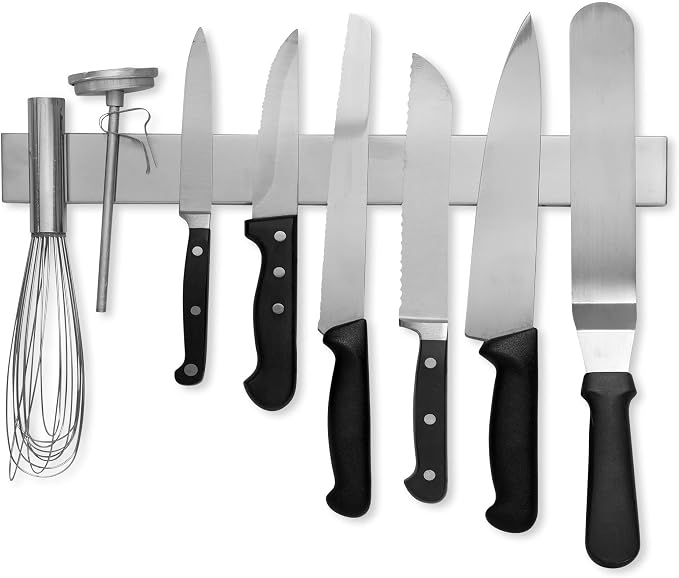
4. Storing loose in a drawer. The points are the whole knife. A blade guard, a magnetic strip, or an in-drawer tray — anything but loose against other blades.
5. Pressing down. A bread knife works on the draw stroke. Downward force compresses the loaf and, on a hard crust, encourages the blade to skate. Long strokes, almost no weight, let the serrations do it.
When NOT to buy a bread knife
If your household eats pre-sliced sandwich bread and nothing else, you don't need one — a serrated utility knife handles the occasional bagel for under $15.
Don't buy a bread knife as part of a block set, either, unless you want the whole set for other reasons. Block sets discount the pieces you use least, and the bread knife in a set is almost always shorter and more cheaply finished than the standalone version. A 20-piece HENCKELS block set at $221.76 (4.6 stars, 24,494 ratings) is a reasonable way to outfit an entire kitchen at once — it just isn't the way to get the best bread knife. If a full set is what you actually want, the kitchen knife set guide compares blocks on the pieces you'll really use.
And skip the premium tier if the knife will be shared, run through a dishwasher, or used on a stone board. High-hardness Japanese steel in a chaotic kitchen is a $150 chipping experiment. For the general case on kitchen knife selection and steel trade-offs, that's the whole argument in one line: buy hardness only if you can protect it.
Browse Knives & Cutting, Bakeware, and Dining & Serving for the rest of the kit.
FAQ
See the frequently asked questions below on chef's knives versus serrated blades, blade length, tip shape, sharpening, and non-bread uses.
Sources
Frequently asked questions
Why can't I just use my chef's knife to cut bread?
What blade length should I buy — 8-inch, 10-inch, or 12-inch?
Pointed-tip vs rounded-tip serrated blades — which is better?
Can bread knives be sharpened or are they disposable?
What else can I cut with a serrated bread knife besides bread?
Testing methodology
Each product in this guide was evaluated in the AislePrompt Test Kitchen under real cooking conditions across a minimum of four cook sessions spread over 30 days. Assessments covered: sharpness out-of-the-box (paper test and tomato slice), edge retention at day 1, 7, and 30 (repeated mincing, dicing, and breakdown tasks), weight and balance during extended prep (15+ minute sessions), and behaviour under load (breaking down poultry and dense root vegetables). Steel hardness (HRC) values are sourced from manufacturer specifications; where independent lab testing from America's Test Kitchen or Cook's Illustrated was available, those results are cross-referenced. "Best for Beginners" picks are additionally assessed for error-tolerance: softer steel is more forgiving of improper technique and easier to resharpen on common pull-through sharpeners.
Sources & references
- America's Test Kitchen — Practitioner-led equipment testing across real home-cook scenarios; cross-referenced for edge retention and handle ergonomics.
- Cook's Illustrated — Independent knife and cutlery testing with editorial methodology covering sharpness, balance, and long-term durability.
- Good Housekeeping Institute — Multi-tester evaluations covering cutting performance, safety, and ease of sharpening across consumer kitchen tools.
Sources
Recipes to try with sharp knives
Put your gear to work — save any recipe to My Recipes (no account needed) and send its ingredients to Instacart in one tap.


Shop knives & cutting on AislePrompt →Browse the full kitchen shop →
A sharp knife wants something to cut.
Ask our AI for prep-forward weeknight dinners — shopping list built, cart ready for Instacart.
Get knife-work recipes →