Best Carving Knives for 2026: Slicing Knives and Carving Sets for Turkey, Brisket and Roasts
Five slicers and carvers for the Thanksgiving bird, a smoked brisket or a holiday prime rib, from an under-$25 Granton slicer to a forged heirloom.
Where to buy these picks
Affiliate links: we may earn a commission on qualifying Amazon purchases. Policy. Prices show only when checked in the last 24 hours.
- Best Overall: Cangshan TS Series 9-Inch Carving Knife $54.99 at Amazon, Check price on Amazon →
- Best Value: DRAGON RIOT Carving Knife SetCheck price on Amazon →
- Best for Beginners: Mercer Culinary Genesis 8-Inch Carving Knife $30.89 at Amazon, Check price on Amazon →
- Best Premium: WÜSTHOF Classic 9" Hollow Edge Carving Knife $170.00 at Amazon, Check price on Amazon →
- Budget Pick: HENCKELS Solution 8-inch Carving Knife $17.91 at Amazon, Check price on Amazon →
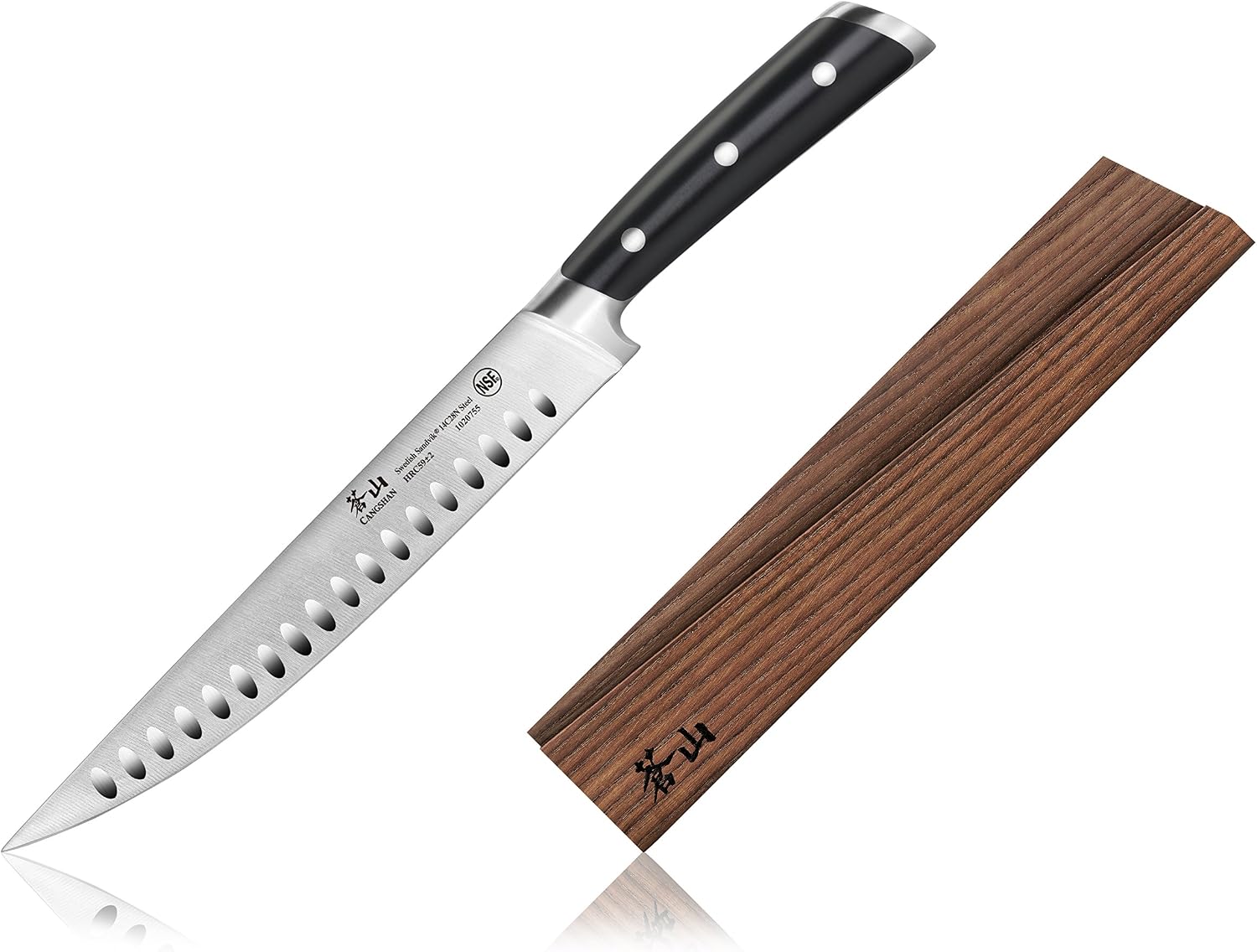
The best carving knife for turkey, brisket and roasts in 2026 is the Cangshan TS Series 9-Inch Carving Knife. It sits in the $50–$100 tier. You get a forged 9-inch Granton-edge blade in Swedish 14C28N steel and a wood sheath that keeps the edge safe between holidays. For the best value, the DRAGON RIOT Carving Knife Set pairs a 12-inch Granton slicer with a boning knife for under $25. Beginners should start with the Mercer Culinary Genesis 8-Inch Carving Knife.
Thanksgiving falls on November 26 this year. A carving knife is the one blade most kitchens own only for that day, plus a few brisket cooks and prime-rib dinners. Buy it in October or early November so you can hone it, learn its balance on a weeknight roast chicken, and avoid sawing at a 16-pound bird with a bread knife while everyone watches.
Picks at a glance
| Award | Model | Blade length | Edge type | Price tier |
|---|---|---|---|---|
| Best Overall | Cangshan TS Series 9-Inch Carving Knife | 9 in | Granton (hollow) | $50–$100 |
| Best Value | DRAGON RIOT Carving Knife Set | 12 in slicer + 6 in boning | Granton slicer | Under $25 |
| Best for Beginners | Mercer Culinary Genesis 8-Inch Carving Knife | 8 in | Plain | $25–$50 |
| Best Premium | WÜSTHOF Classic 9" Hollow Edge Carving Knife | 9 in | Granton (hollow) | Over $150 |
| Budget Pick | HENCKELS Solution 8-inch Carving Knife | 8 in | Plain | Under $25 |
Every pick comes from the Knives & Cutting category on AislePrompt, and the price button on each product page shows the current price. Prices on carving knives swing hard between October and Black Friday, so treat the tiers as a guide and check the live price before you buy.
Our Top 5 Picks
Best Overall: Cangshan TS Series 9-Inch Carving Knife
The Cangshan TS Series 9-Inch Carving Knife is the pick that does every holiday job well. Nine inches is long enough to take a turkey breast off in one pass and slice a 4-bone rib roast, and still short enough to work around a thigh joint. The hollows run the full length of the edge, so the knife also handles brisket and ham.
- Steel: Swedish Sandvik 14C28N stainless, forged, with a hardness of HRC 59 ±2 etched on the blade
- Edge: 9-inch Granton (hollow-ground) edge with a pointed tip for working around bones
- Extras: full tang, triple-riveted handle, NSF mark, and a fitted wood sheath
Pros: a harder steel than most German-style carvers, so it holds an edge longer between sharpenings. The sheath means it can live in a drawer without dulling. Its balance suits both carving and table service.
Cons: at 9 inches it is a little short for a full 14-pound packer brisket, where a 12-inch slicer finishes each slice in one stroke. Hand-wash only.
When it's right: you want one carving knife that covers Thanksgiving, Christmas ham and the occasional brisket, and you'll keep it for a decade.
When it isn't: you smoke briskets every month. Get a dedicated 12-inch slicer (see Best Value).
Best Value: DRAGON RIOT Carving Knife Set
The DRAGON RIOT Carving Knife Set is two working knives for less than most single carvers cost. You get a 12-inch slicer and a 6-inch curved boning knife. That pairing matches how pitmasters actually work: trim with the short blade, slice with the long one.
- Steel: German 1.4116 stainless, the same grade family many mid-priced German knives use
- Edge: 12-inch Granton slicer with a rounded tip; 6-inch curved boning knife for trimming fat caps and removing bones
- Handles: textured non-slip polymer, which is useful when your hands are greasy from a brisket
Pros: the 12-inch length clears a whole brisket flat or a prime rib in one draw. The rounded tip is safer for slicing toward your body on a board. The boning knife earns its place on raw prep day.
Cons: the blue polymer handles look like butcher-shop gear, not something you'd carry to the table. A softer steel needs honing more often.
When it's right: you smoke or braise brisket, you cook big roasts, or you want a long slicer without paying premium prices.
When it isn't: you want a handsome knife to carve at the table on Thanksgiving. Look at the Best Overall or Best Premium.
Best for Beginners: Mercer Culinary Genesis 8-Inch Carving Knife
Mercer's Genesis line is a culinary-school standard, and the Mercer Culinary Genesis 8-Inch Carving Knife brings that forgiving design to carving. The 8-inch blade feels close to a chef's knife in the hand, so a first-time carver isn't wrangling a long, whippy slicer.
- Steel: forged high-carbon German stainless (X50CrMoV15, per Mercer)
- Edge: 8-inch plain edge with a pointed tip, taper-ground for easy resharpening
- Handle: Santoprene, a soft rubbery grip that stays secure when wet; full tang with a bolster
Pros: the grippy handle and bolster keep fingers off the edge. The plain edge is easy to sharpen at home on any knife sharpener. The length suits turkeys up to about 16 pounds and whole chickens.
Cons: too short for brisket. No hollows, so thin slices of ham can cling to the blade.
When it's right: this is your first carving knife and you mostly roast poultry.
When it isn't: brisket is on your menu more than once a year.
Best Premium: WÜSTHOF Classic 9" Hollow Edge Carving Knife
The WÜSTHOF Classic 9" Hollow Edge Carving Knife is the heirloom choice. It matches the most common German knife block line, so it slides into a Classic set without looking out of place.
- Steel: forged from a single piece of chromium-molybdenum-vanadium stainless, rated about 58 HRC by Wüsthof
- Edge: 9-inch hollow edge, finished with Wüsthof's laser-guided PEtec process
- Handle: triple-riveted synthetic handle with a full tang and a full bolster
Pros: strong fit and finish, a heavier blade that powers through crackling and crusts, and a lifetime warranty from the maker. It looks right on a holiday table.
Cons: it costs several times more than the Best Overall pick for a similar blade length and edge style. The full bolster makes the heel harder to sharpen over the years.
When it's right: you already own Wüsthof Classic knives, or you want a gift that lasts.
When it isn't: you carve twice a year and would rather spend the difference on a roasting pan.
Budget Pick: HENCKELS Solution 8-inch Carving Knife
The HENCKELS Solution 8-inch Carving Knife is the cheapest way to stop carving with a chef's knife. It's a stamped blade, so it's lighter and thinner than the forged picks. That thinness actually helps on turkey breast.
- Steel: German stainless, single-piece stamped construction
- Edge: 8-inch plain fine edge with a pointed tip
- Handle: triple-riveted black polymer handle
Pros: light, nimble and thin behind the edge. Lowest cost of the five. It's a respectable spare for a second carving station at a big gathering.
Cons: a stamped blade with no bolster flexes more under pressure on a dense prime rib. It needs more frequent honing.
When it's right: you need a carving knife for this Thanksgiving and your budget is tight.
When it isn't: you want a knife you'll pass down.
Also on the shortlist
Several more slicers made the final cut. The Kitchen perfection 12" Brisket Knife is a single 12-inch Granton slicer with a sheath for cooks who don't need the boning knife. The Mercer Culinary Millennia 14-Inch Slicer suits competition-size briskets and whole hams. The Cutluxe 9" Turkey Carving Knife is a forged German-steel alternative to the Mercer at a similar tier.
Granton edge vs plain edge
A Granton edge, also sold as a "hollow edge" or kullenschliff, has a row of shallow oval scallops ground into the side of the blade just above the cutting edge. According to the Wikipedia entry on kitchen knives, the hollows aim to cut down adhesion by letting a little air between the blade and the food. They show up most often on meat carving and slicing knives.
Here's how that plays out on the holiday table:
- Brisket, ham and salmon: these are wet, fatty and dense, and a thin slice clings to a flat blade. Scallops help each slice fall away cleanly, so you aren't peeling meat off the steel.
- Roast turkey breast: the cut face is drier and the meat is less dense, so a plain edge works almost as well. Sharpness matters far more than hollows here.
- Prime rib: the crust and fat cap reward a long, sharp blade. Hollows help a little; length helps more.
A plain edge is enough if turkey and roast chicken are your main jobs, or if you prefer to sharpen at home (hollows don't slow sharpening, but they eventually reach the edge after many years of sharpening). Choose a Granton edge if brisket, ham or smoked salmon is on your menu more than once a year.
Blade length by job
The right length depends on the widest thing you need to slice in one stroke. Sawing back and forth tears the meat and pushes juices out. A blade that is 2–3 inches longer than the cut lets you finish each slice in one long draw.
| Job | Recommended blade | Why |
|---|---|---|
| Whole turkey up to ~20 lb | 8–10 in | Long enough for a whole breast, short enough to work around joints |
| Turkey breast roast | 8–9 in | The breast is narrow; extra length adds nothing |
| Leg of lamb | 8–10 in, pointed tip | You carve around the bone, so control beats reach |
| Glazed holiday ham | 10–12 in, Granton | Wide slices; hollows stop thin slices from sticking |
| Prime rib / standing rib roast | 10–12 in | The roast is wide once the bones come off |
| Full packer brisket | 12–14 in, Granton, rounded tip | The flat can be 12+ inches across |
Flexible vs stiff: a slightly flexible blade, typical of long rounded-tip slicers, follows the curve of a brisket or salmon side and makes the thinnest slices. A stiffer blade, typical of 8–9 inch pointed carvers, gives more control near bone, which matters on turkey and lamb. If you'll own only one knife, a 9–10 inch carver with moderate stiffness covers both.
To match a knife to the meal, look at what you're actually cooking. An Oven-Roasted Turkey with Sage and Citrus Butter or an Herb-Roasted Turkey Breast with Garlic and Lemon is a 9-inch job. A Slow-Smoked Texas Brisket with Dry Rub and Mop Sauce wants 12 inches. An Oven-Braised Brisket with Heritage Herbs is tender enough that a 10-inch Granton blade keeps the slices from shredding.
Carving sets vs a single slicer
Carving sets pair a knife with a two-tine carving fork, sometimes in a gift box. Whether the fork earns its place depends on how you serve:
- The fork is useful when you carve at the table, because it holds a hot, slippery roast steady without your hand anywhere near the edge. It's also useful on bone-in roasts like ham and prime rib, where you need to anchor the meat while you cut along the bone.
- The fork is padding when you carve in the kitchen on a board. Sturdy locking tongs or a clean towel do the same job, and most kitchens already own them. Many "sets" also bulk out the box with a cheap honing steel or a fork that doesn't match the knife's quality.
AislePrompt's knives catalog currently leans toward slicer-plus-boning-knife sets, like the Cutluxe Carving Knife Set and our Best Value DRAGON RIOT pick, rather than classic knife-and-fork sets. For most cooks that's the more useful pairing: the boning knife does real work on raw prep day, while a carving fork does one job once a year. If you also want a better everyday knife, the Victorinox Fibrox 3 Piece Chef's Set bundles a carving knife with a chef's knife and a paring knife. See the best kitchen knife sets if a full block is on your list.
Carving technique sidebar
Good carving is 70% resting and setup and 30% knife. The short version for a whole turkey:
1. Check doneness, then rest. USDA's safe minimum internal temperature chart puts all poultry at 165°F. Check the thickest part of the thigh and the breast with an instant-read probe. Our leave-in probe thermometer guide and instant-read thermometer picks cover both kinds. FSIS's consumer guide, Let's Talk Turkey, recommends letting the bird stand about 20 minutes before carving so the juices settle.
2. Set up the board. Use a large board with a juice groove, like the Thirteen Chefs 18 x 12 grooved cutting board, set on a damp towel so it can't slide. Hone the knife first on a steel honing rod.
3. Remove the legs and wings. Cut through the skin between the leg and the body, pull the leg outward until the hip joint pops, and cut through the joint. Do the same at each wing joint. Separate drumstick from thigh at the knee.
4. Take each breast off whole. Run the knife down one side of the breastbone, then follow the ribcage with short strokes and lift the breast off in one piece.
5. Slice across the grain. Lay the breast skin-side up and cut ½-inch slices crosswise, so each slice keeps a strip of skin. Art of Manliness's turkey-carving walkthrough explains why whole-breast slicing keeps the meat juicier than shaving slices off the bird.
The same principles apply to other roasts. Rest a Slow-Roasted Prime Rib with Rosemary and Dijon Crust, cut along the bones to release the roast, then slice across the grain. For a Slow-Roasted Leg of Lamb with Garlic and Rosemary, slice down to the bone in parallel cuts, then run the blade along the bone to free the slices. For a spiral or bone-in Baked Maple-Glazed Ham with Clove and Brown Sugar Crust, a long Granton blade earns its keep. The roasting pans guide covers getting the bird out of the oven and onto the board in one piece.
What to Look For
Blade length. Match it to your largest regular roast (see the table above). For most households 9–10 inches is the sweet spot. Go to 12 inches only for brisket and large hams.
Edge type. Choose Granton for wet, fatty, dense meats, and plain for poultry-first cooks who like to sharpen at home. Avoid serrated "carving" knives for roasts. They tear the crust and shred thin slices, and they're hard to resharpen.
Steel and hardness as stated by the maker. German-style X50CrMoV15 and 1.4116 steels typically sit around 55–58 HRC. They're tough and easy to hone, but they need it more often. Harder Swedish 14C28N, like the Cangshan's HRC 59 ±2, holds an edge longer. Treat any hardness figure as the maker's claim; few listings cite independent measurements.
Handle and bolster. A full bolster adds weight and finger protection but makes the heel harder to sharpen. A half bolster or none, as on the stamped Henckels, keeps the whole edge sharpenable. Textured polymer handles grip better with greasy hands; wood and riveted synthetic handles look better at the table.
Tip shape. A pointed tip works around joints and bones (turkey, lamb, bone-in ham). A rounded tip (most 12-inch-plus brisket slicers) is safer for long pull strokes and slices boneless meat cleanly.
Dishwasher guidance. Every maker of a forged knife on this list recommends hand washing. Even "dishwasher-safe" claims on budget knives are about the handle surviving, not the edge. Hot detergent and rattling against other utensils dull edges fast.
Common pitfalls
- Carving too soon. Cutting a turkey straight from the oven floods the board with juice and leaves the meat dry. Rest it.
- Sawing instead of drawing. Long, smooth strokes using the full blade length make clean slices. A knife that's too short forces you to saw.
- A dull "holiday-only" knife. A carving knife that sat in a drawer all year has often lost its edge from contact with other utensils. Hone it, and sharpen if honing doesn't restore the bite.
- Cutting with the grain on brisket. The flat and the point run in different grain directions. Separate them and slice each across its own grain.
- Using a small board. A 16-pound bird on a 12-inch board sends juice onto the counter and the bird off the edge. Size up.
When NOT to buy a carving knife
If you roast one bird a year, own a sharp 8-inch chef's knife, and never cook brisket or ham, you can skip this purchase. Sharpen your chef's knife before Thanksgiving and put the money toward a leave-in probe thermometer, which affects how the meat tastes far more than the blade does. The best chef's knives roundup covers the everyday blade that does most of a carving knife's work.
How we picked
This shortlist comes from the AislePrompt knives catalog at selection time in mid-October 2026. We started from every active carving, slicing and brisket knife in the Knives & Cutting category, and also browsed Cookware for roasting gear that pairs with it. We removed bread knives, butcher's breaking (cimeter) knives and boards, then grouped the remaining knives by price tier.
Specs come from maker listings and the markings printed on each blade. Pros and cons summarize what published reviews and owner feedback report: edge retention, handle grip, and how each length handles real roasts. Background on edge types and blade categories comes from the cited sources below. These picks don't rest on any first-hand testing, and the price tiers reflect listing prices at selection time; the live price button on each product page is the authority on what you'll pay today.
Related links
- Best Kitchen Knife Sets for 2026: if a full block makes more sense than a single carver
- Best Roasting Pans for 2026: racks, handles and sizes for the holiday bird
- Best Leave-In Probe Meat Thermometers for 2026: know exactly when to pull the turkey
- Best Knife Sharpeners for 2026: get the edge back before the big day
- Turkey and roast recipes: Oven-Roasted Turkey with Herb-Butter and Classic Stuffing, Smoked Whole Turkey with Citrus and Herb Brine, or search all recipes
Sources
- USDA FSIS — Safe Minimum Internal Temperature Chart
- USDA FSIS — Let's Talk Turkey: A Consumer Guide to Safely Roasting a Turkey (PDF)
- Wikipedia — Kitchen knife (carving, slicing and Granton-edge knives)
- Art of Manliness — How to Carve a Turkey
Frequently asked questions
What size carving knife do I need for a turkey?
Is a Granton edge worth it on a carving knife?
Do I need a carving fork, or is a carving set a gimmick?
Can I carve a turkey with a chef's knife instead?
How do I keep a carving knife sharp between holidays?
Recipes to try with sharp knives
Put your gear to work — save any recipe to My Recipes (no account needed) and send its ingredients to Instacart in one tap.



Shop knives & cutting on AislePrompt →Browse the full kitchen shop →