
Best Roasting Pans for 2026: Racks, Handles & Sizes for the Holiday Bird
Measure your oven before you measure the turkey — pan width, not bird weight, is what sends people back to the store on Thanksgiving morning.
Where to buy these picks
Affiliate links: we may earn a commission on qualifying Amazon purchases. Policy. Prices show only when checked in the last 24 hours.
- Cuisinart 16-Inch Roasting Pan with Rack $59.95 at Amazon, Check price on Amazon →
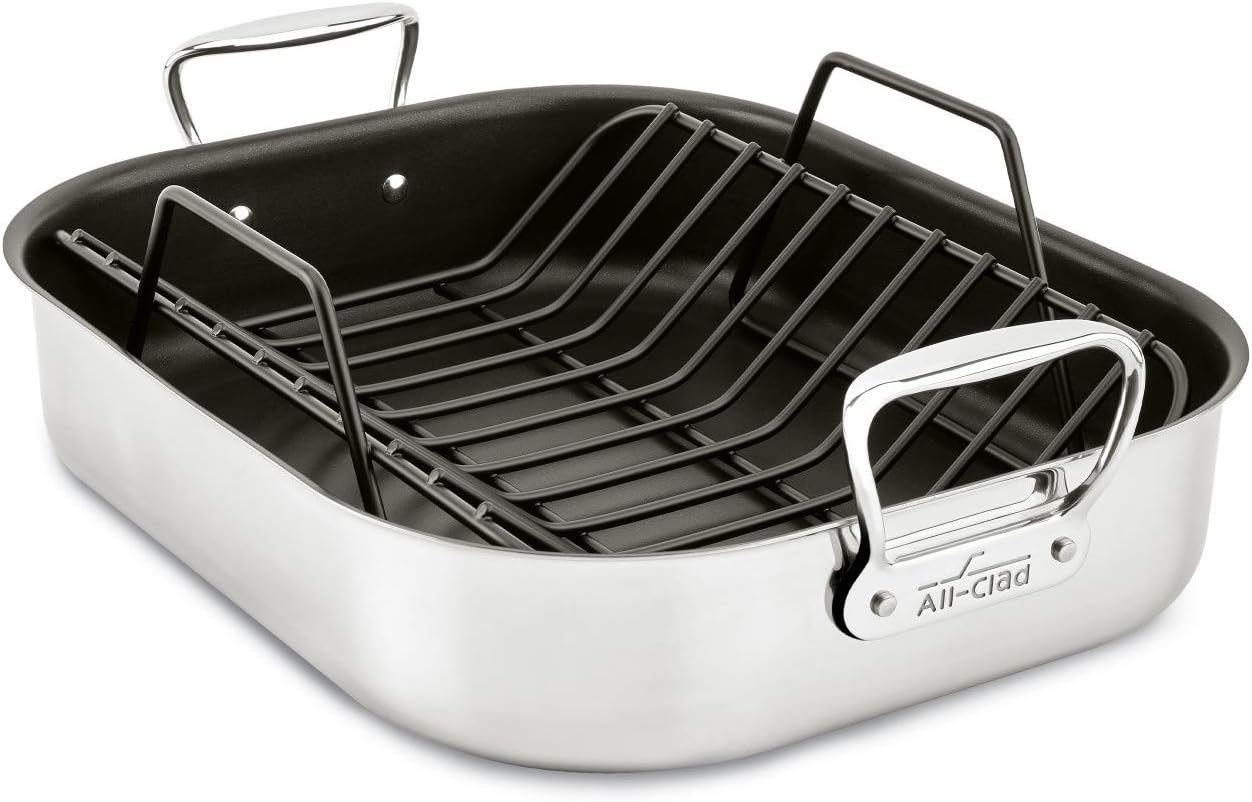
- All-Clad Specialty Stainless Roaster with Nonstick Rack $131.79 at Amazon, Check price on Amazon →
- Circulon Total Nonstick Roaster, 17 x 13 $57.32 at Amazon, Check price on Amazon →
- Farberware Classic Traditions Stainless Roaster $69.99 at Amazon, Check price on Amazon →
- KitchenAid Hard-Anodized Roasting Pan $104.99 at Amazon, Check price on Amazon →
For most households the right roasting pan is a 16 x 13-inch stainless steel model with a V-rack and upright handles, in the $60–$130 range. That size takes a 20-pound turkey with room for air to circulate, fits a standard 30-inch oven with the handles clear of the walls, and is heavy enough to make gravy on the stovetop without warping. The Cuisinart 16-inch at about $80 is the value pick; the All-Clad at about $130 is the buy-once option.
What you'll use with it
A pop-up timer triggers around 180°F, well past juicy; the bird is done at 165°F in the thickest part of the thigh. The thermometer guide has five instant-reads under $100 and safe temps by protein. Read the instant-read thermometer guide →
Instant-read thermometer guide’s top pick: ThermoMaven Professional Digital Meat Thermometer $19.99 at Amazon, Check price on Amazon →Every time the oven door opens it loses 25–50°F. A leave-in probe sits in the thigh and alarms at your target, so the door stays shut; a second probe can watch the breast. Read the leave-in probe thermometer guide →
Leave-in probe thermometer guide’s Best Value pick: TempPro TP17 Dual-Probe $26.99 at Amazon, Check price on Amazon →
Thanksgiving 2026 falls on November 26, which means you have time to buy deliberately rather than grabbing whatever is left in the aisle on November 24. Here is what actually matters.
Measure your oven before you measure the bird
This is the step people skip and regret. A standard 30-inch US wall oven has an interior width of roughly 25 inches, but the usable width between the rack guides is closer to 22 inches, and you need at least an inch of clearance on each side for hot air to move.
A 16 x 13-inch pan with 2-inch upright handles measures about 20 inches overall — that fits. An 18-inch pan with wide loop handles can measure 24 inches and simply will not go in, or will go in only diagonally with the door pressing against it. Measure your rack width first, subtract two inches, and shop to that number.
The second measurement is depth. Roasting pans run 3 to 5 inches deep. Deeper is not better: sides above about 3.5 inches shield the lower half of the bird from radiant heat and from air movement, which gives you a beautifully browned breast over pale, flabby thigh skin. For roasting, 3 inches is the sweet spot for poultry. Save the deep pans for braising.
Material: what it changes, and what it doesn't
A roasting pan does two jobs — hold the food up in moving hot air, and catch drippings you can turn into gravy. Material affects the second job far more than the first.
Tri-ply stainless steel is the default recommendation. It goes on the stovetop without hot spots, so you can deglaze and build gravy in the same pan. Fond browns visibly against the light interior, which makes it easy to judge when to stop. It is the only material here that does all of that.
Hard-anodized aluminum heats faster and weighs noticeably less — a real consideration when you are lifting 25 pounds of pan and bird out of a hot oven. Most hard-anodized roasters have a nonstick interior, which means less fond, easier cleanup, and gravy that needs more help.
Enameled steel (the classic speckled oval roaster) is cheap, light, and fine. It is thin, so it is prone to scorching drippings, and most are not recommended for stovetop use. Good for the once-a-year cook who wants storage-friendly and inexpensive.
Disposable foil works for the bird and fails at everything after. It flexes alarmingly when full — always put it on a rimmed sheet pan — and you cannot deglaze it.
Top picks
#1: Cuisinart 16-Inch Roasting Pan with Rack
Verdict: Best for most people. ~$80, stainless, induction compatible.
The Cuisinart 16-inch hits the size that matters with a stainless interior you can build gravy in and riveted upright handles that stay inside a 30-inch oven. Induction compatible, dishwasher safe, and it comes with a rack rather than making you buy one.
It is not as heavy-gauge as the All-Clad, and on a strong gas burner it can develop a hot spot directly over the flame — move it around while deglazing rather than parking it.
#2: All-Clad Specialty Stainless Roaster with Nonstick Rack
Verdict: Buy it once. ~$130 for the 16x13x5.
The All-Clad 16x13x5 is rated to 600°F, broiler safe, and thick enough that it will not warp when you take it from a 425°F oven to a burner. That thermal shock is what kills cheaper pans — a warped base rocks on a flat cooktop and pools fat on one side.
There is also a 13x16 large roaster version at around $170 rated to 500°F. For most people the cheaper 600°F model is the better buy.
#3: Circulon Total Nonstick Roaster, 17 x 13
The Circulon Total is the choice if scrubbing a roasting pan is the part you dread. Nonstick interior, rack included, and light enough to handle comfortably. Check your oven width against 17 inches plus handles before buying — this is right at the limit for a 30-inch oven.
The tradeoff is gravy: less fond sticks, so you get less flavor to deglaze.
#4: Farberware Classic Traditions Stainless Roaster
Verdict: Best budget stainless. ~$60, 17 x 12.25 inches.
The Farberware Classic Traditions gets you a stainless interior and a rack for $60. Thinner gauge than the Cuisinart, so treat the stovetop gravy step gently, but it is a lot of pan for the money.
#5: KitchenAid Hard-Anodized Roasting Pan
Verdict: Lightest of the serious pans. ~$120, 13 x 15.75 inches.
The KitchenAid hard-anodized is the pick if pan weight is a genuine concern. Removable rack, matte black finish, fast and even heating.
Racks, handles and the details that decide it
The rack is not optional. A bird sitting directly on the pan floor steams its own underside in rendered fat. A rack lifts it into moving air so the skin dries and browns underneath. V-racks cradle a turkey and keep it stable; flat racks are more versatile for roasts and vegetables. Nonstick racks clean up far more easily, which matters more than it sounds when the alternative is picking welded skin out of wire.
Upright handles beat loop handles. They add less than an inch to the footprint and they are far easier to grip with thick oven mitts. Loop handles look better and cost you oven clearance.
Riveted handles beat welded ones. Rivets show on the interior and are marginally harder to clean, but welded handles are the single most common failure point on cheap roasters — and they fail while you are holding 25 pounds over an open oven door.
Real-world numbers: sizing and timing
Pan sizes are rated by the bird they hold with clearance for air movement.
| Pan size | Max bird | Serves | Fits 30-inch oven? |
|---|---|---|---|
| 14 x 10 in | 12 lb | 6–8 | Yes, easily |
| 15 x 11 in | 16 lb | 8–10 | Yes |
| 16 x 13 in | 20 lb | 10–14 | Yes, check handles |
| 17 x 13 in | 22 lb | 14–16 | Usually, measure first |
| 18 x 14 in | 26 lb | 16–20 | Often no |
Roasting times, unstuffed, at 325°F, pulled at 165°F in the thickest part of the thigh:
| Turkey weight | Time at 325°F | Rest |
|---|---|---|
| 10–12 lb | 2¾–3 hr | 20 min |
| 12–14 lb | 3–3¾ hr | 25 min |
| 14–18 lb | 3¾–4¼ hr | 30 min |
| 18–20 lb | 4¼–4½ hr | 30 min |
| 20–24 lb | 4½–5 hr | 40 min |
Stuffed birds add roughly 30–45 minutes, and the stuffing itself must reach 165°F — which is the main argument for cooking dressing in a separate dish. As covered in the general food-safety guidance on poultry, the thigh, not the breast, is the measurement that matters, and the thermometer should not touch bone.
Other gear this guide links
Prices are shown only when checked in the last 24 hours; otherwise check the current price on Amazon.
What to cook in it the rest of the year
A roasting pan that comes out once a year is a bad purchase. It is the right vessel for anything large that benefits from air circulation.
Slow-Roasted Prime Rib with Rosemary and Garlic and Primetime Prime Rib with Herb Crust are the obvious December use.
Herb-Crusted Roast Chicken with Garlic Mashed Potatoes and Native Herb Roast Chicken with Lemon work any Sunday — a roasting pan handles a chicken plus potatoes under the rack, which catch the drippings.
Minnesota Apple Cider Glazed Ham and Vintage 1920s Honey-Glazed Ham cover Easter and Christmas.
And for a weeknight, Most Flavorful Roasted Vegetable Medley — though for vegetables alone a sheet pan from bakeware is the better tool, since the low sides give you more browning.
For the gravy step you will want a whisk and a fat separator from utensils, and a good instant-read thermometer from gadgets. Browse cookware for the pans themselves.
Care: how to make a good pan last twenty years
Roasting pans die of two things — warping and neglected fond.
Warping happens when a hot pan meets cold liquid, or when a thin base sits over a single burner. The base expands faster than the rim, the metal deforms, and it never fully returns. Two habits prevent it: deglaze with warm stock rather than cold, and when you put the pan on a burner, use a low flame and move the pan around rather than parking it over one hot spot. If your cooktop lets you span two burners on medium-low, do that instead.
Baked-on fond looks like a disaster and almost never is. Do not attack it with a scouring pad, which scratches the interior and gives future drippings more places to grip. Instead put half an inch of water in the pan, add a splash of vinegar, and simmer it on the stovetop for five minutes. Nearly everything lifts with a wooden spoon. For the stubborn ring at the waterline, a paste of baking soda and water left for twenty minutes finishes the job.
Nonstick and hard-anodized roasters need the opposite treatment: no abrasives at all, no metal utensils, and hand washing even when the manufacturer says dishwasher safe, because dishwasher detergent is aggressive enough to dull the coating over a few years.
Store the rack inside the pan with a dish towel between them. Metal-on-metal in a cabinet is how nonstick racks lose their coating.
A note on cooking the bird, not just holding it
The pan does not determine whether the turkey is good — technique does — but two things interact with your pan choice.
Dry brining beats wet brining, and it needs the pan. Salt the bird a day or two ahead, leave it uncovered on the rack in the refrigerator, and the surface dries out while the salt works inward. A dry surface is the precondition for crisp skin, exactly as it is for a pan-seared steak. This only works if your pan and rack fit in your refrigerator, which is another argument for measuring before buying.
Start hot, then drop. Twenty minutes at 425°F sets the skin, then 325°F for the remainder cooks the interior gently. A thin enameled pan can scorch drippings during that initial high-heat window; a heavy stainless pan will not. If you own a thin pan, add a cup of stock to the bottom before the bird goes in and it will not burn.
Finally, resist basting. Every time the door opens the oven loses 25–50°F and the recovery costs you ten minutes. Basting also wets the skin you spent a day drying out. A dry-brined bird on a rack needs nothing from you between the temperature drop and the thermometer check.
Common mistakes
Buying for the biggest bird you might ever cook. An 18-inch pan that does not fit your oven is worth zero. Buy for your oven, then buy a bird that fits the pan.
Using a pan that is too deep. Sides over about 3.5 inches shield the lower half of the bird and give you pale thigh skin.
Skipping the rack. The bottom of the bird steams instead of roasting.
Deglazing a warped thin pan. Fat pools on one side, scorches, and the gravy tastes burnt.
Trusting the pop-up timer. They are calibrated to trigger around 180°F — well past the point where breast meat has dried out. Use a thermometer in the thigh.
When NOT to buy a roasting pan
If you cook for four or fewer, a large rimmed sheet pan with a wire rack does nearly everything a roasting pan does, stores flat, costs a fraction, and browns better because there are no tall sides. Spatchcock a 12-pound turkey onto a sheet pan and it cooks in about 80 minutes with more even skin than any roaster will give you. Buy a dedicated roasting pan when you regularly cook birds over 14 pounds, when you want to make gravy on the stovetop in the same vessel, or when you need the depth for a braise.
Sources
Frequently asked questions
What size roasting pan do I need for a turkey?
Do I really need the rack that comes with it?
Can I just use a disposable foil roasting pan?
Which roasting pan material makes the best gravy?
Is there a good alternative if I cook for a small group?
How we picked
This guide is researched, not bench-tested. We shortlisted products from the AislePrompt kitchen catalog and compared them on published manufacturer specifications (such as materials, size and capacity), on what owners report in published reviews, and on any third-party sources linked in this guide. The guide was drafted with AI assistance. We did not run lab or hands-on tests of these products, so any measurement quoted here comes from the manufacturer or a cited source. Prices change often: use the “Check price on Amazon” buttons for today’s price.
Recipes to try with your bakeware
Put your gear to work — save any recipe to My Recipes (no account needed) and send its ingredients to Instacart in one tap.
Shop bakeware on AislePrompt →Browse the full kitchen shop →