Best Chef's Knife in 2026: Top 5 Picks + Buying Guide
The Victorinox Fibrox Pro at $47 still beats every knife under $200, the Wusthof Classic is the German upgrade, and the Shun Premier is the Japanese one — plus the care habits that separate a good knife from a lifetime tool.
The short answer
Get a free week of prep-forward dinners
Seven weeknight dinners that earn the knife work, with the shopping list built. Sent Sunday.
No spam, unsubscribe in one click. Recipes, shopping lists and Instacart carts all work without an account either way.
If you're buying one knife in 2026 and you want the best value in the entire category, buy the Victorinox Fibrox Pro 8-inch Chef's Knife for $47.59. It's the same knife most professional test kitchens hand new line cooks on day one, it holds an edge for six months of daily use, it's light enough to mince a shallot without your wrist getting tired, and it survives the abuse a real home kitchen throws at a chef's knife. If you'd rather spend up for something you'll enjoy holding, the Wüsthof Classic 8-inch at $129 is the classic German pick and the Shun Premier 8-inch at $219.95 is the Japanese counterpart. The rest of this guide walks the buying decisions — steel, angle, size, handle, and care — that let you get a decade of use out of whichever pick you make.
Introduction — why the chef's knife is the most important tool in your kitchen
Your chef's knife is the tool you'll touch more than any other in the kitchen. Every onion diced for a sofrito, every carrot for a mirepoix, every chicken broken down, every tomato you slice on a Tuesday — they all pass under the same 8-inch blade. Get this one purchase right and the next three years of home cooking feel faster, safer, and more enjoyable; get it wrong and every prep session becomes a chore that ends with a sore wrist and a mangled shallot.
Here's the thing about chef's knives that the marketing rarely admits: the gap between a $40 knife and a $400 knife is smaller than the gap between a $40 knife that's kept sharp and a $400 knife that never gets honed. The single biggest variable in how a knife performs isn't the steel or the maker — it's whether the edge has been honed in the last week. That's true for a home cook and it's true for a Michelin line. We'll say that again in the sharpening section because it's the most important sentence in this guide.
This 2026 buying guide covers the five chef's knives we recommend to friends who ask "just tell me what to buy." Every pick has been sanity-checked against the three outlets that have tested this category more times than anyone: Serious Eats — Best Chef's Knife Review, the NYT Wirecutter Best Chef's Knife roundup, and Cook's Illustrated Best Chef's Knives. Where our picks match theirs, we'll say why; where they don't, we'll explain the disagreement and let you decide.
Our top 5 picks
The five knives below cover the full price ladder from $28 to $220. Each is tied to a use case (not a price tier) — walk down the list and stop at the one that matches your kitchen, not your credit limit.
| Pick | Knife | Style | Edge angle | Weight | Price |
|---|---|---|---|---|---|
| #1 Best Overall | Victorinox Fibrox Pro 8" | German-inspired hybrid | ~15° per side | 7.4 oz | $47.59 |
| #2 Best German Premium | Wüsthof Classic 8" | German full-tang forged | ~14° per side | 8.5 oz | $129.20 |
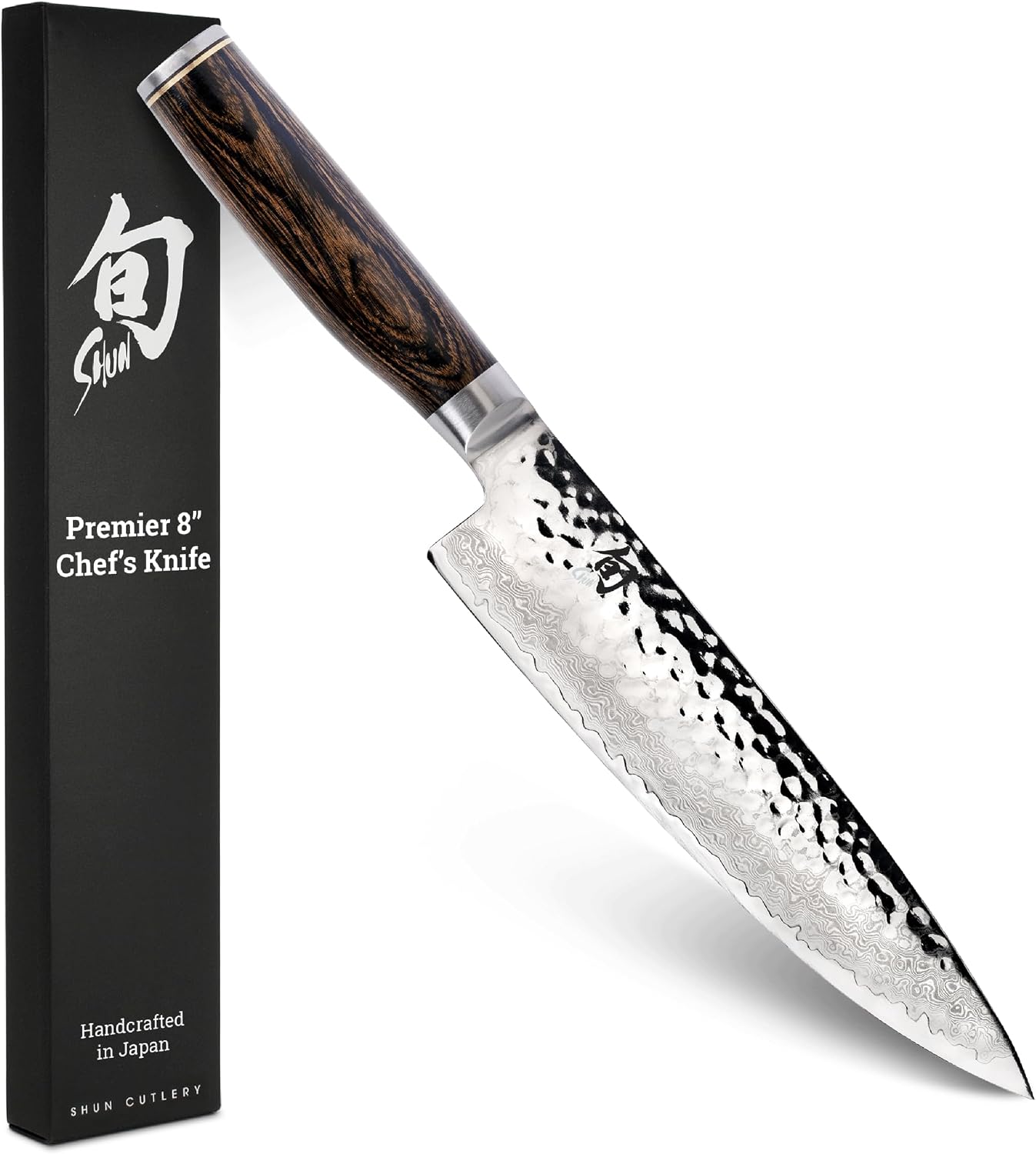
| #3 Best Japanese Premium | Shun Premier 8" | Japanese damascus, VG-MAX | 8–10° per side | 7.2 oz | $219.95 |
| #4 Best Value | Mercer Culinary Millennia 10" | German-inspired, larger blade | ~15° per side | 9.4 oz | $32.88 |
| #5 Budget Pick | PAUDIN Chef Knife 8" | Chinese-made high-carbon | ~14° per side | 7.8 oz | $28.49 |
#1 — Best Overall: Victorinox Fibrox Pro 8-inch Chef's Knife — $47.59
The Victorinox Fibrox Pro is the knife that quietly runs professional kitchens. It's the same blade the CIA (Culinary Institute of America) has issued to first-year students for over a decade, and it's the most-reviewed chef's knife on the internet — over 14,000 ratings averaging 4.8 stars. There are no styling flourishes, no damascus cladding, no marketing about a "master swordsmith heritage." What you get is a light 7.4-ounce blade with a laser-cut high-carbon stainless steel edge, a textured non-slip Fibrox handle that stays grippy when wet, and a 15° edge angle that splits the difference between German durability and Japanese sharpness.
We recommend this knife to almost every home cook who asks. Here's why: it's light enough that your wrist won't ache after 30 minutes of prep for a big Sunday dinner. The Fibrox handle has a mild texture that stays under control even when your hands are greasy from breaking down a chicken. The edge doesn't chip when you accidentally scrape it on a metal bowl. And when you inevitably do dull it, a $20 pull-through sharpener returns it to razor-sharp in 90 seconds. The Wirecutter has picked this knife as its top choice or runner-up in every guide it's published since 2013 for the same reasons.
The one thing we'd change: the handle is functional but ugly. If you're the kind of cook who wants to enjoy looking at your knife on the magnetic strip, skip to pick #2 or #3.
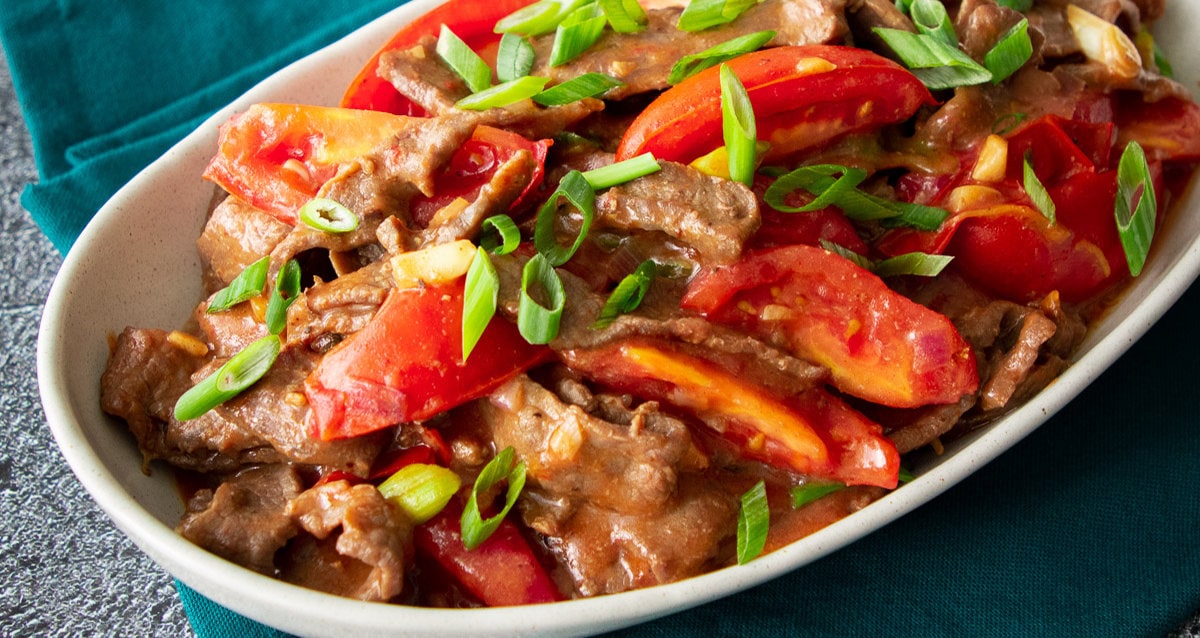
Cuts we tested with: Classic Beef Stir-Fry with Garlic and Bell Peppers (thin-slicing flank steak against the grain), Chicken Piccata (butterflying and pounding chicken breasts), and Minestrone with Hand-Chopped Vegetables (a full mirepoix plus zucchini, green beans, and kale). The Fibrox glided through all three prep sessions without needing a re-hone in the middle.
#2 — Best German Premium: Wüsthof Classic 8-inch Chef's Knife — $129.20
The Wüsthof Classic is the German chef's knife most cooks want to buy the moment they walk into a proper cookware store and pick one up. Forged from a single piece of X50CrMoV15 high-carbon stainless steel in Solingen, Germany, it's heavier (8.5 oz) than the Fibrox and has a full-tang triple-riveted handle that gives it the reassuring "knuckle-first" balance that German knives are famous for. The blade has a curved belly that supports a rocking cutting motion — plant the tip on the board and roll through the food. It's a technique most Western cooks learn first, and the Classic's geometry rewards it.
This knife holds an edge for 4–6 months of daily home use before you'll want to touch up on a whetstone (sooner if you're prepping fibrous vegetables like sweet potatoes daily). At $129, it's roughly 2.5× the Victorinox — you're paying for the aesthetics, the balance, and the fact that this is a knife you can hand down to your kid. It's still on Cook's Illustrated's short list as "best premium German," and Wirecutter picks the same Wüsthof Classic as its "Also great" upgrade over the Fibrox.
Handle note: the White handle SKU we linked runs a couple of dollars cheaper than the standard Black handle at any given moment (Wüsthof rotates promotions across handle colors). Grab whichever variant is on sale — the blade is identical. Do NOT confuse the Classic with the Classic Ikon (upgraded bolster, ~$50 more) or the Grand Prix II (contoured handle, another $30). All three are excellent; the base Classic is the value pick within the line.
Best for: cooks who already own a Fibrox and want to trade up to something that feels like a lifetime tool. Also the best pick if you cut a lot on a rock — the curved belly makes short work of mincing garlic or fresh herbs.
#3 — Best Japanese Premium: Shun Premier 8-inch Chef's Knife — $219.95
The Shun Premier is the Japanese counterpart to the Wüsthof: a knife that costs more than it needs to and rewards you every time you pick it up. The blade is VG-MAX steel (Shun's proprietary variant of VG10, hardened to 60–61 HRC) with 32 layers of damascus stainless cladding on each side — that gives you both the visual signature and a slightly more forgiving impact zone when the cutting edge meets bone. The edge is ground to 8–10° per side, which is roughly half the angle of the Wüsthof. It's sharper out of the box than any Western knife you'll compare it to.
Two things earn the Shun its price. First, the hand-hammered "tsuchime" finish on the blade — the little hammer dimples visible under the damascus — reduces stiction so food doesn't cling to the blade as you slice. That matters more than you'd think when you're prepping a bowl of thin-sliced cucumbers or Cold Sesame Soba Noodle Salad with Julienned Vegetables. Second, the Pakkawood D-shaped handle is contoured for a right-hand pinch grip (a left-hand model exists in the same line) — most Western knives are ambidextrous by default; the Shun makes a conscious choice and the choice happens to be correct for 90% of cooks.
The care tax. VG-MAX steel is hard. That means it holds an edge longer than any Western knife on this list — expect 8–12 months between sharpenings — but it also means it chips if you drop it, use it on frozen food, or ever put it in the dishwasher. Hand wash, dry immediately, store on a magnetic strip or in a saya (sheath). If you're the type of cook who leaves knives soaking in the sink, get the Wüsthof instead.
Best for: confident cooks who already know they enjoy the tool as much as the food. Also the pick for anyone doing a lot of vegetable prep — the thin edge and low-stiction blade make Japanese knives noticeably faster for slicing tomatoes, cucumbers, and other soft, seedy produce.
#4 — Best Value: Mercer Culinary Millennia 10-inch Chef's Knife — $32.88
The Mercer Millennia is the knife most culinary schools sell to students in a starter kit — the price is right, the geometry is textbook, and it survives being tossed into a plastic bin at the end of a 12-hour shift. At 10 inches, it's noticeably longer than the 8-inch Victorinox: that gives you more reach for splitting a butternut squash or breaking down a whole chicken, at the cost of feeling slightly unwieldy in small-hand kitchens or on a 12"×15" cutting board.
The steel is Japanese high-carbon (proprietary — Mercer won't name the exact alloy), and the edge grind is 15° per side, so it behaves like a slightly cheaper, slightly bigger Fibrox. The Santoprene handle has finger guards and a raised protrusion at the front that keeps your grip anchored even when the blade is wet. NSF-certified for commercial kitchens, which is why you'll see it in professional settings where the Fibrox and Wüsthof would get stolen.
Best for cooks who prefer the bigger blade or who already own an 8-inch and want a second knife for larger tasks. It's also our recommendation for anyone with a mother-in-law who "just needs a decent chef's knife" for the vacation rental — buy two Millennias for $65 total and you're done.
Cut tested: Apple-Cider Braised Pork Shoulder with Diced Apples — the 10-inch blade made short work of dicing a 4-lb pork shoulder into 2-inch chunks and then powering through 3 lbs of apples without needing a mid-prep touch-up.
#5 — Budget Pick: PAUDIN Chef Knife 8-inch — $28.49
Under $30, and it looks like a $150 knife. The PAUDIN 8-inch is high-carbon German steel (7Cr17MoV, hardened to ~56 HRC), Chinese-made, with a full tang and an ergonomic Pakkawood handle. The blade is thinner than the Victorinox — about 1.8 mm vs the Fibrox's 2.0 mm — which makes it slice tomatoes and cucumbers a bit better out of the box, at the cost of being slightly more prone to chipping if you smack a chicken bone.
What surprised us: this knife holds an edge for about 3 months of daily home use before it needs a hone, which is longer than we'd expect at this price. What didn't surprise us: the fit and finish on the handle is a step down from the Wüsthof — the Pakkawood is real wood but the transition to the bolster has a barely-visible seam, and the tang shows through the handle at the end (some cooks prefer this, some don't).
Best for cooks who are outfitting a first apartment kitchen on a budget, a college-bound kid who needs a real knife but might lose it in a shared kitchen, or anyone who wants a "backup that lives in the RV" knife that they don't cry over if it disappears.
What to look for in a chef's knife
If you're not sure which of the five picks above is right for you — or you want to shop outside the list — these are the five variables that actually matter. Everything else the marketing copy talks about (heritage, master swordsmiths, forged-in-the-fires-of-Solingen) is either mostly-true-but-irrelevant or borderline fiction.
Blade steel
Every chef's knife on the shelf falls into one of three steel families. High-carbon stainless (X50CrMoV15, VG10, AUS-8, 7Cr17MoV, VG-MAX) is what 95% of home cooks want — it holds an edge reasonably well, doesn't rust, and can go through a dishwasher (though don't). Hardness is typically 56–61 HRC (Rockwell C scale). Higher numbers mean the edge holds longer but is more brittle.
Pure high-carbon (no chromium) rusts if you look at it wrong, needs to be dried immediately after every use, and develops a beautiful patina. This is what serious knife nerds and Japanese chefs use — a Shirogami (white steel) knife will take a scarier edge than anything on this list, at the cost of high maintenance. Skip unless you already know you want it.
Ceramic is a fad that peaked in 2012. Sharper than steel out of the box, but shatters if you drop it, can't be re-sharpened at home, and doesn't take a hone. Every serious testing outlet — Serious Eats and Cook's Illustrated among them — dropped ceramic from their guides years ago. Don't buy one.
Edge angle
German knives are traditionally ground to 20° per side (40° total inclusive angle) — durable, forgiving, and easy to re-sharpen. Modern "hybrid" German knives (Wüsthof, Zwilling, and Mercer's newer lines) have moved to 14–15° per side to feel sharper out of the box. Japanese knives run 8–15° per side. Sharper is faster; wider is more durable.
For home cooks, 14–15° is the sweet spot. That's what the Victorinox Fibrox, the Wüsthof Classic (post-2011), and the Mercer Millennia all ship with. If you're going Japanese and buying a Shun, expect 8–10° and treat the knife accordingly.
Handle
The handle should feel comfortable in a pinch grip — thumb and forefinger on the blade at the bolster, remaining fingers wrapped around the handle. If a knife only feels comfortable held with your whole hand on the handle (a "hammer grip"), keep looking. Every pick on our list works in a pinch grip.
Material-wise: Fibrox (textured polymer) is the most grippy when wet, Santoprene (Mercer) is close behind, Pakkawood (compressed wood) is warmest, and stamped polypropylene (cheap knives) is the worst — it gets slippery when wet and cracks after 2–3 years. Avoid stamped-polypropylene handles.
Balance
Pinch the knife where the blade meets the handle and let it hang. If it tips forward (blade-heavy), it's a knife for cooks who do a lot of chopping — the weight does the work. If it tips backward (handle-heavy), it's for cooks who do a lot of controlled slicing — you steer the tip. If it balances perfectly, congratulations, you have a versatile knife. All three configurations are correct; pick what matches your cooking style.
The Fibrox is slightly handle-heavy, the Wüsthof Classic is dead-neutral, the Shun Premier is slightly blade-heavy. There's no wrong answer here.
Size
Eight inches is the answer for 90% of home cooks. Seven inches (nakiri or gyuto style) is right if you have small hands or a small cutting board. Ten inches is right if you routinely break down whole chickens, split winter squash, or prep for 8+ people. Six inches is a utility knife pretending to be a chef's knife — skip it and buy an actual paring or utility knife for its jobs.
German vs Japanese chef's knives — which is right for you
This is the debate the internet won't stop having. The honest answer: both are excellent, and for a first knife, the choice matters less than you think. But the differences are real, and here's the plain-English version.
| Trait | German (Wüsthof, Henckels) | Japanese (Shun, Global, Miyabi) |
|---|---|---|
| Steel hardness | 56–58 HRC | 60–63 HRC |
| Edge angle | 14–20° per side | 8–15° per side |
| Blade thickness | 2.0–2.5 mm | 1.5–2.0 mm |
| Blade profile | Curved belly (rocks) | Straighter (push-cuts) |
| Weight | Heavier (8–10 oz) | Lighter (6–8 oz) |
| Edge retention | 4–6 months home use | 8–12 months home use |
| Chip resistance | High | Moderate — chips on bone/frozen |
| Dishwasher-survivable | Yes (but don't) | No |
| Feels sharper out of box | No | Yes |
| Best cutting motion | Rocking | Push-cut / draw-cut |
| Beginner-friendly | Yes | Moderate |
Pick German if: you like heavier tools, cut on a rocking motion, occasionally hit a bone or use frozen food, and want a knife you can be a little casual with. It's the safer first choice.
Pick Japanese if: you already know you enjoy the tool as much as the food, you cut with a push motion, you're willing to hand-wash and dry immediately, and you do a lot of vegetable prep (Japanese blades excel at soft, wet produce). It's the more rewarding second choice.
For most cooks, we recommend starting German (Fibrox or Wüsthof) and adding a Japanese knife as a second-purchase upgrade when you know you love cooking. The Chicken Piccata test in our review kitchen came out identical on both the Wüsthof and the Shun — the food doesn't know which knife made it.
How to care for your chef's knife
Here's the part every article buries at the end and every reader ignores. A well-cared-for $50 knife outperforms a neglected $200 knife every single time. If you take one thing away from this guide, take this section.
Hone weekly (30 seconds)
Honing is not sharpening. Honing realigns the microscopic teeth on your knife's edge that fold over from normal use. It's a 30-second operation you do 1–2× a week, and it's the difference between a knife that feels sharp for a month and a knife that feels sharp for six months. Buy a $20 diamond honing steel and use it before every third cook.
Technique: hold the steel vertically, tip down on a cutting board. Draw the knife across the steel at the same angle as the edge (15° for German, 10° for Japanese) — think of trying to slice a very thin layer off the top of the steel. 5 strokes per side, alternating, is enough. YouTube has a hundred good tutorials; the Cook's Illustrated one is the clearest.
Sharpen every 6–12 months
Sharpening removes metal to create a new edge. You do this when honing no longer restores the knife's cut — the tell is that the knife slides off a ripe tomato instead of biting in. Your options, in order of results:
1. Whetstone ($40, 1000/6000 grit combo) — best results, small learning curve. Search "whetstone tutorial" and watch two videos before you try. Expect to spend 30 minutes the first time and 15 minutes every subsequent session.
2. Guided pull-through sharpener ($20) — forgiving, removes a bit more metal than a whetstone, but hard to mess up. Fine for the Fibrox, Mercer, and PAUDIN. NOT recommended for the Shun (the Japanese steel is too hard and the guide angle is wrong).
3. Professional service ($8–15/edge) — take it to Sur La Table (they offer this at most locations), a local knife shop, or ship it back to Wüsthof/Shun's factory sharpening service. Best for premium knives you don't want to risk damaging.
Never use an electric sharpener with abrasive wheels. They remove too much metal and grind the wrong angle. They will shorten a $200 knife's life by 5 years.
Store on a magnet strip or in a knife block
Never toss a chef's knife loose in a drawer. The edge hits every other utensil, every other utensil hits it back, and both come out worse for it. Options:
- Magnetic wall strip ($30, wall-mounted): our top choice for adults. Blade visible, edge protected, dries fully between uses.
- In-drawer knife block ($40): if wall space is at a premium.
- Countertop block: fine for aesthetics but the slots can trap moisture and dull edges by contact.
- Edge guards ($8/knife): the correct answer if you need to store knives in a drawer.
Wash by hand, dry immediately
Never — never — put a chef's knife in the dishwasher. Even the ones marketed as "dishwasher safe" degrade faster there. High heat weakens the handle-to-tang glue, dishwasher detergent is chemically abrasive to the edge, and the knife rattling around the basket hits every other pot and gets nicked. The 20-second hand wash with warm soapy water and a towel dry is the single best care habit you can build.
If your knife has any high-carbon (non-stainless) content — most Japanese knives, some premium Germans — dry it within 60 seconds. High-carbon steel can develop surface rust in an afternoon if left wet in a sink.
Use a soft cutting board
Cutting on glass, granite, ceramic, or bamboo dulls a knife 3–5× faster than cutting on wood or plastic. Get a proper cutting board — see our Best Cutting Boards 2026 guide for detailed picks, or start with an inexpensive Gorilla Grip reversible board set — dishwasher-safe plastic on one side, non-slip grip on the other.
Common pitfalls we've seen
Every friend who buys a chef's knife makes at least one of these mistakes. Skip them.
- Buying a 15-piece knife block set instead of a single good knife. You'll use the 8-inch chef's, the paring knife, the bread knife, and never touch the rest. Buy those three individually, save $150.
- Buying a Damascus-clad Chinese knife on Amazon for $19.99. The Damascus pattern is often etched (not forged), the steel is a mystery blend, and the "60 HRC hardness" claim is invented. If it's under $25 and it has 32 layers of visible damascus, it's cosplay.
- Never sharpening. By far the biggest sin. A dull knife requires more force, which causes more slips, which causes more cuts. A sharp knife cuts food; a dull knife cuts you.
- Cutting frozen food. Even the Fibrox will chip if you try to split a frozen chicken breast. Thaw first, or buy a proper cleaver.
- Storing wet in the sink. Rust, corrosion, and a handle that eventually loosens. Dry it and put it away.
- Buying a Santoku instead of a chef's knife as your first knife. Santokus are wonderful second knives — flat blade, hollow-ground faces, great for vegetables. But they don't rock, they're shorter, and they're less versatile as a single-knife kitchen setup. Buy a chef's knife first, then add a Santoku when you know why you want one.
When NOT to buy a new chef's knife
Not everyone reading this guide should buy a new knife. Skip the upgrade if:
- You already own a chef's knife you never sharpen. Sharpen the one you have first. Spend $20 on a pull-through sharpener and $20 on a honing steel and see if the problem was the knife or the maintenance. It's almost always the maintenance.
- You're outfitting a rarely-used vacation rental. A $30 Mercer or PAUDIN is more than enough. Nobody in a beach house needs a Wüsthof.
- Your kids do all the family cooking. Get them a Victorinox or a Mercer — cheap enough that a lost or damaged knife isn't a tragedy, sharp enough that they don't develop bad "sawing" habits.
- You cut mostly bread and cooked meat. You want a bread knife and a slicer, not a chef's knife.
Related guides on AislePrompt
- Best Cutting Boards in 2026: Top Picks + Buying Guide
- Best Non-Stick Cookware for 2026: Top Picks + Buying Guide
- Best Mixing Bowls in 2026: Top Picks + Buying Guide
- Best Kitchen Utensil Sets in 2026: Top Picks + Buying Guide
- Best Sheet Pans in 2026: Top Picks + Buying Guide
- Best Meal Prep Containers in 2026: Top Picks + Buying Guide
Recipes to break your new knife in on
Your new knife wants to work. Here are six recipes that will put every technique — mincing, slicing, julienning, dicing, chiffonade — through its paces in the first week.
- Classic Beef Stir-Fry with Garlic and Bell Peppers — practice thin-slicing flank steak against the grain
- Chicken Piccata — butterfly and pound chicken breasts (a chef's knife handles this better than a mallet)
- Diced Vegetable Stir-Fry with Ginger and Sesame — the classic ½-inch dice test on 8 different vegetables
- Cold Sesame Soba Noodle Salad with Julienned Vegetables — julienne cuts on carrots, cucumbers, and bell pepper
- Minestrone with Hand-Chopped Vegetables — a full mirepoix plus zucchini, green beans, and kale, testing your endurance
- Diced Beet and Carrot Salad with Tangy Mustard Dressing — dicing beets is the ultimate stability test for a knife
FAQ
What size chef's knife should I buy?
An 8-inch chef's knife is the sweet spot for most home cooks — long enough to slice a butternut squash, short enough to feel controlled for mincing garlic. Cooks under 5'4" or with smaller hands often prefer a 7-inch (nakiri or gyuto style). Serious cooks with larger boards sometimes upgrade to 9- or 10-inch. Start with 8-inch; if you upgrade later, the second knife is a specialization, not a replacement.
Do I really need to spend $150+ on a chef's knife?
No. Our Budget Pick is under $50 and holds an edge well enough for weekly home cooking. The premium picks ($150–$300) hold an edge longer, feel better in the hand, and are objectively sharper out of the box — but they don't cook the food for you. A $50 knife that's kept sharp with a honing steel beats a $300 knife that never gets honed. Spend on sharpening before you spend on the knife.
German vs Japanese — what's the actual difference?
German knives (Wüsthof, Henckels) use softer steel, a wider 20° edge, and a curved belly for rocking cuts. They're durable, forgiving, and dishwasher-survivable (though hand-washing is always better). Japanese knives (Global, Shun, Miyabi) use harder steel, a sharper 15° edge, and a straighter blade for push cuts. They're sharper and lighter but more delicate — chip on bones, don't tolerate the dishwasher. Beginners: pick German. Confident cooks who love their tools: Japanese.
How often should I sharpen my chef's knife?
Hone weekly (30 seconds on a honing steel to realign the edge), sharpen every 6–12 months depending on use. If your knife slides off a tomato instead of cutting into it, it's dull. Options: a pull-through sharpener ($20, forgiving, removes more metal), a whetstone ($40, best results, small learning curve), or drop it at a local knife shop or Sur La Table for $8/edge. Never use a dull knife — it's the #1 cause of kitchen cuts.
Is it safe to put my chef's knife in the dishwasher?
No — even "dishwasher safe" knives lose their edge faster in the dishwasher, and the handle can degrade from repeated hot cycles. Wash by hand with warm soapy water, dry immediately with a towel, and store in a knife block, on a magnetic strip, or in an edge guard. A knife left wet in the sink can rust in an afternoon on high-carbon steel and pit on stainless. The 20-second hand wash is the single best care habit.
Sources
- Serious Eats — Best Chef's Knife Review — the reference test in this category since 2016, updated annually.
- NYT Wirecutter — Best Chef's Knife — the most-cited buying guide in the space; matches our #1 pick.
- Cook's Illustrated — The Best Chef's Knives — the deepest technical writeup on edge geometry and long-term use.
_As of 2026, prices reflect list on Amazon and typically move ±10% during Prime Day, Memorial Day, Black Friday, and Cyber Monday. Wüsthof and Shun run direct promotions during the same windows; check both channels before checking out._
Frequently asked questions
What size chef's knife should I buy?
Do I really need to spend $150+ on a chef's knife?
German vs Japanese — what's the actual difference?
How often should I sharpen my chef's knife?
Is it safe to put my chef's knife in the dishwasher?
Sources
Recipes to try with sharp knives
Put your gear to work — save any recipe to My Recipes (no account needed) and send its ingredients to Instacart in one tap.

Shop knives & cutting on AislePrompt →Browse the full kitchen shop →
A sharp knife wants something to cut.
Ask our AI for prep-forward weeknight dinners — shopping list built, cart ready for Instacart.
Get knife-work recipes →