Best Kitchen Utensil Sets in 2026: Top Picks + Buying Guide
Five sets — silicone, nylon, and stainless — plus the eight tools home cooks actually use every week.
The best kitchen utensil set in 2026 for most home cooks is one you build from OXO Good Grips singles — a silicone turner, a slotted spoon, locking tongs, a balloon whisk and a swivel peeler — because each is the version OXO sells on its own, not box filler.
Where to buy these picks
Affiliate links: we may earn a commission on qualifying Amazon purchases. Policy. Prices show only when checked in the last 24 hours.
- Best Overall: OXO Good Grips singles (build-your-own set)OXO Good Grips 11-Inch Balloon Whisk →OXO Good Grips Swivel Peeler →OXO Good Grips Large Silicone Flexible Turner →OXO Good Grips 12-Inch Tongs with Nylon Heads →OXO Good Grips Stainless Steel Slotted Spoon →
- Best Value: HOTEC 600°F Silicone Spatula SetCheck price on Amazon →
- Best for Beginners: U-Taste 14-Piece Silicone Set $24.99 at Amazon, Check price on Amazon →
- Best for Durability: Di Oro Living Silicone Spatula Set $21.97 at Amazon, Check price on Amazon →
- Best for Nonstick: HOTEC Silicone-Tipped Locking Tongs (Set of 3) $9.98 at Amazon, Check price on Amazon →
Quick answer
Which kitchen utensil set fits a different budget or need?
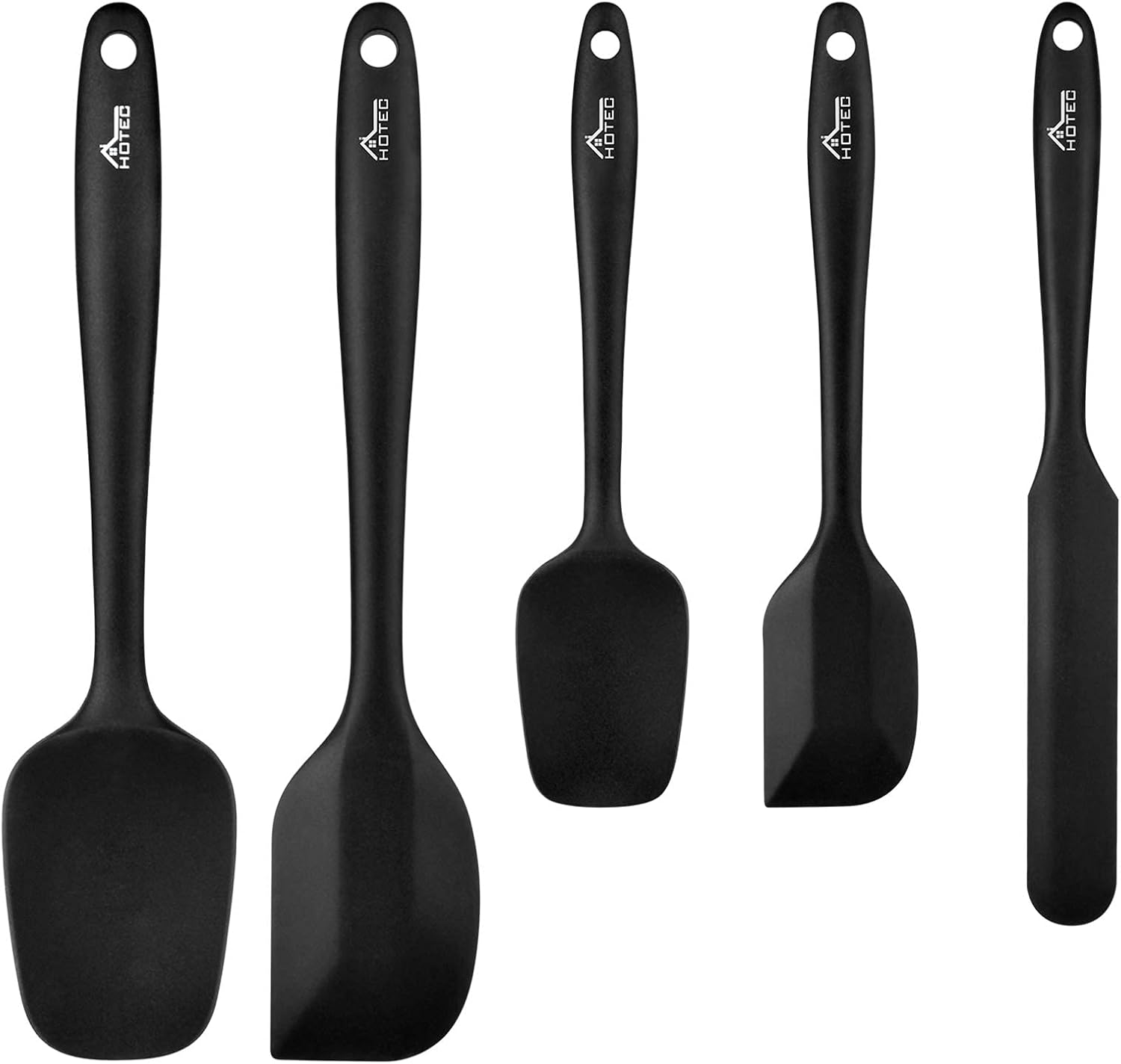
On a budget, our Best Value pick is the HOTEC 600°F Silicone Spatula Set: five seamless silicone spatulas rated to 600°F. Silicone won't scratch nonstick coatings, handles high-heat sautéing without melting, and goes straight in the dishwasher.
Below are five picks for different budgets and use cases — plus how to ignore the marketing and figure out what a "good" set actually means.
Our Top 5 Picks for 2026
| Pick | Best for | Pieces | Material | Heat rating |
|---|---|---|---|---|
| OXO Good Grips singles (build-your-own set) | Best Overall | 5 (add more as needed) | Silicone, nylon and stainless (varies by tool) | Varies by tool — see each listing |
| HOTEC 600°F Silicone Set | Best Value | 5 | Single-piece silicone | 600°F |
| U-Taste Silicone Set | Best for Beginners | 14 | Silicone + stainless cores | 600°F |
| Di Oro Living Silicone Spatula Set | Best for Durability | 3 | Pro-grade silicone over steel | 600°F |
| HOTEC Silicone-Tipped Locking Tongs (Set of 3) | Best for Nonstick | 3 | Stainless with silicone tips | 600°F |
Heat ratings are as stated by the manufacturer or on the Amazon listing for each product; we have not tested them. The OXO singles are rated tool by tool, so check each listing.
A few notes before you scroll to the picks. First, piece count is the kitchen-gadget industry's favorite vanity metric — most "20-piece" sets pad the count with measuring spoons, a basting brush, and a slotted spaghetti server you'll use twice a year. Second, trust a heat rating the manufacturer prints on the package or its own product page over one that appears only in listing copy. The ratings in our table come from the manufacturer or the Amazon listing, so confirm the number on the box when it arrives. Buy silicone rated to 600°F: an empty pan on high heat blows past 450°F fast. In stovetop tests commissioned by the Environmental Working Group, an empty nonstick pan preheated on high reached 721°F in five minutes (EWG, Canaries in the Kitchen), which is why our silicone spatula guide calls 450°F-rated sets a false economy. Third, if you cook on stainless or cast iron at high heat, you still want one or two stainless tools — a whisk and a pair of tongs — for the rare moment when silicone wants to bend and steel doesn't.
Best Overall: Build Your Own Set from OXO Good Grips Singles
OXO doesn't currently make a single boxed 15-piece "set" that's actually good — the closest products bundle a peeler, a can opener, and a few other items most cooks already own. Instead, we recommend assembling a working set from their proven, dishwasher-safe singles. Five tools cover ~95% of weeknight cooking:
- OXO Good Grips 11-Inch Balloon Whisk — the big-enough whisk that won't bend on stiff doughs
- OXO Good Grips Swivel Peeler — the classic; the soft grip is the actual upgrade over bargain-bin grocery-store peelers
- OXO Good Grips Large Silicone Flexible Turner — won't scratch nonstick
- OXO Good Grips 12-Inch Tongs with Nylon Heads — locking, and long enough to keep your hand out of splatter
- OXO Good Grips Stainless Steel Slotted Spoon — fishes out vegetables from soup without dragging the broth
Why this beats a boxed set: piece-by-piece you spend roughly what a mid-range boxed set costs, every tool is one OXO would actually sell on its own (i.e. their best version, not a filler), and you replace one tool at a time when it wears out. The Soft Grip handles are dishwasher-safe and don't absorb odors the way wood or low-end nylon does. According to America's Test Kitchen's equipment editors, the ergonomic-handle approach OXO popularized in the 1990s is now the industry default — most "premium" brands are competing on aesthetics within a category OXO already perfected. We agree.
That's the whole point: Avocado-Chive Scrambled Eggs you can fold without scraping the surface of your nonstick pan.
Skip if: you already own a primarily-silicone set you like. Don't double-buy "better" handles when the tools you have work.
Best Value: HOTEC 600°F Silicone Spatula Set
The HOTEC 600°F Heat Resistant Silicone Spatula Set is the genuine surprise of the price tier. Five tools — a large flat spatula, a large spoon-style spatula, smaller versions of both, and a narrow spreader — at a budget price, and they hold up to dishwasher cycles for years. The bodies are single-piece molded silicone (no fused metal core that can fail at the joint), the handles have a slight texture that helps when your hands are wet, and the set is sold with a 600°F rating.
The catch is that there is no turner in the box, and with no core the heads flex: the large flat spatula handles eggs, vegetables, and most fish, but for flipping a 3/4-inch burger or a thick chicken thigh on stainless, you'll want something stiffer. Pair this set with a single stainless turner for those moments and you've solved 95% of the home cook's problem without leaving the budget tier.
For nonstick weeknight cooking — think Turmeric-Ginger Ground Turkey Stir-Fry with Broccoli, Black Sesame Chicken Stir Fry with Broccoli, or One-Pan Chicken and Veggie Stir-Fry — this set plus a nonstick-safe turner is all you need. At this price, a head that eventually tears is a failure you can live with.
Skip if: you want a single-tool kit with stainless reinforcement for heavy cooking — see Di Oro below.
Best for Beginners: U-Taste 14-Piece Silicone Set
The U-Taste Silicone Spatula Set is what we'd hand a college kid setting up their first kitchen. You get 14 tools — turner, slotted turner, solid spoon, slotted spoon, soup ladle, pasta server, two scrapers, a small whisk, a basting brush, a draining spoon, and three smaller measuring/butter knives — at a low cost per tool, and the silicone is bonded mechanically (not just glued) onto a stainless core, so the heads don't twist off in heavy use.
The 600°F heat rating is published on the listing (not just in the title), and U-Taste publishes a real spec sheet with food-grade silicone certification that meets FDA food-contact packaging guidance. For a beginner, that's important because the cheapest no-name sets on Amazon are routinely off-spec and shed silicone particles after a year of heat cycles.
Pair this set with two cheap stainless tools (a 12-inch whisk and a pair of locking tongs) and you have a complete kitchen toolkit on a budget. It's the setup we'd recommend before a premium-priced boxed set with the same actual functionality.
Skip if: you're more advanced and want to invest in two or three pro-grade tools rather than fourteen cheaper ones — see Di Oro.
Best for Durability: Di Oro Living Silicone Spatula Set
The Di Oro Living Silicone Spatula Set is the durability pick. You get three (or five, depending on which set you buy) silicone spatulas — usually a small jar/sauce scraper, a medium pan scraper, and a large turner — all built around a stainless steel inner core that the silicone is mechanically fused to (the brand's term is "Pro-Grade"). The result is the rigidity you want for flipping or folding meringue without the scratch hazard of bare metal.
What you pay for is durability rather than a premium tier: the silicone is denser, the seams are flush enough to actually be food-safe (no crevices to harbor flour or batter), and the warranty is genuinely lifetime — Di Oro replaces any spatula that delaminates, period. Consumer Reports' cookware buying guide calls out "fused silicone-on-steel" specifically as the durability sweet spot for nonstick-safe utensils, and Di Oro is one of the few brands that actually executes it well at this price.
The downside is the small set count — three spatulas don't make a complete kitchen kit. Plan to layer this on top of a separate budget HOTEC set or build from OXO singles.
Skip if: you almost never use a spatula (some people genuinely cook with tongs and a wooden spoon and that's it).
Best for Nonstick: HOTEC Silicone-Tipped Locking Tongs (Set of 3)
Nonstick pans are the most common pan in American kitchens and the most commonly destroyed by the wrong utensil. For nonstick-specific use, the right answer is a focused two-tool kit: a HOTEC Locking Kitchen Tongs set with silicone tips (three sizes — 7-, 9-, and 12-inch — at a budget price) plus the Di Oro silicone spatula set above.
Why this combo and not a 15-piece kit? Because for nonstick the only tools you actually need to be careful about are the ones that touch the pan with force — tongs and turners. Everything else (whisk, ladle, slotted spoon, etc.) usually touches food, not surface, and material doesn't matter. So pay for material safety on the two tools where it counts and don't waste money on materials-grade ladles.
The HOTEC tongs are silicone-tipped (not coated steel) — important because the cheapest "silicone tongs" are usually thin silicone over steel that wears through within months and starts scratching pans. For a modest total, this two-tool kit takes care of every nonstick-cooking risk. Use it on One-Pan Chicken Thighs with Root Vegetables and One-Pan Chicken and Asparagus with Garlic and White Wine without the slow erosion of the pan's coating.
Skip if: you don't own a nonstick pan or only cook on stainless and cast iron, where steel utensils are fine.
What to Look For
Material: silicone, nylon, wood, or stainless
| Material | Pros | Cons | Best for |
|---|---|---|---|
| Silicone (food-grade, ≥500°F) | Won't scratch nonstick, dishwasher-safe, durable | Slightly soft for heavy lifting | Daily use, all nonstick cooking |
| Nylon | Cheap, light, decent heat resistance to ~400°F | Warps in the dishwasher long-term | Budget setups, secondary tools |
| Wood (beech or olive) | Doesn't scratch anything, gentle, attractive | Absorbs odors, hand-wash only, eventually cracks | Stirring pots, traditionalists |
| Stainless steel | Indestructible, perfect rigidity | Scratches nonstick on contact | Cast iron, stainless steel pans, high-heat searing |
The honest answer for 90% of cooks: silicone primary set + one stainless whisk + one pair of stainless tongs reserved for cast iron and stainless. Wood is lovely but high-maintenance; nylon was once the budget answer but has been outpriced by mid-tier silicone in 2026.
Heat resistance — read the actual rating
The number on the package or product page should be 600°F, which most modern silicone carries. A 400–450°F rating leaves no margin: an empty pan left on high heat passes that within minutes, and a stainless pan preheated for a sear runs hotter still. Cheap unmarked silicone often deforms around 350°F and starts shedding micro-particles — that's where the "silicone smells funny" reviews come from. If the rating isn't published by the manufacturer, assume the worst.
Dishwasher safety
Silicone and food-grade nylon (rated to ≥400°F) are genuinely dishwasher-safe and survive years of cycles. Wood is not — heated drying warps and cracks it, every time. Cheap unbranded nylon under $10 a set will also warp from heated drying; that's a cost-of-cheapness signal, not a material flaw. OXO, KitchenAid, Di Oro, and U-Taste publish dishwasher-cycle ratings on their product pages; if a brand doesn't publish, hand-wash to be safe.
Handle ergonomics
The single biggest underrated factor. A thin, slick handle slides out of your grip when wet, especially with hot food on the business end. Silicone over-mold, dimpled rubber, or OXO's "Soft Grip" approach all work; bare plastic doesn't. If you can't try it in person, look for owner reviews that mention the grip or handle.
Joint quality
If a utensil has a separate head and handle (rather than being molded single-piece), look at how they're joined. Mechanical bonding — where the silicone is forced into ribs or dimples in the steel core during molding — is strong. Glue-only joints fail in the dishwasher within 18 months. Single-piece molded silicone (no metal core at all) is the safest from a longevity standpoint, but you sacrifice some rigidity.
How Many Pieces You Actually Need
Honest count for daily use: eight tools.
1. Solid silicone spoon (for stirring soups, sauces, stir-fries)
2. Slotted silicone spoon (for fishing veg out of broth)
3. Wide silicone turner (for flipping)
4. Narrow silicone spatula (for scraping bowls and sauce reduction)
5. Whisk — 11-inch balloon (stainless is fine; you rarely whisk in a nonstick pan)
6. Locking tongs, 9- or 12-inch (silicone-tipped for nonstick; bare stainless for cast iron)
7. Ladle
8. Slotted turner (for fried eggs, delicate fish)
That covers everything most cooks do six nights a week — sautéing, stir-frying, soup, pasta sauce, baking, weekend brunch, the whole meal-plan week. Past eight you're paying for tools you'll use occasionally:
9. Pasta server (only if you eat pasta 3+ times a week)
10. Basting brush (only if you grill or roast frequently)
11. Potato masher (only if you make mash from scratch — once a month at best for most households)
12. Skimmer (only if you make stock or fry regularly)
13. Spaghetti rake / spider strainer (for genuine pasta enthusiasts)
14. Small ladle / sauce spoon
15. Carving fork (only if you serve roasts)
A 15-piece set is fine if it doesn't cost much more than an 8-piece — count the dollars-per-essential-tool, not the dollars-per-piece. A $40 15-piece set is $5/essential ($40 spread over 8 tools you actually use). A $25 8-piece is $3.13/essential. The 8-piece is the deal if it includes the right eight tools.
Crock or Drawer?
Crock-style sets (a tall ceramic or stainless tube on the counter, utensils standing handles-up) save drawer space if you cook frequently and want tools at hand. The downside is dust and the visual clutter. Drawer storage is cleaner-looking but adds a half-second of friction to grabbing a tool mid-cook — multiply that by a hundred cooking sessions per year and it's an argument for the crock. If you genuinely cook five or more nights a week, the crock is better. If you cook two nights and order in five, the drawer wins on aesthetics with no real downside.
Common Pitfalls
1. Buying for piece count instead of essentials. A 24-piece set with a single decent turner and 23 fillers is worse than an 8-piece set built on quality. Match the brand to the picks above first; let the piece count fall where it does.
2. Buying the cheapest no-name set. Rock-bottom silicone is real silicone but the joints, the dishwasher tolerance, and the heat rating fall off a cliff. HOTEC's budget set is the floor for "buy with confidence." Below that you're entering the lottery.
3. Choosing a wooden "premium" set for daily use. Wood is beautiful and feels good in the hand, but every wooden utensil you own will eventually crack and warp; they need to be hand-washed and oiled. Reserve one or two wooden spoons for visual joy and stirring; do the daily work on silicone.
4. Using stainless on nonstick. It seems harmless — "I'm being gentle." You'll be gentle for the first month, then a moment of vigorous scrambling later you'll scrape the coating. Once nonstick is scratched it's a one-way trip. Buy silicone or nylon and stop having the thought.
5. Skipping the locking tongs. Non-locking tongs take up triple the drawer space and clatter open at random. The small extra cost pays for itself in week one.
When NOT to Buy a "Set"
If you already own three or more silicone tools you like, do not buy a set. Buy the missing tools individually from OXO, Di Oro, or U-Taste's single-tool listings, and skip the mass-market boxes. You'll save 30–50% over the equivalent boxed set and end up with tools that match the rest of your kit better. The "set" purchase is for first-time setup or full kitchen replacement (a move, a fire, a wedding gift). It's not the default upgrade path once you have a working kitchen.
How These Pair with Cookware
If you're buying a utensil set, you probably already have a cookware setup in mind. The matchup matters: silicone for cookware on the nonstick side, stainless reserved for cast iron and high-carbon steel. If you cook from a meal-plan rotation that mixes a nonstick frypan and a cast-iron skillet, keep two small drawers — your silicone daily-driver tools on one side, your stainless cast-iron tools on the other. Pulling the wrong utensil mid-cook is how nonstick coatings die.
For weeknight rotations like One-Pan Garlic Butter Salmon with Asparagus (nonstick or oven-safe stainless), a silicone turner is the only safe tool — the salmon skin tears with stainless every time. For cast-iron searing, a stainless turner with a thin leading edge is right. Match the tool to the pan, not to the food.
Single-Tool Picks: Buy the One Piece You Need
A set is not always the answer. If you are replacing one worn-out piece or filling one gap, these single-tool guides pick the best of that one thing:
- Best silicone spatulas: heat-rated picks that will not melt.
- Best instant-read thermometers: fast, accurate picks under $100.
- Best kitchen shears: poultry, herb and take-apart shears.
- Best measuring cups and spoons: the ones that stay legible.
- Best microplane graters and zesters: citrus, ginger and hard cheese.
- Best bar tools: shakers, jiggers and strainers.
Sources
- America's Test Kitchen — Essential Kitchen Tools
- Consumer Reports — Cookware & Cooking Utensils Buying Guide
- FDA — Food Ingredients & Packaging (food-grade silicone guidance)
Frequently asked questions
Silicone, nylon, wood, or stainless — which utensil material is best?
Is a 15-piece set overkill?
Can silicone utensils really handle high heat?
Do I need a separate utensil set for my nonstick pans?
Are dishwasher-safe utensils actually fine in the dishwasher?
How we picked
This guide is researched, not bench-tested. We shortlisted products from the AislePrompt kitchen catalog and compared them on published manufacturer specifications (such as materials, size and capacity), on what owners report in published reviews, and on any third-party sources linked in this guide. The guide was drafted with AI assistance. We did not run lab or hands-on tests of these products, so any measurement quoted here comes from the manufacturer or a cited source. Prices change often: use the “Check price on Amazon” buttons for today’s price.
Recipes to try with the right utensils
Put your gear to work — save any recipe to My Recipes (no account needed) and send its ingredients to Instacart in one tap.
Shop utensils & tools on AislePrompt →Browse the full kitchen shop →