Best Santoku Knives for 2026: Japanese Blades for Everyday Prep
Shorter, lighter and flatter than a chef's knife. Five picks from budget to premium, plus how to keep a Japanese edge sharp.
Where to buy these picks
Affiliate links: we may earn a commission on qualifying Amazon purchases. Policy. Prices show only when checked in the last 24 hours.
- Best Overall: Mercer Culinary Genesis 7-Inch SantokuCheck price on Amazon →
- Best Value: Cuisinart C77TR-7SAN Triple Rivet 7-InchCheck price on Amazon →
- Best for Beginners: Victorinox Fibrox 7-Inch Santoku, Granton BladeCheck price on Amazon →
- Best Premium: Shun Classic Blonde 7-Inch SantokuCheck price on Amazon →
- Best Compact: WÜSTHOF Gourmet 5-Inch Hollow Edge SantokuCheck price on Amazon →
The best santoku knife for most home cooks in 2026 is the Mercer Culinary Genesis 7-inch santoku at $39.95. It has a forged blade, a 15° edge and a grippy handle that stays secure when wet. If you want a true Japanese blade with harder steel and a finer edge, buy the Shun Classic Blonde 7-inch at $171.99. If you want to spend under $20, the Cuisinart Triple Rivet 7-inch is the one to get.
Get a free week of prep-forward dinners
Seven weeknight dinners that earn the knife work, with the shopping list built. Sent Sunday.
No spam, unsubscribe in one click. Recipes, shopping lists and Instacart carts all work without an account either way.
Prices below are the listings in our catalog when we checked in September 2026. Amazon prices move week to week, so treat them as a price class rather than a promise.
Introduction — the santoku's three virtues (shorter, lighter, easier)
Santoku bōchō translates roughly as "knife of three virtues". The three virtues are usually read as the ingredients it handles (meat, fish and vegetables) or the cuts it makes (slicing, dicing and mincing). Wikipedia's santoku entry dates the design to 1940s Japan. It was a single general-purpose knife that folded the jobs of three traditional knives into one: the deba for fish, the gyuto for meat and the nakiri for vegetables.
For a home cook shopping in 2026, the three virtues that actually matter are more practical:
- Shorter. Most santokus are 5 to 7 inches long. A typical chef's knife is 8 to 10. On a small cutting board or a crowded apartment counter, that missing inch or two makes a real difference.
- Lighter. The blade is thinner and the tip drops down to meet the edge (a "sheep's foot" profile), so there is less steel out in front of your hand. That means less wrist fatigue over a 30-minute prep session.
- Easier. The edge is flatter than a chef's knife. Instead of rocking the knife back and forth, you lift and press straight down, and that motion is easier to learn and control. The tall, flat blade also doubles as a bench scraper for carrying chopped onions to the pan.
None of this makes the santoku better than a chef's knife. It makes it different. For cooks who mostly prep vegetables, boneless proteins and fish, it is often the knife that ends up living next to the cutting board.
Our Top 5 Picks (Best Overall / Best Value / Best for Beginners / Best Premium / Best Compact)
| Pick | Knife | Price | Blade |
|---|---|---|---|
| Best Overall | Mercer Culinary Genesis M20707 | Check current price | 7 in, forged German steel, 15° |
| Best Value | Cuisinart C77TR-7SAN Triple Rivet | Check current price | 7 in, stainless |
| Best for Beginners | Victorinox Fibrox 7 in, Granton | Check current price | 7 in, stamped, scalloped |
| Best Premium | Shun Classic Blonde 7 in | Check current price | 7 in, VG-MAX core, 16° |
| Best Compact | WÜSTHOF Gourmet 5 in Hollow Edge | Check current price | 5 in, hollow edge |
Where to buy the picks in this guide
Prices are shown only when checked in the last 24 hours; otherwise check the current price on Amazon.
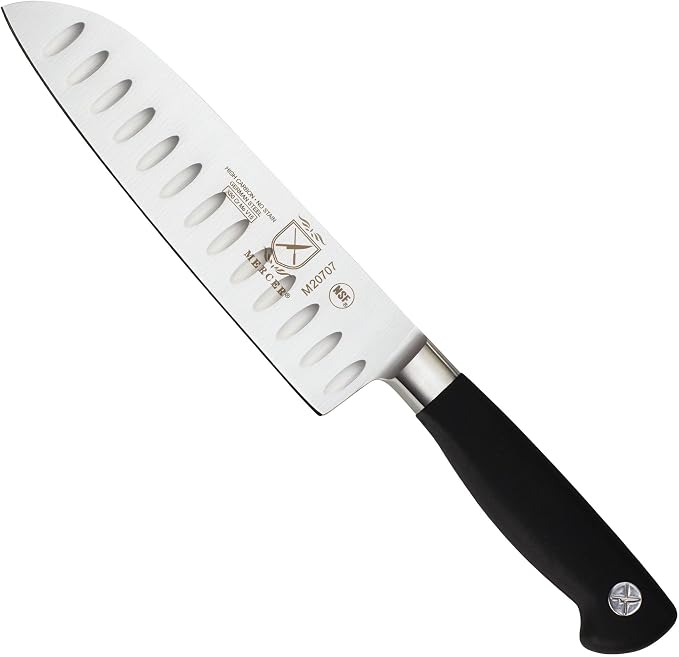



#1 Best Overall: Mercer Culinary Genesis 7-Inch Santoku
Verdict: Forged construction, a Japanese-style edge angle and a restaurant-grade handle for under $40.
According to Mercer's own Genesis santoku spec sheet, the Genesis M20707 is precision-forged from high-carbon German steel, is sharpened to a 15° blade angle, has a hardness of 56 ±1 on the Rockwell C scale and carries NSF certification. The Santoprene handle is the reason we rank it first: it stays tacky with wet or oily hands, which matters more on a santoku than on most knives, because you'll be using it on juicy things like tomatoes, cucumbers and raw fish.
At HRC 56 the steel is softer than a Japanese blade, so it needs honing more often. The trade-off is that it's tough enough to survive the occasional bump against a sink or pan, and it sharpens back quickly on a whetstone or a decent pull-through set to 15°. Mercer says not to put it in the dishwasher, and they're right.
Buy it if: you want one santoku that you use hard every day and don't have to baby.
#2 Best Value: Cuisinart C77TR-7SAN Triple Rivet 7-Inch
Verdict: A full 7-inch santoku for the price of a takeout lunch.
The Cuisinart Triple Rivet santoku is the right answer if you're not sure you'll like the santoku shape at all. It has a traditional riveted handle. It won't hold an edge as long as the Mercer or the Shun, and the finish is plainer. But for $16.95 you find out whether the lift-and-press cutting style suits you before you spend $170 finding out.
Buy it if: you're testing the santoku shape, stocking a second kitchen, or want a knife guests can use without you flinching.
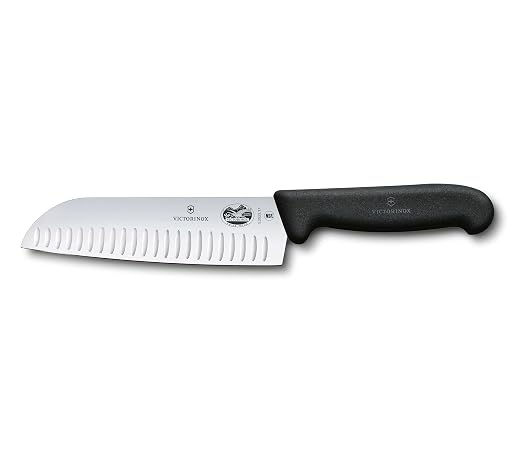
#3 Best for Beginners: Victorinox Fibrox 7-Inch Santoku, Granton Blade
Verdict: The most forgiving handle in the category plus a scalloped blade that releases food.
The Victorinox Fibrox santoku uses the same textured Fibrox handle that has been standard in commercial kitchens for decades, and it's the easiest grip to hold correctly if you've never been taught a pinch grip. The Granton edge (a row of scallops along the blade) leaves small air pockets that help slices of potato, cucumber and cheese fall away from the blade instead of sticking.
The blade is stamped rather than forged. That makes it lighter and thinner behind the edge, which is a good thing on a santoku, and it's why this knife glides through onions better than its price suggests. The softer steel dulls sooner than Japanese steel, but it also forgives mistakes that would chip a harder blade.
Buy it if: this is your first "real" knife, or someone in your household tends to leave knives in the sink.
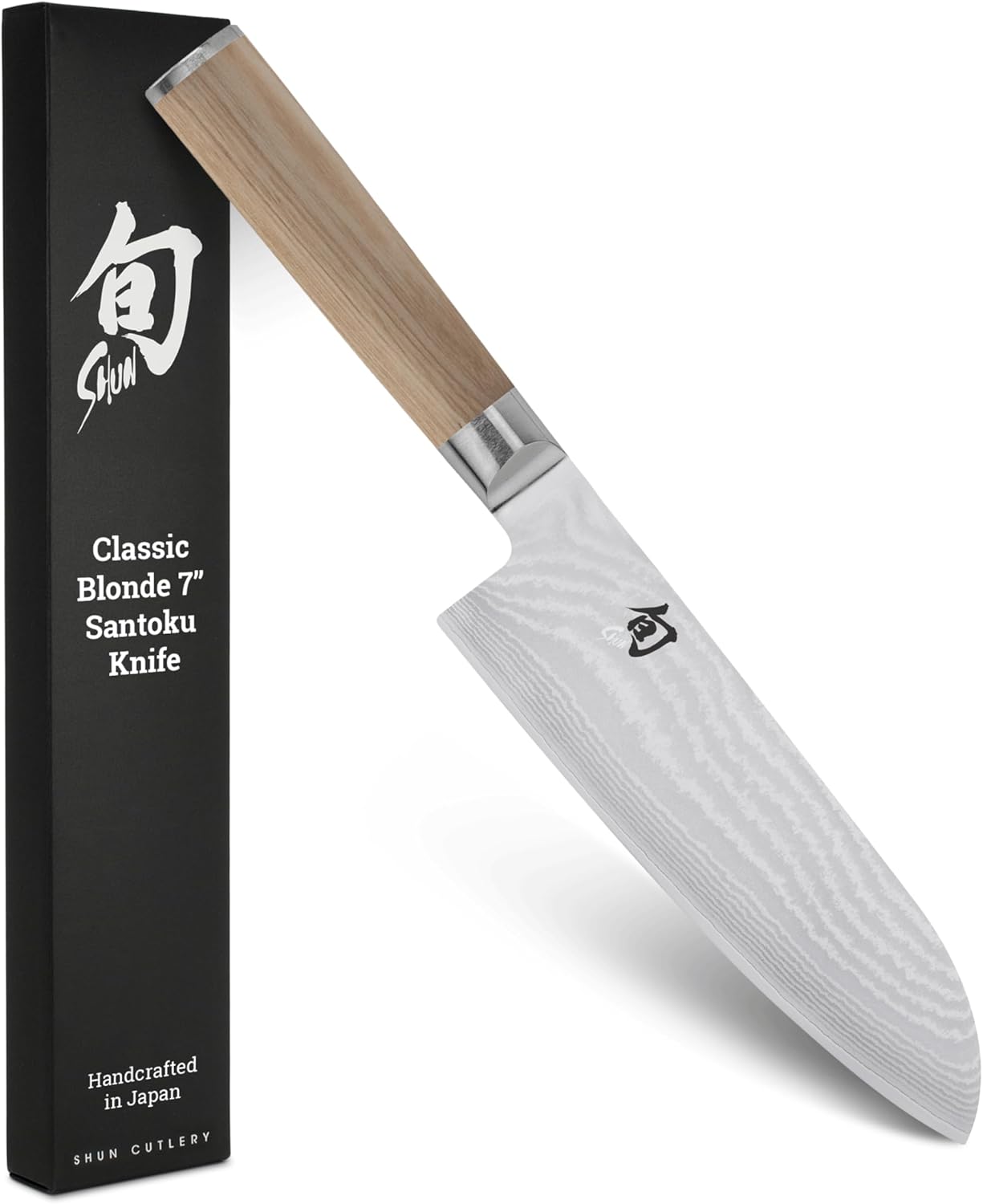
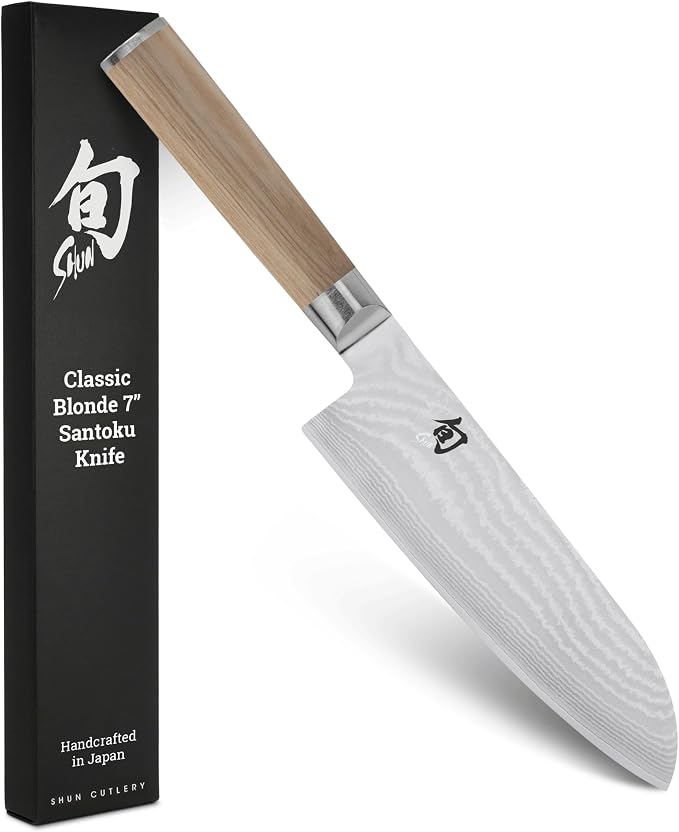
#4 Best Premium: Shun Classic Blonde 7-Inch Santoku
Verdict: A real Japanese blade: harder steel, a 16° edge and a long-lasting bite.
Per Shun's Classic Blonde santoku product page, the Classic Blonde has a VG-MAX steel core with 34 layers of stainless Damascus cladding on each side (68 total). It's sharpened to 16° per side, uses a D-shaped blonde Pakkawood handle that works for left- and right-handed cooks, and is handcrafted in Japan. VG-MAX is Shun's proprietary development of the VG family of Japanese cutlery steels. VG-10, its better-known sibling, is a high-carbon stainless with about 1% carbon, 15% chromium and 1.5% cobalt.
In practice, the harder steel holds a fine edge much longer than the German-steel picks above. Paper-thin cucumber and scallion slices stay crisp instead of being crushed. The trade-off is brittleness: this knife isn't for bones, frozen food or hard squash rinds (more on that below).
Buy it if: you already know you like the santoku shape and you'll hand-wash and dry it every time.
#5 Best Compact: WÜSTHOF Gourmet 5-Inch Hollow Edge Santoku
Verdict: The 5-inch size that lives in the cutting-board drawer and handles the small jobs.
The WÜSTHOF Gourmet 5-inch fills the gap between a paring knife and a full-size santoku. It's the right size for a shallot, a lime, a handful of herbs or a single chicken breast, and for small hands it can serve as the main knife. The hollow edge works like the Victorinox's Granton scallops, and the Gourmet line's stamped blade keeps it light.
At 5 inches you'll struggle with a whole cabbage or a large sweet potato. That's the trade-off you accept for a knife you can use on a 9-by-12 board next to the stove.
Buy it if: you have limited counter space, small hands, or already own a full-size chef's knife and want a nimble partner for it.
Also worth considering
- WÜSTHOF Classic 7-inch santoku: a forged German heavyweight for cooks who like more weight in the hand than the Shun offers.
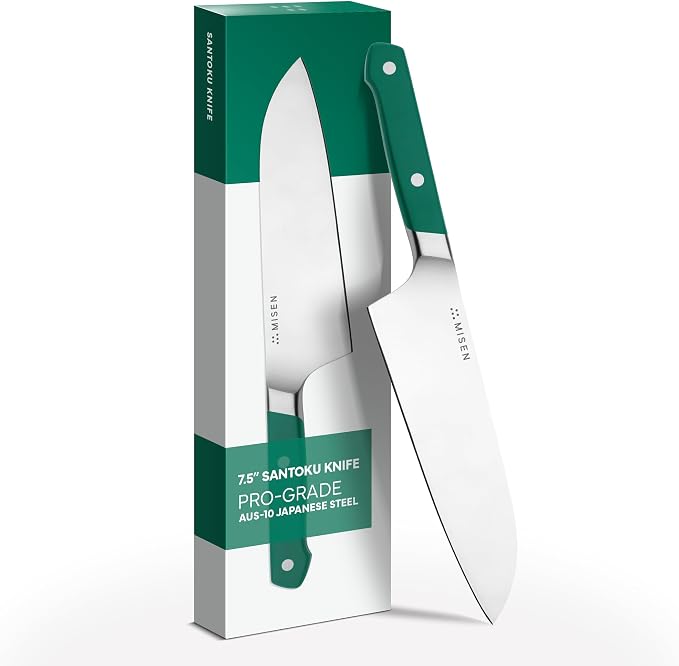
- Misen 7.5-inch santoku: a direct-to-consumer middle ground between the Mercer and the Shun.
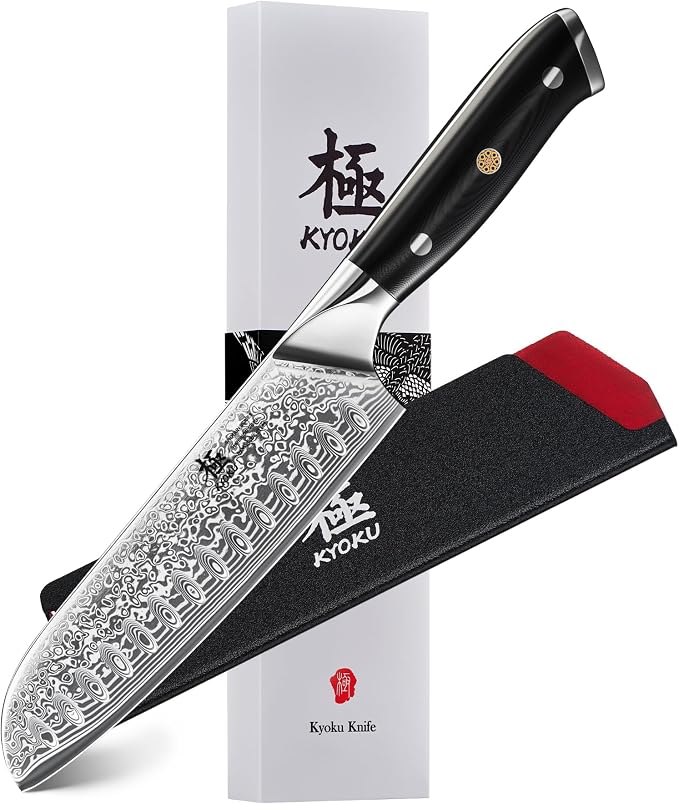
- KYOKU Shogun Series 7-inch: a VG10 core with Damascus cladding at about half the Shun's price, and it comes with a sheath.
- ZWILLING TWIN Signature 7-inch Hollow Edge: a lighter German option from ZWILLING, the company behind the Henckels brand.
Santoku vs Chef's Knife: When Each One Wins
The honest answer is that they overlap by about 80%. The difference is in the remaining 20%, and in how you like to cut. Wikipedia's chef's knife entry calls the santoku a smaller, lighter hybrid of the Western chef's knife and traditional Japanese blades. The chef's knife's curved belly suits a rocking cut; the santoku's flatter edge and sheep's-foot tip favor straight up-and-down chopping and push cuts.
| Task | Santoku | Chef's knife (8 in) |
|---|---|---|
| Dicing an onion | Wins: push cuts, flat edge, scoop with the blade | Good: rock-chop works well too |
| Paper-thin cucumber or scallion | Wins: thinner blade, less wedging | Fine |
| Mincing herbs or garlic | Fine: lift-and-press | Wins: rocking is faster |
| Butternut squash, whole cabbage | Struggles at 5–7 in | Wins: length and heft |
| Breaking down a whole chicken | Avoid on Japanese steel | Wins: tougher German blade |
| Slicing raw fish or boneless meat | Wins: thin, harder edge | Good |
| Small board / tight counter | Wins | Awkward |
| Hands under ~7 in glove size | Usually wins | Can feel long |
Pick the santoku if you mostly prep vegetables, boneless proteins and fish, cook on a small board, or have never gotten comfortable rocking a knife.
Pick the chef's knife if you regularly break down poultry, cut through winter squash, or like the rock-chop rhythm. Our best chef's knives guide covers the 8-inch options.
Own both if you cook most nights. The chef's knife handles the heavy work, and the santoku handles the fine vegetable prep that makes up most of a weeknight dinner.
What to Look For: Steel, Handle, Edge Angle, Blade Length
Steel and hardness
Blade hardness is measured on the Rockwell C scale (HRC). Rough bands:
| Steel class | Typical HRC | Edge retention | Chip risk | Examples in this guide |
|---|---|---|---|---|
| German-style stainless | ~56–58 | Moderate: hone weekly | Low | Mercer Genesis (56 ±1), WÜSTHOF, ZWILLING |
| Swiss stamped stainless | mid-50s | Moderate | Low | Victorinox Fibrox |
| Japanese stainless (VG-10, VG-MAX) | ~60–61 | Long | Higher | Shun Classic, KYOKU Shogun |
Harder steel holds a thinner edge for longer, but it's more brittle. Softer steel dulls sooner but bends back instead of chipping. Neither is wrong. Match it to how carefully you treat your knives.
Edge angle
This is where the old "Japanese knives are sharper" rule has blurred. Traditional German knives were sharpened near 20° per side, but many current German-style lines ship much finer: Mercer lists 15° for the Genesis santoku. Shun lists 16° per side for the Classic. The real difference in 2026 is less the angle and more how long the steel holds it.
Handle
- Synthetic, textured (Santoprene, Fibrox): the best wet grip and the least fussy to maintain. They're also inexpensive.
- Pakkawood (Shun, KYOKU, many Japanese brands): resin-stabilized wood that's handsome and comfortable, but slicker when wet.
- Riveted polymer (Cuisinart, WÜSTHOF Classic): the traditional Western feel, with a heavier balance point.
Hold the knife in a pinch grip (thumb and index finger on the blade just ahead of the handle). If the spine digs into your finger, keep shopping.
Blade length
| Length | Best for | Pick here |
|---|---|---|
| 5 in | Small hands, small boards, garnish work, a second knife | WÜSTHOF Gourmet 5 in |
| 6.5–7 in | The default: every recipe below | Mercer, Victorinox, Shun, Cuisinart |
| 7.5–8 in | Cooks who want santoku geometry with chef's-knife reach | Misen 7.5 in |
Granton or hollow edge: worth it?
The scallops help slices of starchy or wet foods (potatoes, cucumbers, cheese) release from the blade. They don't make the knife sharper, and on a very thin Japanese blade they aren't needed. Consider them a small bonus, not a deciding factor.
Care & Sharpening: Whetstones for Japanese Blades
Most santoku problems come from care, not from the knife. Shun's guide to caring for Japanese knives lists the habits that chip and dull good blades:
- cutting bones, frozen foods or very hard rinds;
- twisting the blade during a cut;
- scraping food off the board with the edge (flip the knife and use the spine);
- tossing knives loose in a drawer;
- leaving blades wet after washing, or putting them in the dishwasher.
Hone often, sharpen rarely
Every time the edge hits a board, the finest part of it curls slightly to one side. That's a rolled edge, and it's why a knife that "went dull" often just needs honing, not sharpening. Shun sells a honing steel with a built-in 16° angle guide for exactly this. Five light strokes per side once a week is enough for most home kitchens.
Sharpen on a whetstone
When honing stops bringing the edge back, it's time to remove metal. A sharpening stone gives you control of the angle, which matters because many pull-through sharpeners are fixed at a wider Western angle than a 15–16° santoku was sharpened at.
A practical home setup:
1. 1000 grit sets a working edge. This is the stone you use most.
2. 6000 grit polishes the edge for clean tomato and fish slices.
3. A flattening stone keeps the whetstone flat so the edge stays straight.
The KING KW65 1000/6000 combination whetstone is the traditional starting stone. The Sharp Pebble 1000/6000 kit adds an angle guide and a bamboo base that beginners appreciate. Our knife sharpener guide compares stones, pull-throughs and electric sharpeners in detail.
If you'd rather not learn to sharpen, Shun offers free sharpening for its knives: you pay shipping and a processing fee, and the sharpening itself is free.
Board and storage
Use a wood or quality plastic board. Shun specifically warns against glass, marble, granite, ceramic and titanium surfaces, which can quickly dull or damage a fine edge. See our cutting board guide for end-grain and plastic picks. Store the knife on a magnetic strip, in a block or in a sheath, never loose in a drawer.
Common pitfalls we see
- Chipping the tip on a pit. Twisting a Japanese santoku to pop an avocado pit is the most common way people chip one. Use the heel of a softer German blade, or a spoon.
- Dishwasher "just once". Heat, detergent and rattling against other utensils dull the edge and damage wood handles in one cycle.
- Scraping with the edge. It rolls the edge sideways every time. Flip the knife over and use the spine.
- A pull-through set to 20°. It slowly regrinds a 15–16° edge to a thicker angle, and after a year the knife cuts like a cheaper one.
Where the Santoku Shines: 5 Recipe Categories It Handles Best
The fastest way to learn a new knife is to cook with it. These five categories suit the santoku's flat edge and thin blade, and each recipe is in our catalog with real prep and cook times.
1. Thin-sliced vegetables for stir fries
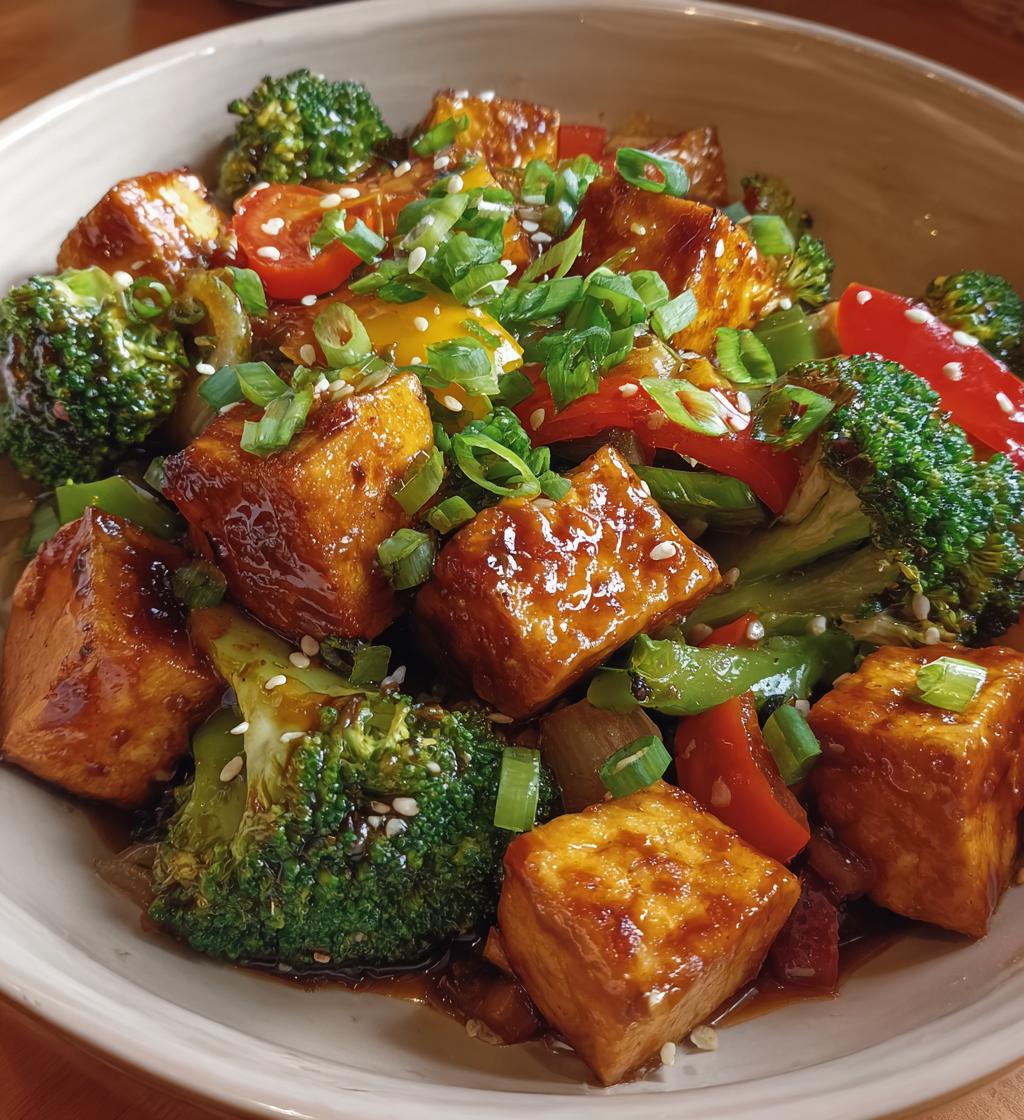
A stir fry is decided at the cutting board: even, thin slices cook in the same 90 seconds. The Tofu and Vegetable Stir-Fry with Soy-Ginger Sauce (20 minutes prep, 15 minutes cook, 320 calories) is all push cuts through bell peppers, carrots and broccoli. For Japanese-style noodles, the Stir-Fried Yakisoba with Bonito Flakes and Vegetables needs cabbage, carrot and green onion cut into matching strips. It's 10 minutes of prep with a sharp santoku. For 20 more, see our one-pan stir fry recipes.
2. Raw and seared fish
This is where the Shun's hard, thin edge earns its price. The Sushi-Style Tuna Poke Bowl with Avocado and Sesame asks for clean cubes of sushi-grade tuna, and a dull knife tears the flesh. The Sesame-Ginger Tuna Tataki with Lime is 10 minutes of prep and 5 minutes of cooking, and the whole dish depends on slicing a seared steak into neat pieces without shredding the crust.
3. Shredded cabbage and fine mince
A tall, flat blade makes quick work of a head of cabbage. The Authentic Japanese Okonomiyaki is built on shredded cabbage bound with batter and ground pork. For the Shrimp and Cabbage Pan-Fried Gyoza, the filling is finely chopped shrimp, shredded cabbage, minced garlic and ginger, and chopped green onions. That knife work makes up much of the recipe's 30-minute prep, and a santoku does it comfortably in a pinch grip.
4. Boneless chicken
Boneless thighs are ideal santoku work: no bones to chip the edge, just trimming fat and cutting even pieces. The Japanese-Style Chicken Teriyaki with Steamed Rice takes 10 minutes of prep for 45g of protein per serving. For the Sake-Marinated Chicken Katsu with Ginger, cut the thighs to an even thickness before the four-hour marinade so they fry evenly in the 10-minute cook.
5. Thin-sliced beef, tofu and mushrooms for hot pots
The Japanese Beef Sukiyaki with Tofu and Vegetables calls for thinly sliced ribeye, firm tofu, shiitake mushrooms and napa cabbage. That's four different textures, all cut straight down, which is exactly what the santoku's flat edge is built for. Tip: 20 minutes in the freezer firms up the ribeye so you can slice it paper-thin (then let the slices thaw before they hit the pot, and never cut frozen-solid meat with a Japanese blade). For a finishing dish, the Japanese-Inspired Miso-Glazed Eggplant with Sesame and Scallions shows how the flat edge handles scoring eggplant flesh and slicing scallions thin.
Want more? Our 25 easy Japanese dinners roundup is a month of santoku practice. Our fresh herb recipes guide covers the chiffonade and fine chop that finish most of these dishes.
FAQ
What's the difference between a santoku and a chef's knife?
A santoku is shorter (usually 5–7 inches versus 8–10), has a flatter edge and a sheep's-foot tip, and its blade is taller and thinner. You cut with it by lifting and pressing straight down rather than rocking. A chef's knife's curved edge is built for rock-chopping, and its extra length and heft handle big squash and poultry. Neither is better overall: the santoku is more precise for vegetables, fish and boneless proteins, and for smaller hands.
Are Japanese knives really sharper than German ones?
The gap is smaller than it used to be. Traditional German knives were sharpened near 20° per side, but many modern German-style knives ship much finer: Mercer lists 15° for its Genesis santoku, and Shun lists 16° per side for the Classic. The real difference is the steel. Japanese VG-type steels typically run harder, around HRC 60 or above versus 56 for the Mercer, so they hold that fine edge much longer. The cost is brittleness: harder steel chips on bones, pits and frozen food.
Do I need to sharpen a santoku differently than a chef's knife?
Mostly you need to match the original angle. A 15–16° santoku should be sharpened at 15–16°, ideally on a 1000-grit whetstone with a 6000-grit stone for polishing. Many pull-through sharpeners are fixed at a wider Western angle, and they slowly regrind a finer edge into a thicker one. Hone weekly between sharpenings. Shun also offers free sharpening for its knives if you cover shipping and a processing fee.
What size santoku is best for a first-time buyer?
Buy a 7-inch santoku. It's long enough for an onion, a bunch of celery or a pound of chicken thighs, and short enough to feel controllable if you're moving up from a paring knife. A 5-inch model like the WÜSTHOF Gourmet makes a great second knife or a primary knife for small hands, but it struggles with cabbage and large sweet potatoes. Much above 7.5 inches, you lose the compact advantage that draws people to the santoku.
What cutting board should I use with a Japanese knife?
Use wood or a good plastic board. Shun's care guide recommends quality wooden boards and warns that glass, marble, granite, ceramic and titanium surfaces can quickly dull or damage even a fine edge. End-grain maple or walnut is the gentlest on the blade. A thick plastic board is an inexpensive, dishwasher-safe alternative for raw meat. Avoid decorative glass and stone "cutting boards" entirely; they're serving platters, not prep surfaces.
Related reading
- Best Chef's Knives for 2026: the 8-inch alternative to a santoku
- Best Knife Sharpeners for 2026: whetstones, pull-throughs and electrics compared
- Best Kitchen Knife Sets for 2026: many include a santoku alongside a chef's knife
- Best Paring Knives for 2026: the small knife every santoku owner also needs
- Best Bread Knives for 2026: the one blade a santoku can't replace
- Best Cutting Boards for 2026: protect the edge you paid for
- 25 Easy Japanese Dinners: recipes built for santoku prep
Frequently asked questions
What's the difference between a santoku and a chef's knife?
Are Japanese knives really sharper than German ones?
Do I need to sharpen a santoku differently than a chef's knife?
What size santoku is best for a first-time buyer?
What cutting board should I use with a Japanese knife?
How we picked
This guide is researched, not bench-tested. We shortlisted products from the AislePrompt kitchen catalog and compared them on published manufacturer specifications (materials, size, capacity, warranty), on what owners report in published reviews, and on any third-party sources linked in this guide. The guide was drafted with AI assistance. We did not run lab or hands-on tests of these products, so any measurement quoted here comes from the manufacturer or a cited source. Prices change often: use the “Check price on Amazon” buttons for today’s price.
Sources
- en.wikipedia.org
- en.wikipedia.org
- en.wikipedia.org
- en.wikipedia.org
- en.wikipedia.org
- shun.kaiusa.com
- shun.kaiusa.com
- mercerculinary.com
Recipes to try with sharp knives
Put your gear to work — save any recipe to My Recipes (no account needed) and send its ingredients to Instacart in one tap.




Shop knives & cutting on AislePrompt →Browse the full kitchen shop →
A sharp knife wants something to cut.
Ask our AI for prep-forward weeknight dinners — shopping list built, cart ready for Instacart.
Get knife-work recipes →