The Complete Gluten-Free Guide: 30+ Family Recipes, Pantry Essentials and What to Eat
Celiac, sensitivity or choice — the hidden gluten sources, the flour blends that actually work, and 30+ family recipes that need no specialty products.
Affiliate disclosure: AislePrompt may earn a commission on qualifying purchases made through Amazon and Instacart links in this article, at no additional cost to you. See our affiliate policy →
A complete gluten-free diet means removing wheat, barley, rye and their derivatives — bread, pasta, most baked goods, beer, soy sauce, and a long list of hidden sources like malt, brewer's yeast and modified food starch. Everything else stays: meat, fish, eggs, dairy, produce, rice, corn, potatoes, beans, quinoa, and nuts. Most home cooking is already gluten-free.
Introduction — who really needs to eat gluten-free (celiac, NCGS, wheat allergy) and who's chosen to
Three medical conditions require gluten avoidance, and they are not the same thing.
Celiac disease is an autoimmune disorder affecting roughly 1 in 100 people worldwide. Gluten triggers the immune system to attack the lining of the small intestine, flattening the villi that absorb nutrients. It causes real, measurable damage, and the threshold is low — as little as 10 mg of gluten a day (about 1/70th of a slice of bread) is enough to sustain intestinal injury in a diagnosed celiac. There is no cheat day. According to the Celiac Disease Foundation, the only treatment is complete, lifelong avoidance.
Non-celiac gluten sensitivity (NCGS) affects an estimated 0.5–6% of people. The symptoms overlap — bloating, fatigue, brain fog, joint pain — but there is no autoimmune attack and no intestinal damage. Trace exposure is generally tolerated. NCGS is diagnosed by exclusion, after celiac and wheat allergy have been ruled out.
Wheat allergy is an IgE-mediated allergic response to wheat proteins, not gluten specifically. It can be immediate and severe, including anaphylaxis. People with wheat allergy can often eat barley and rye safely — which makes it the one condition where "gluten-free" is not exactly the right label.
And then there is choice. Roughly 20–25% of American adults report reducing gluten without a diagnosis. If that is you, the good news is that you can be relaxed about cross-contamination, shared toasters and restaurant fryers. The bad news is that "gluten-free" is not inherently healthier — gluten-free packaged breads and snacks are typically higher in sugar, lower in fiber, and more expensive than their wheat equivalents. If you are eating gluten-free by choice, build the diet around naturally gluten-free whole foods rather than gluten-free replacement products.
One critical warning: do not go gluten-free before testing for celiac. Both the blood antibody test and the intestinal biopsy require active gluten consumption to produce a valid result. Removing gluten first can generate a false negative and cost you a diagnosis, which matters for family screening, follow-up care and insurance coverage.
If you want the tactical version of this — a fixed 7-day menu and a printable shopping list — that lives in The Complete Gluten-Free Meal Plan. This guide is the broader manual: the science, the hidden sources, the cross-contamination rules, dining out and kids.
What contains gluten — the obvious list, the hidden list, the cross-contamination trap
The obvious list: wheat (including spelt, farro, einkorn, kamut, durum, semolina, bulgur, freekeh, farina), barley, rye, and triticale. That covers bread, pasta, pizza, cereal, crackers, cake, cookies, pastry, breading, beer and most soy sauce.
The hidden list is where people get caught. These are the ones worth memorizing:
| Hidden source | Where it shows up | Safe alternative |
|---|---|---|
| Malt, malt extract, malt vinegar | Cereals, candy, condiments, some "healthy" bars | Rice vinegar, cider vinegar |
| Soy sauce (brewed with wheat) | Marinades, stir-fries, dressings, takeout | Tamari, coconut aminos |
| Modified food starch (unspecified) | Sauces, soups, processed meats | Corn or tapioca starch |
| Brewer's yeast | Supplements, some seasonings | Nutritional yeast |
| Oats (unless certified GF) | Oatmeal, granola, flour blends | Certified gluten-free oats |
| Wheat starch in medication | Pill binders and coatings | Ask the pharmacist |
| Seitan | "Vegetarian meat" — it is pure gluten | Tofu, tempeh, legumes |
| Roux-thickened soups and gravies | Restaurant soups, canned soups | Cornstarch slurry |
| Imitation crab (surimi) | Sushi rolls, seafood salad | Real crab or shrimp |
| Licorice, some ice creams, some chips | Confectionery and snacks | Check the label |
Oats deserve a paragraph. Oats contain no gluten, but they are almost always grown in rotation with wheat and processed on shared equipment. Standard supermarket oats test well above the 20 ppm gluten-free threshold. Buy oats labeled "certified gluten-free" — which is a testing claim, not a marketing one. Separately, about 5–8% of celiacs react to avenin, a protein in oats themselves, so introduce them cautiously even when certified.
Cross-contamination is the trap for anyone with celiac. The rules that actually matter:
1. A shared toaster is the number-one household source. Crumbs are ubiquitous and toaster interiors cannot be cleaned. Buy a dedicated gluten-free toaster ($25) or use toaster bags.
2. Wooden spoons, wooden boards and scratched nonstick pans hold gluten in pores and scratches. Replace them or dedicate them.
3. Shared colanders are worse than shared pots — pasta residue clings to the mesh.
4. Butter, jam, peanut butter and cream cheese tubs get double-dipped with crumb-covered knives. Squeeze bottles or clearly labeled dedicated jars solve it.
5. Flour hangs in the air for hours. If someone bakes with wheat flour, gluten-free food prep in that kitchen should wait.
6. Deep fryers are shared. French fries cooked in the same oil as breaded chicken are not gluten-free, regardless of what the fries themselves contain.
The 20 ppm threshold is the legal definition of "gluten-free" in the US and EU. It exists because zero is not measurable at scale — but the practical takeaway is that trace exposure at that level is safe for the overwhelming majority of celiacs.
The Gluten-Free Pantry: flours, thickeners, breads, pastas
Gluten does two jobs in baking: it builds structure and it traps gas. No single gluten-free flour does both, which is why gluten-free baking uses blends plus a binder.
| Flour | Behaves like | Best for | Notes |
|---|---|---|---|
| White rice flour | Neutral base, slightly gritty | Blends, dusting | Buy superfine; regular grind is sandy |
| Brown rice flour | Nuttier, heavier | Breads, muffins | Rancid fast — refrigerate |
| Almond flour | Fat-rich, tender, no rise | Cookies, cakes, breading | 1:1 swaps rarely work; reduce fat |
| Oat flour (certified GF) | Soft, absorbent, mild | Muffins, pancakes, cookies | Cheap to make in a blender |
| Cassava flour | Closest single-flour to wheat | Tortillas, flatbread | Very absorbent — add liquid |
| Tapioca starch | Chew and stretch | Pizza crust, breads | Gummy if overused |
| Potato starch | Moisture and softness | Cakes, breads | Not potato flour — different item |
| Sorghum flour | Sweet, wheat-like | Bread blends | Best structure of the whole-grain GF flours |
| Chickpea flour | Savory, dense, protein | Flatbread, fritters | Strong flavor; not for sweets |
Binders. Xanthan gum at 1/4 teaspoon per cup of flour for cakes, 1/2 teaspoon for breads. Psyllium husk (1–2 tablespoons per loaf) is better than xanthan for yeasted bread because it holds water and produces a genuinely bread-like crumb. Ground flax or chia works for muffins and cookies.
The shortcut most people should take: buy a good measure-for-measure blend (King Arthur, Bob's Red Mill 1-to-1, Cup4Cup) rather than mixing your own. As of 2026 these run $5–$9 per pound and already contain the binder. Blend your own only when you are baking weekly.
Pastas. Corn-and-rice blends hold texture best. 100% brown rice pasta goes mushy fast — pull it 2 minutes before the box says. Chickpea and lentil pastas have double the protein and fiber but a distinctly beany flavor. Rinse gluten-free pasta after draining to stop the starch from gluing it together, and never cook it ahead.
Breads. Frozen is better than shelf-stable — gluten-free bread stales in hours, not days. Keep it frozen and toast slices from frozen.
5-Day Sample Meal Plan
Every meal below is naturally gluten-free or uses a single simple swap. Nothing here requires specialty replacement products.
| Day | Breakfast | Lunch | Dinner | Snack |
|---|---|---|---|---|
| Monday | Gluten-free buttermilk pancakes | Taco-style black bean salad | Sheet-pan lemon-garlic chicken | Apple + almond butter |
| Tuesday | Eggs, sweet potato hash | Leftover sheet-pan chicken | Thai green curry over rice | Greek yogurt + berries |
| Wednesday | Almond-flour pancakes | Chickpea and spinach curry | Gluten-free thin-crust pizza | Popcorn |
| Thursday | Certified GF oats + banana | Leftover curry | Quinoa-stuffed peppers | Rice crackers + hummus |
| Friday | GF banana oat muffins | Corn tortillas + pico | Gluten-free fried chicken night | Dark chocolate |
Cook Sunday, and Monday's sheet-pan chicken covers Tuesday's lunch; Wednesday's curry covers Thursday's. That is two cooks producing four meals.
Top 12 Gluten-Free Family Recipes from the AislePrompt Catalog
These are the twelve that get requested again. All are family-scale and none require a specialty ingredient beyond a flour blend.
Dinners:
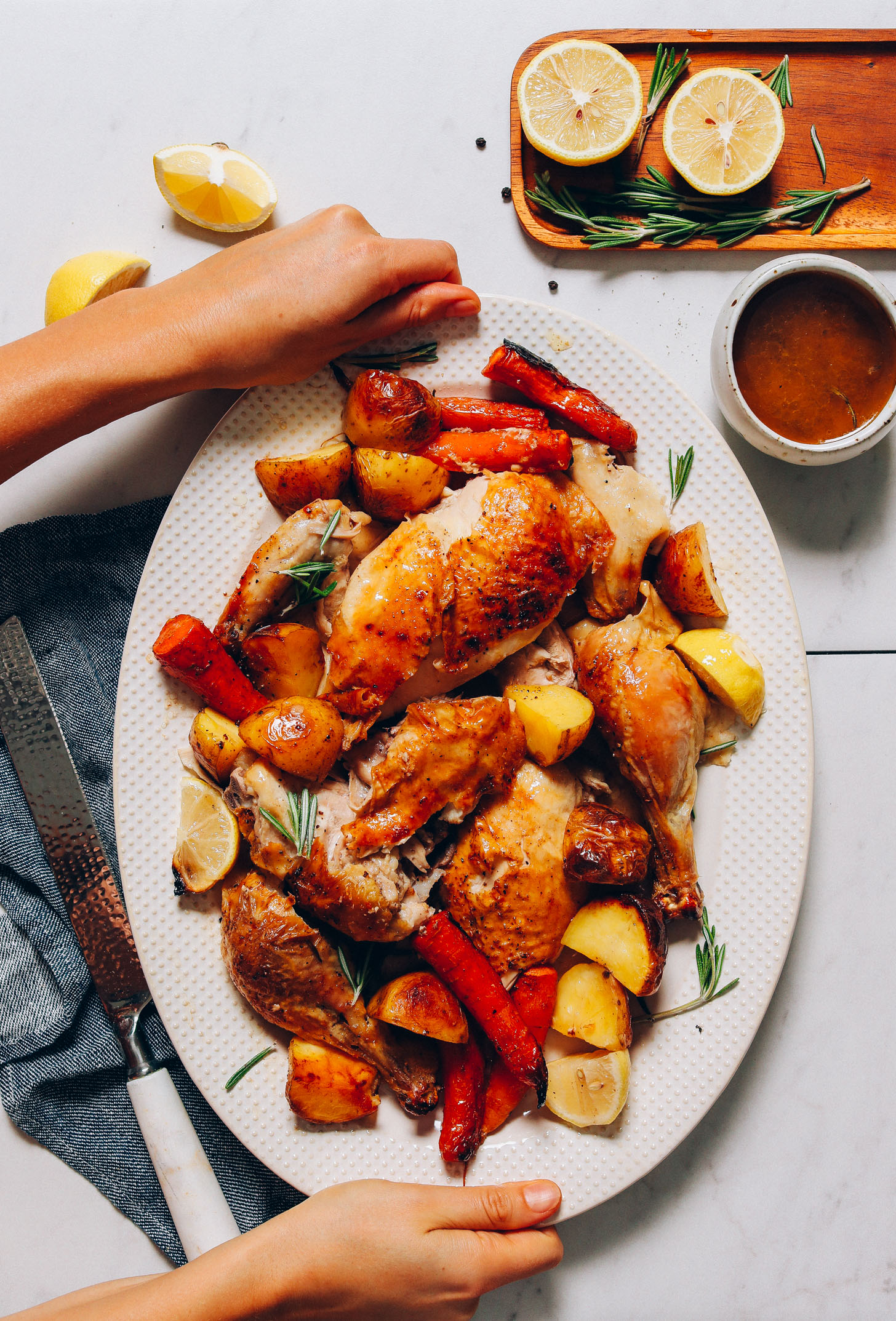
1. Sheet Pan Lemon-Garlic Chicken with Jazzed-Up Roasted Vegetables — 40 minutes, one pan, naturally gluten-free with zero swaps.
2. Gluten-Free Baked Lemon Herb Chicken with Roasted Vegetables — the hands-off weeknight default.
3. Gluten-Free Thin Crust Margherita Pizza — the crust that converts skeptics; par-bake it before topping.
4. Gluten-Free Thin Crust Pizza with Roasted Vegetables — the vegetable version of the same crust.
5. Gluten-Free Vegan Chickpea and Spinach Curry — 30 minutes, pantry-only, doubles cleanly.
6. Gluten-Free Quinoa and Black Bean Stuffed Peppers — freezes and reheats better than almost anything else here.
7. Gluten-Free Mini Chicken Pot Pies — the dish kids miss most, rebuilt properly.
8. Gluten-Free Asian Fried Chicken with Chili-Lime Dipping Sauce — rice flour gives a crunchier crust than wheat, genuinely.
Breakfast and baking:
9. Gluten-Free Buttermilk Pancakes with Maple Butter — the weekend default; batter rests 10 minutes to hydrate.
10. Gluten-Free Almond Flour Pancakes with Blueberry Compote — grain-free and higher protein.
11. Gluten-Free Southern-Style Buttermilk Biscuits — the hardest gluten-free bake to get right, and this one works.
12. Gluten-Free Banana Oat Muffins with Cinnamon — lunchbox-safe, freezes for a month.
And for the rest of the week: Gluten-Free Almond Flour Pancakes with Mixed Berries, Gluten-Free Buttermilk Pancakes with Maple Pecan Syrup, Gluten-Free Sweet Potato and Black Bean Breakfast Hash, Gluten-Free Herb Flatbread with Garlic Oil Drizzle, Gluten-Free Herb Flatbread with Olive Oil and Sea Salt and Gluten-Free Casero Bread Toast with Coconut Milk and Mixed Seed Butter.
Desserts: Gluten-Free Chocolate Chip Monster Cookies, Gluten-Free Monster Cookies with Oats and Chocolate Chips, No-Bake Gluten-Free Chocolate Cheesecake, Gluten-Free No-Bake Mixed Berry Cheesecake, Gluten-Free Lemon Blueberry Pudding Cake and Gluten-Free Mango Coconut Pudding.
Naturally Gluten-Free Cuisines — Mexican, Thai, Indian, Vietnamese, Ethiopian, Southern (mostly)
The fastest way to eat well gluten-free is to cook cuisines that never used wheat as a staple.
Mexican is corn-based. Corn tortillas, beans, rice, grilled meat, salsa, guacamole — all naturally gluten-free. Grilled Corn Tortillas with Guatemalan Pico de Gallo and Queso Fresco and Taco-Style Black Bean and Corn Salad with Cilantro-Lime Dressing are both zero-swap dishes. Watch only for flour tortillas and beer-battered anything.
Thai is rice and rice noodles. Green Thai Chicken Curry with Coconut Milk and Fresh Basil needs nothing changed. Watch for oyster sauce and soy sauce in stir-fries — swap tamari.
Indian is largely rice, lentils and chickpea flour in the south; naan and chapati are the wheat exceptions. Dosa, idli, most curries, dal and papadum are gluten-free. Watch for asafoetida (hing), which is often cut with wheat flour.
Vietnamese runs on rice noodles and rice paper — pho, bún, and fresh spring rolls are safe. Watch for hoisin and the wheat-based versions of fried rolls.
Ethiopian injera is made from teff, which is gluten-free — but many US restaurants blend it with wheat flour for cost and handling. Ask specifically.
Southern American is mostly corn: grits, cornbread, collards, beans, barbecue. Watch for flour-dredged fried chicken, roux-based gravy, and the fryer sharing.
Dining Out & Shopping — reading labels, restaurant scripts, avoiding cross-contamination
The label rule. In the US, wheat is one of nine major allergens and must be declared in plain language. Barley and rye are not — they hide as "malt," "malt flavoring" or "brewer's yeast." So the plain-English rule is: a label with no wheat declaration can still contain gluten. Look for a certification seal (GFCO, NSF) if you have celiac.
The restaurant script that actually works, in this order:
1. "I have celiac disease — this is a medical allergy, not a preference." The word allergy moves the kitchen from menu-consultation mode into protocol mode.
2. "Can this be made without any wheat, barley or rye — including the sauce and the marinade?"
3. "Is it cooked in a shared fryer?"
4. "Can it be prepared on a clean surface with clean utensils?"
Cuisines that are easiest to order gluten-free: Mexican (corn tortilla), Thai, Vietnamese, Indian (south), Japanese sashimi and steakhouses. Hardest: Chinese-American (soy in everything), Italian, pubs, bakeries, and anywhere the fryer is the main cooking method.
Cost reality. Gluten-free specialty products run 150–250% of the wheat equivalent — a loaf of gluten-free bread averages $6.50 as of 2026 versus $2.80 for wheat. Building meals from naturally gluten-free whole foods (rice, potatoes, beans, meat, produce) rather than replacement products cuts the grocery premium to nearly zero. This is the single biggest lever on a gluten-free food budget.
The Kids Question — packing school lunches, birthday parties, sleepovers
Kids do not mind eating differently. They mind eating conspicuously differently. That distinction drives every practical decision here.
School lunch. Aim for things that look like everyone else's lunch: a sandwich on frozen-then-toasted gluten-free bread, corn-tortilla roll-ups, rice-noodle salad, or leftover pizza from the crust above. Pack in an insulated container and label the box clearly for staff. Get a 504 plan on file if your child has diagnosed celiac — it obligates the school to accommodate.
Birthday parties. Send a cupcake ahead of time so it is already there when the cake comes out, rather than produced from a bag. Freeze a batch of gluten-free cupcakes unfrosted and pull one as needed — 40 seconds in the microwave, frost, done.
Sleepovers. Send a labeled food box that covers breakfast and one snack, and text the host parent the three sentences that matter: no shared toaster, no shared butter tub, no fryer. Most parents want to help and just do not know where the risk is.
Teaching self-advocacy. By age 7 or 8 a celiac child can reliably ask "does that have wheat in it?" By 11 they can read a label. Practicing the question at home, out loud, makes it routine rather than embarrassing.
Kitchen setup for a gluten-free household (dedicated toaster, colander, cutting boards)
A mixed household — one celiac, everyone else eating wheat — needs about $120 of dedicated equipment and one shelf.
A dedicated toaster. $25–$40. Non-negotiable in a mixed kitchen; toaster interiors cannot be cleaned of crumbs. A second option is toaster bags at $10 for a reusable pack. Browse small appliances for a compact second toaster and for the countertop oven that many families use instead.
A dedicated colander and a dedicated pasta pot. $30 together. Mesh colanders hold pasta residue in the weave. Color-code it — a red colander that is only ever gluten-free removes the daily decision. See cookware for pots and the nonstick skillet worth replacing if yours is scratched.
Separate cutting boards. $25 for a set. Wooden and heavily scored plastic boards hold gluten in the grooves. Assign colors and stick to them. The knives and cutting category covers boards and the dedicated bread knife you want, since a crumb-covered serrated blade is a common contamination path.
Labeled, sealed storage. $30. Flour is airborne and settles everywhere — gluten-free flours belong in sealed containers on a top shelf, above wheat flour, so nothing sifts down onto them. The storage and containers category has airtight sets and the labeled bins that make a shared pantry workable.
Add-ons worth having: silicone spatulas instead of wooden spoons (nonporous), a dedicated butter dish, squeeze bottles for condiments, and parchment paper for shared baking sheets.
Common pitfalls — the six mistakes new gluten-free households make
1. Going gluten-free before testing for celiac. It invalidates both the antibody test and the biopsy. Test first.
2. Buying regular oats. Cross-contact in the field and mill puts most oats well above 20 ppm. Certified only.
3. Assuming soy sauce is fine. Standard soy sauce is brewed with wheat. Tamari is the swap.
4. 1:1 substituting a single flour for wheat flour. Almond flour alone will not rise; rice flour alone is gritty. Use a blend with a binder.
5. Relying on gluten-free packaged foods. Higher sugar, lower fiber, 2–3× the price. Build from whole foods.
6. Sharing the butter tub. Crumbs from a knife into a shared condiment is the most common repeat exposure in mixed households.
When gluten-free is NOT the right call
If you have no diagnosed condition and no reproducible symptoms, going gluten-free is more likely to cost you than help you. Whole wheat, barley and rye are among the better sources of dietary fiber, B vitamins and iron in a standard Western diet, and gluten-free replacement products are usually fortified less and sweetened more. The Academy of Nutrition and Dietetics is direct about this: the gluten-free diet is a medical treatment, not a general wellness strategy.
If you suspect a problem, the sequence matters — see a doctor, get the celiac blood panel while still eating gluten, and only then run an elimination trial. Skipping to elimination is how people spend a decade on a restrictive diet without ever learning whether they needed it.
Sourcing and further reading
The Celiac Disease Foundation is the best patient-facing resource on diagnosis and daily management. Mayo Clinic — Celiac Disease covers symptoms, complications and the testing sequence clearly. The Academy of Nutrition and Dietetics has the most balanced writing on nutritional adequacy on a gluten-free diet.
Related reading
- The Complete Gluten-Free Meal Plan: 25+ Recipes + 7-Day Shopping List for 2026 — the fixed-menu companion to this guide
- 22 Easy Gluten-Free Dinners for Busy Weeknights
- 22 Gluten-Free Desserts Anyone Can Make (Beginner-Friendly Recipes)
- 25 Mexican Weeknight Dinners: Tacos, Enchiladas & One-Pot Rice Bowls in 30 Minutes — a naturally gluten-free cuisine
- 22 Easy Thai Dinner Recipes: Pad Thai, Curries & Stir-Fries Under 30 Minutes