How to Cook Salmon: 15 Recipes + Complete Guide to the Perfect Fillet
Buying, storing, and the four techniques that turn a $6 fillet into a restaurant plate
Cook salmon by pulling it from the fridge 20 minutes ahead, drying the surface, salting well, and cooking it skin-down over medium-high heat for 4-5 minutes until an instant-read thermometer at the thickest point reads 120-125°F for medium or 130-135°F for medium-well. Rest 3 minutes before serving. That single technique — dry surface, hot pan, thermometer — works for pan-sear, oven, grill, and air fryer, and it is the reason restaurants ship $34 salmon plates that home cooks struggle to replicate on a $12 fillet.
Get a free week of easy dinners
Seven weeknight dinners with the shopping list already totalled, sent Sunday. No account needed, unsubscribe in one click.
No spam, unsubscribe in one click. Recipes, shopping lists and Instacart carts all work without an account either way.
Introduction: Why salmon is the highest-value protein in your fridge
Salmon sits at the intersection of price, nutrition, and forgiving cook window. A 6-ounce fillet delivers roughly 34 grams of complete protein, 1,500-2,200 mg of long-chain omega-3s (EPA + DHA), and 90-100% of your daily vitamin B12 for about $3-6 depending on species. Nothing else in the average American fridge — not chicken breast, not sirloin, not eggs — hits those three numbers together.
The forgiving cook window is what separates salmon from tuna and swordfish. Salmon is fatty enough (11-15% fat for farmed Atlantic, 6-10% for wild sockeye) that a 15-20°F overshoot on internal temperature still yields an edible fillet. Chicken breast dries out in the same window. That fat buffer is why salmon has become the default weeknight fish across every price tier from Aldi to Whole Foods, and why the Half-Hour Honey-Garlic Glazed Salmon has 41 minutes of active kitchen time from open-the-fridge to on-the-table.
The techniques below assume 1-inch-thick fillets (the standard grocery-store cut, around 6 oz). Adjust up or down 30 seconds per side for every quarter-inch of thickness. If you already have a fillet in front of you and just need the pan-sear recipe, jump to Pan-Seared Salmon with Herb-Infused Lemon Butter Sauce — everything else in this guide is context.
Buying salmon: wild vs farmed, fresh vs frozen, skin-on vs skinless
Wild vs farmed
Wild Alaskan sockeye, king (chinook), and coho carry deeper flavor, firmer texture, and a natural carotenoid color from the krill and shrimp they eat. Expect $18-28 per pound at retail as of 2026, with a hard peak from June through September during Alaska's short commercial season.
Farmed Atlantic salmon is milder, fattier, and cheaper — $9-14 per pound, available year-round. The extra fat makes it more forgiving on high heat and better for glazing recipes, which is why every teriyaki, miso, and honey-garlic recipe on our site defaults to farmed Atlantic. Look for Aquaculture Stewardship Council (ASC) or Best Aquaculture Practices (BAP) certification, which independently audit water quality, feed sourcing, and sea-lice management. Norwegian, Faroese, and Scottish farms currently score highest on those audits.
If your recipe leads with a glaze, sauce, or aggressive seasoning (Miso-Glazed Salmon with Miso-Butter Rice, Baked Lemon-Honey Salmon with Dill Yogurt Sauce), farmed Atlantic is the right call — the sauce is doing the heavy lifting and you don't need to pay for sockeye's flavor. If the fish is the star (Cedar-Plank Grilled Salmon with Herb and Lemon Glaze), spring for wild.
Fresh vs frozen
Frozen wild salmon in vacuum-sealed portions is usually fresher than the "fresh" salmon at the grocery counter, which has been shipped from Chile or Norway 3-5 days earlier and thawed 24-48 hours before display. Modern flash-freezing on the boat drops the fish to -40°F within hours of catch, locking in texture at the exact moment it comes over the rail.
Thaw frozen fillets overnight in the fridge on a rack over a plate (never at room temperature — that puts the surface in the 40-140°F danger zone). If you forgot, thaw the sealed vacuum pack under cold running water for 20-30 minutes.
Skin-on vs skinless
Buy skin-on for every technique except poaching and salmon cakes. The skin acts as a heat shield that protects the delicate flesh from direct pan or grill contact, and pan-searing skin-on yields the crispy top-layer texture that turns a $6 fillet into a $34 restaurant plate. If you dislike eating the skin, cook it on and slide a spatula between skin and flesh at the plate — the skin peels away in one sheet.
For poaching, en papillote / foil packets like Herbed Salmon Foil Packets with Zucchini and Cherry Tomatoes, and salmon cakes, skinless is easier to work with and there's no crispy-texture benefit to preserve.
How to store salmon (and how long it actually lasts)
Fridge (below 38°F): raw salmon lasts 1-2 days from purchase; cooked salmon lasts 3-4 days in an airtight container. Freezer (0°F or below): raw salmon holds top quality for 3 months and remains food-safe indefinitely, though texture degrades after 6 months.
Store raw salmon in the coldest part of your fridge, typically the bottom shelf at the back, on a wire rack over a plate to catch any drip. Do not store it on the counter to "temper" — the surface will pass through the danger zone before the center loses its chill. If you buy on Sunday and won't cook until Wednesday, freeze it.
| Storage | Temp | Raw salmon | Cooked salmon |
|---|---|---|---|
| Fridge — coldest shelf | ≤38°F | 1-2 days | 3-4 days |
| Fridge — top shelf | 40-42°F | 12 hours | 2 days |
| Freezer | ≤0°F | 3 months (peak) | 2 months |
| Vacuum-sealed freezer | ≤0°F | 6-9 months | 4 months |
Signs to toss: ammonia smell (a strong "fishy" hit indicates trimethylamine buildup — bacterial breakdown), slimy or tacky surface, dull gray color, or gaps between muscle bands wider than a pencil lead. Fresh salmon should smell of ocean brine and nothing else.
The four techniques every cook should know
1. Pan-sear (best for weeknight speed and crispy skin)
Best for 1-inch-thick skin-on fillets. Total time from fridge to plate: 12 minutes.
Heat a 10-12 inch stainless-steel or cast-iron pan over medium-high for 3 minutes. A carbon-steel or thick-bottomed pan from a decent cookware set is worth every dollar here — thin nonstick pans warp under the heat and the salmon steams instead of searing. Add 1 tablespoon of neutral oil (avocado, grapeseed, canola — not olive; smoke point matters). Dry the salmon's skin aggressively with paper towels. Salt heavily on both sides just before it hits the pan.
Lay the fillet in skin-down and press gently with a fish spatula for 10 seconds to prevent curling. Cook 4-5 minutes untouched — the skin releases from the pan when it's properly crisped, not before. Flip once, cook 60-90 seconds on the flesh side. Pull at 120°F internal (medium) or 125°F (medium-well). Rest 3 minutes; carryover pushes to 125°F / 130°F respectively.
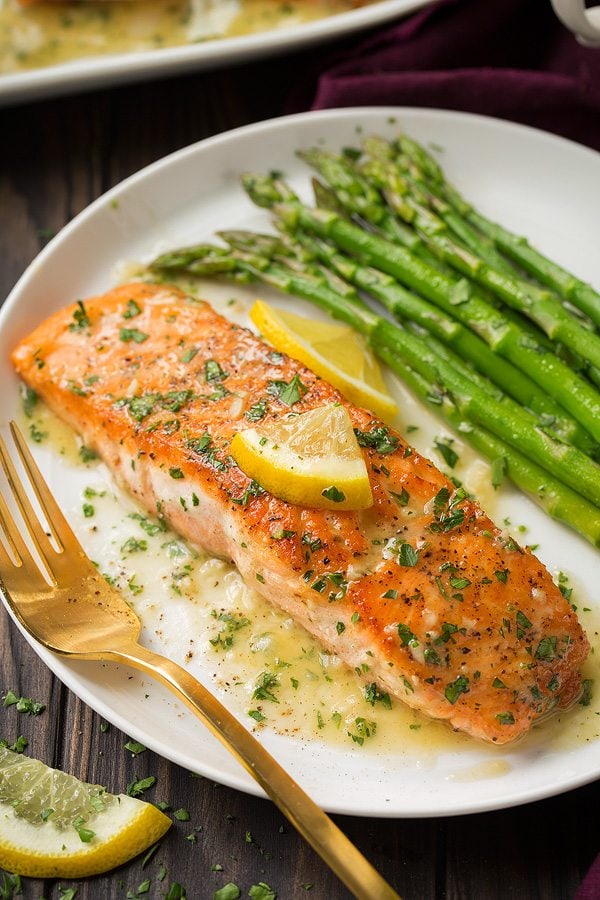
Canonical worked example: Pan-Seared Salmon with Herb-Infused Lemon Butter Sauce.
2. Bake (best for hands-off and multi-portion)
Best for cooking 3+ fillets at once, or when you want to build a full sheet-pan meal around the fish. Total active time: 8 minutes. Oven time: 12-15 minutes at 400°F.
Line a rimmed sheet pan with parchment. Salt and oil the fillets. Bake at 400°F for 12 minutes (thin/skinless), 15 minutes (1-inch skin-on). Pull at 125°F internal. For a sheet-pan meal, roast dense vegetables (potatoes, carrots) for 15 minutes first, then add tender vegetables (asparagus, cherry tomatoes) and the salmon for the final 12-15 minutes.
Worked example: Sheet Pan Lemon-Garlic Mediterranean Salmon with Roasted Vegetables.
Low-and-slow variant: 275°F for 25-30 minutes yields silky, sashimi-adjacent texture with almost no way to overcook. Recommended by Serious Eats as the technique with the widest forgiving window. Worked example: One-Pan Baked Mediterranean Salmon with Cherry Tomatoes and Olives.
3. Grill (best for June-September and cedar-plank flavor)
Best for skin-on fillets over 3/4-inch thick. Cleanliness matters more than any other technique — a grubby grate destroys salmon. Scrape the grate hot, oil it with a folded paper towel dipped in neutral oil, then bring one side of the grill to medium-high (400-450°F) and the other to low (300°F) for a two-zone setup.
Sear the salmon skin-down over the hot zone for 3-4 minutes, then slide to the cool zone until it hits temperature (another 3-5 minutes). If you're grilling for guests and want zero risk of sticking, use a cedar plank soaked 30 minutes in water: Cedar-Plank Grilled Salmon with Herb and Lemon Glaze. The plank steam-smokes the fillet at the same time.
4. Poach (best for delicate flavor and salmon salads)
Best when the salmon is going into a salad or bowl and texture takes priority over crust. Season 4 cups of water with 1 tablespoon salt, 1 lemon (sliced), a few peppercorns, and a bay leaf. Bring to 180°F — bare shimmer, no visible bubbles. Slide in the fillets, cover, and hold at 180°F for 8-10 minutes until 125°F internal.
Poached salmon is the foundation of every cold salmon salad on the site, including Mediterranean Salmon Niçoise Bowl with Lemon Vinaigrette. It also holds beautifully in the fridge for 3 days — poach on Sunday, pack for lunches through Wednesday.
Getting the internal temperature right
This is the single lever that separates decent from restaurant-quality salmon. Buy a $15 instant-read thermometer from the small appliances section of any kitchen catalog and stop guessing. The USDA-recommended 145°F for "fully cooked" fish is the same conservative floor they publish for every commodity fish, and it produces a dry, chalky fillet.
| Doneness | Pull temp | Final temp (after 3-min rest) | Texture |
|---|---|---|---|
| Rare (sushi-adjacent) | 105°F | 110°F | Translucent, buttery, spoon-soft |
| Medium-rare | 115°F | 120°F | Translucent center, silky |
| Medium | 120°F | 125°F | Just-opaque center, moist flake |
| Medium-well | 125°F | 130°F | Fully opaque, still juicy |
| Well done (USDA) | 140°F | 145°F | Dry, firm, white albumin bleed |
Insert the probe from the side at the thickest part, angled toward the center. Read at the tip. Pull 5°F below your target temperature — carryover cooking during the 3-minute rest closes the gap.
The white ooze on the surface after overcooking is albumin, a water-soluble protein squeezed out of the muscle when the fish overheats. Some albumin is unavoidable; a lot of it means you cooked past 140°F.
15 salmon recipes from our catalog
The 15 recipes below cover every technique and cuisine bucket a home cook needs. All are catalog-tested, thermometer-timed, and paired with a shopping list you can send to Instacart.
| Technique | Recipe | Time |
|---|---|---|
| Pan-sear | Pan-Seared Salmon with Herb-Infused Lemon Butter Sauce | 25 min |
| Bake | Sheet Pan Lemon-Garlic Mediterranean Salmon with Roasted Vegetables | 40 min |
| Bake | One-Pan Baked Mediterranean Salmon with Cherry Tomatoes and Olives | 35 min |
| Bake | Baked Lemon-Honey Salmon with Dill Yogurt Sauce | 30 min |
| Grill | Cedar-Plank Grilled Salmon with Herb and Lemon Glaze | 50 min |
| Foil packet | Herbed Salmon Foil Packets with Zucchini and Cherry Tomatoes | 30 min |
| Glaze | Half-Hour Honey-Garlic Glazed Salmon | 30 min |
| Glaze | Miso-Glazed Salmon with Miso-Butter Rice | 45 min |
| Bowl | Japanese-Style Teriyaki Salmon Bowls | 35 min |
| Bowl | Sushi-Style Salmon Poke Bowl with Avocado and Pickled Ginger | 30 min |
| Curry | Pan-Seared Salmon with Thai Coconut Curry Sauce | 40 min |
| Salad | Mediterranean Salmon Niçoise Bowl with Lemon Vinaigrette | 45 min |
| Blackened | True-to-Form Blackened Salmon with Citrus Glaze | 25 min |
| Fishcake | Scottish Salmon and Leek Fishcake with Mustard Dill Sauce | 40 min |
| Appetizer | Avocado-Smoked Salmon Mini Tarts | 20 min |
If you want the shortest possible weeknight version, start with the Half-Hour Honey-Garlic Glazed Salmon — 30 minutes total, one pan, four ingredients you probably already own. For a Sunday dinner that feels earned, go with the Cedar-Plank Grilled Salmon with Herb and Lemon Glaze.
Common salmon-cooking mistakes
Cooking straight from the fridge. A 40°F fillet needs 8-9 minutes to hit 125°F; a 55°F fillet needs 5-6. The colder fillet's exterior overcooks by 15°F before the center reaches temperature. Pull salmon out 20 minutes before it hits the pan.
Skipping the pat-dry. Any surface moisture converts to steam and blocks the Maillard reaction — you get gray, chalky skin instead of golden-crisp. Pat every side dry with paper towels; leave the fillet uncovered on a rack in the fridge for 15 minutes if you want next-level dryness.
Under-salting. Salmon can absorb roughly 1 percent of its weight in salt without tasting salty — that's about 1/2 teaspoon of kosher salt per 6-ounce fillet, distributed across both sides. A too-light hand yields a bland fillet no glaze can save.
Flipping too early. Skin-down salmon releases from a hot pan when the skin is properly crisped — usually 4-5 minutes in. If you try to lift it at 2 minutes and it fights back, wait another 60 seconds. Forcing the flip tears the skin.
Cooking to USDA 145°F. See the temperature table above. 125°F center is the target for medium; 130°F for medium-well.
Using a nonstick pan on high heat. Damages the coating and the salmon won't sear anyway — nonstick pans don't retain enough heat to develop a crust. Reach for cast-iron or stainless from your cookware shelf.
Cutting a fillet with a dull knife. Salmon flesh is delicate; a dull knife tears the muscle bands and drives out moisture before the fish even hits the pan. Keep a sharp fillet knife or santoku from your knives drawer honed weekly.
Sustainability and mercury: what to actually worry about
Mercury: salmon is one of the lowest-mercury commercial fish available. The FDA classifies both wild and farmed salmon as "best choice" and safe to eat 2-3 servings per week during pregnancy. That is not true for tuna, swordfish, mackerel, or halibut, all of which carry meaningful mercury loads. If you were previously rotating salmon and tuna weekly, drop the tuna and eat more salmon.
Sustainability: Monterey Bay Aquarium's Seafood Watch currently rates most wild Alaskan salmon (sockeye, king, coho, pink, chum) as "Best Choice" and most Chilean and Canadian farmed Atlantic as "Avoid" due to sea-lice, disease transfer, and open-net pollution concerns. Norwegian, Faroese, Scottish, and Icelandic farmed Atlantic score "Good Alternative." Land-based recirculating-aquaculture (RAS) systems out of Maine, Florida, and Denmark are the fastest-growing "Best Choice" farmed category and worth paying a premium for.
Practical shortcut: if the label says wild Alaskan, buy it. If it says farmed Atlantic, look for ASC or BAP certification and country-of-origin. Skip anything that just says "Atlantic salmon" without a certification badge.
FAQ
What internal temperature should salmon reach? USDA recommends 145°F for fully cooked salmon, but most restaurants serve at 120-125°F for medium (translucent center, moist flake). Pull 5°F below your target — carryover cooking during a 3-minute rest closes the gap.
Wild vs farmed salmon — which should I buy? Wild Alaskan for pure-fish presentations where flavor matters. Farmed Atlantic for glazed, sauced, and marinated recipes where the fish is a canvas. Look for ASC or BAP certification on farmed and MSC certification on wild.
How do I know if my salmon is fresh? Ocean-brine smell (not fishy or ammonia), firm flesh that springs back when pressed, bright translucent color without brown edges or muscle-band gaps, and shiny intact skin. Frozen is often fresher than "fresh" counter salmon that has been thawed for 2-3 days.
Do I need to remove the skin before cooking? No, and you probably shouldn't. Skin acts as a heat shield, holds the fillet together, and delivers restaurant-crispy texture on a pan-sear. Slide a spatula between skin and flesh at the plate if you don't want to eat it.
How long does salmon last in the fridge? Raw: 1-2 days below 38°F. Cooked: 3-4 days airtight. Frozen: 3 months peak quality, 6-9 months vacuum-sealed. If it smells even slightly off or feels slimy, discard.
Sources
- Monterey Bay Aquarium — Seafood Watch: Salmon
- FDA — Advice About Eating Fish
- Serious Eats — The Food Lab: How to Cook Salmon
Frequently asked questions
What internal temperature should salmon reach?
Wild vs farmed salmon — which should I buy?
How do I know if my salmon is fresh?
Do I need to remove the skin before cooking?
How long does salmon last in the fridge?
Sources
Plan a week of meals in two minutes.
Tell our AI what you have and what you like — it builds your plan, shopping list, and Instacart cart. No account needed.
Try free →