Summer Grilling Guide 2026: 20 Backyard Recipes + Full Menu Planner
Two full menus (weeknight-for-four and cookout-for-eight), a tested pull-temperature chart, and the five-tool kit that actually earns its space over the July-August peak grilling window.
The 8-week window that decides your summer grilling season
Get a free cookout plan for a crowd
Mains, sides and quantities scaled to your headcount, with one Instacart cart instead of a spreadsheet.
No spam, unsubscribe in one click. Recipes, shopping lists and Instacart carts all work without an account either way.
Summer grilling recipes get more Google searches between the first weekend of July and Labor Day than the rest of the year combined. You have eight weekends. Fire up the grill for six of them and you are running two-thirds of your entire annual outdoor-cooking budget through the same two burners. This guide gives you the recipes, the two-zone cook order, the make-ahead plan, and the shopping lists to make those weekends count — no filler, no "add a pinch of love," and no ten-piece grilling kits you will never use.
The 3-menu framework
Most backyard grilling nights collapse into one of three shapes: a 60-minute weeknight for four, a Saturday cookout for eight, or a bigger holiday spread for twelve or more. The mistake home cooks make is treating those three as the same problem. They are not. A weeknight grill needs preheat-to-plated speed and one protein. A weekend cookout needs a two-zone fire, one make-ahead side, and one salad that gets better sitting out. A twelve-person party needs 40% of the food done before anyone shows up, because you cannot both grill and host.
Every recipe in this guide is tagged to one of those three menus, and the two full menu builds at the end of the article walk the exact prep order — what to marinate the night before, what to make cold in the morning, and what hits the grate in the last 45 minutes before you plate.
5 grill-ready proteins (with marinade + cook time)
The proteins below hit the two things people actually want from a grill: char and juice. Every one of them is on a chart below with the marinade window (how long ahead of time), the two-zone cook (sear side vs. hold side), and the internal pull temp. Pull temp matters more than cook time — a chicken thigh at 30 minutes over indirect heat and a chicken thigh at 22 minutes over screaming direct heat can both hit 175°F and be perfect, and both can hit 160°F and be raw. Buy a thermometer, cook to temp, ignore the clock.
| Protein | Marinade window | Direct heat time | Indirect heat time | Pull temp |
|---|---|---|---|---|
| Flank steak | 4-24 hours | 4 min/side sear | none | 130°F |
| Salmon on cedar | 30 min brine | none | 25-30 min | 130°F |
| Short ribs | 6-24 hours | 3 min/side | 10 min | 145°F |
| Chicken thighs | 2-8 hours | 4 min/side sear | 12-15 min | 175°F |
| Shrimp skewers | 30 min max | 2 min/side | none | 120°F |
The five headliners:
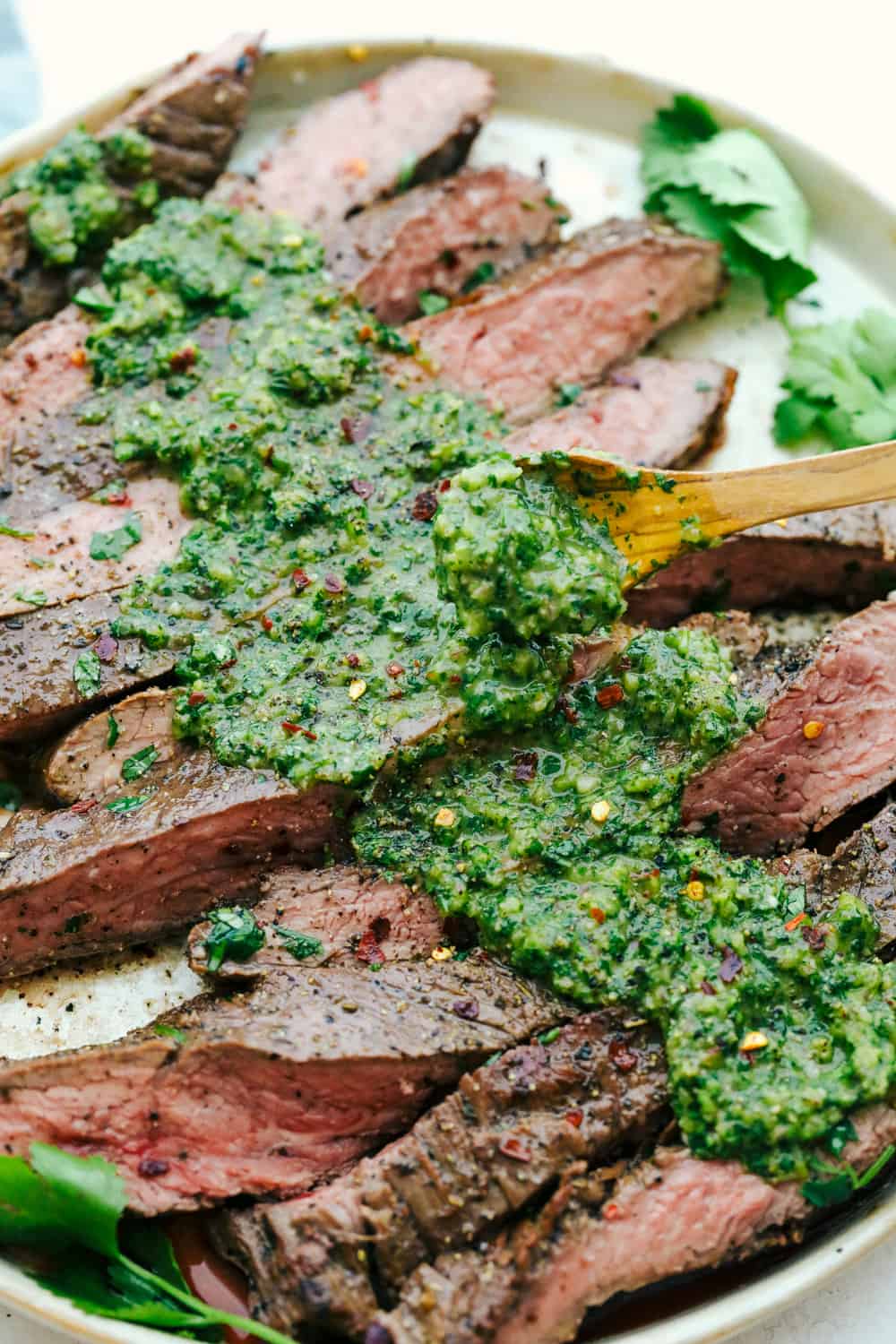
1. Grilled Chimichurri Flank Steak. Flank is our default weeknight protein — it takes marinade fast, cooks in eight minutes, and slices into fifteen portions off a single 1.5-pound cut. Slice against the grain and hard; a diagonal cut hides tough fibers.
2. Cedar-Plank Salmon with Maple Mustard Glaze. Soak the plank an hour ahead and cook lid-down over indirect heat. The plank both flavors the fish and keeps it from sticking — this is the recipe that converts salmon skeptics because the smoke floor rounds the muddy notes.
3. Serious Korean BBQ Short Ribs. Flanken-cut ribs (thin, across the bone) not English-cut. Marinate in soy, pear, sesame, and garlic 6-24 hours; cook hot and fast so the sugar caramelizes before the meat overcooks. Great party food because every guest gets fifteen little ribs on a plate.
4. Grilled Bourbon-Glazed Chicken Thighs with Peach Salsa. Bone-in, skin-on thighs are the most forgiving protein on a grill — they carry a five-degree overshoot and still taste better than breast. Glaze in the last three minutes so the sugar does not burn.
5. Grilled Cajun Shrimp Skewers. Shrimp is the fastest hot-and-fast protein and the one most people ruin by leaving on too long — pull at 120°F, four minutes total. Soak wooden skewers 30 minutes so they do not flare.
5 vegetable sides that hold on a grill
Vegetables let you use the grate you already have hot for the protein. Timing is easier than most cooks realize: a vegetable that has been oiled and salted holds well between the sear pass and the rest, so you can cook it on the fringe of the fire while the protein finishes. Green beans, corn, zucchini, peppers, and asparagus are the five that reliably tolerate a two-zone cook without turning to mush.
1. Charcoal-Grilled Corn with Chili Lime Butter. Grill in the husk 8-10 minutes over direct heat, peel back, and glaze with cotija-lime butter. The husk protects the kernels from drying while the coal smoke seasons them through.
2. Outdoor Patio Grilled Peach and Burrata Salad. Halve firm-ripe peaches, brush with oil, hit them cut-side down for 3-4 minutes over medium-high. Serve on burrata with balsamic and torn basil. This is the side that ends up on Instagram.
3. Grilled Zucchini and Shrimp Skewers with Lemon Dill Sauce. Zucchini rounds skewered with shrimp so the vegetable cooks in the same 4-minute window as the protein. Salt the rounds 20 minutes ahead to draw moisture — otherwise they weep and slide off.
4. Grilled asparagus with lemon zest. Toss with olive oil, salt, and pepper; grill over direct heat 4-5 minutes turning once. Zest over the top after they come off — never before, because heat kills citrus oils.
5. Grilled bell pepper strips. Half peppers, oil, direct heat 3 minutes per side. Slice, dress with sherry vinegar and thyme, keep at room temp until service. These are your sneaky-good side.
5 make-ahead sides that don't compete for grill space
The mistake at parties is trying to grill everything the day of. The best cookouts run 40% of the food out of the fridge or oven — sides that are actually better after resting overnight. These are the ones we run at every twelve-person party.
1. Classic Potato Salad. Boil the potatoes the night before, dress warm, chill overnight so the flavors marry. The mayo binds better cold and the acidity mellows. Never dress right before serving — it tastes flat.
2. Honey-Lime Roasted Watermelon Salad with Feta and Mint. Cube watermelon, salt lightly to draw sugar, toss with feta, mint, and a honey-lime dressing. Holds two hours at room temperature without weeping.
3. Broccoli slaw with peanut-lime dressing. Cabbage and broccoli slaw hold texture better than iceberg for 4+ hours; the acid in the dressing tenderizes stems without softening them.
4. Pasta salad with sun-dried tomato and salami. Cook pasta al dente, cool under running water, dress with olive oil so it does not clump. Dress the salad component the morning of; combine 30 minutes before service.
5. Corn and black bean salsa. Grill corn ahead (see corn recipe above), cut kernels, mix with rinsed black beans, red onion, cilantro, lime juice, and jalapeño. Improves overnight.
5 desserts that finish on the grill or benefit from summer produce
Dessert on the grill is a payoff move — you already have the heat, the guests are relaxing, and the sugar caramelizes better on a grate than in an oven. Grilled peaches, pineapple, watermelon slices, and pound cake all take a hot dry surface beautifully. Save two feet of the grate for dessert during the main service and hit them at the end.
1. Grilled peaches with vanilla ice cream. Cut-side down over direct heat 3 minutes, serve with high-quality vanilla and a drizzle of honey. The single easiest showstopper on this list.
2. Grilled pineapple with rum-brown-sugar glaze. Fresh pineapple rings, brushed with brown sugar and dark rum, grilled 2 minutes per side. Serve over Greek yogurt for breakfast the next morning.
3. Berry crumble on the grill. Cast-iron skillet, indirect heat, foil tent — bake as you would in the oven but with a smoke floor most home ovens cannot deliver.
4. Chocolate-hazelnut grilled banana boats. Split banana longways in the peel, stuff with Nutella and marshmallow, wrap in foil, grill 5 minutes over medium heat. Party trick.
5. Grilled pound cake with strawberries and cream. Store-bought pound cake, sliced thick, grilled 90 seconds per side. The best 3-minute dessert in this guide.
Full menu 1: 4-person weeknight (60 minutes start to plated)
The point of this menu is to get from raw ingredients to a plate in an hour without any make-ahead work. Marinade the protein while you set up the grill. Everything else runs on the grill you already have hot.
| Time | Task | What's happening |
|---|---|---|
| 0:00 | Season shrimp, thread skewers | Grill preheats |
| 0:10 | Grill preheated (450°F direct, 300°F indirect) | Shrimp on direct heat |
| 0:14 | Pull shrimp, keep warm | Corn on direct heat (husk on) |
| 0:24 | Turn corn | Grill peaches for dessert prep |
| 0:34 | Pull corn, glaze with cotija butter | Grate goes idle |
| 0:38 | Toast baguette on grate 90 sec/side | Plate corn, peaches |
| 0:45 | Reheat shrimp 60 sec | Everything on the table |
| 0:60 | Plate + serve | Dessert already on the counter |
Menu: Cajun Shrimp Skewers, Charcoal-Grilled Corn with Chili Lime Butter, grilled baguette, grilled peaches with vanilla ice cream. Total active time on the grill: 22 minutes. Total wall-clock: 60 minutes.
Shopping list (4 servings):
- 1.5 lb large (16-20 count) shrimp, peeled + deveined
- Cajun seasoning (or make from paprika, garlic, cayenne, thyme)
- 4 ears corn in husk
- 1 lime, cotija cheese (2 oz), butter (4 tbsp)
- 4 ripe peaches
- 1 baguette
- Vanilla ice cream
Full menu 2: 8-person weekend cookout (make-ahead + grill day)
The eight-person weekend cookout is where most home hosts fall apart because they try to cook everything on Saturday afternoon. This menu splits work into three passes: Thursday night marinade prep, Saturday morning cold sides, Saturday afternoon grill.
Thursday night (20 minutes)
- Marinate flank steak in chimichurri (4-24 hour window)
- Marinate short ribs in Korean BBQ (6-24 hour window)
- Prep potatoes for potato salad — boil, drain, dress warm, refrigerate
Saturday morning (60 minutes)
- Watermelon-feta salad — cube, salt, drain 20 min, mix with feta, mint, honey-lime dressing
- Cut and skewer zucchini + shrimp for the skewer side
- Pull steak and ribs from marinade, let come to room temp 30 minutes before grill
Saturday afternoon (75 minutes, active grill)
| Time | Action | Grill state |
|---|---|---|
| -30 min | Light chimney of charcoal, then coals to grill | Preheat 450°F direct + 300°F indirect |
| 0:00 | Flank steak on direct heat | Sear 4 min/side |
| 0:08 | Flank steak rests off grill, tented | Grate for ribs |
| 0:12 | Short ribs on direct heat | Sear 3 min/side, watch sugar |
| 0:18 | Short ribs to indirect side | Corn goes on direct |
| 0:28 | Turn corn, glaze ribs | Both hold well |
| 0:38 | Pull corn, ribs rest tented | Grate clears |
| 0:42 | Zucchini-shrimp skewers direct | 4 min total |
| 0:46 | Skewers off, grate for peaches | 3 min cut-side down |
| 0:50 | Everything plated + served | Grill cools |
Menu: Grilled Chimichurri Flank Steak (main 1), Serious Korean BBQ Short Ribs (main 2), Charcoal-Grilled Corn (side 1), Grilled Zucchini and Shrimp Skewers (side 2), Classic Potato Salad (cold side, make-ahead), Honey-Lime Watermelon Salad (cold side, make-ahead), grilled peaches with vanilla ice cream.
8-person shopping list
| Category | Item | Quantity |
|---|---|---|
| Protein | Flank steak | 2.5 lb |
| Protein | Flanken-cut short ribs | 3 lb |
| Protein | Large shrimp (16-20 ct) | 1 lb |
| Produce | Corn ears (in husk) | 8 |
| Produce | Zucchini | 3 medium |
| Produce | Ripe peaches | 8 |
| Produce | Watermelon | 1 small (4 lb) |
| Produce | Yukon Gold potatoes | 3 lb |
| Produce | Fresh mint, cilantro, parsley | 1 bunch each |
| Dairy | Feta cheese | 6 oz |
| Dairy | Cotija cheese | 4 oz |
| Dairy | Vanilla ice cream | 1 pint |
| Pantry | Soy sauce, sesame oil, rice vinegar | 1 bottle each |
| Pantry | Olive oil, red wine vinegar | 1 bottle each |
| Pantry | Honey, brown sugar | 1 jar each |
| Pantry | Charcoal (chimney method) | 2 bags |
Everything on this list clips through the AislePrompt shopping list feature — build the cookout as one meal-plan and hit "generate cart," and Instacart delivers by Friday afternoon. That is the entire pitch for the AislePrompt cookout workflow: one plan, one cart, zero last-minute grocery runs.
Kitchen and grill equipment you actually need
You need five things to run every recipe in this guide. Skip the 20-piece grilling sets — you will use tongs, a thermometer, a spatula, a brush, and a spray bottle. That is it.
1. Instant-read thermometer. The one piece of grill kit that separates people who overcook chicken every time from people who never do. The ThermoWorks Thermapen ONE reads in one second and stays accurate for a decade. If the $99 sticker is too much, the $20 Alpha Grillers alternative is 90% as good.
2. 12-inch locking tongs. Long-handle, spring-loaded, one-handed operation. The OXO Good Grips 12-Inch Locking Tongs are the industry default because the pivot lasts and the grip does not get slippery when wet. Do not use a fork on the grill — piercing the meat releases juice.
3. Grill brush or scraper. Clean the grate hot, before every session and after every session. A wire brush works, but many cooks now use a stainless-steel scraper or a wooden grill "shark" because loose bristles have caused real ER visits.
4. Chimney starter (if charcoal). Replaces lighter fluid entirely. Newspaper on the bottom, coals on top, 15 minutes to a full load ready to dump. Never buy lighter fluid again.
5. Spray bottle of water. Flame flare-ups happen when fat drips on hot coals. A quick spritz kills the flame without cooling the grate. Beats the panic-move of closing the lid, which just smothers the fire.
Two more that pay for themselves the moment you use them: a set of long metal skewers (wooden burns, metal lasts forever), and a fish basket or grill mat for the gadgets drawer — either turns delicate fish, small shrimp, or asparagus into a one-handed flip instead of a mid-grate rescue mission. And for prep on cookout day, a decent set of tongs, brushes, and turners from the cookware and utensils rack is worth the counter space.
Common pitfalls (5 mistakes that ruin an otherwise-perfect cookout)
- Skipping the rest. Cutting meat within 30 seconds of pulling it off releases 30-40% of the moisture onto the cutting board. Rest 5-10 minutes tented loosely with foil. Every time.
- One-zone fires. A single-heat grill gives you either burnt outsides or raw insides. Two zones (hot for sear, cool for finish) is not optional for anything thicker than a chicken thigh.
- Sugar too early. Any sugar-based glaze (bourbon, honey, hoisin, teriyaki) burns at 350°F. Brush on in the last three minutes of cook, not before.
- Cold protein. Meat straight from the fridge sears unevenly because the outside cooks before the inside reaches serving temperature. Bring to room temperature 30 minutes before grilling.
- Overloading the grate. Too much cold meat drops grill temperature by 100°F and you get gray boiled surfaces instead of char. Cook in batches; hold finished portions on the indirect side.
When NOT to grill (real answer: three cases)
Not every summer dinner belongs on the grill. Three cases where the grill loses:
1. Sub-25°F wind, cold rain, or 100°F+ humidity. Weather that makes the cook miserable is weather that produces bad food. Move indoors, use a cast-iron pan, salvage the night. According to the National Weather Service, extreme summer heat + food-handling in the sun is also the highest-risk period for foodborne illness (see the FDA safe cooking guidance for the temperature charts we use in this article).
2. Anything more than 45 minutes cook time. Grilling is a sear-and-finish medium, not a braise. Ribs go on the smoker, chuck roast in the oven, pork shoulder in a Dutch oven. If cook time is over 45 minutes, use a different method — Serious Eats' grilling guides have the full playbook on when to switch to smoke or oven.
3. Delicate herbs and dressings. Fresh basil, mint, and cilantro belong at the very end, off the heat. If your recipe has an herb-forward dressing, build the dish cold and let the grilled protein warm it, not the other way around. Bon Appétit's summer grilling collection has the best examples of "grill the protein, keep the herbs cold" builds.
Real-world numbers: what a summer of grilling actually costs
Six cookouts in the July-August peak window at eight people each = 48 person-meals. Average per-person cost breakdown:
| Component | Cost per person |
|---|---|
| Protein (mixed) | $6.50 |
| Sides + salad | $2.75 |
| Charcoal or gas share | $0.80 |
| Beer / soda (host-provided) | $2.00 |
| Total | $12.05 |
That is $12 per person, which is $580 across the season for hosting six eight-person cookouts. Cheaper than one restaurant dinner out for a family of four in most cities. The people-per-cost math is why the summer cookout beats every other backyard entertaining format on utility.
FAQ
Gas grill or charcoal — which is better?
Gas for weeknight speed (10-minute preheat, precise temperature control, easy cleanup); charcoal for weekend flavor (smoke ring, high-heat searing, wood-chip infusion). Most serious backyard cooks own both. If forced to pick one, gas wins for utility — you'll actually use it 3x more nights per week, and the flavor gap has narrowed with quality gas grills and smoker boxes. Buy the grill you'll fire up on a Tuesday, not the one that looks best on Instagram.
What's the safe internal temperature for grilled meats?
Beef and lamb: 130-135°F medium-rare (steaks, chops), 160°F for ground beef. Pork: 145°F for chops and tenderloin (medium), 195-205°F for pulled pork and ribs. Chicken: 165°F breast, 175°F thighs. Fish: 125-130°F for salmon and tuna, 145°F for white fish. Always use an instant-read thermometer, not the color or firmness test — 40% of home grillers overcook chicken and undercook pork based on visual cues. A $15 thermometer prevents both mistakes forever.
How long can grilled food sit out at a cookout?
Two hours max at temperatures under 90°F; one hour if it's over 90°F. After that, discard or refrigerate — the 2-hour rule is when Staphylococcus and Bacillus cereus populations cross the risk threshold, and reheating doesn't undo it. Serve in batches from a chilled cooler or warming tray rather than laying everything out for 4 hours. Foodborne illness at a family cookout is one of the most common preventable food-safety failures per CDC data.
How do I keep grilled food from drying out?
Three rules: brine or marinate lean proteins (chicken breast, pork chops) 30+ min in advance, use a two-zone fire (hot side to sear, cool side to finish gently), and rest all meats 5-10 minutes off heat before slicing so juices redistribute. Skipping the rest step is the #1 mistake — cutting immediately releases 30-40% of the moisture onto the cutting board. Cover loosely with foil while resting; don't seal it or the skin turns soggy.
What's the minimum grill tool kit?
Long-handle tongs (not a fork — piercing releases juice), a grill brush or scraper for cleaning, an instant-read thermometer, a spatula wide enough to flip a burger, and a spray bottle of water for flame flare-ups. Nice-to-haves: a chimney starter (charcoal only, replaces lighter fluid), a fish basket, and a grill mat for delicate vegetables. Skip the 20-piece 'grilling set' — you'll use 5 tools and lose the rest.
Sources
- FDA / FoodSafety.gov safe minimum internal temperatures — the authoritative pull-temperature table used throughout this guide.
- Serious Eats grilling guides — Kenji López-Alt's two-zone fire methodology and salt-early-versus-late testing.
- Bon Appétit best grilling recipes 2026 — current-year seasonal grilling collection referenced for menu construction.
Written by Mike Perry, founder of AislePrompt. Last updated July 4, 2026.
Frequently asked questions
Gas grill or charcoal — which is better?
What's the safe internal temperature for grilled meats?
How long can grilled food sit out at a cookout?
How do I keep grilled food from drying out?
What's the minimum grill tool kit?
Sources
Plan the whole cookout in one go.
Ask our AI for mains, sides and quantities for your headcount — one Instacart cart, no spreadsheet.
Plan my cookout →