15 Georgian Recipes: Khachapuri, Khinkali & Herby Walnut Feasts
Walnuts, blue fenugreek and a hot oven get you most of the way — here's what to buy, what to cook first, and how to pace a nine-dish table.
Georgian cooking is one of the easiest world cuisines to reproduce at home because it leans on three things almost every American kitchen already has: walnuts, fresh herbs, and a hot oven. Start with imeruli khachapuri, khinkali, pkhali and chakhokhbili — four dishes that cover bread, dumpling, salad and stew, and that teach the whole grammar of the cuisine.
Get a free week of easy dinners
Seven weeknight dinners with the shopping list already totalled, sent Sunday. No account needed, unsubscribe in one click.
No spam, unsubscribe in one click. Recipes, shopping lists and Instacart carts all work without an account either way.
Introduction: The Georgian supra and the joy of feast cooking
The Georgian meal has a name — the supra — and it is not a dinner party in the Western sense. Dishes do not arrive in courses. Cold plates go down first and stay on the table; hot plates land on top of them, sometimes literally stacked on the rims, until the tablecloth disappears. A tamada (toastmaster) runs the pacing with toasts rather than a menu card. UNESCO added the supra to its Representative List of the Intangible Cultural Heritage of Humanity in 2024, which tells you how much of Georgian identity is bound up in it — see the UNESCO supra listing for the official inscription.
For a home cook, that structure is a gift. Nothing has to be plated hot and served in three minutes. Most of the canonical dishes are better at room temperature — pkhali, badrijani, lobio, satsivi are all traditionally served cool or barely warm. You can cook a nine-dish Georgian table across two days and have almost nothing left to do at 6 p.m. except pull one bread out of the oven.
The cuisine sits at a genuine crossroads. Georgia is on the Silk Road; it got dumplings from the Mongol north, walnut-thickened sauces from Persia, cilantro and fenugreek from the Levant, and clay-vessel wine-making that predates almost every other tradition on earth by ~6,000 years. What it did not get is a heavy hand with dairy fat or a French-style stock-and-reduction technique. Georgian sauces are thickened with ground nuts and finished with vinegar, pomegranate or unripe fruit. That is why the food tastes bright and heavy at the same time — a combination the Wikipedia overview of Georgian cuisine documents region by region.
Fifteen dishes follow, grouped the way you would actually cook them. Wherever AislePrompt has a recipe that uses the same technique or a very close flavor profile, I've linked it so you have a tested version to cook from tonight while you source the specifically Georgian ingredients.
The 4 pantry cornerstones (khmeli suneli, blue fenugreek, walnuts, tkemali plum sauce)
Get these four right and roughly eleven of the fifteen dishes below become achievable. Get them wrong — particularly the fenugreek — and everything tastes like generic Mediterranean cooking.
Khmeli suneli is the house blend: coriander, dried marigold petals (imeretian saffron), blue fenugreek, dill, bay, summer savory, mint, and usually a little black pepper. It is not curry powder and it is not za'atar. Buy it from a Russian or Eastern European grocer, or from a spice house that lists the components. A blend that skips blue fenugreek is not khmeli suneli.
Blue fenugreek (Trigonella caerulea, called utskho suneli in Georgian) is the flavor most Americans have never tasted and cannot fake. It is grassier and far less bitter than the common Indian fenugreek seed (Trigonella foenum-graecum) — the botanical distinction is real and worth reading, because substituting standard methi will make satsivi taste medicinal. If you can only buy one Georgian ingredient, buy this one. A 4 oz bag runs $6–9 and lasts a year.
Walnuts are structural, not garnish. Georgian cooking uses them the way Italian cooking uses olive oil — as the fat and body of a sauce. Expect to go through 1.5–2 lb across a full supra. Buy halves rather than pieces (they oxidize slower), keep them in the freezer, and toast them only when a recipe says to; most Georgian walnut sauces use them raw so the sauce stays pale. A food processor is genuinely required here — the target texture for satsivi is a smooth paste, not a chunky pesto. If you're upgrading, this is the one place where a real processor beats a blender, and AislePrompt's small appliances and kitchen gadgets shelves cover the range.
Tkemali is a sour plum sauce made from unripe Prunus cerasifera, seasoned with pennyroyal or ombalo mint, garlic and coriander. It functions as ketchup does in an American kitchen — it goes on grilled meat, potatoes, and bread, and it cuts the walnut richness that otherwise dominates the table. Jarred tkemali is widely available and honestly fine; the traditional preparation is documented here. If you can't find it, an unsweetened sour-plum or green-gooseberry compote with garlic and cilantro folded in gets you 80% of the way.
| Ingredient | Typical cost | Where to buy | Acceptable substitute |
|---|---|---|---|
| Khmeli suneli | $5–8 / 3 oz | Eastern European grocer, spice retailer | Blend it yourself: 2 tsp coriander, 1 tsp blue fenugreek, 1 tsp marigold, 1/2 tsp savory, 1/2 tsp dill |
| Blue fenugreek | $6–9 / 4 oz | Same, or online spice houses | None — do not use Indian methi |
| Walnut halves | $9–14 / lb | Any supermarket, warehouse clubs | Raw cashews change the dish but work in a pinch |
| Tkemali | $6–10 / jar | Eastern European grocer | Sour plum or gooseberry compote + garlic + cilantro |
| Sulguni cheese | $12–16 / lb | Russian deli | 50/50 low-moisture mozzarella + feta |
4 breads and cheese pies (adjaruli khachapuri, imeruli khachapuri, mchadi, lobiani)
1. Adjaruli khachapuri is the boat — an open oval of dough filled with cheese, baked, then finished with a raw egg yolk and a slab of butter stirred into the molten center at the table. It is the dish that put Georgian food on American menus. It is also the hardest of the four, because the dough has to be strong enough to hold a liquid center without a soggy floor. Bake it on a preheated stone or steel at 500°F, not on a sheet pan at 400°F. The regional variations are catalogued here — there are at least a dozen, and adjaruli is a comparatively modern one.
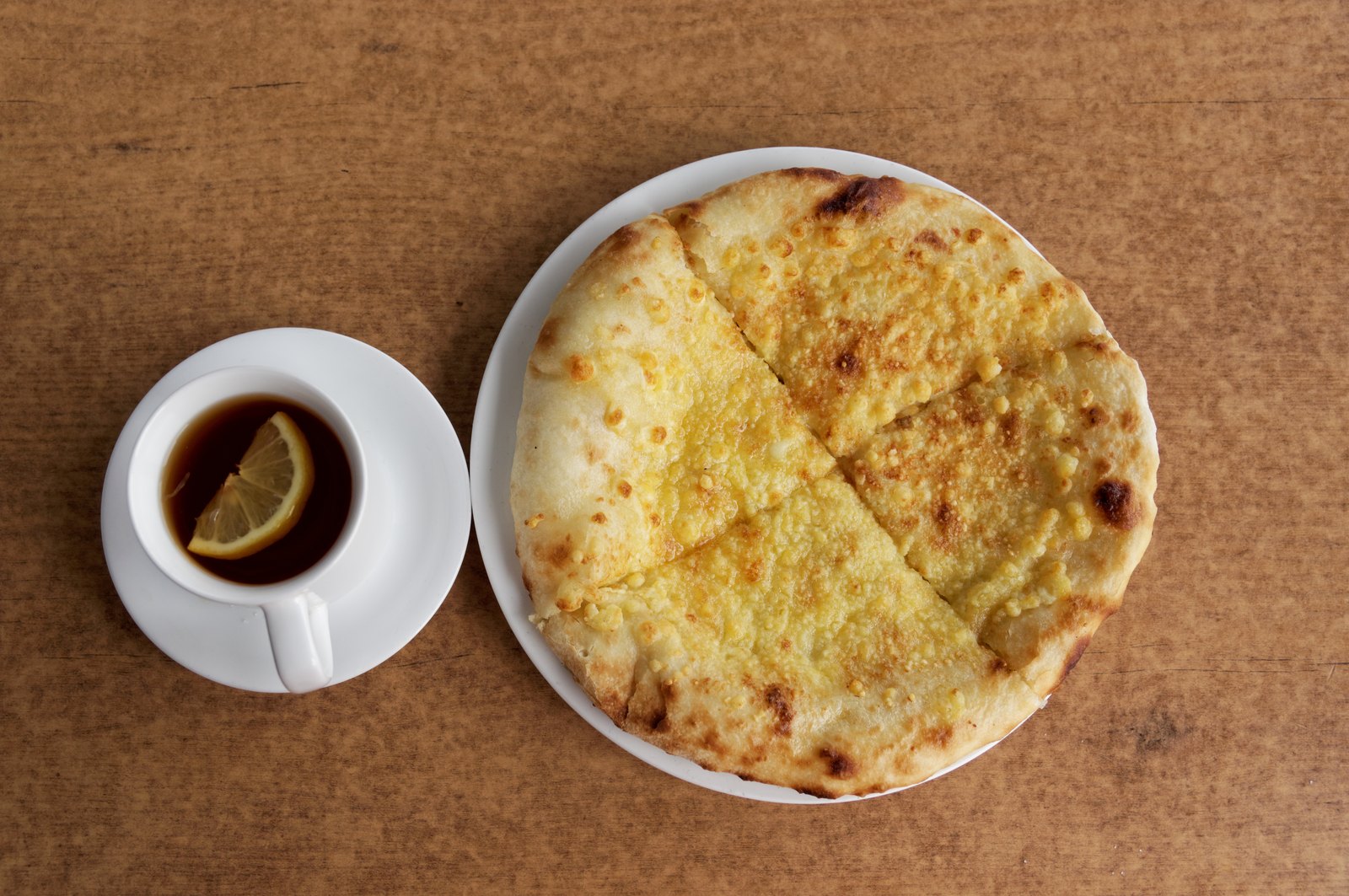
2. Imeruli khachapuri is the beginner's version and the one Georgians actually eat most days: a sealed round, cheese entirely enclosed, cooked in a dry skillet or a moderate oven until blistered. Think of it as a stuffed flatbread rather than a pizza. The technique — soft dough, generous cheese, sealed and flattened gently so it doesn't tear — is exactly what AislePrompt's Soft Goat Cheese and Spinach Stuffed Flatbread teaches. Cook that once with the goat cheese, then repeat it with a 50/50 mozzarella-feta mix and you have imeruli. The real filling is sulguni, a brined pasta-filata cheese with the stretch of mozzarella and the salt of feta.
3. Mchadi are unleavened cornbread rounds — coarse white cornmeal, water, salt, pressed flat by hand and fried in a dry cast-iron pan. No egg, no sugar, no leavening. They are dense, faintly sweet from the corn itself, and exist mainly to be broken into lobio. Eight minutes a side over medium heat in a well-seasoned pan. This is the single cheapest dish on the entire list — about $0.30 per person.
4. Lobiani is imeruli's savory cousin, stuffed with mashed spiced kidney beans instead of cheese, often with rendered bacon fat worked into the filling. It's a workingman's bread, traditionally eaten around Barbaroba in December. The rolled-and-sealed method mirrors Creamy Yogurt and Walnut Burek with Spinach — swap the spinach filling for seasoned mashed beans and you're within one ingredient of the real thing.
All four want a heavy pan or a stone. A cast-iron skillet handles mchadi and imeruli; adjaruli and lobiani want a baking stone. AislePrompt's bakeware and cookware shelves have both.
4 dumplings and mains (khinkali, chakhokhbili, ostri, satsivi)
5. Khinkali are the twisted soup dumplings of the mountains — spiced ground beef and pork, a good amount of broth or water in the filling, and a thick pleated knot on top used as a handle. They are gathered by hand into 18–20 pleats and boiled, not steamed. The two techniques you need are pleating and broth-retention. For pleating and filling ratio, cook Stuffed Pelmeni Dumplings with Savory Beef and Onion Filling first — same meat, same wrapper thickness, simpler shape. For the liquid-inside-the-dumpling trick, Shanghai-Style Steamed Soup Dumplings (Xiao Long Bao) uses gelled stock cubes, which is a far more forgiving way in than the Georgian method of simply adding cold water to the meat. Khinkali's mountain origins and eating protocol are worth reading before you serve them, because the etiquette matters to Georgians.
6. Chakhokhbili is chicken braised with an enormous amount of onion and tomato and finished with a fistful of cilantro, basil and khmeli suneli. Critically, there is no added fat and no liquid — the onions release enough. Traditionally the chicken is browned dry in a hot pan first. The braising rhythm is the same as Slow-Braised Chicken with Tomato, Olives, and Capers; drop the olives and capers, triple the onion, and stir in the herbs off-heat in the last two minutes so they stay green.
7. Ostri (or chashushuli) is the beef version — cubed chuck, tomato, hot pepper, garlic, cilantro, simmered 90 minutes until the sauce is thick enough to coat bread. Where chakhokhbili is aromatic, ostri is sharp and hot. It is the only genuinely spicy dish in the standard repertoire, and it wants a serious knife for the chuck; the knives shelf covers that.
8. Satsivi is the walnut showpiece: poached turkey or chicken, cooled, then bathed in a room-temperature sauce of ground walnuts, garlic, blue fenugreek, marigold, cinnamon, clove and a little of the poaching broth, finished with vinegar or pomegranate. It is served cold — the name literally means "cooled." Almost nothing in American cooking works this way, and the closest analog on the site is the Persian-adjacent Slow-Cooked Chicken Stew with Pomegranate and Walnut Sauce, which uses the same walnut-plus-sour-fruit backbone. Make it a day ahead; satsivi is measurably better on day two.
| Dish | Cook time | Make-ahead? | Serve at | Difficulty |
|---|---|---|---|---|
| Khinkali | 2 hr active | Freeze raw, boil from frozen | Hot | Hard |
| Chakhokhbili | 50 min | Yes, 2 days | Hot | Easy |
| Ostri | 2 hr | Yes, 3 days | Hot | Easy |
| Satsivi | 90 min + chill | Required, 1 day | Cold | Medium |
4 salads and herby sides (pkhali, badrijani nigvzit, lobio, jonjoli)
9. Pkhali is the template that generates a dozen dishes: any blanched vegetable — spinach, beet greens, leek, cabbage, beets — squeezed dry, chopped, and bound with a paste of walnuts, garlic, cilantro, blue fenugreek, vinegar and a little water. Rolled into balls, dotted with pomegranate seeds, served cold. AislePrompt has the real thing: Savory Georgian Mountain Herb and Walnut Pkhali. Make it in three colors — spinach green, beet red, and leek pale — and you have a third of your cold table.
10. Badrijani nigvzit is eggplant sliced lengthwise, fried or grilled until fully soft, spread with the same walnut-garlic paste, rolled, and topped with pomegranate. It is the single most-photographed Georgian dish and the easiest to nail. The paste is exactly the spread in Crimean-Style Eggplant and Walnut Spread; for the grilled-and-herbed version, Grilled Eggplant and Herb Salad with Walnut Dressing gets you the char and the dressing in one recipe. If you want the softer, silkier fried texture instead, Grilled Eggplant with Garlic Yogurt shows the right doneness — the slices should collapse, not hold a bite.
11. Lobio is red kidney beans stewed with onion, coriander, blue fenugreek and a great deal of cilantro, mashed to a coarse texture and served warm in a clay pot with mchadi and raw onion. Vegetarian by default, and about $1.50 for four servings. The bean-and-herb architecture carries over cleanly from Tomato & White Bean Stew with Herbed Feta — swap in kidney beans, drop the feta, double the cilantro, and finish with a splash of vinegar. Lobio's regional versions range from soupy to nearly dry.
12. Jonjoli are pickled bladdernut flower buds, dressed with onion and oil. There is no substitute and no way to make them from scratch in North America — buy the jar at a Russian deli or skip the dish. If you skip it, add a plate of quick-pickled cabbage and beets instead; the table needs something acidic and crunchy against all those walnuts.
3 stews and grilled meats (chanakhi, mtsvadi shashlik, kharcho soup)
13. Chanakhi is a layered clay-pot bake: lamb, eggplant, potato, tomato, garlic and herbs, assembled raw in individual pots and baked slowly so everything cooks in its own juice. No browning, no stock, no stirring. Slow-Simmered Lamb with Tomato and Eggplant Stew uses the identical lamb-eggplant-tomato triangle; make it in a Dutch oven at 325°F for two hours and you're cooking chanakhi in everything but the vessel.
14. Mtsvadi is Georgian shashlik — chunks of pork neck or lamb, salted, sometimes marinated in nothing more than onion and pomegranate juice, skewered and grilled over grapevine cuttings. The Georgian version is deliberately under-seasoned before the fire and finished with tkemali or raw onion after. Two site recipes get you there: Mediterranean-Inspired Grilled Lamb Skewers with Herb Yogurt Sauce for lamb timing, and Herbed Grilled Beef Skewers with Mustard Dipping Sauce for the sear-then-sauce structure. If you want a spicier, ground-meat direction instead, Spicy Adana Kebab with Sumac is the Turkish neighbor.
15. Kharcho is the beef soup — brisket or shank simmered with rice, ground walnuts, tklapi (sour plum leather) and enough garlic and cilantro to be assertive. The walnut is what separates it from every other beef-and-rice soup on earth; it thickens the broth and makes it faintly opaque. Use 1/2 cup ground walnuts per quart of finished soup, added in the last 20 minutes so they don't turn bitter.
Common pitfalls
- Substituting Indian fenugreek for blue fenugreek. The most common failure. Methi is bitter and medicinal; blue fenugreek is grassy and sweet. Omit it entirely rather than substitute.
- Toasting the walnuts. Georgian walnut sauces use raw nuts. Toasting turns satsivi beige and gives it a roasted flavor that Georgians would find wrong.
- Under-squeezing the greens for pkhali. Wet spinach makes a soupy paste that won't hold a ball. Wring it in a towel until you can't get another drop out — you should lose about 60% of the blanched weight.
- Baking adjaruli too cool. Below 475°F the base steams instead of crisping and the cheese weeps. Preheat a stone for a full 45 minutes.
- Adding the herbs early. Cilantro and basil go in at the very end, off-heat. Simmered for 20 minutes they turn dull and hay-like.
- Serving everything hot. Half this menu is supposed to be cold. Fighting that turns a relaxed two-day cook into a frantic one.
When NOT to cook a Georgian supra
If you're feeding two people on a weeknight, don't. The supra format assumes 6+ eaters and a table that stays occupied for three hours; scaled down to two, you get a fridge full of leftover walnut paste and no sense of what the meal is for. Cook a single dish instead — chakhokhbili over rice is a complete 50-minute dinner. Also skip it if nobody at the table eats nuts: walnut is load-bearing in pkhali, badrijani, satsivi and kharcho, and there is no honest substitution. And if you cannot source blue fenugreek by the time you cook, push the date rather than swap it — the entire flavor signature depends on that one jar.
Building a home supra: menu and pacing for 4-6
Nine dishes, two days, roughly $70–85 in groceries for six people. Nothing is plated hot except the bread.
Two days out: make satsivi (poach the bird, build the walnut sauce, refrigerate separately and combine day-of). Make tkemali if you're making it from scratch.
Day before: make all three pkhali colors and the badrijani rolls. Make the lobio. Mix and refrigerate the khinkali filling. Chill the wine — Georgian amber wine from a qvevri if you can find it, otherwise a dry orange wine or a Rkatsiteli.
Day of, afternoon: roll and pleat khinkali (freeze on a tray until dinner). Prep mtsvadi — cube the pork, salt it, layer it with sliced onion. Make the mchadi dough.
Day of, 90 minutes out: start chanakhi in the oven. Set the cold table — pkhali, badrijani, lobio, jonjoli, satsivi, all of it out at once, plus bread and a bowl of tkemali.
Day of, 30 minutes out: fry mchadi. Light the grill for mtsvadi.
Day of, last 15 minutes: bake the khachapuri. Boil khinkali to order in two batches so they hit the table hot. Serve the adjaruli last, egg and butter stirred in at the table.
For dessert, Georgians would serve churchkhela — walnuts strung on thread and dipped repeatedly in thickened grape must. It takes three days to dry and cannot be improvised. Spiced Russian Honey Cake with Walnut Crumble is the regionally-adjacent choice that a home baker can actually finish the same week.
| Course | Dishes | When | Temp |
|---|---|---|---|
| Cold table | Pkhali x3, badrijani, jonjoli, satsivi | Set out first, stays all night | Cold |
| Bread | Imeruli khachapuri, mchadi | Continuous | Hot |
| Warm plates | Lobio, chanakhi | 30 min in | Warm |
| Hot to order | Khinkali, mtsvadi | 45 min in | Hot |
| Finale | Adjaruli khachapuri | Last | Molten |
| Dessert | Churchkhela or honey cake | With tea | Room temp |
If this is your first pass, cook four dishes rather than nine: imeruli khachapuri, pkhali, chakhokhbili and lobio. That's bread, cold plate, main and side, all achievable in one afternoon, and it will tell you honestly whether the walnut-and-fenugreek axis is something your table wants more of. Once you know, ask AislePrompt's meal planner to build the shopping list for the full nine.
For neighboring cuisines that share the walnut, herb and grilled-meat vocabulary, see our 20 Persian Recipes and 20 Turkish Recipes roundups.
Sources
- Georgian cuisine — regional overview
- Khachapuri and its regional variations
- Khinkali — origins and eating protocol
- UNESCO — Georgian supra, culture of the traditional feast
- Blue fenugreek (Trigonella caerulea)
- Sulguni cheese
- Tkemali sour plum sauce
- Lobio — regional versions
Frequently asked questions
What is khachapuri and which type should I start with?
Where do I find Georgian spices like khmeli suneli and blue fenugreek?
What cheese can I substitute for sulguni in khachapuri?
How do I eat khinkali correctly?
How do I plan a Georgian supra for 6 guests?
Sources
- en.wikipedia.org
- en.wikipedia.org
- en.wikipedia.org
- ich.unesco.org
- en.wikipedia.org
- en.wikipedia.org
- en.wikipedia.org
- en.wikipedia.org
Plan a week of meals in two minutes.
Tell our AI what you have and what you like — it builds your plan, shopping list, and Instacart cart. No account needed.
Try free →